Sixty-eight trees are slated for destruction in a plan devised without opportunity for public input on the fate of this historic park.
After thirteen months of asking, the City finally answered the question via email on Friday afternoon, January 12: sixty-eight. That’s how many trees the City of Aiken plans to destroy in a project intended to improve the parklands at the five-acre Smith Hazel Recreation Centerin the historic Schofield neighborhood.
Two weeks later, on Friday, January 26, another answer arrived, this time via the local newspaper: No, the City is not going to hold a public hearing to give Smith Hazel neighborhood residents, park-goers, and the larger community opportunity to provide input on the future of the Smith Hazel park and its trees.
ABOVE: From the Aiken Standard newspaper, January 26, 2024
The largest among the Smith Hazel trees once shaded the grounds of the Aiken Graded School that formerly stood here — a school built in 1924 by contractor W.M. McGhee on 8 acres of land purchased by the hard work and effort of Aiken’s Black community of that era, including Messrs. W.M. McGhee, A.B. McGhee, George Ball, and Dr. C.C Johnson; a school where Mrs. Josie Smith Hazel once taught; a school that, despite the efforts of the northside community to save it, was closed in 1969, the year the Aiken schools integrated, and 1demolished by the City in 1973, as it was deemed too expensive to maintain. This history and these trees are part and parcel of this place.
A historic marker for the Aiken Graded School located at the northwest corner of the Smith Hazel Park.
And it’s not just the grand trees that matter. All of the trees matter; all are integral to the lovely, natural, parkland setting and the quality experience of this park.
April 2023 views of Smith Hazel. The ribbons on dozens of the trees, as was later learned, were intended to tag trees to be spared from demolition.
The decisions on each and every tree have deserved thoughtful consideration and our best efforts to preserve them where possible. This is why Smith Hazel park-goers and neighborhood residents spent the past thirteen months asking questions about the fate of the trees and pushing the City to allow them input. These citizens deserved, above all, the opportunity for at least one public hearing over the past thirteen months, so that they could help steer the course of Smith Hazel’s future. In the end, however, the fate of the park and its trees was seemingly decided by fiat.
How did we get here?
Below is an attempt to answer that question through a compilation of information gathered piecemeal over the past 13 months. The following is broken down into three sections — an overview, a timeline, and a list of points for further thought. Each section is expandable to allow for an optional, abridged account. This article will likely be updated as more information becomes known.
FAQs
What is the project? Smith Hazel is slated for improvements to the indoor and outdoor facilities at the center. This article will address only the outdoor improvements, which include:
The demolition and replacement of the two existing tennis courts.
The demolition and replacement of the playground equipment and the addition of artificial turf.
The closure of the existing basketball court to be replaced with two new basketball courts.
The addition of a second picnic shelter.
The resurfacing and rerouting of the existing 1/4 mile walking trail.
So far, so good. It would appear that, with the exception of the second basketball court and the second picnic shelter, the footprint of the improved park would be similar to the footprint of the existing park.
So why are 68 trees slated to be removed? A few explanations have been heard piecemeal over the months and been repeated anecdotally, including (1) that areas of the park will essentially be bulldozed to provide “clear lines of sight” for security reasons, and, (2) that the sloping elevations of the existing walking track is not ADA compliant, so the terrain will have to be leveled, requiring regrading of the earth and the removal of many trees.
Who is funding this project? The funding came from a Land and Water Conservation Fund (LWCF) grant awarded to the City in October 2022. The City matched this with Capital Project Sales Tax IV funds, bringing the total money for the project to $900k.
What is being funded? This particular grant is for outdoor recreation area only. No indoor work. The terms of the grant provide for, specifically, the replacement of existing amenities. For example, it will replace the two old tennis courts with two new tennis courts. It will replace the old playground with a new playground. Artificial turf is being added to the playground which will compound drainage and stormwater issues at the park. This is only one of a number of topics suited for a public hearing.
Why, then, are two basketball courts being installed to replace the one existing basketball court? The City was reportedly able to secure additional funding to install a second basketball court as part of this project.
Why is the baskeball court being relocated from its existing spot? As is the case with some other parks in Aiken, parts of the Smith Hazel property are located on SCDOT right of way land. The existing basketball court is in the SCDOT right of way. The LWCF grant can only be done on City property, which means the basketball court must be relocated to another part of the park.
What will happen to the existing basketball court? This area will be incorporated into the creation of approximately 40 parking spaces that are planned for a future project.
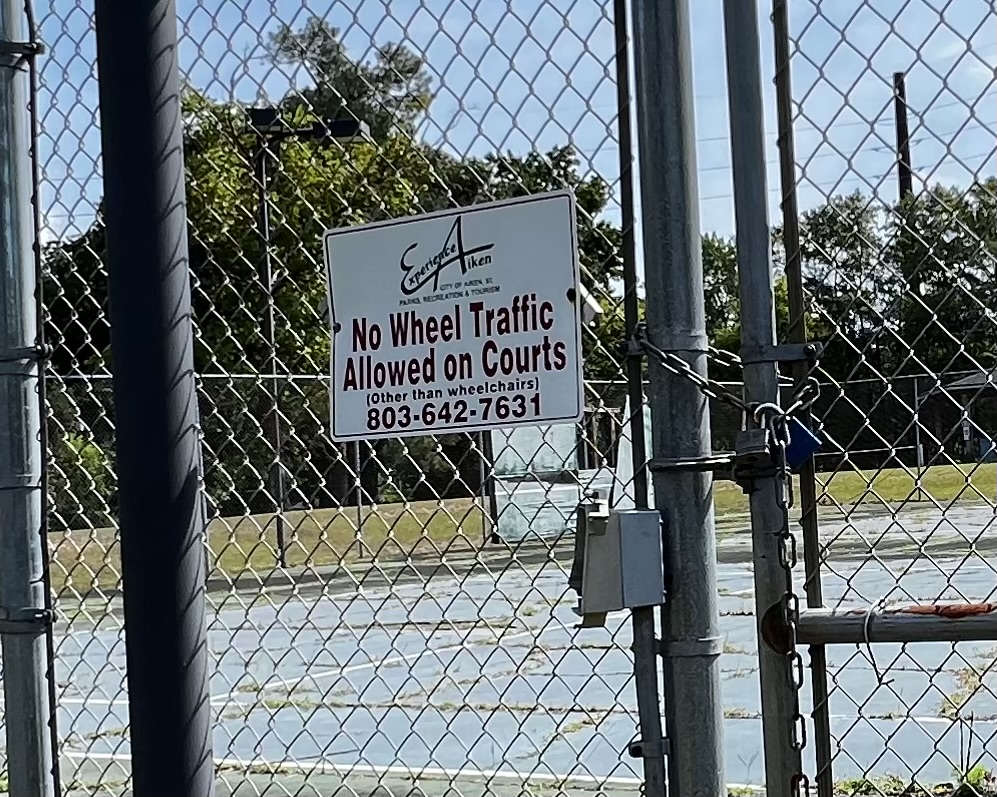
Why are the tennis courts being replaced when no one ever uses them? For those unfamiliar with this park, the tennis courts were formerly used, but have been padlocked for years and off-limits to the public due to their hazardous condition from years of disinvestment by the City of Aiken in the Smith Hazel Recreation Center.
The tennis courts at Smith Hazel have been padlocked for years.
What will happen with the existing 1/4 mile walking track? The plan is to reconfigure the track to be ADA compliant. As was learned by those who attended the September 21, 2023 monthly meeting of the Schofield Community Association, the sloping terrain prevents the track from being ADA compliant. Leveling the elevation — which will require earth-moving equipment and the removal of a large number of trees — is seen as necessary to making an ADA compliant track on the 5-acre Smith Hazel park. Were other alternatives considered? Could a future, second walking track be created across the street at the 25-acre Perry Memorial Park? The potential is there for an even longer track. Might this be preferable to destroying the historic, Smith Hazel parkland to make it ADA compliant? A public hearing with public input could have integrated such questions, ideas and potential solutions into the process.
TIMELINE: December 2022 through January 2024
December 8, 2022 A meeting had been called by the City of Aiken at the Smith Hazel Recreation Center. This was described as a “public input meeting for local community residents to review Smith-Hazel Park design options.” Attendees arrived believing they would be providing input on the newly-announced, outdoor improvement project which was set to begin within just a few months. The presentation was given by Aiken Parks, Recreation and Tourism Director, Jessica Campbell.
As the meeting progressed, it became clear that input was not actually being sought for this project, or “phase one,” as it was being termed, but for other, future projects. At approximately minute 18:00 of the meeting, (per a citizen-recorded audio of the meeting) a citizen spoke up and asked Ms .Campbell if the citizen input being solicited by the City was for the current project or for future projects. Ms. Campbell confirmed that the input was for projects “down the road.” She said, “The idea is to have a concept plan for future development.”
In other words, the concept plan for the current project (below) had already been drawn up by Cranston Engineering, and there was no public input sought either before or after this plan was drawn.
ABOVE: A photo of the concept plan for the present-day project, which was posted at the December 8, 2022 meeting. In a peculiar twist of plot, attendees were not asked for input on the current project, as seen in the above drawing but, rather, were being asked for feedback on potential projects down the road.
Citizens had been called together to comment on ideas for potential future projects, illustrated by Option A and Option B.
ABOVE: Photos of the other two drawings present in the December 8, 2022 meeting. The public had been brought together to vote on Option A or B, not to give input on plans for the current project.
When asked if any trees would be disturbed by the project, Jessica Campbell stated that they did not yet know, as the final course of the walking track hadn’t yet been determined.
April 2023 After citizens observed ribbons on dozens of the trees in the Smith Hazel park, Aaron Campbell, the City horticulturist, was contacted. He stated his shared concern to spare as many trees as possible during the project. He stated his belief that the tagged trees were those NOT be cut. He assured the caller that there would be opportunity for public input on the trees before any action was taken.
April 10, 2023 Two citizens spoke at the regular City Council meeting about the trees at Smith Hazel and wondered if the ribbons were intended to mark the trees slated for removal. According to the minutes of the non-agenda comment period, Laura Lance, “noted that she understood that the matter would be before Council at some future date where the public would have an opportunity to talk about removal of the trees. She pointed out the importance of the tree canopy in Aiken. She asked when there would be opportunity for the public to know what is going to happen and have some input.”
PRT Director Jessica Campbell, also present at the meeting, responded that the flags were for the trees not to be removed. According to the minutes, Ms. Campbell, “pointed out that those trees marked have been identified as substantial, high importance, high-priority to remain as is. she said the trees that are marked so the engineers can look and make sure the footprint of the amenities that are to be placed on the property fit within the landscape and does not create the removal of any of those marked trees.”
September 11, 2023 City Council held a work session on September 11, 2023, during which the topic of tree removals went undiscussed. There were, however, two items in the agenda package pertinent to the trees.
ABOVE: The two agenda items pertinent to the Smith Hazel outdoor improvement project. At this time, the precise number of inches of trees slated for removal was known, yet the number of trees slated for removal could not be given.
During the regular City Council meeting following the work session, Luis Rinaldini spoke to City Council about the above agenda items and on need for clarification on the matter of the trees:
“I would just like to comment on the agenda item that was included in the work session regarding the Smith Hazel renovation. It has a map and it has a page… referring to trees being cut down. But it really doesn’t give a lot of information. The information it gives us is confusing. There are something like 500 inches worth of trees, I’m not sure how that’s measured and what it means And 230 inches to be removed, which sounds like, to the uninformed person, that half of the trees in that area are going to be to be cut down. So I think that, rather than just let it sit at that, we ought to get clarification and get a map that shows what trees are being affected, and why. Because, as you know, we’ve had some not great situations with trees, And I think it’s important that we change the way we look at those things, and we change the way, we approach things, reducing the number of trees that get cut down in our activities.”
Bill McGee also spoke at this meeting. Referring to earlier mention in the meeting that some trees would have to be removed at Smith Hazel, Mr. McGhee stated that they (the SCA, or Schofield Community Association) have requested the City to come to the next SCA meeting on September 21, 2023 to discuss with the community the plans and exterior of Smith Hazel. He said he hoped the tree issue would be included in the presentation.
September 21, 2023 Attendees at the SCA’s regular monthly meeting received, from Mary Catherine Lawton,* Capital Projects Manager, what may have been the most comprehensive explanation by the City through the entire 13 months on the Smith Hazel park project. Even at this, the specifics on the numbers and locations of trees slated for destruction were not given. A video of this meeting can be viewed here, with the discussion on the outdoor improvements beginning at minute 22:35, starting with a citizen question on the any public input that went into the project. The answer provided Ms. Lawton was not quite clear.
*Correction: an earlier version of this story incorrectly identified the Assistant City Manager as the speaker at this event.
November 27, 2023 Bill McGhee, president of the Schofield Community Association, wrote to the City horticulturist, Aaron Campbell, requesting “a walkthrough of the plans for the trees involved in the project.”
December 5, 2023 Aaron Campbell responded to Mr. McGhee via email at 8:49 a.m. saying, “We are available to meet today at 1pm or Friday, December 22nd at 1pm.”
December 9, 2023 Bill McGhee sent notice that a meeting had been arranged with Aaron Campbell for Dec 22 “to have a SCA group review the exterior SH renovation plans and the status of the surrounding trees.”
December 12, 2023 Notices of the upcoming meeting were posted at the Aiken Chronicles and on social media including the Do It Right and Schofield Community Association Facebook pages.
Notice posted at the SCA webste on December 12 for the Dec. 22 walk-through at Smith Hazel.
December 14, 2023 Beatrice McGhee emailed notice of the meeting to the SCA membership
December 22, 2023 The meeting convened with over a dozen in attendance. Landscape architect Lance Cheeley, with Cranston Engineering, was in attendance and indicated, without further specifics, the plan to remove “many trees” including two significant pine trees and one significant oak. There was no actual walk-through, however, nor tagging of the trees, nor identification or total numbers of the trees slated for removal. There was reportedly discussion among some attendees that a factor in the tree removal was the need for a “clear line of site” for security purposes.
December 26, 2023 Bill McGhee emailed a recap of “The Smith Hazel Tree Walk-through” to the SCA membership, with this update on the trees:
“The draft RFP includes the removal of two ‘significant” pine trees, one ‘significant’ oak, and many other non-significant trees. No trees were tagged. The many trees to be removed were not specifically identified. It was stated that the tree removal and replacement plan complied with the city’s landscape/tree maintenance policies.
January 8, 2024 Bill McGhee emailed Aaron Campbell requesting a copy of the City’s tree inventory of the Smith Hazel trees to review for discussion.
January 10, 2024 Aaron Campbell responded that he could not give this information.
January 12, 2024 (Friday at 3:20 p.m.) Aaron Campbell emailed Bill McGhee a pdf (see image below) of the Cranston’s “Tree Removal Exhibit” for the park, with the following note: “Attached is the plan from Cranston engineering showing what trees are slated for removal. Please let me know if you have any further questions.”
TOP: The Cranston Engineering “Tree Removal Exhibit” dated November 10, 2023. BELOW: The total number of trees to be removed.
A total of 68 trees are slated to be removed according to the Cranston drawing. This drawing is dated November 10, 2023. The drawing was only emailed to Mr. Bill McGhee on January 12, 2023. This was the first time that the City divulged the total number of trees to be destroyed.
January 15, 2024: (Monday holiday, Martin Luther King Day)
January 16, 2024: — Bill McGee left a message with Aaron Campbell to give him a call. Mr. McGhee’s call was never retuned. — Bill McGhee put out a notice urging attendance at the 5:30 p.m. meeting that evening of the City Recreation Commission on Banks Mill Road. A total of six SCA member/tree preservation advocates attended: Bill McGhee, Linda Johnston, John Howard, Lee Doran Thornton, Lisa Smith, and Laura Lance. All gave their perspectives on this project regarding the shocking number of trees slated for removal and the frustration over the lack of public participation in the process. A public hearing was requested. The Recreation Commission respectfully listened and responded by making and approving two motions: (1) to recommend to City Council that a public hearing be held to allow for public input on the Smith Hazel trees, and (2) that ribbons be attached to the trees slated for removal so that the City, SCA and all interested parties could see what is planned for the park. — At 10:43 p.m. that night, local park advocates began a social media campaign to “pause the project.” Public interest and comment was robust.
January 25,2024 Bill McGhee submitted a FOIA request for a listing, from the City’s tree inventory, of the type of grand and significant trees slated for removal at Smith Hazel and the dollar value assigned to each tree.
January 26, 2024 The local newspaper announced online that the Smith Hazel project is going to go forward without “more” public input, stating:
“The City of Aiken doesn’t intend to pause plans to make long-awaited upgrades to the Smith-Hazel Recreation Center, despite a community group and city board asking for a brief stoppage to have more public input on the project.”
POINTS FOR FURTHER DISCUSSION
— Why is the City using the term, “more public input”? Given that the City has provided no opportunity for public hearing for public input on this project, the word “more” isn’t applicable.
— Cranston Engineering had already drawn the concept plans for the this project before the December 8, 2022 meeting. Why was there no public hearing for public input on this plan either before or after the plan was drawn up?
— Why was the public given opportunity during this same December 8, 20220 meeting for input on hypothetical future plans for future projects of the park, but none for the current project, as shown in Cranston’s concept plan?
— Why were dozens of trees at Smith Hazel tagged with different color ribbons in April 2023? Who decided which trees would be tagged to be spared and which would be destroyed? And by what criteria? Does this mean that the City knew as far back as April 2023 how many trees would be destroyed? Why wasn’t the public included in at this stage of planning?
— Why did the city refuse the recent requests by citizens and the recommendation by the Recreation Commission in the wake of January 16th 2024 meeting to have to have the trees marked with ribbons to show the public and the city the trees slated for destruction?
— Why did the City Council not discuss the number of trees slated for destruction in its September 11, 2023 work session? And why didn’t the City take the opportunity of Mr. Rinaldini’s call for clarification in the City Council meeting that night to state how many trees will be removed?
— Why did the City hold a work session, (which only allows the public to attend as spectators), rather than a public hearing on September 11 to accommodate public input in the discussions?
— Were alternate plans considered to reduce the destruction of trees, and, if so, what were these plans and where is a record of them?
— Why did the City — knowing how important this topic was to advocates for our City’s parks and the trees — repeatedly fail to provide the requested information on the trees for all these months?
In Closing
One marked similarity in the Williamsburg Street and Smith Hazel stories is the lack of a public hearing for pubic input on a project that would radically change a public parkland. Another is the stealth manner in which the demolition of trees was planned and kept from the pubic. A less obvious similarity is what almost appears to be the staging of a felled, hollowed tree, as if this might justify the destruction of all.
An important difference in the two stories is that is that the destruction of the 11 trees on Williamsburg cannot be undone today. The planned destruction of 68 trees at Smith Hazel can and should be undone.
The issue at hand is not about being pro or anti-progress. Nor is it about an inability or refusal to acknowledge that reality that trees sometimes need to be removed in the course of development. No, this issue is about the need to follow good faith governance and established processes. Those among us advocating for our trees and our parks are merely asking that processes be followed, and that these processes be open, transparent, fair, lawful, and available to all.
Visible in the distance is a walker on the Smith Hazel walking track.
1Correction: The date of the Aiken Graded School demolition was incorrectly given as 1969 in an earlier version. This has been correct to reflect the school was closed in 1969, the year the Aiken schools integrated. The school as then demolished in 1973.
The Development of the Aiken Corporation’s “25 Acres”
by Don Moniak January 22, 2024
This month Aiken City Council is conducting public hearings on a proposed 7-acre development within a larger 25-acre parcel of land between York and Kershaw streets in North Aiken. The first hearing was held on January 8, 2024, and the second hearing is scheduled for tonight, January 22nd. (The development information can be found on pages 75-107 of Council’s agenda packet).
(Update: The development was approved).
The developer, High Brass LLC, is applying to rezone the property from General Business to Planned Residential, and intends to build seven townhomes with a total of 26 residential units alongside a 15,000-square-foot commercial building with a 66-space parking lot. The remainder of the acreage is slated for future development.
“Planned Residential” zoning allows for up to five percent of the area to be developed for commercial purposes (1) The proposed development calls for seven percent commercial space, which led to a recommended waiver by the Planning Commission at its December 2023 public hearing.
During its January 8th public hearing, no Aiken City Council members objected to the waiver, but the two Council members representing the Northside of Aiken did have objections to the look and feel of the townhouses. The developer had only provided one page and two grainy photographs (Figure 1) depicting the approximate look of the townhomes, and another of the commercial building. Detailed drawings and original architectural renderings are absent from this development application.
Commerical BuildingTownhomes
Figure 1: Original Commercial Building and Townhome examples in original development application.
According to the meeting minutes, District Two Councilwoman Lessie Price stated that the homes are “not anything to get excited about,” “wondered if there could be some amenities added,” and asked “if the homes could be a little more attractive.”
District One Councilwoman Gail Diggs offered the opinion, that:
“The buildings are not attractive at all. Just because they are affordable housing, doesn’t mean that it can’t be attractive housing and that is what we want on the north side, something attractive and affordable.”
These admonishments were atypical for both Councilwomen, who normally welcome, with few reservations, development on the often neglected Northside. In response to their concerns, Planning Director Marya Moultrie stated the developer would be asked to provide additional drawings and details for the next hearing.
The developer subsequently delivered a series of additional grainy photographs that appeared to be from other area developments. One of the photos bore a resemblance to Pacer’s Run Apartments, minus the backdoors.
Townhome Example on the 25 AcresPacer’s Run Apartments
Figure 2: Backside of Townhome example and Pacer’s Run Apartments (Photo from Google Earth).
An added dynamic is that both Councilmembers are only nine months removed (2) from the Executive Committee of a non-profit organization that presently owns the property, and who recruited the developer. That organization is the Aiken Corporation; which also is in the process of landing a no-bid, sole-source $20 million contract with the City of Aiken to develop a “mixed-use” office building on one acre of land it owns on Newberry Street; for the purpose of hopefully leasing it to the Savannah River National Laboratory’s operating contractor.
Aiken Corporation’s Acquisition of the 25-Acres.
In November 2021 the Executive Committee of the Aiken Corporation was informed by City of Aiken staff that the owner of the 25-acre parcel wished to donate this land to the city. The caveat was that it could not be developed for at least two years due to its stand of forestland having been heavily logged without permission from the City. (Figure 3)
March 2014January 2019
Figure 3: Before logging and after logging of the 25 Acres. (Aiken County property database aerial images)
According to ACorp meeting minutes from November 2021, the original owner of that property wished to donate it to the City of Aiken. At the time the Aiken Municipal Development Commission (AMDC) was charged with developing beat-up properties in the city, but was consumed with the ill-fated Project Pascalis. Instead of granting the donated property to a public entity like the AMDC which would have been accountable to City Council, the City opted to grant it to the private Aiken Corporation and allow it to plot the future of the property.
For the next two years, the Aiken Corporation wrestled with the future of the property, with “The 25-Acres” being a subject of “Old Business” at the next 15-20 meetings.
On May 24, 2022, former City of Aiken Economic Development Director Tim O’Briant reported to City Manager Stuart Bedenbaugh that an offer had been “secured…to purchase 25 acres on York Avenue held by the Aiken Corporation. Aiken Corp has approved the purchase and sale agreement for $625,000. Intended use would be a built-for-rent single- family residence subdivision.”
Two months later, the Aiken Corporation’s for-profit property purchase and management arm, LED Inc, spent $650,000 to purchase three lots totaling one acre in the 100 block of Newberry Street, NW. The purchase was funded by a $625,000 loan from Security Federal Bank. Whether the York Street property was used as collateral for that loan is unknown. (The story of the Newberry Street purchase and eventual selection of that property for the $20 million “SRNL/Mixed Use” project is told in Aiken’s Cousin Problem—The Aiken Corporation Targets Newberry Street for SRNL Spec Project.)
Unfortunately, the $625,000 with the prospective purchaser, the Auben Company of Augusta, was cancelled at the end of 2022. A subsequent negotiation with Southeastern LLC, the developer of the Aiken Mall, also went nowhere.
According to its May 2023 meeting minutes, the Executive Committee then authorized using a local realtor to list the property. (3)
In June of 2023, the ACorp Board voted to accept an offer of $437,500, from an unidentified party. The price closely corresponded to the appraisal value that was ordered to quantify the size of the donation for IRS reporting purposes. The Aiken Corporation’s latest IRS financial filing lists a noncash donation of $420,000.
If the High Brass Development’s proposed combined housing and commercial development is approved, Aiken Corporation has 180 days to sell the property or otherwise transfer ownership. If it chooses to do so, ACorp/LED would then be able to pay off two-thirds of its $650,000 Security Federal Bank loan for its recently acquired Newberry Street property.
The Aiken Corporation and its developer were both absent from City Council’s first public hearing on January 8th; there is also no record of ACorp representatives being present at the Planning Commission’s December 12, 2023, public hearing; where three representatives of the development team appeared.
The task of answering Council’s questions was left to a Cranston Engineering employee who has no authority to alter the planned development, and who is only accountable to his company’s client.
The Aiken Corporation’s stated mission is to “diversify and expand the City’s economic base and to improve the quality of life in Aiken.” If the first phase of the 25-acre development is approved, one of the organization’s most significant accomplishments in achieving their stated mission over the past ten years will be the sale of a donated property to build 26 generic townhomes and a small strip mall.
The decision on the High Brass development of the ACorp property will take place after the approval process for adding $20 million to the City’s budget to pursue the SRNL/Mixed Use office building project in downtown Aiken. The memo for that agenda item states, “City staff is working with Aiken Corporation on an agreement that will be before Council at a future meeting by February.”
Thus, the disconnect between the City’s commitment to a sole-source contract with Aiken Corporation for a $20 million project, and the absence of tangible major accomplishments by the organization in the past decade, is highly likely to continue unabated.
Footnotes
(1) The basis for the five-percent rule is unknown, even to the Planning Department.
“Once commercial development exceeded 5% of the total neighborhood land, property prices would begin to experience a substantial decline. A more recent study by Song and Knaap (2004) drew similar conclusions, showing that commercial development had no negative effect on the property values that they had assessed. The findings showed that housing prices increased as their distance from neighborhood commercial land uses shortened. Furthermore, homeowners that lived within walking distance from the commercial development were likely to pay an additional premium due to improved accessibility. Despite these results, the paper does conclude that the size of a particular commercial development can have powerful effects on neighboring home values and that larger commercial developments are more likely to create a negative impact.”
As reported in The Village at Woodside’s Clever Accounting, the City of Aiken allowed the Village at Woodside development to artificially keep the development under five percent commercial by not including parking lots as commercial space. This accounting scheme involves the Property Owner’s Association holding the deed to the parking lots, and paying less than $25 per year in taxes for those improvements.
(2) Councilwomen Price and Diggs resigned from their ex-officio positions on the Board of the Aiken Corporation in March 2023. The resignations were tendered to avoid any perceived conflict of interest between their official duties and their role on the ACorp Board.
The SC Ethics Commission ruled, in an informal opinion, that Council members can serve on the ACorp Boards because it is a nonprofit that was created by, and serves at the pleasure of City Council. However, as reported in The Aiken Corporation-City of Aiken Relationship: Partners, Not Cousins, the Aiken Corporation is a stand-alone organization that was not created by Aiken City Council and does not serve as its pleasure. While the City of Aiken could deprive ACorp of city taxpayer funds, it cannot dissolve the organization. Councilwomen Price’s and Digg’s decisions to resign were certainly proper, and arguably necessary.
(3) The May 2023 minutes read:
“25-Acre Parcel Contract and Discussion — Before the discussion, (Board member) Ms. Karen Daly was asked to recuse herself and she left the room.
Mr. Pat Cunning reported that Southeastern withdrew their contract offer from the 25-acre property. The Executive Committee met to decide if they wanted to hire a realtor to get an appraisal on the property or complete a market study. If they move forward with hiring a realtor, they would like to hire Meybohm Realty and use Ms. Karen Daly as the agent.
Motion was made by Mr. Norman Dungan and seconded by Ms. Martha Lockhart to allow the Executive Committee to work out a final arrangement with Meybohn Realty with Ms. Karen Daly as representative agent.
Once the Executive Committee reaches an agreement, the Chairman of the Corporation is authorized to sign such agreements, including a listing agreement as the Executive Committee may determine, and to complete a market analysis of the 25-acre parcel on York Street. The motion was unanimously approved.”
How the Department of Energy addressed Governor McMaster’s and Attorney General Alan Wilson’s conflicting and sometimes harsh opinions regarding the future of surplus plutonium.
by Don Moniak January 22, 2024
The U.S. Department of Energy’s (DOE) National Nuclear Security Administration’s (NNSA) Final Surplus Plutonium Disposition Environmental Impact Statement (SPDEIS) was completed last month and announced in the Federal Register this past Friday, January 19th. A Record of Decision (ROD) is expected sometime in February, although that ROD might not result in any actual plans.
The Final SPDEIS is the fifth National Environmental Policy Act (NEPA) analysis addressing all or parts of 61.5 metric tons (MT) of surplus plutonium that has been conducted in the past three decades. During that time, the DOE/NNSA’s various contractors have processed and disposed of less than five tons of the surplus stockpile, and spent billions of dollars on a failed plutonium/Mixed Oxide (MOX) fuel factory originally intended to handle up to eighty percent of the surplus material. Major changes in plans have occurred at least five times.
The latest analysis was released almost twenty-seven years to the day of the the 1997 Record of Decision to consolidate all surplus, “non-pit” plutonium at DOE’s Savannah River Site (SRS) for up to fifty years; nearly sixteen tons at the time but later reduced to about twelve tons. Less than a ton of surplus plutonium has since been removed from the site.
Controversy over the storage decision began in 2002, and eventually resulted in the $600 million settlement between the federal government and the State of South Carolina in August 2020. That settlement requires DOE/NNSA to remove 9.5 metric tons from SRS by 2037. If the recent rate of transfer of plutonium waste from SRS to WIPP continues, that task will not be completed until well after 2040.
In the meantime, more than forty additional tons could be imported into South Carolina, stored, and then processed into waste over the next three to four decades. Several more tons of non-surplus plutonium is scheduled to be transported to SRS for the job of producing new plutonium pits for the weapons arsenal.
The Final SPDEIS nearly mirrors the Draft SPDEIS released in January 2023; summarized in Feds Propose 27 More Tons of Plutonium for Processing at Savannah River Site. The preferred alternative and associated sub-alternatives remains the same: Use some combination of capabilities at SRS and Los Alamos to convert upwards of 34 metric tons (MT) of surplus military grade plutonium to plutonium oxide powder, dilute the plutonium into a less easily retrievable waste form, and dispose of that waste in the Waste Isolation Pilot Plant (WIPP).
The proposed action (Figure 1) does not commit to a specific plan. SRS could be assigned the whole job, part of the job, or very little of the job.
Figure 1: Simplified version of DOE/NNSA’s proposed action to dispose of up to 34 metric tons of surplus military-grade plutonium. The total includes approximately 27 tons of plutonium within weapon components known as “pits,” which are the primary nuclear trigger in the U.S. arsenal; and 7.0 tons of already separated plutonium in metal or powder form.
Since January 2023, sixteen changes were made to the nearly one-thousand-page record, in response to 121 written comments submitted during the two month public comment period, and 53 oral comments made during three in-person public meetings and one Zoom call. The public comment process was incredibly subdued in comparison to the competitive spirit between weapons communities in the late 1990s; when thousands of comments were submitted, hundreds spoke at public hearings, and Senator Strom Thurmond described weapons workers in Texas as “amateurs.” (Comments and responses are contained in Volume III of the SPDEIS.)
Three of the submitted comments were from the South Carolina Congressional Delegation, Governor Henry McMaster, and Attorney General Alan Wilson.
The comments and concerns from our elected representatives had several contradictory themes:
An obsession with long-term plutonium storage, but a near absence of concern about the most pivotal aspect of the program—the future availability of the Waste Isolation Pilot Plant (WIPP) for disposal of the final plutonium wastes produced at SRS (most likely) or LANL (least likely).
Skepticism to outright hostility towards DOE/NNSA, but strong support for the DOE’s Savannah River Site and its contract workforce.
Support for the more dangerous task of importing and processing more than forty tons of plutonium at SRS, but opposition to the more benign task of long-term storage. This is in keeping with the nearly decade-old tradition of South Carolina political leaders of welcoming plutonium into the state, but terming above-ground, long-term plutonium storage as “plutonium dumping.”
DOE/NNSA’s responses to the comments from SC elected officials were uniformly finalized as:
“These comments did not result in a modification in the Final EIS.”
The most strident comments (Figure 2) were made by Attorney General Wilson, which included, in bold type, that:
“DOE/NNSA has an appalling record of not following through on its promises or projects. Its project management is abysmal, and South Carolina’s pessimism of DOE/NNA’s ability to implement any proposed alternative is well earned.”
Wilson also wrote that, “DOE/NNNSA must be committed to removing the weapons grade plutonium on a schedule that ensures that South Carolina is not the dumping ground for such plutonium.” DOE/NNSA did not commit to any schedule, and Wilson’s comments “did not result in a modification to the Final EIS.”
Figure 2. Comments made by Attorney General Alan Wilson, with reference to DOE/NNSA’s response. (Highlighting is in the original document)
Wilson’s most harsh comment was lumped into the response category of “General Opposition to SPDP and NNSA/DOE.” In other words, AG Wilson’s comments were not well accepted by the federal government.
Such objections in the past have resulted in thinly veiled threats from NNSA. In 2018, a State of South Carolina lawsuit led by Wilson that opposed NNSA’s decision to terminate the MOX program resulted in the prospect to move tritium production operations from SRS:
“In light of this injunction, NNSA must reevaluate the viability to execute enduring missions at the Savannah River Site.”
Comments from the Governor’s office were more tactful. Governor McMaster wrote that his support for decades of more plutonium processing at SRS should “not be construed as support for long-term storage of surplus plutonium in South Carolina.” Because of his concern that “South Carolina not become a permanent plutonium repository,” McMaster asked NNSA to “conduct regular, direct, and detailed briefings with me and members of my staff.” (Page 229 of comments)
To this request, the DOE/NNSA merely responded that “NNSA has committed to periodic briefings on progress toward meeting the removal commitment to the Governor and the Attorney General of South Carolina.”
Of course, the Governor’s comments “did not result in a modification in the Final EIS.”
The Congressional Delegation’s joint letter was the least combative and most diplomatic, stating only that “NNSA does not have the greatest track-record with the State regarding a follow-through on commitments.” The delegation also asked for updates, continued operation of WIPP, compliance with legal obligations, and “maximum possible transparency;” while stating “ we are not supportive of long-term storage of surplus plutonium storage in South Carolina.” (Page 223).
Overall, DOE/NNSA issued platitudes to South Carolina’s highest elected officials, committed only to a minimal level of compliance and token updates on its progress, and refused to set a hard schedule for removal of plutonium. Again, there were no modifications of the Final EIS as a result of the delegation’s concerns.
DOE/NNSA’s responses are to be expected when, on the one hand, political leaders express full support for Savannah River Site, its corporate contractors, and the prospect of importing and processing more than forty additional tons of plutonium (Figure 3) into South Carolina; while on the other hand expressing distrust in the same federal cabinet agency that owns and oversees the Savannah River Site to merely store the material during the same time period.
Figure 3: Diagram in the SPDEIS showing the various forms of surplus plutonium and their future pathways. DOE/NNSA remains undecided on how to move forward with 18 tons, and has only disposed of less than five tons (3.2 MT of “scraps, residues” were transferred from Rocky Flats to WIPP in the early 2000s; and SRS has shipped less than 1 MT to WIPP since 2018.)
Footnotes
(1) Regarding the DOE/NNSA response methodology.
In the past, DOE printed individual comments with responses on an opposing column on the same page. Concerned parties who took the time to comment on matters affecting their communities and their constituents could see responses to their concerns without exerting any additional effort.
In Volume III of the Final SPDEIS, DOE employed a torturous response method. The agency’s contractor first sorted all comments into nearly thirty categories. These were followed by the actual comments. Determining DOE’s response to individual comments requires the concerned party to backtrack to the category of concern. For example, Attorney General Wilson would have to refer
For example, to determine DOE’s response to comments by Attorney General Alan Wilson published on page 255 of the comment section, the AG’s office would have to backtrack to five different response groupings on five separate pages.
The system is symbolic of the general attitude of the Department of Energy’s National Nuclear Security Agency; that “you the people” work for “us the government.”
(2) The plan does not involve changing the isotopic composition for the plutonium to make it less attractive for re-use in the nation’s nuclear arsenal.
As I sit here on a blustery January day, avoiding doing all of the things that REALLY should be done, I look out the window. What do I see? Spanish moss, hanging from the bald cypress tree out front…. Spanish moss, billowing in the wind …. Spanish moss … what exactly is this plant? My chores will just have to wait.
Spanish moss (Tillandsia usneoides) is a native perennial herb that grows on trees. It is neither Spanish nor is it a moss. It is a species of the Bromeliad family, which includes the pineapple and many of the potted plants found in homes and offices. It is classified as an epiphyte, which is a plant that grows on the surface of another plant. It has no roots. Contrary to popular belief, it takes nothing from the plant that it grows on. It does not kill trees. Rather, it has scales (called trichomes) along its body that collect and store water from rain and fog, and nutrients from the atmosphere. Much of these come from the dead cells that are continually shed from trees, along with other dust and debris floating around in the atmosphere. Atmospheric debris and sunlight: that is all it needs to live.
Close-up views of Spanish moss
So how did the myth start that Spanish moss damages or kills trees? Here is a theory. Because older trees tend to shed more dead cells than young trees, and with dying trees shedding even more, these trees provide a more nutrient-rich atmosphere for an epiphyte than younger trees. It’s not that the Spanish moss causes trees to be old or die; the epiphyte is merely thriving in favorable conditions.
I was surprised to learn that Spanish moss is an actual flowering plant — just like any other bromeliad. (I’ll have to be more observant.) In springtime, its inconspicuous yellow-to-green blossoms appear, lasting around four days. On warm, humid evenings, you may be able to smell their delicate fragrance. The resulting seeds have feathery appendages, somewhat resembling those of the dandelion. Those seeds are released into the wind to float around and hopefully land into a tree with suitable habitat, where they will grow and flourish. Most likely, though, Spanish moss will spread through “festoons.” These are broken-off pieces of the original plant that are spread around by animals or the wind and readily grow in their new locations.
Spanish moss flowers in springtime
Spanish moss is native to the tropical and subtropical regions of South America, Central America, Mexico, and the southeastern US. When French colonizers first arrived in what is now the southern US, they asked “What is this?”
Indigenous peoples told them it was Itla-okla (tree hair). The French colonists renamed it barbe espagnol, or Spanish beard, because it reminded them of the long beards of the Spanish explorers. Spanish colonists, in turn, renamed it cabello francais, or French hair. As time passed, the “Spanish” part of the name stuck, but the “beard” part transitioned to “moss.”
Spanish moss in its native setting in the wild.
How has this plant figured into human history? Well, Native Americans of the southeast, including the Natchez and the Seminoles, would gather large quantities and soak it in shallow bodies of water until the outer layer of the strands rotted away, leaving behind the tough black inner fibers of the plant. Those fibers were used to make a coarse fabric for blankets, clothing and floor mats. The fibers were also twisted into rope and cords for making fishing nets and lashing poles together for housing structures.
Closer to home and, as the crow flies, only about 30 minutes from downtown Aiken, is Stallings Island, a site where Spanish moss was used in pottery-making some 4,000-5,000 years ago. Located in the middle of the Savannah River above Augusta, Georgia, Stallings Island is said to be home to the earliest pottery sherds in North America.1
In 2008, a group of clay artists in Augusta, Georgia held a workshop to replicate the Stallings Island method of pottery construction and pit-firing. As workshop leader, Gary Dexter, described it, “These pots were made from indigenous clay with Spanish moss mixed into it to temper the clay. By temper, I mean it opens the clay body up some and allows it to dry and fire over open flame without cracking.”
Without the Spanish moss or some other material to make the clay body porous, the pieces would shrink and dry unevenly and crack. Of course, the Spanish moss would burn up in the fire, leaving behind its impressions in the clay body. Below are some photos from the two firings in the 2008 pottery workshop.
TOP: Stallings-type pot bathed by fire. BELOW: Stallings pots cooling down after the firings.
Utilitarian uses of Spanish moss were not limited to ancient cultures. These uses continued through the ages and into the mid-20th century. In addition to its uses in bedding, weaving and rope-making, it has been used as a building material for insulation from the cold and as a useful additive to mud chinking to fill in the gaps of log cabins and other structures. More recently (well, still centuries ago), Spanish moss was used as a filler and stuffing for pillows and mattresses. Moths are not attracted to it. Called “vegetable horsehair,” it gained favor over wool in furniture upholstery. In the mid-19th century, it was woven to make horse blankets and pads. Contemporary artisans and weavers have helped revive the demand for horse blankets and other goods woven from Spanish moss.
In the early 20th century, South Carolina had several moss gins. At the time, it sure was hard to beat a cool and comfy Spanish moss-stuffed mattress on a sultry, summer night. Believe it or not, a rudimentary air conditioner was once made from fanning air through a mesh of moist Spanish moss, cooling the air. Automaker Henry Ford used it as a filler in the seats and headliners of his Model T in the early 20th century.
Medicinally, a tea was made from it to be used for chills and fever. The plant does contain inulin, which has shown some promise, combined with other agents, in diabetes treatment. Some people enjoy keeping Spanish moss indoors (google it for images). Articles abound on indoor care and culture, and plant makes for an easy houseguest.
Spanish moss fits nicely into the natural world. Many birds and animals utilize its fibers– bald eagles, ospreys, owls, hawks and many others use it to cushion and insulate their nests. Northern parula warblers build their nests directly in the moss. Several species of bat roost in it, as well. Examine a mass of it and you may find any number of animals using it for shelter– tree frogs, snakes and lizards to name a few. One jumping spider (Pelegrina tillandsia) occurs only in Spanish moss. The one organism that you WILL NOT find there is the chigger. This fact has been confirmed in many entomological studies. The idea that Spanish moss stored on the ground gathers chiggers also appears to be the stuff of myth.
TOP: Spanish moss growing on power lines. BELOW: Spanish moss festooning live oak trees in formal gardens in Charleston, SC.
Though it can grow on almost any surface, including fences and power lines, Spanish moss seems to grow best on oak and cypress trees. As I was driving around my hometown of Aiken yesterday, I could find no instances of it growing on oaks, cypresses, or any other trees. Aiken is included in its native range. Local gardeners increasingly incorporate palmetto trees and other coastal-region plantings to their landscapes … why not Spanish moss? I will meditate on that thought as I watch mine wafting in the January breeze.
Spanish moss festooning in the bald cypress tree in my yard.
Contributor Burt Glover became an accidental naturalist during his earliest childhood days exploring the dirt roads, backyards, polo field and barns of the Magnolia-Knox-Mead neighborhood of 1950s Aiken. Birds are his first love, and he can identify an impressive range by song alone. He asserts that he is an observer, not an expert, on the topics of his writings, which range from birds, box turtles, frogs and foraging, to wasps, weeds, weather and beyond.
The Friends of the Aiken County Historical Museum are excited to present “Opera & Broadway in Banksia,” a fundraiser for the museum on January 27. This intimate musical performance will feature Cristina Fontanelli & Friends.
Cristina Fontanelli is a well-known personality through her recordings, her appearances on TV, radio, in concert, nightclubs, and opera, and through her acting debut on network television. She has sung title roles with the Palm Beach Opera, the Cairo Opera, Opera of Hong Kong, the NY Grand Opera, NJ State Opera, and the Opera of the Hamptons.
Cristina is a guest artist with many prestigious orchestras, including the Boston Pops and the St. Louis Symphony, performing in major concert halls throughout the U.S. and the world, including the Lincoln and Kennedy Centers. She has completed three world tours with the Mantovani Orchestra. A listing of some of the popular “giants” she has appeared with include Tony Bennett and Joel Grey. Cristina’s beautiful soprano voice has taken her to the White House as part of President Clinton’s holiday celebration and Cristina was invited to open the ceremonies at the Stars and Stripes Inaugural Ball for President George W. Bush.
She has appeared as a PBS-TV/NY affiliate host for Andrea Bocelli’s “Live From Central Park” also starring Celine Dion and Tony Bennett; for the “Il Volo Takes Flight” special; Vienna Boys Choir and Qi Gong PBS-TV Specials. Please join Cristina plus world-class tenor and pianist friends for a night of dramatic singing in history.
Tickets can be purchased at achmfriends.org/events. There is a $75 General Admission ticket with a cocktail reception and a $100 VIP ticket with reserved seating, a champagne reception, and a meet & greet with the performers.
The Friends of the ACHM is a 501(c)3 non-profit organization. All proceeds from this event will benefit the Museum’s educational programming, artifact preservation, and exhibits development. (Text taken from the Facebook event page)