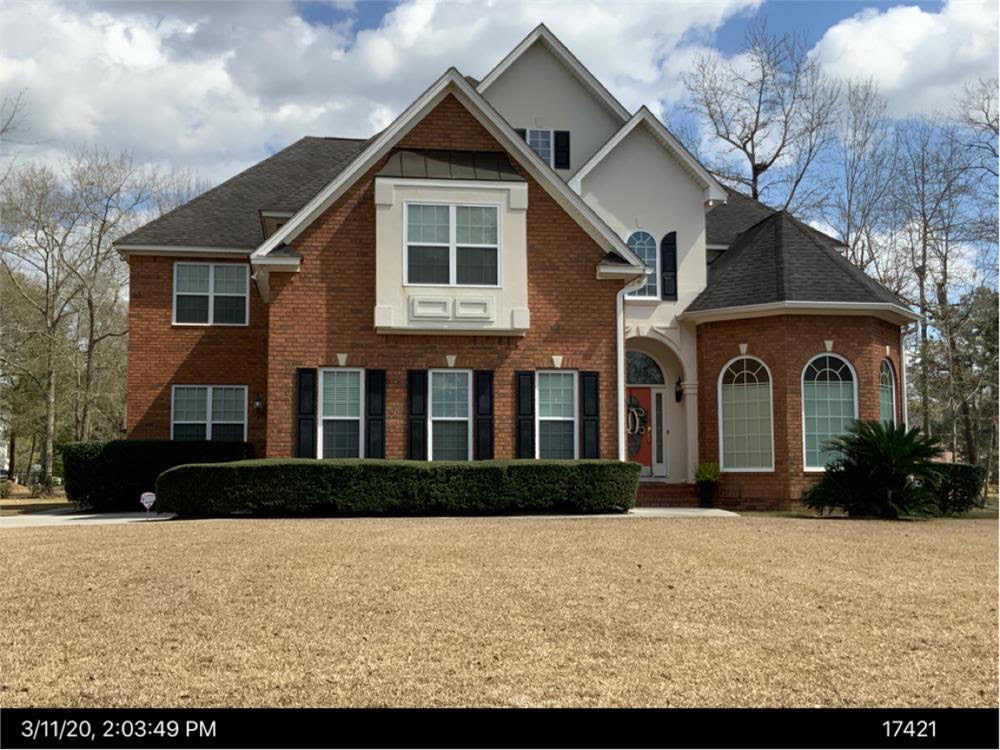
Yesterday’s arrival of the August 1, 2023 Design Review Board meeting package came with news of a proposed plan by St. John’s Methodist Church to enlarge their parking area. This plan calls for the demolition of the 1978 building, (originally built as a doctor’s office, later used as a kindergarten) on the corner of Chesterfield Street and Barnwell Avenue. The plan also calls for the removal of seven trees.
With the shock and anger still fresh over the City’s recent destruction of the Williamsburg Street parkway, the public mood for cutting yet more trees is non-existent.
The Historic Aiken Foundation (HAF) commented, “Removal of these trees would detract from the integrity of the site and the historic district.”
The materials in the DRB agenda package (beginning on pg 17) provide answers to some of the questions being raised about this plan. Below are selected screenshots from the DRB agenda package plus photos taken today at the proposed site.
Concerned citizens can familiarize themselves with this information and attend the Tuesday August, 1 meeting at the Municipal Building at 111 Chesterfield St to learn more. The DRB work session begins at 5:30 p.m. ( no public comment permitted), and the regular DRB meeting begins at 6:30 p.m.
Note: As HAF points out in their comments, below, the legend is a bit fuzzy on the locations of the trees proposed for cutting. The photos below offer good, tentative guesses based on comparisons made between the x-marked trees on the plan and and the physical layout of the site, as viewed in-person.
There will be a special primary on August 15, 2023 for County Council seat 8 that was vacated this past May when long-serving Councilman Willar Hightower was compelled to resign so that he could focus his strength on overcoming some major health issues. Below are the basics on this election.
First, confirm your information
To confirm your voter registration, precinct location or county council seat number CLICK HERE.
Who is running
Four candidates are vying for this seat and will face off in the August 15th Democratic and Republican primary elections. In alphabetical order:
DEMOCRATS P.K. Hightower Brian A. Parks
REPUBLICANS James Hankinson Michael Rozocvich
When to Vote
EARLY VOTING Early voting for County Council District 8 special primary election starts Monday, July 31 and continues through Friday, August 11, weekdays only, from 8:30 a.m. – 5:00 p.m.
PRIMARY DAY VOTING Primary Election Day is on Tuesday, August 15th from 7:00 a.m. – 7:00 p.m.
Where to vote
WHERE TO GO FOR EARLY VOTING MONDAY, JULY 31 – FRIDAY, AUGUST 11
The Aiken County Government Center 1930 University Parkway Aiken, SC 29801
WHERE TO GO FOR PRIMARY DAY VOTING TUESDAY, AUGUST 15
According to the Aiken County Board of Voter Registration and Elections, the precinct locations for District 8 include the following:
Aiken No. 1 – St. John’s United Methodist Church, 104 Newberry St. N.W. Aiken No. 2 – Lessie B. Price Aiken Senior and Youth Center, 841 Edgefield Ave. N.W. Aiken No. 3 – Aiken High School, 449 Rutland Dr. N.W. Aiken No. 4 – St. Mary Catholic Church’s Smith Hall (temporary), 125 Park Ave. S.E. Aiken No. 5 – St. Mary Catholic Church’s Smith Hall, 125 Park Ave. S.E. China Springs – Center Fire and Rescue Department Substation, 7 T & S Drive Graniteville – Hope Center, 3 Hickman St. Montmorenci No. 22 – First Baptist Church Montmorenci, 44 Old Barnwell Road Shiloh – J.D. Lever Elementary School, 2404 Columbia Highway North Six Points No. 35 – USC Aiken Convocation Center, 2049 Champion Way Vaucluse – First Baptist Church of Vaucluse, 2 Church St. Warrenville – Hope Center (temporary), 3 Hickman St. Six Points No. 46 – USC Aiken Convocation Center (temporary) 2049 Champion Way Couchton – Aiken Electric Cooperative, 2790 Wagener Road Redd’s Branch – East Aiken School of the Arts, 223 Old Wagener Road Levels No. 72 – Aiken Electric Cooperative, 2790 Wagener Road.
OTHER DATES FOR COUNTY COUNCIL SEAT #8 SPECIAL ELECTION 2023
August 29: Primary runoff (if needed) October 17: Election Day October 31: Election runoff (if needed)
We welcome questions, below, on the election/voting process and will do our best to find answers. Please, no back and forth debates on national politics and issues. Many thanks. 🌿
UPDATED July 28, 2023 to clarify that this is an at-large election, open to all City of Aiken voters, Democrats and Republicans alike.
FIRST, AN IMPORTANT NOTE
This is an at-large election, which means that all City of Aiken residents who are registered to vote can vote in this race — Democrats and Republicans alike. The winner of the primary election will serve as Aiken’s mayor, as there are no Democratic challengers in the race.
WHO IS RUNNING
There are three candidates vying in the Aiken mayor election. Below are the candidates’ names in alphabetical order. Links are provided to their websites to learn more. To win, a candidate must receive more than 50% of the vote. This is an important race! Every single vote matters.
The primary election will be held onTuesday August 8th. Early voting for the primary election began on Monday, July 24 and will continue through Friday, August 4, 2023, weekdays only, from 8:30 a.m. to 5:00 p.m.
WHERE TO GO FOR EARLY VOTING July 24 – August 4
Early voting for all precincts is at the Aiken County Government Center at 1930 University Parkway, Aiken, SC 29801. See dates and times below.
Vote at your designated precinct location, as indicated on the chart, below from the Aiken County GOP website. Note that some precincts (see asterisks) have been temporarily changed for the mayoral election. Be sure to confirm your precinct location before going to the polls!
OTHER IMPORTANT DATES:
CITY OF AIKEN 2023 ELECTIONS
August 22 — Mayor race runoff (if needed) November 7 – General Election
_________________________
We welcome questions, below, on the election/voting process and will do our best to find answers. Please, no back and forth debates on national politics and issues. Many thanks. 🌿
The City of Aiken’s residential DEMO 200 program is easily exploited by investors and speculators who profit from both government subsidies and lower taxes.
by Don Moniak
July 25, 2023
The City of Aiken’s DEMO 200 program has been in effect for more than two decades. While it is a relatively small program currently involving four to six properties per year, the program has been controversial for many years.
Twice in the past five years Aiken residents have raised concerns about the disproportionate impact on Northside neighborhoods, and potential abuse of the system. The DEMO 200 ordinance was amended in 2020 following a program suspension; but citizen discontent led to another program suspension in February 2023 pending a City Council review.
DEMO 200 allows residential property owners to have the City demolish houses the Building Inspection Division deems to be “dilapidated beyond repair.” The DEMO 200 Ordinance merely requires a structure to be “substandard” to qualify. There are no other criteria for qualification.
As reported in Homes Demolished Under DEMO 200, the cost to property owners is a mere $200. The City pays the remaining costs generally ranging from $6,500 to $8,000, and up to $21,000 in extreme cases. The residential program is available without restrictions to any property owner. (1)
The ninety-seven to ninety-nine percent subsidies, generally funded by federal community block grants, are never recovered. Owners who choose to leave lots vacant further benefit financially via a substantial reduction in property taxes. Participants can realize a profit from their $200 demolition investment as soon as the next tax cycle.
City Council did conduct a tour of DEMO 200 sites on April 17th that was attended by several staffers, six citizens, Mayor Rick Osbon, and four of six Council members. (2)
The meeting minutes for the event described the Building Inspection Division’s official version of the program:
“(We) work with the property owners and try to get properties rehabilitated, but in many cases the property owners don’t have the financial means to rehabilitate the houses. Many of the property owners don’t live in Aiken, and the properties are inherited.”
In an Aiken Standard story published two weeks after the tour, Mayor Osbon reportedly said:
“He wanted to make sure the property was for families to improve a lot that they otherwise wouldn’t be able to do anything with. He said he didn’t want the program to become a way for investors to get a low-cost demolition and increase their profit margin on a development project.”
Council member Gale Diggs reportedly said:
“Demo 200 is a very good program to provide low-income property owners with the ability to have a rundown, uninhabitable house torn down.” (3)
This is the prevailing narrative–that the program is for low-income property owners who are unable to maintain houses and are without means to demolish a house and rebuild.
The truth is more complicated. Affluent property owners who do not reside in those neighborhoods and have recently bought the properties are allowed to participate in the program. The city funds nearly the entire demolition cost, often with federal dollars, saving investors seeking to redevelop more than $6,500 in future costs.
All participants profit from a reduced tax rate, as only the land is taxed after the improvements are demolished. Participants who choose not to rebuild have reduced tax rates as long as they own the property.
The extent of past program exploitation by affluent speculators and opportunistic property owners is unknown. The City of Aiken is reluctant to release information and has provided no evidence that the program has been tracked. Efforts to obtain further information via the Freedom of Information Act have been met with resistance and a lack of full disclosure. (4)
TWO EXAMPLES OF DEMO 200 EXPLOITATION
In the past two years, at least a quarter of the DEMO 200 applicants have not fit the city’s official narrative about “low-income” property owners being the beneficiaries.
One very recent example of program exploitation is at 327 Chesterfield Street North. An Aiken County resident purchased the property in October 2021, along with the adjacent property at 333 Chesterfield that shares the same fenced area.
One week later that same resident closed on a $750,000 purchase for high-end real estate in south-central Aiken. The owner applied for DEMO 200 for the 327 Chesterfield St N home one year later, and it was demolished this past January.
327 Chesterfield was, and is, a well-maintained lot. The home had no external signs of blight. The previous owner, who also purchased both properties in July of 2019, participated in DEMO 200 and had 333 Chesterfield demolished. Thus, two homes on adjacent properties within a single fenced area were demolished within a three-year period.
A second example of very recent program exploitation is at 213 Cherokee Street, SE, which was on City Council’s tour. A resident of Effingham County, Georgia purchased the property in November 2020 for $6,200. Two years later the owner applied for DEMO 200. The application is pending while the program is suspended.
The Cherokee Street property has changed hands eight times since 2000. The newest owner and DEMO 200 applicant also owns a 4,740 square foot home (below) in Effingham County. The county’s combined appraisal value of the property and home is $459,000.
PROFITING FROM REDUCED TAXES
As reported in Homes Demolished Under Demo 200, another benefit of the program is a reduced tax burden for participants, especially those who choose for their lots to remain vacant. Instead of paying taxes on improvements and land, only land is taxed after demolition. This is an incentive for speculation, being that the lots are kept at reduced tax rates with the expectation of rising property values.
In the first year alone, the savings from reduced taxes can more than offset the participant’s $200 demolition cost. After that, the reduced tax burden is clear profit.
For example, one property on northeast Horry Street had a pre-demolition tax bill of $614 and a post demolition tax bill of $211. The owners realized a $203 profit in the first year. Since the lot remains vacant, the owner has realized an additional annual profit of $403 per year.
PROFITING FROM THE SYSTEM
During the April 17th tour, Aiken resident Lisa Smith asked:
“Can an investor profit from the city paying for the demolition and still own and control the property.”
According to the meeting minutes, the answer was contradictory. On the one hand, one program administrator stated, “We have not found that to be the case.”
Another staffer stated, “In the seven years that he has been working the program, he has not run into” the issue of millionaires taking advantage of the program.
On the other hand, staffers admitted the “City does not pull financial records,” and financial means are “not even considered.” All that matters for applicants, wealthy or poor, is that the structure qualifies as substandard.
At no time did officials acknowledge that reduced tax burdens can also provide a incentive for demolition. In other words, the DEMO 200 ordinance is so vague and subject to interpretation that opportunities for abuse are built into the system.
Mayor Osbon acknowledges that abuse is possible and should be curtailed. However, no effort to prevent abuse for residential demolition applicant was taken when the DEMO 200 ordinance was amended in 2020.
The lack of guidance from elected officials to put into effect more definitive qualification criteria, and measures to prevent exploitation for profit, has left the program open to abuse. Whether any measures will be pursued before the current suspension is lifted has not been openly discussed in the past five months.
(Author’s Note: A more detailed version of this information was provided by the author via email to Aiken City Manager Stuart Bedenbaugh, Mayor Rick Osbon, and Aiken City Council two months ago. There was no reply or acknowledgement of the email.)
FOOTNOTES.
(1) The commercial property program put into effect in 2020 is more restrictive. Participants must own the property for at least two years and remit a $2,000 fee for demolition costs up to $20,000. The City “loans” the remainder of the costs at zero percent interest, and the owner is forgiven the loan at a rate of 25% per year for four years. If the owner sells within a four year period the pro-rated demolition costs must be paid to the city.
(2) The work session was not announced at Council’s April 10th meeting. City officials chose word of mouth notifications days in advance to notify select “stakeholders,” but not the general public. Several people on the city’s public meeting notification program were removed from the email list. Six citizens still managed to attend.
Five Council members attended. Only Councilwoman Andrea Gregory and Councilman Ed Woltz (recovering from surgery) were absent. Ms. Gregory has missed both special work sessions held this year, and four of twenty two Council meetings in the past year.
(3) The general public was invisible in the Aiken Standard’s May 2nd story. Neither the presence of citizens on the tour nor any of their questions or comments were noted. City Council was given full credit for requesting a suspension of the program, while citizen demands for a review, suspension, and public hearing went unreported.
(4) Example: In response to a 2022 FOIA request for “the DEMO 200 application submitted in September 2022 for 327 Chesterfield Street, N. , and all DEMO applications from November 23, 2020 to November 22, 2022,” the City of Aiken only provided the Demolition Permit application from the demolition contractor, not the property owner’s application nor any record of their request for participation.
I attended the June 26th, 2023 City Council meeting to put my questions and concerns regarding the Williamsburg Street tree massacre, or “mistake” as the City has termed it, on the record. I wondered: Just whose project is it?
Below is the transcript from that meeting.
Transcript
Kelly Cornelius: My name is Kelly Cornelius. I came down this evening with concerns about the Williamsburg Street tree massacre as well. I was able to find a report on the AMDC’s website that is still up, and it’s called the Williamsburg final draft report, and that was done by a company named Origin Landscape Architecture. I looked them up. They were dissolved, like the AMDC, but they were dissolved earlier on February 3, 2022. I also read the award letter that was posted on the Facebook page of the Aiken Chronicles, and it was dated February 15, 2023, and it awarded $1.4 million to Quality Plus services, and it referenced a December 15, 2022 due date for the proposal. Now if you recall what was going on. December 15, 2022 the AMDC was down to a party of two because on December 14, I believe, is when Mr. Jameson put in his resignation.
The AMDC did not have a quorum when the proposal due date came about, so my question is, who awarded Quality Plus Services this project? Because we didn’t have an AMDC, and you all would not have your first meeting as the AMDC until March 13, 2023. When was the streetscape project transferred, and who was it transferred to? Because I’ve seen on the most recent Aiken corporation agenda there were two agenda items regarding the project. One was an update… there was just two things on there. So are they in control of it now? Are you in control of it now? Who is in control of the project. ?
[silence]
Kelly Cornelius: Anybody? …….Bueller?
Stuart Bedenbaugh: We’ve always been
Rick Osborn: Kelly…. [then, spoken under breath to Bedenbaugh, “I’m going to answer this”) We’re in control of it
Kelly Cornelius: So it’s the City?
Stuart Bedenbaugh: And has been from the start. It’s been a CBDG project. It has never been an AMDC project, the project you reference. What, um… So anyway… it is….
Kelly Cornelius: On the sign it says AMDC out there, but now there’s a piece of tape over it.
Stuart Bedenbaugh: Yes, I think that was related to the Jackson Petroleum property at Williamsburg, on the southeastern corner of that — that was the AMDC component. The Parkway project that you referenced earlier has always been a CDBG project. The public hearing I referenced several minutes ago that was March 26, 2021 was held under the auspices of the Community Development Block Grant program, so I wanna make that clear. It was not an AMDC project. That is just not correct.
Kelly Cornelius: So that report found on their website is not associated with this project at all?
Stuart Bedenbaugh: I don’t have the report in front of me, and I can’t answer that. I just don’t know. I mean, if you had reached out to me ahead of time I could have that answer. I will look and report that in the next issues an updates memo.
Kelly Cornelius: I agree with what Ms. Lance said, I think it should be stopped until everybody is clear on this.
Later, $100,000K worth of invoices were found from Cranston Engineering with checks attached for the Williamsburg Streetscape Improvements paid for by the Aiken Municipal Development Commission on their financials binder page.
Exhibit A:
Photo of first bill for $32K
Photo of last bill found on the AMDC Financials Binder
Notice that the Bid Phase (highlighted) in the contract amount column, below, is the only one not paid for. That bid process seems to have started after the AMDC was left without a quorum, as evidenced by the email below obtained in a recent FOIA request.
A review of a recent article in the Aiken Chronicles revealed this piece of the puzzle, which is a March 9th, 2023 invoice from Cranston for the same project showing the Bid Phase paid. While the invoice is addressed to the AMDC, it is now paid by the City of Aiken. The invoice also has the same project number as the AMDC paid bills.
Follow-up
Unable to find the March 26th, 2021 minutes referenced by City Manager Bedenbaugh, I emailed him on July 17th, 2023 asking him to provide a copy of them as well as requesting an explanation on the AMDC funding of the design portion of this project. So far no response has been received on my inquiry.
There is reference, however, in a 5/09/2022 City Council agenda CBDG Committee update to the loan being released for the Williamsburg St project, which stated “work is already in progress with consultants.”
So if this is strictly a City project why did the AMDC sign the checks for the design portion? Recall failed the Project Pascalis was funded by the City’s “Parkway” Bond but it was still an AMDC project.
To Review
Here is what we already knew before finding the cancelled AMDC checks:
a) A plan for the Williamsburg St Redevelopment Project was and is on the now dissolved AMDC’s website. This plan can be viewed here.
b) The sign at the scene of the tree massacres on Williamsburg St had an AMDC logo on it which later was taped over.
The City has since officially put the Williamsburg Streetscape project on pause, and, in this interview, Mr. Bedenbaugh was unwilling to point fingers as he took one one for the “team.”