This August, I visited Peru with my son, on break from his Peace Corps duties in Ecuador. We spent a week in Lima and a few days each in the picturesque old colonial city of Cusco and the ancient Incan ruins of Machu Picchu.
Peru was great, with friendly people, fresh ceviche, grand cathedrals, and sublime mountain scenery. But there were less wonderful aspects. In Lima, we gringos were told to stay away from certain neighborhoods because of crime and gang activity. In Cusco, the oxygen already thin from the altitude, car exhaust would concentrate in the narrow, high-walled streets. In all parts of Peru, you were reminded not to flush toilet paper—the old sewage system can’t handle it—so instead you tossed it in the bathroom trash can. And the tap water was non-potable, so buying bottled water was a daily chore.
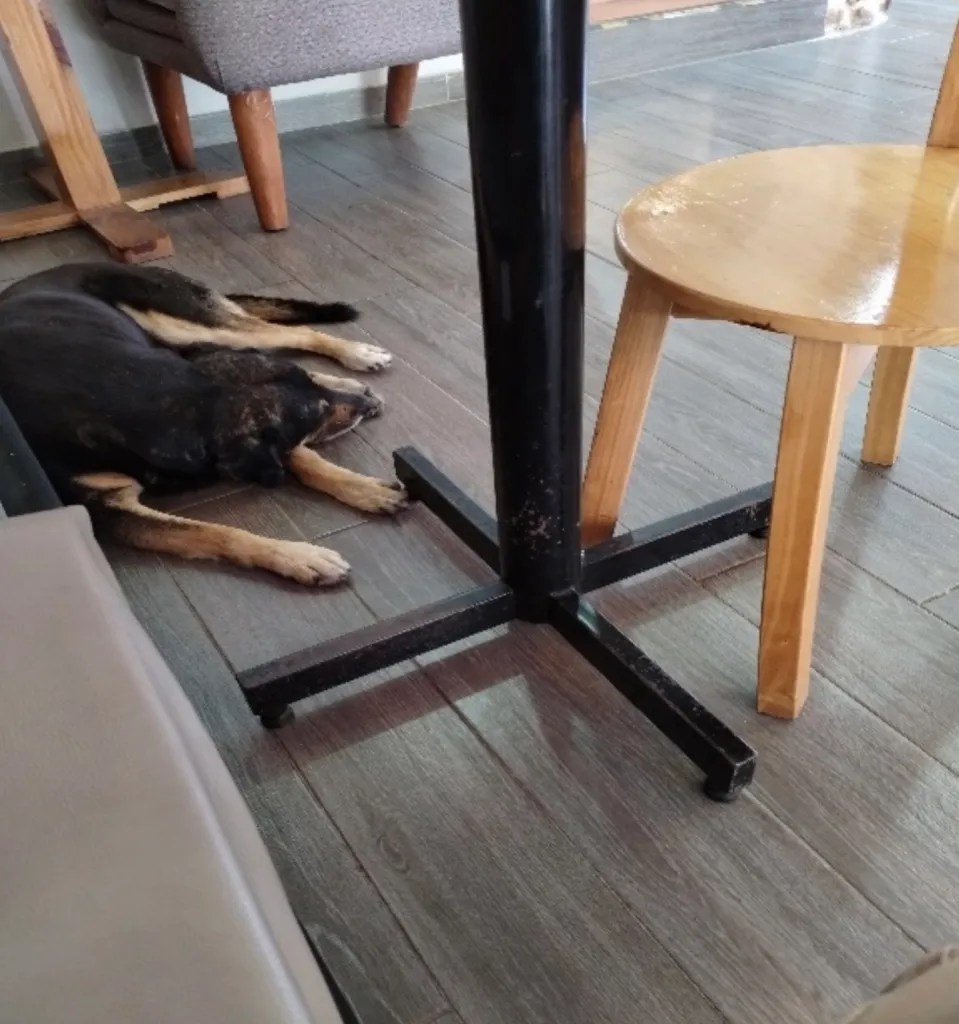
But what troubled me most was the ubiquity of street dogs. I first noticed them while walking around the central, historic district of Lima. We’d be in the main square, gawking at the cathedral and other national monuments, and then I’d see a scrawny-looking dog with no collar and no leash sauntering among the crowds, or one nosing through some garbage, or another lying on a doorstep. My heart would clench. They were no obvious breed, mixes of some sort, ranging in size from a Chihuahua to a Lab, but they all looked pretty scruffy. And they also looked rather lonely, a bit sad, and without any clear connection to a human.
In the tourist-friendly Miraflores section of Lima, where we stayed in a nice Airbnb apartment, I saw many dogs, but no street dogs. Here, owners and their dogs—many of them were golden retrievers, French bulldogs, and well-coiffed poodles—walked happily along the Malecon, the municipal greenway along the edges of the cliffs overlooking the Pacific, or along the sidewalks bordering the many cafes and restaurants. (Or in Kennedy Park, with its dozens of free-ranging cats regularly cared for by volunteers).
But outside of ‘nice’ districts like Miraflores, I’d see street dogs quite often. And the same was true of Cusco and Aguas Calientes, the tourist-trap town at the base of Machu Picchu. As a lifelong dog lover, this was painful to see. My son, having spent the last several months in Ecuador, had gotten more used to it. But in general we Americans share our homes, and even our beds, with our dogs, and treat them like members of the family. We volunteer at shelters, we foster dogs, we bond with other people over dogs, we watch endless internet videos featuring dogs and other cute animals. Even as I’m writing this article, I’m taking breaks to walk and play with a dog I’m sitting for, an adorable beagle mix.
I’d order extra food at a restaurant and, sitting at one of the outside tables, share some delicious lomo saltado or anticuchos de llama with a street dog that happened to be nearby. I’d buy a pack of hot dogs at a bodega and distribute them to dogs I’d come across during the course of the afternoon. Doggy bags were no longer merely a metaphor.
At a restaurant in Aguas Calientes
***
The first morning in Lima, I walked down the long stairway that leads from the town to the beach. Surfers bobbed in the water. Here and there, a ‘surf school’ student struck a bent-knee pose, arms out, imagining what it would be like to catch a wave. Sellers of snacks and touristy-knick-knacks hawked their wares, and a few ancient VW vans sat alongside the curb.
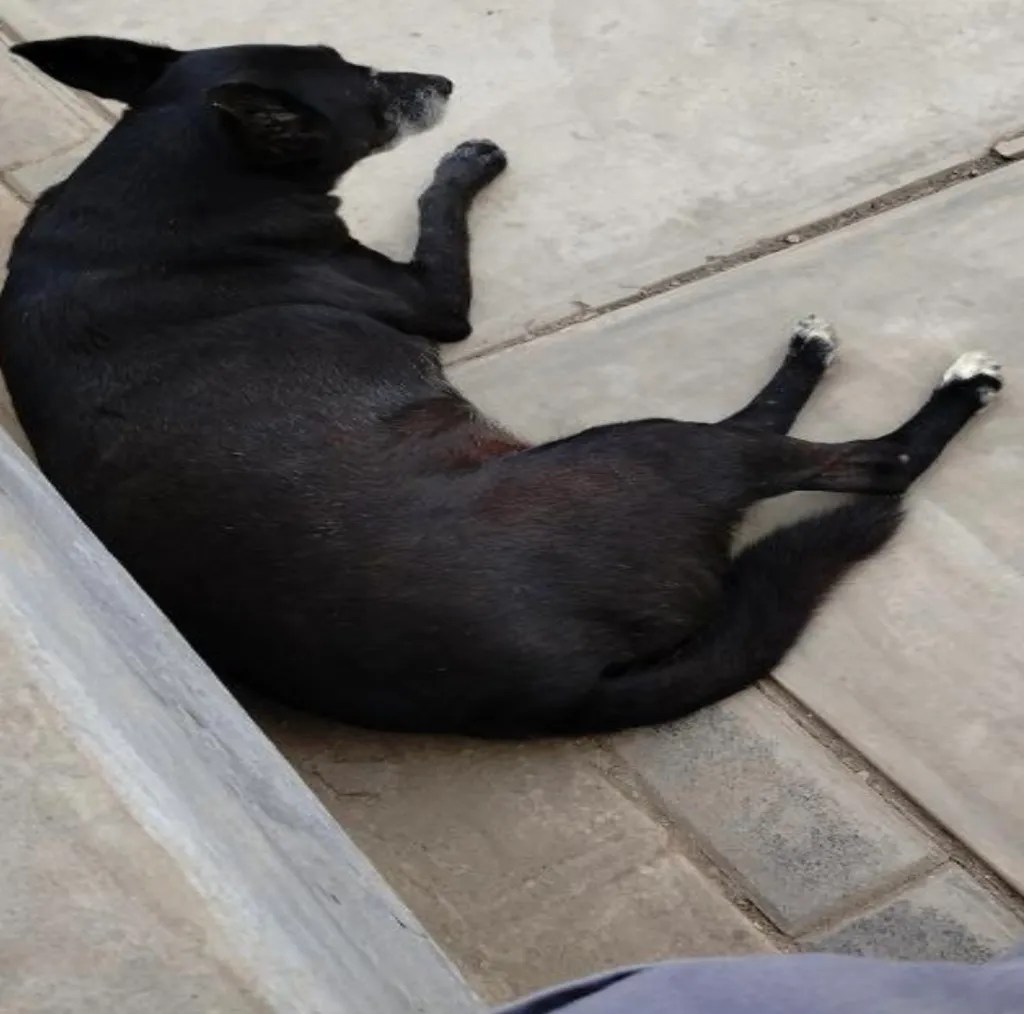
I breezed along the path that bordered the beach for a while. Then I saw him—a medium-sized, black-coated dog walking slowly in my direction. I sat down on a bench, and he approached, lying down at my feet. His ears were pointy, his feet were tipped white, and he had a swatch of grey on his muzzle. But he looked fairly healthy and well-fed. He just seemed to want some human company for a while.
After 10 or 15 minutes, I said adios and continued on my walk south toward Barranco, the pretty district just south of Miraflores. I had coffee at a café housed in a beautiful old colonial and strolled around, gawking at the colorful street murals and poking my head into a few local art galleries. Then I stopped at a market and bought a bottle of water for the walk back and some wet dog food enclosed in a squeezable Capri Sun-type packet.
I saw my new friend nearby, where I had first found him, on a small patch of grass between the street curb and beach, in the shade of a few palm trees. He was sitting on a rusty old chair topped with a stained yellow cushion. I sat in the chair next to him. “Hola, Señor.”
He raised his chin, acknowledged me with a glance, then put his head back down on his paws. I noticed a homemade dog house of heavy cardboard lined with strips of old cloth and carpet. A water dish sat next to the house. I squeezed out the dog food on some napkins, and he ate, taking his time. Though it was just one meal, I at least felt like I had done my good deed for the day.
I went back to visit Señor the next few mornings. He was always in his little area, usually resting, enjoying the ocean breeze. I’d bring him some ham or more dog food and sit with him for a while. Maybe this is not such a bad life for a dog, I wondered. The weather is very mild here—it never fell below 65, and this is winter for Lima. Plenty of fresh air and enough food, it seemed, to get by. Maybe this is even better than the lives many dogs lead back home in Aiken, the ones I would see (or hear) on my walks with my new friend Niles around the neighborhood—dogs behind windows or fences, dogs I never saw outside on a walk, dogs alone.
Señor
I stopped by Señor’s place the morning before my son and I took our flight to Cusco. This time someone was sitting in one of the chairs. I went up and introduced myself in my basic Spanish. Ernesto was a member of a city maintenance crew that covered the area that included Señor’s little spot. They’d bring him a little food and water, and stay with him for a while. Señor was lying on the ground at the foot of Ernesto’s chair. I leaned over and petted him. Ernesto and I had a good little chat—turns out Ernesto had lived in Boston for a few years, but decided he liked Lima better—and then I stood up to go. I dug a 50 sol bill—worth about $15 —out of my wallet, and gave it to Ernesto.
“Comida y agua, para el perro?”
Ernesto smiled. “Si, no problema. Muchas gracias.”
“Gracias, buenas suerte.”
I gave Señor a final pat on the back and went on my way. You have to trust somebody, I thought to myself.
Up in Cusco, the beautiful old city in the Andes, gateway to Machu Picchu, there also were many street dogs. Just in the Uber from the airport to the Airbnb, I must have seen 15 or 20 of them, lounging on doorsteps, loping along sidewalks, nosing through litter. Nearby our apartment, uphill from downtown, I spied a small, black-haired dog nestled in a patch of long grass. My heart clenched yet again. The mountain air was cool, and would fall into the 30s overnight. Our Airbnb had a clear no-pet policy. Smuggling the dog inside didn’t seem a good option. Instead, I bought a pack of hot dogs at a nearby bodega and gave one to the dog. He didn’t seem interested, so I laid it next to him on the grass. My son and I went on our way. I had a pint of the best porter I ever had at a brewery down the hill.
The next morning I went to check on the dog. He wasn’t there, but neither was the hot dog. A small success, hopefully. I took the rest of the hot dogs, then walked down to the main square and quickly found several other dogs. Sometimes they wouldn’t take the food from my hand but would eat it after I set it on the ground. After the hot dogs were gone, I visited the amazing Cusco Cathedral, built in the 1500s in the wake of the Spanish conquest.
***
In beautiful places, scars seem uglier. Peru’s food, architecture, mountains and Incan ruins are unlike anywhere else. Yet its poverty is pretty common for the still-developing world. For every upscale Lima neighborhood like Miraflores or Barranco, there’s a crime-ridden district like Callao or a shantytown like Villa El Salvador. In fact, there are far more Callaos than Barrancos. And the worse the conditions are for humans, the worse they are for animals—especially dogs, who, more than most other creatures, rely on humans both materially and socially. Perhaps a good analogy for Peru would be homelessness—the more homeless humans inhabit a locality, the more likely there will be numerous street dogs.
To South Carolinians, this will likely come as no surprise. There are umpteen small, rural towns where many folks are just scraping by, or worse. The 421 corridor between Aiken and North Augusta is just one example. And many of us know that South Carolina has long had a stray dog problem. Animal rescues are continually finding abandoned dogs—and then shipping them up north, where there is often a shortage of adoptable dogs (and less rural poverty, in general).
The endemic street dogs of Peru are therefore a symptom of a deeper human problem as much as anything else. And like the homeless person we might see holding up a sign along the road—we register their existence and then continue on our way—in Peru, street dogs are more or less part of the scenery. So while dogs like Señor seem to have a pretty good life—a great spot on the beach, plenty of fresh air and sunshine, people to keep an eye on him—he is the exception, unfortunately, just like Miraflores is an exception to the general living conditions in Lima. For the vast majority of street dogs, life is rather nasty, brutish, and short.
Señor at his beach spot.
___________________
Douglas Higbee is an English professor at the University of South Carolina Aiken.
Transparency and Openness Needed During Aiken County Council’s Public Hearings on Ordinances Involving Fee-in-Lieu-of-Tax and Incentive Agreements
By Vicki Simons August 16, 2026
If you learned that people elected into office — purportedly to represent you — have been making decisions without transparency and openness, how would that make you feel?
Furthermore, if you knew that there was something that you could do to change that situation for the better, wouldn’t you want to do it?
The Eye-Opening Series of Events
In 2023, Aiken County Council approved by majority (not unanimous) vote an ordinance regarding a Fee in Lieu of Tax and Incentive Agreement for an entity referred to as “Project Sabal.”
When at-that-time Councilman Kelley Mobley (District 4) and current Councilman Mike Kellems (District 2) objected to the ordinance, the eyes of my understanding were opened:
Regarding at least Project Sabal — and who knows how many projects before that — Council members had been kept in the dark regarding the entity with whom they were preparing to enter into a legally binding contract.
What Is A Fee in Lieu of Tax Agreement?
Before I proceed, I need to back up and cover some background.
A FILOT is a Fee in Lieu of Tax agreement, which is a contractual Property Tax incentive between a company and the county where the company’s project is located.
Industries that invest at least $2.5 million in South Carolina may negotiate for a fee-in-lieu of Property Taxes. This can result in a savings of about 40% on Property Taxes…
In this article, I shall refer to all of the following as FILOT Agreements (or FILOTs):
“Fee In Lieu of Ad Valorem Taxes Agreement”;
“Fee in Lieu of Tax Agreements”;
“Fee in Lieu of Tax and Incentive Agreements”; and
“Fee in Lieu of Property Tax Agreements.”
Where is Documentation About Fee in Lieu of Tax Agreements?
As it concerns counties within South Carolina, at least 3 places in the South Carolina Code of Laws cover Fee in Lieu of [Property] Tax agreements:
“(a) The council shall take legislative action by ordinance. …”‘;
“(b) With the exception of emergency ordinances, all ordinances shall be read at three (3) public meetings of the council, on three (3) separate days, with an interval of not less than seven (7) days between the second and third reading; provided that a verbatim reading of an ordinance shall not be required unless such reading is requested by a member. Public hearings may be held on the same day as a reading of the ordinance is made. …”; and
“d) Public hearings, after reasonable public notice, must be held before final council action…”
How Are FILOT Ordinances Worded?
In the past, in Council’s agendas, the titles of ordinances involving FILOT Agreements have typically been written similar to (or exactly like) this, with the project name completed:
Ordinance Authorizing (1) The Execution And Delivery Of A Fee In Lieu Of Tax And Incentive Agreement By And Between Aiken County, South Carolina And A Company Identified For The Time Being As Project ___________ (The “Company”) With Respect To The Establishment Of Certain Facilities In The County (The “Project”); (2) The Benefits Of A Multi-County Industrial Or Business Park To Be Made Available To The Company And The Project; (3) Certain Special Source Revenue Credits In Connection With The Project; And (4) Other Matters Relating Thereto.
To get the details — which can be dozens of pages long — one has to dig down into the “CC Docs” document that accompanies the meeting agenda where the Public Hearing is listed.
Information Withheld from Aiken County Citizens Regarding FILOT Agreement Details
In my speech during the May 2, 2023, meeting of Aiken County Council — which followed the vote on Project Sabal — I posed the following question and comments:
How are Aiken County citizens supposed to talk intelligently during Public Hearings regarding various “projects” when the company’s name and the scope of those “projects” are withheld from them?
… During the April 18, 2023, Regular Session, numerous Council members spoke during a Public Hearing about “Project Sabal.”
… by the time a “project” makes it to a Public Hearing, it is my opinion that the mystery, the secrecy, and the lack of transparency must be stripped away so that the public can speak intelligently before Council on this matter.
I feel compelled to remind you that Article I, § 1, of The South Carolina Constitution says: “All political power is vested in and derived from the people only, therefore, they have the right at all times to modify their form of government.” (6)
Furthermore, we read in Title 30, Chapter 4 of the South Carolina Code of Laws, The Freedom of Information Act, in Section 30-4-15: “The General Assembly finds that it is vital in a democratic society that public business be performed in an open and public manner so that citizens shall be advised of the performance of public officials and of the decisions that are reached in public activity and in the formulation of public policy. …” (7)
Therefore, I am requesting that in every future meeting, before there is a Public Hearing about any “project,” that the name of the company and the scope of its business be made known so that the citizens of Aiken County — and even Council members — can make fully informed decisions and speak intelligently about the business that may be about to happen in our own backyard.
FILOT Details?
If one searched online for something like “SC Department of Revenue list of Fee in Lieu of Tax agreements”, one would possibly receive a result like this:
“The South Carolina Department of Revenue (SCDOR) does not maintain or publish a centralized public statewide list or database of individual Fee in Lieu of Tax (FILOT) agreements.”
In order to find specific FILOT Agreements, one is directed to:
either contact county offices;
or search County Council records.
So, on May 15, 2023, I requested pursuant to Section 30-4-20 and Section 30-4-30 of the Code of Laws of South Carolina (the Freedom of Information Act), specific information regarding FILOTs in Aiken County.
In one June 6, 2023, speech before Aiken County Council, specifically during the Public Hearing on the Fiscal Year 2023 – 2024 Budget, I said:
What bearing do Fee in Lieu of Tax Agreements passed by Aiken County Council have on the Fiscal Year 2023 – 2024 budget? During the May 16, 2023, Aiken County Council meeting, I informed the Council that I had submitted a Freedom of Information Act (FOIA) request in order to learn some very specific information about “Fee in Lieu of Tax” agreements that Aiken County Council has passed by majority vote over the last 10 years. (1) I asked for: — a list of the agreements; — the votes cast by the Council; — the fees that were paid; and — a calculation of the total taxes that would have been paid by each of the project names, businesses, and other entities — from the time they came into Aiken County through Fiscal Year 2022 – 2023 — had they not paid the fee up-front. I have received from the County Attorney enough information to be able to summarize some things for you. From his first email: (1) The County would have all of the individual documents that are part of economic development projects, a list of which were named, and from which information would need to be gleaned and put into the format I requested. (2) The County is not believed to have a comprehensive listing of projects, as each agreement is “a distinct economic matter for the County.” (3) Furthermore, “the FOIA does not require a public body to create a document (such as a list or a spreadsheet) it does not have at the time of [an] FOIA request.” (4) I understand that each entity’s potential tax payment outside a Fee in Lieu of Tax agreement would have been hypothetical and is not something the County would calculate and set forth in a record. From his second email: (1) He reached out to the President of the Western SC Economic Development Partnership, who provided him with information. (2) There were numerous attachments to his second email, including: — a spreadsheet containing a list of 24 entities with “investments” ranging from $2.5 million to $400 million; and — 9 PDF documents, for each of the years 2013 through 2021, each of which was entitled “South Carolina Department of Revenue Fee In Lieu of Tax Status Report.” (3) For each of the Status Reports, the columns are entitled [with my notes in brackets]: — SID/SFX [undefined]; – Owner/Operator [entity’s name]; — Schedule [a code, also undefined]; — Term [in years, usually ranging from 15 to 40 years]; — Type [“Little”, “Big”, “Simplified”, and “Super”]; — Investment Years [beginning through ending years]; — Status [“Open” or “Closed”]; — Certified [date]; – Contractual Amt ($); — Gross Cost ($); and – Fee ($).
I received for each of the years 2013 – 2021, a South Carolina Department of Revenue Fee ln Lieu of Tax Status Report.
Please note that the time frame (“Term”) for each FILOT in the Reports that I received ranges from 15 to 40 years.
So, it is no trivial matter that a company can request — and Aiken County Government can enter into — a FILOT Agreement spanning 4 decades!
Limits of Non-Disclosure Agreements?
During my second June 6, 2023, speech to Aiken County Council — and regarding a different entity with whom the Council was about to enter into a FILOT Agreement — I said:
While I understand that a Non-Disclosure Agreement (or “NDA”) (5) requires contracting parties to keep material, knowledge, or information confidential, by the time a proposed “Fee in Lieu of Tax” agreement makes it to a Public Hearing, it is my opinion that any and all mystery, secrecy, and lack of transparency must be stripped away so that the public understands what may be about to happen in our own backyard.
On behalf of the citizens, taxpayers, and voters of Aiken County, South Carolina, I am requesting — before Aiken County Council takes a vote on this — that Council reveals the entire nature and scope of what is behind and concerning “a Fee Agreement By And Between Aiken County, South Carolina And [Entity Name] Providing For A Payment Of A Fee In Lieu Of Taxes And Other Matters Related Thereto.”
The reason why I am asking for this information is because during the April 18, 2023, Regular Session of Aiken County Council, numerous Council members spoke during a Public Hearing about a project, during which it became apparent that Council members were NOT familiar with the company, the nature, or the scope of the project on which it was preparing to vote.
I feel compelled to remind you that Article I, § 1, of The South Carolina Constitution says: “All political power is vested in and derived from the people only, therefore, they have the right at all times to modify their form of government.” (6)
Again, I am requesting that the nature and scope of the business behind this proposed Fee in Lieu of Tax agreement be fully disclosed before Council votes on it.
Explanation of FILOT Ordinances by Aiken County Council
Over time since 2023, I have observed that Aiken County Council’s Chairman has been slightly more transparent and open regarding FILOT ordinances.
It has also been my observation that a number of economic development opportunities — that give rise to FILOT agreements — have been brought before Council by the director of the Western SC Economic Development Partnership (WSCEDP).
Since 2023 — and I think in direct response to the speeches I have made calling for transparency and openness regarding FILOT Agreements — I have also observed that the WSCEDP director has been a little bit more forthcoming with details about the entities with which Aiken County are preparing to enter into a legally binding contract.
In my March 5, 2024, speech before Aiken County Council, I said that:
the Project Sabal name hid the company name;
there were many unknowns; and
in spite of all of that, [a majority of] Council voted in favor of the FILOT ordinance.
In my September 17, 2024, speech before Aiken County Council, I addressed the “big reveal” that “Project Sabal” was actually Meta and I further said:
Regardless of the size of the investment and the number of new jobs that any company will be bringing to Aiken County, the highest importance is to uphold the self-evident truths that we have a Creator, that all men are created equal, and that He endowed each of us with certain unalienable Rights, among which are Life, Liberty and the pursuit of Happiness. (9)
Recall that: — Article I, § 1, of The South Carolina Constitution begins: “All political power is vested in and derived from the people only…”; (10) and — The First Amendment to The Constitution of the United States secures our God-endowed rights of freedom of speech and freedom of the press. (11)
In my opinion, Aiken County Council and Aiken County Government must revise Chapter 17 of the Aiken County Code of Ordinances about Planning, such that all future economic development here honors and upholds these precious truths. (12)
About Public Hearings in General
I have observed that Aiken County Council’s Public Hearings on various matters have taken place during the First Reading, Second Reading, or Third Reading.
I do not know why Public Hearings are held during different readings on different kinds of ordinances.
When it comes to FILOT ordinances, I have observed in the past that each one’s related Public Hearing takes place during the Third Reading (when there is no further time to consider the matter).
During my June 17, 2025, speech to Aiken County Council, I said:
How can Aiken County Council increase transparency and public trust when it comes to Public Hearings? Per the definition that I gave in my February 4 speech (A), Public Hearings have two purposes: 1. Citizens, taxpayers, and voters can express their opinions about the ordinance; and 2. Aiken County Council needs to answer questions from their constituents. Second, when Aiken County Council is considering an ordinance that requires a Public Hearing — especially one that offers a financial incentive — Council needs to ensure that there is adequate time for research, meaning that the Public Hearing for said ordinance needs to be held during the Second Reading, not the Third Reading. A clause from Aiken County’s Code of Ordinances, Section 2-63, paragraph (d), reads: (B) “A public hearing will be held on all pending ordinances no later than prior to the meeting at which third and final reading is scheduled…” It does not read that a public hearing will be held prior to the third and final reading during the same meeting. Third, Aiken County Council members need time on these ordinances to consider input from all Aiken County voters (your bosses), including those who: — Either are unable to attend the Public Hearing in person; — Or become aware of information that was not known when the Public Hearing took place. (C)
In 2023 and 2024, I called on Aiken County Council to ensure that there is adequate time between Public Hearings and Third Readings of ordinances. (D) During Council’s June 3, 2025, meeting, a Public Hearing on an ordinance offering a financial incentive for a “project” took place during the Third Reading, not the Second Reading. (E) That makes three such situations this year: Project Wisteria, Project Calypso, and Project Sunflower. (F)(G)(E) This lack of transparency is unacceptable to me! So, let’s fix it!
Please note that the Code of Ordinances may have been updated on this matter since I read this speech.
However, I have pressed more than once for Aiken County Council to hold Public Hearings for FILOTs on the Second Reading instead of the Third Reading.
To-date, Aiken County Council has made no move to make this happen.
Questions Remain Regarding FILOTs
Since I was so concerned about the lack of transparency and openness concerning FILOT agreements entered into in Aiken County, I compiled a list of what I considered to be “fundamental questions” that I believed Council needed to answer — or have answered — during FILOT Public Hearings.
I delivered the most recent iteration of these fundamental questions during a Public Hearing on a FILOT on June 16, 2026, in my speech before Aiken County Council, part of which is as follows:
By way of reminder: — The Aiken County Organizational Chart (C) shows Aiken County Voters at the top, over entities including Aiken County Council; — and – From The Declaration of Independence (D), we read that to secure our Creator-endowed, unalienable rights, “Governments are instituted among Men, deriving their just powers from the consent of the governed.” Per the definition that I gave in my February 4, 2025, speech (E), Public Hearings have two purposes: 1. Citizens, taxpayers, and voters can express their opinions about the ordinance; and 2. Aiken County Council needs to answer questions from their constituents. Per my March 4, 2025, speech (F), the Freedom of Information Act within the South Carolina Code of Laws completely allows answering constituent questions in public. Note that I give the phrase “Fee in Lieu of Tax Agreement” and similar such phrases the acronym F-I-L-O-T, which I pronounce “FILOT”. On behalf of all Aiken County Voters (your bosses), I am requiring you to answer all of my questions tonight before you vote on this ordinance. Let’s read these questions… Aiken County Council 1. Has every member of County Council read and understood ALL of the documentation regarding this ordinance in the CC Docs document that accompanies this reading? 2. Will you as a member of County Council vow never to vote in favor of this ordinance — that is, “rubber stamp” it — merely because: — a. you have always — in the past — trusted the entities who brought it before you; — b. you don’t want to mar your record of supporting economic development; and/or — c. your habit has been to vote the same way someone else on Council votes?
Personnel 3. As it concerns this ordinance, will Aiken County Government provide complete lists of: — a. the names of any and all persons — by his/her level of government — who has received advice or input; and — b. the names of all persons — together with their titles and organization names — from whom the advice and input has come?
Company 4. What is a brief overview of this company’s history? 5. Is this company domestic-owned or foreign-owned? 6. What are all of the products/services that this company plans to manufacture/provide at this new or expanded location? 7. How will offering the company this FILOT Agreement affect or influence the Creator-endowed and unalienable rights of Aiken County Voters?
Fee In Lieu of Tax (FILOT) Agreement 8. Can you explain both the pros and the cons of offering a FILOT Agreement to this company at this time? 9. What is the projected “investment” that this company plans to make as a result of this FILOT Agreement? 10. In years, what is the length of this FILOT Agreement? 11. In dollars, what amount of taxes will this company not have to pay? 12. How will Aiken County compensate for this lost tax revenue?
Resources 13. What resources will this company require on a monthly basis, including, but not limited to: — a. electricity, — b. water, and — c. sewage treatment? 14. Does Aiken County have the resources to meet the needs of existing residents and businesses — as well as this new company/location? 15. Has a traffic study been done that shows the increase in traffic by types of vehicles? 16. What commitments has the company made for infrastructure maintenance and improvements?
Environment 17. Once operational, what are the anticipated impacts of this new/expanded location, including, but not limited to: — a. emissions into the air; — b. effluents into the water; — c. waste solids that will be produced; and — d. odors that can be detected by the human nose? 18. How often will testing of water and air be done to assure Aiken County residents that there is no contamination?
Jobs 19. Once construction is completed, how many new employees will the company employ at this new or expanded location? 20. Will these new employees come primarily from within Aiken County? 21. How many of these jobs will be categorized as: — a. skilled labor; and — b. unskilled labor? 22. At start-up, what wages — or ranges of wages — will the company pay to: — a. skilled labor; and — b. unskilled labor? I have done the homework for you by asking fundamental questions, so that when they are answered, you will not be voting blind on this ordinance. Your constituents deserve answers to all of my questions. To make answering these questions easy, I have printed and had distributed enough written copies of this speech for each of you, a company representative, and the County Administrator. Thank you for answering all of my questions before you vote.
To-date, every time I have asked questions like this during a Public Hearing, they have not been fully answered.
In fact, it has been my experience that Council members never engage at all with members of the audience regarding questions about FILOT Agreements during Public Hearings.
Does CouncilEverTalk About FILOT Agreements in Public?
Up to June 2023, I confess that I:
Had never attended any of the Council’s Committee meetings; and
Was naively under the impression that all Council members totally understood all of the details associated with every agreement upon which they voted.
Could it have been the case that Aiken County Council members were talking about FILOTs during Committee meetings?
I began to attend a number of Council’s Committee meetings — Administrative, Development, and Judicial and Public Safety Committees — particularly when something on the agenda caught my attention.
I have observed that these Committee meetings are generally held within either 15- or 30-minute time frames.
One wonders how a legally binding agreement — like a FILOT that spans up to 4 decades — can adequately be discussed during a 15- or 30-minute meeting.
I credit Don Moniak for sharing with me that ordinances are not discussed during Aiken County Council’s Committee meetings!
He further shared with me that the Aiken City Council does discuss potential ordinances during their Work Sessions; i.e. the proposed hospitality tax increase and the proposed transfer of the Shaw Creek Preserve to the South Carolina Forestry Commission.
So, I went digging for information on Aiken County Council’s most recent previous FILOT Ordinance — regarding “Project Synthesis” — to see if any Committee or Work Session covered this topic and here’s what I found (from oldest to newest):
So, it appears that Aiken County Council never discussed any details regarding Project Synthesis during any Committee meeting or any Work Session.
And I know that they didn’t talk about this FILOT ordinance during Aiken County Council’s meeting!
This seems to be a repeated pattern:
Aiken County Council members almost always have zero discussion about FILOT ordinances in public.
Why?
At the top of every Aiken County Council Agenda, we read: “Council Administrator Form of Government”.
The question follows then: If the Aiken County Council leads the charge on government, why don’t Aiken County Council members lead — or at least respond — with transparency and openness regarding FILOT ordinances during Public Hearings?
To me, this practice of being mute during Public Hearings on FILOTs is not acceptable; however, it is going to take more than just one Aiken County Voter to change things.
Citizen Awareness and Involvement
Over the years, I have seen these examples of citizens who have shown up en masse at Aiken County Council meetings and stood up for their Creator-endowed and unalienable rights in one way, shape, or form:
2024.04.16: “Standing-room-only” sized crowd showed up at the Aiken County Council meeting over the House of Raeford Farms, Inc. (“Project Sunny” or chicken slaughterhouse) issue
2026.04.23: A huge crowd showed up to support the Comprehensive Plan.
2026.06.19: Aiken County residents were persistent in voicing their concerns about the planned construction of a 115-kilovolt transmission line.
I would like to see many more of Aiken County’s citizens, taxpayers, and voters regularly attend Aiken County Council’s meetings and stand up for their Creator-endowed and unalienable rights on issues, including Public Hearings on Fee in Lieu of Tax Agreements.
Call to Action
During my January 16, 2024, speech to Aiken County Council, I said:
Some time back, I was informed of the difference between “transparency” and “openness,” which I want to describe for you:
— “Transparency” is when someone shows you an envelope; — “Openness” is when someone tells you what’s in the envelope.
In my opinion, Aiken County Council and Aiken County Government need to do a much better job of demonstrating transparency and openness during Public Hearings on Fee in Lieu of Tax Agreements.
Wouldn’t you agree that if a FILOT is all that it needs to be, it should hold up well under scrutiny?
Here is what I would personally like to see happen regarding Aiken County Council’s handling of FILOT ordinances:
All FILOT Public Hearings are held during the Second Reading, not the Third Reading, of the ordinance;
Every Council member is required to read ALL of the documentation regarding every FILOT ordinance;
Every Council member is required to understand ALL FILOT documentation;
Every Council member is able to answer the fundamental questions that I — and others from within Aiken County — have raised regarding a FILOT ordinance; and
Before a FILOT ordinance is passed on Third Reading, all answers from the pubic are answered during the Public Hearing.
I would not be opposed to the Council Chairman calling upon either the County Administrator or County Attorney to answer FILOT ordinance questions, as long as they are all answered.
In my opinion, if the questions cannot be answered about a FILOT ordinance, it should not be passed. Period.
Opportunity to Act
Researching SCPublicNotices.com, one sees that on Tuesday, August 18, 2026, Aiken County Council will be holding a Public Hearing described as:
“There will be public hearing at the regular meeting of County Council on Tuesday, August 18, 2026 at 6:00 pm, in the County Council Chambers, Third Floor, Aiken County Government Center, 1930 University Parkway, Aiken, SC 29801 concerning the following matter: … 3. Ordinance Authorizing an Amendment of That Certain Fee In Lieu of Ad Valorem Taxes Agreement by And Between Aiken County, South Carolina and Project NEXGEN, Relating to, Without Limitation, The Extension Of The Investment Period Under The Agreement; And Providing For Other Related Matters.”
The FILOT ordinance for “Project NEXGEN” was introduced under First Reading on July 21, 2026 and was not listed on the agenda for either of the Special Called Meetings on July 28 or August 4.
Even if this Public Hearing will be held during the Second Reading, I do not see a company name associated with “Project NEXGEN” online and won’t be able to see Aiken County Council’s Agenda for August 18, 2026, until it is published for the public on Monday, August 17.
If you believe that greater transparency and openness are needed during Aiken County Council’s Public Hearings on FILOT ordinances, please do 2 things:
The Department of Energy’s (DOE) National Nuclear Security Administration (NNSA) has put the brakes on the surplus plutonium Dilute and Dispose program and reassigned K-Area surplus plutonium processing capabilities to the plutonium pit production defense mission. The action marks the end of the latest effort to convert surplus military plutonium into a waste form that is impractical for reuse in nuclear weaponry. Thirty years have now passed since Savannah River Site was selected for long-term—up to 50 years—storage of various surplus plutonium oxides and “non-pit” metals without any meaningful disposition of the materials.
by Don Moniak July 12, 2026
Since the early 1990’s, when the U.S. declared that approximately 50 metric tonnes of military plutonium was surplus to national security needs (leaving about 45 as nonsurplus), the Department of Energy (DOE) and its “semiautonomous” National Nuclear Security Agency (NNSA, formerly known as “Defense Programs.”) have pursued various means to process the material into a form that is both inaccessible and much less usable for nuclear weaponry.
In January 1997, DOE decided to store all surplus plutonium not contained within plutonium pits at Savannah River Site (SRS)—a total ranging from 11-14 metric tonnes—for up to fifty years. By 2010 approximately 9.5 metric tonnes (1) of the material had been shipped from Rocky Flats and the Hanford site to SRS for storage in the old K-Reactor.
At the same time, DOE settled on a plutonium disposition plan called the dual track, one which involved converting two-thirds of the surplus into nuclear reactor fuel referred to as MOX (mixed-oxide) for use in nuclear reactors, and one-third into ceramic “pucks’ to be encased within the high level waste canisters produced at SRS’ Defense Waste Processing Facility (DWPF); a process called Immobilization.
DOE bailed out on the Immobilization path within five years and then attempted to proceed on the Pu/MOX fuel path alone. This path failed miserably, and in 2018 the final plug was pulled on the program, after a cost of more than $5 billion. Left behind was a shell of a hardened plutonium processing plant that DOE/NNSA is now converting into a plutonium pit production facility.
In 2018, DOE chose a new path, known as Dilute and Dispose, in which the plutonium oxide powder is mixed with a classified blend of “adulterants” that are said to denature the plutonium and make it much less reusable for weapons. The resulting waste material is then packaged and shipped to the Waste Isolation Pilot Plant in New Mexico for disposal in deep salt caverns. (For more information on the Dilute and Dispose program, see Offsite Insights 2022-1).
In August 2020, the State of South Carolina and the Federal Government agreed to a $600 million settlement agreement (2) due to the combination of the MOX fiasco and DOE’s failure to remove any significant amount of surplus plutonium to another state. The settlement now requires DOE to move the 9.5 MT that was shipped into SRS in the early 2000’s to another state by 2036. Failure to do so will result in unspecified fines, or probably an amended settlement agreement.
The Dilute and Dispose program was intended to resolve the issue. But the pace never came close to what was needed to satisfy the settlement, as only a single glovebox line was in place. That pace of work was scheduled to be increased with the addition of two more glovebox lines, but in 2025 DOE/NNSA put the brakes on that effort by shifting funds to the Savannah River Plutonium Processing Facility, a.k.a the Plutonium Pit Plant.
In a letter to the DNFSB regarding tritium safety at SRS, DOE/NNSA wrote that “The Tritium Finishing Facility project was one of three projects paused to redirect funding and personnel to higher-priority projects in the DOE/NNSA complex, including the Savannah River Plutonium Processing Facility (SRPPF), the Los Alamos Plutonium Pit Production Project (LAP4), and the Uranium Processing Facility (UPF), all of which require increased funding to remain on schedule.”
One of the other two projects with funding cuts was the dilute and dispose program. The program was to proceed with its single glovebox line.
In their May 29, 2026, weekly report, DNFSB staff reported that the K-Area Dilute and Dispose facility will undergo a transformation in support of “metal preparation” (3) for plutonium pit production, and recommit to three glovebox lines:
“K-Area Plutonium Metal Preparation (K-PuMP): The RIs received a briefing from SRNS andNNSA personnel on their plans to convert the Surplus Plutonium Disposition (SPD) project in K-Area to a Defense Programs mission (see 4/17/2026 report). The new mission, K-PuMP, will produce plutonium metal feed to support the future Savannah River Plutonium Processing Facility’s and Los Alamos National Laboratory’s pit production. The project will repurpose all three SPD gloveboxes for metal preparation while retaining process flexibility in one glovebox to have the ability to support future SPD mission scope if needed. The change to support plutonium metal preparation includes the addition of new equipment and changes to safety controls, including ventilation modifications, new fire dampers, inert glovebox and glovebox monitoring systems, and nuclear incident monitors for criticality.”
It is unclear whether any surplus plutonium will be reconverted to defense purposes, but the potential is there. SRS currently stores ~2.5 MT of weapons-grade Pu metals and 5.4 MT of weapons-grade Pu oxide powder in K Reactor
Meanwhile, the future of the ~9.0+ metric tonnes of surplus plutonium remaining from past Rocky Flats and Hanford shipments is now subject to new, advanced nuclear power options developed by industry and supported by federal government research and development, direct loans, and other subsidies.
In late May 2025, the Trump administration issued Executive Order #14302 titled “Reinvigorating the Nuclear Industrial Base.” One facet of the order involved the future of surplus plutonium contained within plutonium pits, as well as any other surplus plutonium not a part of the 9.5 metric tons involved in the South Carolina SRS/Plutonium settlement with the federal government.
Section 3(c) of the order states that:
The Secretary of Energy shall halt the surplus plutonium dilute and dispose program except with respect to the Department of Energy’s legal obligations to the State of South Carolina. In place of this program, the Secretary of Energy shall establish a program to dispose of surplus plutonium by processing and making it available to industry in a form that can be utilized for the fabrication of fuel for advanced nuclear technologies.”
In other words, DOE was still authorized to continue Dilute and Disposte for the 9.0+ tons covered under the settlement agreement. But DOE/NNSA’s decision to end the program for ALL surplus plutonium appears to contradict the provision “except with respect to DOE’s legal obligations to the State of South Carolina.”
In either case, the future of surplus plutonium storage at SRS is shaping up to be more and more like the original 1996 decision of not more than 50 years. South Carolina’s political leadership is more likely to be patient this time around since the future of surplus plutonium again rests in part in the nuclear power industry’s hands (4).
Various forms of plutonium metal. Photos from various open source websites.
Footnotes:
1. During the closure processes at Rocky Flats, approximately 3.5 to 4.0 tons of plutonium “residues” were processed with some form of Dilute and Dispose and disposed of at the Waste Isolation Pilot Plant in New Mexico, a.k.a the plutonium waste dump. This process greatly reduced the amount of plutonium scheduled for shipment to SRS.
2. For more information regarding the plutonium settlement, see
For information on the pace of Pu disposition at SRS relative to the settlement, the following was reported in We Will Have to Get Back to You:
“Since fully implementing a program known as “dilute and dispose,” in 2021, only 0.123 metric tons (MT) of the ~10.5 MT of surplus Pu stored at SRS has been processed into a waste form and sent to DOE’s Waste Isolation Pilot Plant (WIPP) in New Mexico for disposal.
Less than 0.3 metric tons per year are currently being processed at K-Area; much of it awaiting approval for shipment to WIPP. The processing pace is not expected to pick up until after 2030, and only if an $800 million project to add two glovebox processing lines is completed.
3. Section S.2.2. of the Draft Programmatic Environmental Impact Statement for Plutonium Pit Production describes metal preparation as a plutonium purification process:
“Plutonium Purification. Pit-derived (and other older) plutonium is not suitable for new manufacturing—it contains plutonium radioactive decay products (uranium, americium-241, and neptunium-237) and other undesirable characteristics. Therefore, the plutonium will be purified using pyrochemical (nonaqueous) recovery techniques, which generate plutonium-bearing residues that must be either recovered using aqueous techniques or disposed of as TRU waste.
The proposed purification techniques are well known and have been used successfully at DOE sites for many years.
Nonaqueous plutonium metal purification operations could include a combination of the following primary processes: (1) direct oxide reduction, which generally uses calcium metal to reduce plutonium oxide to plutonium metal; (2) molten salt extraction, which uses chloride salts to remove americium-241 from the plutonium; and (3) electrorefining, which uses chloride salts to remove other key impurities from the plutonium metal.”
4. A Request for Applications for usage of the surplus plutonium was issued in October 2025. As of June 2026, DOE’s Office of Nuclear Energy wrote that advanced negotiations are underway.
The RFA described 19.7metric tonnes of surplus plutonium as being available:
Screenshot
The breakdown in locations of these materials was not made available. Below is the 2019 breakdown of surplus Pu stored at SRS:
Screenshot
More information on this process is available from SRS Watch.
In an area that annually averages nearly four feet of rain, with some years exceeding five feet, stormwater management is a constant challenge. Our predominantly sandy soils also create greater risks of sedimentation damage to down-gradient property owners and to our public waterways.
Aiken County has an agreement in place with the South Carolina Department of Environmental Services (DES, formerly DHEC) to manage stormwater runoff; and has an Ordinance dealing strictly with stormwater. In short, the County regulates stormwater management while DES oversees the County.
In regard to its stormwater management practices, Aiken County was sued twice in 2025 for allegedly failing to protect property owners.
The first suit against the County was filed in March 2025, and involves an equestrian development known as Park Place Polo. The other lawsuit, filed in August 2025, involves a new golfing establishment, the 21 Golf Club.
In both suits, the Plaintiffs allege that the defendants’ actions have negatively impacted their properties and created stormwater runoff and sedimentation events that rise to the level of a trespass and loss of property values. Aiken County’s actions during the permitting process, or lack thereof, are alleged to have facilitated the damages.
The complaint alleges that since 2022 storm water runoff (Figure 2) from Park Place Polo’s property developments have damaged the private property of two long-time residents—as well as causing the road itself to chronically washout. Sediments have smothered floodplains and flowed into a private pond along Cedar Creek.
Figure 2: Typical flooding from stormwater on Cedar Creek Road. (Photo by Duane Gamm).
The County permitted the large equestrian development without requiring any stormwater retention structures that would slow the streams of water during major rain events and thus protect downhill/downstream parties—including Cedar Creek and its associated wetlands, which are waters of the state.
As predictable, to date all defendants deny any wrongdoing.
However, SC DOT’s answer included the following statement that impugned the County and Park Place Polo:
“The Defendant SCDOT is informed and believes the inundation of storm water during rain events will continue without Aiken County modifying its permit for development or enforcing the permit Aiken County issued, and the Defendant SCDOT joins in the Plaintiffs’ request for injunctive relief to abate the continued inundation of storm water during rain events from which there is no adequate remedy at law for the Plaintiffs or the Defendant, SCDOT.”
SC DOT also filed a Motion for Joinder (to also be named as a Plaintiff) that stated drainage “had been fully adequate up until the development in the area above the Plaintiffs’ property whereupon the Plaintiffs’ property and the state highway, Coleman Bridge Road, have become inundated by storm water during rain events.” (The Motion was denied).
As for Aiken County’s role, in early 2023 County officials gave strong hints as to its complicity in this problem—which has cost taxpayers tens of thousands of dollars, if not more than a hundred thousand, to address; and for which there is no foreseeable resolution of the problem.
The Aiken County Council’s February 21, 2023 public meeting featured a fifteen-minute discussion on the matter after Cedar Creek Road resident Duane Gamm brought the issue to Council’s attention.
The dialogue that evening, which occurred from the four minute to twenty-one minute mark in this audio, included the following statements:
Duane Gamm: “We have had at least seven events where the road is being washed out. Every time it washes out they run the runoff onto my property. We have one inch of rain and the county comes out and spends $5,000 to fix the road.”
“There is 80 acres that they have developed where the runoff comes down . Cedar Creek Road is actually a ridge. 80 acres up there does not have a cross drainage.“ (Figure 2)
“The wetlands are on my property and the county has cut a drain that goes right into it.”
Councilman Kelly Mobley: “Are DHEC and the Corps aware of the wetlands issue we have?….Is there a solution that does not involve paving? If this happened because of a development that we allowed to happen, assuming this is a new polo field area….Whose responsibility is this? What is the challenge?”
Duane Gamm: “They have to keep the runoff at or below the levels before they developed it.”
Councilman Mobley: “DId the developer dump water from the new polo field onto Cedar Creek ? Is there stormwater being dumped on that road that was not being dumped there before?”
Councilman Mike Kellems: “When we built a fire department station on an acre and a half, we had to build a retention pond. Can staff answer why this wasn’t required here?”
Councilman Mobley: “Mr. Killian, what kind of recourse do we have after the fact if in fact we find we did not adequately prepare? Is there remedial action we can take with the polo folks.”
Assistant County Administrator Brian Sanders: “We tried to get the polo people to do something more.”
Since this exchange, the road has continued to wash out after every major rainfall event; generally an inch or more within one day. Everytime it washes out, the County sends a grader to repair the damage and make the road passable again.
The solution proposed by the County is paving. But Cedar Creek Road is not on the list of paving projects to be funded by Capital Project Sales Tax dollars; nor is it on the list of County roads to be paved with state funding.
Meanwhile, the lawsuit slogs through the courts. According to a recent Consent Order, there will be no trial until at least after November 1, 2026, to allow for both more discovery time and an opportunity to “convene a meaningful mediation conference.
The 21 Golf Lawsuit
21 Golf is a new golf club being constructed on a 474-acre parcel northwest of Jackson, near Drag Strip Road.
According to the lawsuit, water is being discharged from a newly constructed pond onto the Plaintiff’s property.
The suit alleges that Aiken County is responsible for permitting and enforcing the stormwater management regulations applicable to 21 Golf Club, but has “failed to adequately investigate complaints about the improper discharge and failed to enforce stormwater regulations to protect the Plaintiff’s property.”
In its response, the County denied all culpability.
In its answer, 21 Golf denied the allegations but also named a Third Party, its grading contractor Morton Civil Services, writing that the company “expressly and/or implied warranted to 21 Golf that all work performed by them would be performed in a careful, diligent, and workmanlike manner and that any materials and/or services designed, supplied, or sold by them for use on the project would be merchantable and fit for their intended or specific purpose. To the extent the Plaintiffs’ allegations are true, the Third-Party Defendant breached their implied and/or express warranties of merchantability, workmanlike service, and/or fitness for a particular or intended purpose in the construction of the project.”
In other words, while admitting no liability, 21 Golf has taken the preemptive action to pass legal costs onto its contractor in the case of an award to Plaintiffs.
Do you ever wish that you knew what was going on at Aiken County Government meetings, but you:
can’t attend the meetings in person;
feel that it’s a hassle — yea, even an obstruction to open and transparent government — to have to request under FOIA an audio of each meeting individually; and
wonder why in the world Aiken County Government isn’t already providing livestreaming, recording, and archiving videos of all public meetings when so many other government entities are already providing this service?
What follows includes:
aspects concerning this topic,
what I consider to be the need for this service,
parts of my speeches before Aiken County Council; and
an urgent call to action for readers to contact their Council members and the Council Chairman, requesting that money be put in the FY 2026-2027 budget, in order to make this service a reality this calendar year.
The Need
Aiken County, South Carolina, (A) is larger than the State of Rhode Island (B) and it takes considerable effort for Aiken County residents from outlying areas to attend meetings in person.
Earlier this year, one speaker commented during the “Informal Meeting of the Whole” (public input period of Aiken County Council meetings) that for every speaker who spoke that night, there were 20 other people who wanted to be there to speak.
In my opinion, livestreaming, recording, and archiving videos of Aiken County’s public meetings will:
1. Enhance government transparency and accountability;
2. Increase public trust in elected officials, county employees, and appointees;
3. Ensure equal access to government proceedings for all citizens, including:
a. those who cannot attend meetings in person, b. shift workers, c. parents with school-age children, d. the elderly, e. those with disabilities, f. those who cannot drive at night, and g. those who live a distance from Aiken;
4. Increase civic engagement and voter awareness;
5. Create a permanent record of government decisions;
6. Prove that county government has nothing to hide;
7. Attract businesses and investors by showcasing government transparency;
8. Demonstrate a commitment to innovation and technological advancement;
9. Reduce the need for personnel to fulfill individual FOIA requests for meeting audios;
10. Allow viewers to see and hear material that is not captured in meeting minutes or reported by the press;
11. Help educate students on government processes;
12. Increase general political awareness in the community;
13, Reinforce the idea that the government works for the people, not behind closed doors; and
14. Many other reasons not listed here.
Many people these days consider it backwards not to livestream public meetings, since resources show that:
These South Carolina cities are already doing so:
o Aiken (C), Charleston (D), Columbia (E), Fort Mill (F), Goose Creek (F), Hardeeville (G), Rock Hill (H), and York(I); and
These South Carolina counties were listed as doing so:
o Abbeville, Georgetown, Williamsburg, and York. (J)
Times When Livestreaming Meetings Would Have Been Helpful
1. During Council’s June 3, 2025, meeting, a Public Hearing took place regarding an AI data center, during which one speaker asked 12 specific questions, none of which Council members addressed, but Council subsequently approved the ordinance authorizing the Fee in Lieu of Tax and Incentive Agreement anyway. (Agenda: G.1., H.1.) (K)
2. During Council’s February 3, 2026, Work Session, a presentation was made via Zoom meeting about impact fees.
In my opinion, this use of technology was a win-win.
It would have been very helpful if the people of Aiken County could have seen the presentation about impact fees, to keep them informed.
Figure 1: February 3, 2026 County Council work session zoom meeting regarding impact fees. This zoom session was not publicly accessible, Photo by Vicki Simons. Figure 2: Example of slide presented during February 3, 2026 zoom meeting.
3. During Council’s March 17, 2026, meeting, the County Attorney made an excellent presentation on a Resolution in Opposition to H. 5321, A Bill to Establish the “Horse Creek Regional Public Service Authority” and to Dissolve the Aiken County Public Service Authority. (Agenda K.1.) (L)
This is the only time when I have personally heard that two government entities — Aiken County Council and the Aiken County Legislative Delegation, both of which represent Aiken County voters — had a major disagreement.
It would have been very helpful if the people — including Aiken County citizens, Aiken County businesses, and the Delegation — could have seen not only the PowerPoint presentation, but also Council’s interaction with the County Attorney about this subject.
4. During Council’s April 14, 2026, meeting, a Public Hearing took place about a proposed ordinance regarding putting a referendum about Sunday alcohol sales and consumption on an upcoming ballot. (Agenda: G.3.) (M)
In my opinion, it would have been helpful if people could have heard the viewpoints presented.
I could provide numerous other examples of when livestreaming Aiken County Council meetings — including Committee meetings — would have been helpful.
Calls to Livestream Aiken County Meetings
1. During the Judicial and Public Safety Committee meeting on January 6, 2026 (N), and during Aiken County Council’s meeting on January 20, 2026 (O), two different people requested that all public meetings be broadcast online.
2. I have publicly requested seven (7) times that Aiken County Council approve funding for livestreaming meetings — on 11/19/2024, 3/18/2025, 5/6/2025, 6/3/2025, 7/15/2025, 2/3/2026, and 4/14/2026 — one of those speeches being made during the Public Hearing on Aiken County’s budget for Fiscal Year 2025-2026.
3. For two years in a row, one County Councilman has requested that money for livestreaming meetings be put in the County’s budget.
How Much Money is Really Required?
On October 29, 2014, the City of Aiken announced, “Live and Archived City Council Meetings Now Available on YouTube.” (P)
At that time, the City of Aiken was paying $1,500 a month for this service. (P)
Multiplying $1,500 per month times 12 months per year, the annual cost would have been (at that time) $18,000.
One Aiken County Councilman proposed modifying the County’s budget to allow for $80,000 per year for video services.
That price seemed high to me, but upon further investigation, I learned that that price quote had been received from a county department.
I requested publicly that that quote be examined in detail because livestreaming public meetings to YouTube or other video platforms cost a fraction of the cost cited.
I have not received an answer to my request.
Aiken County Voters Must Speak Up
Even though a line near the top of every Aiken County Council meeting agenda reads, “Council Administrator Form of Government…”, the Aiken County Organizational Chart (Q) clearly shows that Aiken County Voters are over numerous government entities, including Aiken County Council.
Furthermore, we know that The Declaration of Independence (R) says that,
“Governments are instituted among Men, deriving their just powers from the consent of the governed,” meaning that Aiken County Government derives its just powers from the people of Aiken County.
Going beyond just livestreaming Council meetings, I have publicly requested that Aiken County Government’s budget include paying for livestreaming, recording, and archiving videos of all public meetings, including, but not limited to, meetings of:
the Planning Commission;
the Board of Appeals;
the Voter Registration and Elections Board;
all Aiken County Council committees; and
Aiken County Council’s work sessions, regular meetings, and special meetings.
In my opinion, there is no valid reason why Aiken County Council should delay approving funding for livestreaming, recording, and archiving services similar to those used by the City of Aiken.
Yet, the request for this service can’t come from just a couple of concerned Aiken County citizens. There must be a massive outpouring of requests from across Aiken County.
Urgent Call to Action
The Aiken County Administrator presented a proposed FY 2027 County Budget to Aiken County Council during their meeting on May 5, 2026. (S)
Since Aiken County Council has been holding budget work sessions for the 2026-2027 Fiscal Year, now is the time when the Aiken County Voters’ voices need to be heard.
This urgent call to action is for Aiken County Voters to:
request that, in their FY 2026-2027 budget, money be allocated to pay for livestreaming, recording, and archiving videos of all public meetings, with implementation this calendar year.
The budget must be passed by the end of June, so time is of the essence.
(Editor’s note: The Aiken County Council Public Hearing on the 2026-2027 County budget will be held Tuesday, June 2, 2026, at 1930 University Parkway (County Administration Building, 3rd Floor) at 7 pm. This is the Second Reading and vote on the matter. The Third Reading will likely be June 16th).