This August, I visited Peru with my son, on break from his Peace Corps duties in Ecuador. We spent a week in Lima and a few days each in the picturesque old colonial city of Cusco and the ancient Incan ruins of Machu Picchu.
Peru was great, with friendly people, fresh ceviche, grand cathedrals, and sublime mountain scenery. But there were less wonderful aspects. In Lima, we gringos were told to stay away from certain neighborhoods because of crime and gang activity. In Cusco, the oxygen already thin from the altitude, car exhaust would concentrate in the narrow, high-walled streets. In all parts of Peru, you were reminded not to flush toilet paper—the old sewage system can’t handle it—so instead you tossed it in the bathroom trash can. And the tap water was non-potable, so buying bottled water was a daily chore.
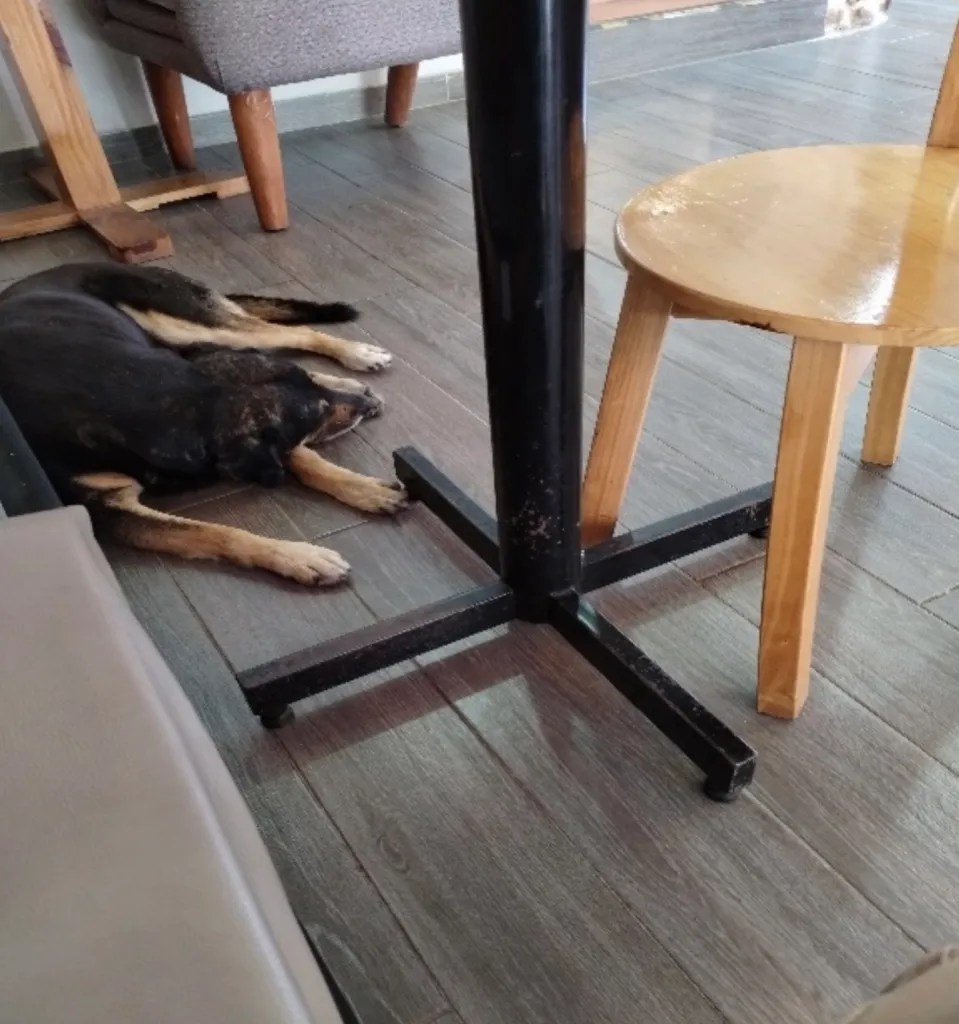
But what troubled me most was the ubiquity of street dogs. I first noticed them while walking around the central, historic district of Lima. We’d be in the main square, gawking at the cathedral and other national monuments, and then I’d see a scrawny-looking dog with no collar and no leash sauntering among the crowds, or one nosing through some garbage, or another lying on a doorstep. My heart would clench. They were no obvious breed, mixes of some sort, ranging in size from a Chihuahua to a Lab, but they all looked pretty scruffy. And they also looked rather lonely, a bit sad, and without any clear connection to a human.
In the tourist-friendly Miraflores section of Lima, where we stayed in a nice Airbnb apartment, I saw many dogs, but no street dogs. Here, owners and their dogs—many of them were golden retrievers, French bulldogs, and well-coiffed poodles—walked happily along the Malecon, the municipal greenway along the edges of the cliffs overlooking the Pacific, or along the sidewalks bordering the many cafes and restaurants. (Or in Kennedy Park, with its dozens of free-ranging cats regularly cared for by volunteers).
But outside of ‘nice’ districts like Miraflores, I’d see street dogs quite often. And the same was true of Cusco and Aguas Calientes, the tourist-trap town at the base of Machu Picchu. As a lifelong dog lover, this was painful to see. My son, having spent the last several months in Ecuador, had gotten more used to it. But in general we Americans share our homes, and even our beds, with our dogs, and treat them like members of the family. We volunteer at shelters, we foster dogs, we bond with other people over dogs, we watch endless internet videos featuring dogs and other cute animals. Even as I’m writing this article, I’m taking breaks to walk and play with a dog I’m sitting for, an adorable beagle mix.
I’d order extra food at a restaurant and, sitting at one of the outside tables, share some delicious lomo saltado or anticuchos de llama with a street dog that happened to be nearby. I’d buy a pack of hot dogs at a bodega and distribute them to dogs I’d come across during the course of the afternoon. Doggy bags were no longer merely a metaphor.
At a restaurant in Aguas Calientes
***
The first morning in Lima, I walked down the long stairway that leads from the town to the beach. Surfers bobbed in the water. Here and there, a ‘surf school’ student struck a bent-knee pose, arms out, imagining what it would be like to catch a wave. Sellers of snacks and touristy-knick-knacks hawked their wares, and a few ancient VW vans sat alongside the curb.
I breezed along the path that bordered the beach for a while. Then I saw him—a medium-sized, black-coated dog walking slowly in my direction. I sat down on a bench, and he approached, lying down at my feet. His ears were pointy, his feet were tipped white, and he had a swatch of grey on his muzzle. But he looked fairly healthy and well-fed. He just seemed to want some human company for a while.
After 10 or 15 minutes, I said adios and continued on my walk south toward Barranco, the pretty district just south of Miraflores. I had coffee at a café housed in a beautiful old colonial and strolled around, gawking at the colorful street murals and poking my head into a few local art galleries. Then I stopped at a market and bought a bottle of water for the walk back and some wet dog food enclosed in a squeezable Capri Sun-type packet.
I saw my new friend nearby, where I had first found him, on a small patch of grass between the street curb and beach, in the shade of a few palm trees. He was sitting on a rusty old chair topped with a stained yellow cushion. I sat in the chair next to him. “Hola, Señor.”
He raised his chin, acknowledged me with a glance, then put his head back down on his paws. I noticed a homemade dog house of heavy cardboard lined with strips of old cloth and carpet. A water dish sat next to the house. I squeezed out the dog food on some napkins, and he ate, taking his time. Though it was just one meal, I at least felt like I had done my good deed for the day.
I went back to visit Señor the next few mornings. He was always in his little area, usually resting, enjoying the ocean breeze. I’d bring him some ham or more dog food and sit with him for a while. Maybe this is not such a bad life for a dog, I wondered. The weather is very mild here—it never fell below 65, and this is winter for Lima. Plenty of fresh air and enough food, it seemed, to get by. Maybe this is even better than the lives many dogs lead back home in Aiken, the ones I would see (or hear) on my walks with my new friend Niles around the neighborhood—dogs behind windows or fences, dogs I never saw outside on a walk, dogs alone.
Señor
I stopped by Señor’s place the morning before my son and I took our flight to Cusco. This time someone was sitting in one of the chairs. I went up and introduced myself in my basic Spanish. Ernesto was a member of a city maintenance crew that covered the area that included Señor’s little spot. They’d bring him a little food and water, and stay with him for a while. Señor was lying on the ground at the foot of Ernesto’s chair. I leaned over and petted him. Ernesto and I had a good little chat—turns out Ernesto had lived in Boston for a few years, but decided he liked Lima better—and then I stood up to go. I dug a 50 sol bill—worth about $15 —out of my wallet, and gave it to Ernesto.
“Comida y agua, para el perro?”
Ernesto smiled. “Si, no problema. Muchas gracias.”
“Gracias, buenas suerte.”
I gave Señor a final pat on the back and went on my way. You have to trust somebody, I thought to myself.
Up in Cusco, the beautiful old city in the Andes, gateway to Machu Picchu, there also were many street dogs. Just in the Uber from the airport to the Airbnb, I must have seen 15 or 20 of them, lounging on doorsteps, loping along sidewalks, nosing through litter. Nearby our apartment, uphill from downtown, I spied a small, black-haired dog nestled in a patch of long grass. My heart clenched yet again. The mountain air was cool, and would fall into the 30s overnight. Our Airbnb had a clear no-pet policy. Smuggling the dog inside didn’t seem a good option. Instead, I bought a pack of hot dogs at a nearby bodega and gave one to the dog. He didn’t seem interested, so I laid it next to him on the grass. My son and I went on our way. I had a pint of the best porter I ever had at a brewery down the hill.
The next morning I went to check on the dog. He wasn’t there, but neither was the hot dog. A small success, hopefully. I took the rest of the hot dogs, then walked down to the main square and quickly found several other dogs. Sometimes they wouldn’t take the food from my hand but would eat it after I set it on the ground. After the hot dogs were gone, I visited the amazing Cusco Cathedral, built in the 1500s in the wake of the Spanish conquest.
***
In beautiful places, scars seem uglier. Peru’s food, architecture, mountains and Incan ruins are unlike anywhere else. Yet its poverty is pretty common for the still-developing world. For every upscale Lima neighborhood like Miraflores or Barranco, there’s a crime-ridden district like Callao or a shantytown like Villa El Salvador. In fact, there are far more Callaos than Barrancos. And the worse the conditions are for humans, the worse they are for animals—especially dogs, who, more than most other creatures, rely on humans both materially and socially. Perhaps a good analogy for Peru would be homelessness—the more homeless humans inhabit a locality, the more likely there will be numerous street dogs.
To South Carolinians, this will likely come as no surprise. There are umpteen small, rural towns where many folks are just scraping by, or worse. The 421 corridor between Aiken and North Augusta is just one example. And many of us know that South Carolina has long had a stray dog problem. Animal rescues are continually finding abandoned dogs—and then shipping them up north, where there is often a shortage of adoptable dogs (and less rural poverty, in general).
The endemic street dogs of Peru are therefore a symptom of a deeper human problem as much as anything else. And like the homeless person we might see holding up a sign along the road—we register their existence and then continue on our way—in Peru, street dogs are more or less part of the scenery. So while dogs like Señor seem to have a pretty good life—a great spot on the beach, plenty of fresh air and sunshine, people to keep an eye on him—he is the exception, unfortunately, just like Miraflores is an exception to the general living conditions in Lima. For the vast majority of street dogs, life is rather nasty, brutish, and short.
Señor at his beach spot.
___________________
Douglas Higbee is an English professor at the University of South Carolina Aiken.
Transparency and Openness Needed During Aiken County Council’s Public Hearings on Ordinances Involving Fee-in-Lieu-of-Tax and Incentive Agreements
By Vicki Simons August 16, 2026
If you learned that people elected into office — purportedly to represent you — have been making decisions without transparency and openness, how would that make you feel?
Furthermore, if you knew that there was something that you could do to change that situation for the better, wouldn’t you want to do it?
The Eye-Opening Series of Events
In 2023, Aiken County Council approved by majority (not unanimous) vote an ordinance regarding a Fee in Lieu of Tax and Incentive Agreement for an entity referred to as “Project Sabal.”
When at-that-time Councilman Kelley Mobley (District 4) and current Councilman Mike Kellems (District 2) objected to the ordinance, the eyes of my understanding were opened:
Regarding at least Project Sabal — and who knows how many projects before that — Council members had been kept in the dark regarding the entity with whom they were preparing to enter into a legally binding contract.
What Is A Fee in Lieu of Tax Agreement?
Before I proceed, I need to back up and cover some background.
A FILOT is a Fee in Lieu of Tax agreement, which is a contractual Property Tax incentive between a company and the county where the company’s project is located.
Industries that invest at least $2.5 million in South Carolina may negotiate for a fee-in-lieu of Property Taxes. This can result in a savings of about 40% on Property Taxes…
In this article, I shall refer to all of the following as FILOT Agreements (or FILOTs):
“Fee In Lieu of Ad Valorem Taxes Agreement”;
“Fee in Lieu of Tax Agreements”;
“Fee in Lieu of Tax and Incentive Agreements”; and
“Fee in Lieu of Property Tax Agreements.”
Where is Documentation About Fee in Lieu of Tax Agreements?
As it concerns counties within South Carolina, at least 3 places in the South Carolina Code of Laws cover Fee in Lieu of [Property] Tax agreements:
“(a) The council shall take legislative action by ordinance. …”‘;
“(b) With the exception of emergency ordinances, all ordinances shall be read at three (3) public meetings of the council, on three (3) separate days, with an interval of not less than seven (7) days between the second and third reading; provided that a verbatim reading of an ordinance shall not be required unless such reading is requested by a member. Public hearings may be held on the same day as a reading of the ordinance is made. …”; and
“d) Public hearings, after reasonable public notice, must be held before final council action…”
How Are FILOT Ordinances Worded?
In the past, in Council’s agendas, the titles of ordinances involving FILOT Agreements have typically been written similar to (or exactly like) this, with the project name completed:
Ordinance Authorizing (1) The Execution And Delivery Of A Fee In Lieu Of Tax And Incentive Agreement By And Between Aiken County, South Carolina And A Company Identified For The Time Being As Project ___________ (The “Company”) With Respect To The Establishment Of Certain Facilities In The County (The “Project”); (2) The Benefits Of A Multi-County Industrial Or Business Park To Be Made Available To The Company And The Project; (3) Certain Special Source Revenue Credits In Connection With The Project; And (4) Other Matters Relating Thereto.
To get the details — which can be dozens of pages long — one has to dig down into the “CC Docs” document that accompanies the meeting agenda where the Public Hearing is listed.
Information Withheld from Aiken County Citizens Regarding FILOT Agreement Details
In my speech during the May 2, 2023, meeting of Aiken County Council — which followed the vote on Project Sabal — I posed the following question and comments:
How are Aiken County citizens supposed to talk intelligently during Public Hearings regarding various “projects” when the company’s name and the scope of those “projects” are withheld from them?
… During the April 18, 2023, Regular Session, numerous Council members spoke during a Public Hearing about “Project Sabal.”
… by the time a “project” makes it to a Public Hearing, it is my opinion that the mystery, the secrecy, and the lack of transparency must be stripped away so that the public can speak intelligently before Council on this matter.
I feel compelled to remind you that Article I, § 1, of The South Carolina Constitution says: “All political power is vested in and derived from the people only, therefore, they have the right at all times to modify their form of government.” (6)
Furthermore, we read in Title 30, Chapter 4 of the South Carolina Code of Laws, The Freedom of Information Act, in Section 30-4-15: “The General Assembly finds that it is vital in a democratic society that public business be performed in an open and public manner so that citizens shall be advised of the performance of public officials and of the decisions that are reached in public activity and in the formulation of public policy. …” (7)
Therefore, I am requesting that in every future meeting, before there is a Public Hearing about any “project,” that the name of the company and the scope of its business be made known so that the citizens of Aiken County — and even Council members — can make fully informed decisions and speak intelligently about the business that may be about to happen in our own backyard.
FILOT Details?
If one searched online for something like “SC Department of Revenue list of Fee in Lieu of Tax agreements”, one would possibly receive a result like this:
“The South Carolina Department of Revenue (SCDOR) does not maintain or publish a centralized public statewide list or database of individual Fee in Lieu of Tax (FILOT) agreements.”
In order to find specific FILOT Agreements, one is directed to:
either contact county offices;
or search County Council records.
So, on May 15, 2023, I requested pursuant to Section 30-4-20 and Section 30-4-30 of the Code of Laws of South Carolina (the Freedom of Information Act), specific information regarding FILOTs in Aiken County.
In one June 6, 2023, speech before Aiken County Council, specifically during the Public Hearing on the Fiscal Year 2023 – 2024 Budget, I said:
What bearing do Fee in Lieu of Tax Agreements passed by Aiken County Council have on the Fiscal Year 2023 – 2024 budget? During the May 16, 2023, Aiken County Council meeting, I informed the Council that I had submitted a Freedom of Information Act (FOIA) request in order to learn some very specific information about “Fee in Lieu of Tax” agreements that Aiken County Council has passed by majority vote over the last 10 years. (1) I asked for: — a list of the agreements; — the votes cast by the Council; — the fees that were paid; and — a calculation of the total taxes that would have been paid by each of the project names, businesses, and other entities — from the time they came into Aiken County through Fiscal Year 2022 – 2023 — had they not paid the fee up-front. I have received from the County Attorney enough information to be able to summarize some things for you. From his first email: (1) The County would have all of the individual documents that are part of economic development projects, a list of which were named, and from which information would need to be gleaned and put into the format I requested. (2) The County is not believed to have a comprehensive listing of projects, as each agreement is “a distinct economic matter for the County.” (3) Furthermore, “the FOIA does not require a public body to create a document (such as a list or a spreadsheet) it does not have at the time of [an] FOIA request.” (4) I understand that each entity’s potential tax payment outside a Fee in Lieu of Tax agreement would have been hypothetical and is not something the County would calculate and set forth in a record. From his second email: (1) He reached out to the President of the Western SC Economic Development Partnership, who provided him with information. (2) There were numerous attachments to his second email, including: — a spreadsheet containing a list of 24 entities with “investments” ranging from $2.5 million to $400 million; and — 9 PDF documents, for each of the years 2013 through 2021, each of which was entitled “South Carolina Department of Revenue Fee In Lieu of Tax Status Report.” (3) For each of the Status Reports, the columns are entitled [with my notes in brackets]: — SID/SFX [undefined]; – Owner/Operator [entity’s name]; — Schedule [a code, also undefined]; — Term [in years, usually ranging from 15 to 40 years]; — Type [“Little”, “Big”, “Simplified”, and “Super”]; — Investment Years [beginning through ending years]; — Status [“Open” or “Closed”]; — Certified [date]; – Contractual Amt ($); — Gross Cost ($); and – Fee ($).
I received for each of the years 2013 – 2021, a South Carolina Department of Revenue Fee ln Lieu of Tax Status Report.
Please note that the time frame (“Term”) for each FILOT in the Reports that I received ranges from 15 to 40 years.
So, it is no trivial matter that a company can request — and Aiken County Government can enter into — a FILOT Agreement spanning 4 decades!
Limits of Non-Disclosure Agreements?
During my second June 6, 2023, speech to Aiken County Council — and regarding a different entity with whom the Council was about to enter into a FILOT Agreement — I said:
While I understand that a Non-Disclosure Agreement (or “NDA”) (5) requires contracting parties to keep material, knowledge, or information confidential, by the time a proposed “Fee in Lieu of Tax” agreement makes it to a Public Hearing, it is my opinion that any and all mystery, secrecy, and lack of transparency must be stripped away so that the public understands what may be about to happen in our own backyard.
On behalf of the citizens, taxpayers, and voters of Aiken County, South Carolina, I am requesting — before Aiken County Council takes a vote on this — that Council reveals the entire nature and scope of what is behind and concerning “a Fee Agreement By And Between Aiken County, South Carolina And [Entity Name] Providing For A Payment Of A Fee In Lieu Of Taxes And Other Matters Related Thereto.”
The reason why I am asking for this information is because during the April 18, 2023, Regular Session of Aiken County Council, numerous Council members spoke during a Public Hearing about a project, during which it became apparent that Council members were NOT familiar with the company, the nature, or the scope of the project on which it was preparing to vote.
I feel compelled to remind you that Article I, § 1, of The South Carolina Constitution says: “All political power is vested in and derived from the people only, therefore, they have the right at all times to modify their form of government.” (6)
Again, I am requesting that the nature and scope of the business behind this proposed Fee in Lieu of Tax agreement be fully disclosed before Council votes on it.
Explanation of FILOT Ordinances by Aiken County Council
Over time since 2023, I have observed that Aiken County Council’s Chairman has been slightly more transparent and open regarding FILOT ordinances.
It has also been my observation that a number of economic development opportunities — that give rise to FILOT agreements — have been brought before Council by the director of the Western SC Economic Development Partnership (WSCEDP).
Since 2023 — and I think in direct response to the speeches I have made calling for transparency and openness regarding FILOT Agreements — I have also observed that the WSCEDP director has been a little bit more forthcoming with details about the entities with which Aiken County are preparing to enter into a legally binding contract.
In my March 5, 2024, speech before Aiken County Council, I said that:
the Project Sabal name hid the company name;
there were many unknowns; and
in spite of all of that, [a majority of] Council voted in favor of the FILOT ordinance.
In my September 17, 2024, speech before Aiken County Council, I addressed the “big reveal” that “Project Sabal” was actually Meta and I further said:
Regardless of the size of the investment and the number of new jobs that any company will be bringing to Aiken County, the highest importance is to uphold the self-evident truths that we have a Creator, that all men are created equal, and that He endowed each of us with certain unalienable Rights, among which are Life, Liberty and the pursuit of Happiness. (9)
Recall that: — Article I, § 1, of The South Carolina Constitution begins: “All political power is vested in and derived from the people only…”; (10) and — The First Amendment to The Constitution of the United States secures our God-endowed rights of freedom of speech and freedom of the press. (11)
In my opinion, Aiken County Council and Aiken County Government must revise Chapter 17 of the Aiken County Code of Ordinances about Planning, such that all future economic development here honors and upholds these precious truths. (12)
About Public Hearings in General
I have observed that Aiken County Council’s Public Hearings on various matters have taken place during the First Reading, Second Reading, or Third Reading.
I do not know why Public Hearings are held during different readings on different kinds of ordinances.
When it comes to FILOT ordinances, I have observed in the past that each one’s related Public Hearing takes place during the Third Reading (when there is no further time to consider the matter).
During my June 17, 2025, speech to Aiken County Council, I said:
How can Aiken County Council increase transparency and public trust when it comes to Public Hearings? Per the definition that I gave in my February 4 speech (A), Public Hearings have two purposes: 1. Citizens, taxpayers, and voters can express their opinions about the ordinance; and 2. Aiken County Council needs to answer questions from their constituents. Second, when Aiken County Council is considering an ordinance that requires a Public Hearing — especially one that offers a financial incentive — Council needs to ensure that there is adequate time for research, meaning that the Public Hearing for said ordinance needs to be held during the Second Reading, not the Third Reading. A clause from Aiken County’s Code of Ordinances, Section 2-63, paragraph (d), reads: (B) “A public hearing will be held on all pending ordinances no later than prior to the meeting at which third and final reading is scheduled…” It does not read that a public hearing will be held prior to the third and final reading during the same meeting. Third, Aiken County Council members need time on these ordinances to consider input from all Aiken County voters (your bosses), including those who: — Either are unable to attend the Public Hearing in person; — Or become aware of information that was not known when the Public Hearing took place. (C)
In 2023 and 2024, I called on Aiken County Council to ensure that there is adequate time between Public Hearings and Third Readings of ordinances. (D) During Council’s June 3, 2025, meeting, a Public Hearing on an ordinance offering a financial incentive for a “project” took place during the Third Reading, not the Second Reading. (E) That makes three such situations this year: Project Wisteria, Project Calypso, and Project Sunflower. (F)(G)(E) This lack of transparency is unacceptable to me! So, let’s fix it!
Please note that the Code of Ordinances may have been updated on this matter since I read this speech.
However, I have pressed more than once for Aiken County Council to hold Public Hearings for FILOTs on the Second Reading instead of the Third Reading.
To-date, Aiken County Council has made no move to make this happen.
Questions Remain Regarding FILOTs
Since I was so concerned about the lack of transparency and openness concerning FILOT agreements entered into in Aiken County, I compiled a list of what I considered to be “fundamental questions” that I believed Council needed to answer — or have answered — during FILOT Public Hearings.
I delivered the most recent iteration of these fundamental questions during a Public Hearing on a FILOT on June 16, 2026, in my speech before Aiken County Council, part of which is as follows:
By way of reminder: — The Aiken County Organizational Chart (C) shows Aiken County Voters at the top, over entities including Aiken County Council; — and – From The Declaration of Independence (D), we read that to secure our Creator-endowed, unalienable rights, “Governments are instituted among Men, deriving their just powers from the consent of the governed.” Per the definition that I gave in my February 4, 2025, speech (E), Public Hearings have two purposes: 1. Citizens, taxpayers, and voters can express their opinions about the ordinance; and 2. Aiken County Council needs to answer questions from their constituents. Per my March 4, 2025, speech (F), the Freedom of Information Act within the South Carolina Code of Laws completely allows answering constituent questions in public. Note that I give the phrase “Fee in Lieu of Tax Agreement” and similar such phrases the acronym F-I-L-O-T, which I pronounce “FILOT”. On behalf of all Aiken County Voters (your bosses), I am requiring you to answer all of my questions tonight before you vote on this ordinance. Let’s read these questions… Aiken County Council 1. Has every member of County Council read and understood ALL of the documentation regarding this ordinance in the CC Docs document that accompanies this reading? 2. Will you as a member of County Council vow never to vote in favor of this ordinance — that is, “rubber stamp” it — merely because: — a. you have always — in the past — trusted the entities who brought it before you; — b. you don’t want to mar your record of supporting economic development; and/or — c. your habit has been to vote the same way someone else on Council votes?
Personnel 3. As it concerns this ordinance, will Aiken County Government provide complete lists of: — a. the names of any and all persons — by his/her level of government — who has received advice or input; and — b. the names of all persons — together with their titles and organization names — from whom the advice and input has come?
Company 4. What is a brief overview of this company’s history? 5. Is this company domestic-owned or foreign-owned? 6. What are all of the products/services that this company plans to manufacture/provide at this new or expanded location? 7. How will offering the company this FILOT Agreement affect or influence the Creator-endowed and unalienable rights of Aiken County Voters?
Fee In Lieu of Tax (FILOT) Agreement 8. Can you explain both the pros and the cons of offering a FILOT Agreement to this company at this time? 9. What is the projected “investment” that this company plans to make as a result of this FILOT Agreement? 10. In years, what is the length of this FILOT Agreement? 11. In dollars, what amount of taxes will this company not have to pay? 12. How will Aiken County compensate for this lost tax revenue?
Resources 13. What resources will this company require on a monthly basis, including, but not limited to: — a. electricity, — b. water, and — c. sewage treatment? 14. Does Aiken County have the resources to meet the needs of existing residents and businesses — as well as this new company/location? 15. Has a traffic study been done that shows the increase in traffic by types of vehicles? 16. What commitments has the company made for infrastructure maintenance and improvements?
Environment 17. Once operational, what are the anticipated impacts of this new/expanded location, including, but not limited to: — a. emissions into the air; — b. effluents into the water; — c. waste solids that will be produced; and — d. odors that can be detected by the human nose? 18. How often will testing of water and air be done to assure Aiken County residents that there is no contamination?
Jobs 19. Once construction is completed, how many new employees will the company employ at this new or expanded location? 20. Will these new employees come primarily from within Aiken County? 21. How many of these jobs will be categorized as: — a. skilled labor; and — b. unskilled labor? 22. At start-up, what wages — or ranges of wages — will the company pay to: — a. skilled labor; and — b. unskilled labor? I have done the homework for you by asking fundamental questions, so that when they are answered, you will not be voting blind on this ordinance. Your constituents deserve answers to all of my questions. To make answering these questions easy, I have printed and had distributed enough written copies of this speech for each of you, a company representative, and the County Administrator. Thank you for answering all of my questions before you vote.
To-date, every time I have asked questions like this during a Public Hearing, they have not been fully answered.
In fact, it has been my experience that Council members never engage at all with members of the audience regarding questions about FILOT Agreements during Public Hearings.
Does CouncilEverTalk About FILOT Agreements in Public?
Up to June 2023, I confess that I:
Had never attended any of the Council’s Committee meetings; and
Was naively under the impression that all Council members totally understood all of the details associated with every agreement upon which they voted.
Could it have been the case that Aiken County Council members were talking about FILOTs during Committee meetings?
I began to attend a number of Council’s Committee meetings — Administrative, Development, and Judicial and Public Safety Committees — particularly when something on the agenda caught my attention.
I have observed that these Committee meetings are generally held within either 15- or 30-minute time frames.
One wonders how a legally binding agreement — like a FILOT that spans up to 4 decades — can adequately be discussed during a 15- or 30-minute meeting.
I credit Don Moniak for sharing with me that ordinances are not discussed during Aiken County Council’s Committee meetings!
He further shared with me that the Aiken City Council does discuss potential ordinances during their Work Sessions; i.e. the proposed hospitality tax increase and the proposed transfer of the Shaw Creek Preserve to the South Carolina Forestry Commission.
So, I went digging for information on Aiken County Council’s most recent previous FILOT Ordinance — regarding “Project Synthesis” — to see if any Committee or Work Session covered this topic and here’s what I found (from oldest to newest):
So, it appears that Aiken County Council never discussed any details regarding Project Synthesis during any Committee meeting or any Work Session.
And I know that they didn’t talk about this FILOT ordinance during Aiken County Council’s meeting!
This seems to be a repeated pattern:
Aiken County Council members almost always have zero discussion about FILOT ordinances in public.
Why?
At the top of every Aiken County Council Agenda, we read: “Council Administrator Form of Government”.
The question follows then: If the Aiken County Council leads the charge on government, why don’t Aiken County Council members lead — or at least respond — with transparency and openness regarding FILOT ordinances during Public Hearings?
To me, this practice of being mute during Public Hearings on FILOTs is not acceptable; however, it is going to take more than just one Aiken County Voter to change things.
Citizen Awareness and Involvement
Over the years, I have seen these examples of citizens who have shown up en masse at Aiken County Council meetings and stood up for their Creator-endowed and unalienable rights in one way, shape, or form:
2024.04.16: “Standing-room-only” sized crowd showed up at the Aiken County Council meeting over the House of Raeford Farms, Inc. (“Project Sunny” or chicken slaughterhouse) issue
2026.04.23: A huge crowd showed up to support the Comprehensive Plan.
2026.06.19: Aiken County residents were persistent in voicing their concerns about the planned construction of a 115-kilovolt transmission line.
I would like to see many more of Aiken County’s citizens, taxpayers, and voters regularly attend Aiken County Council’s meetings and stand up for their Creator-endowed and unalienable rights on issues, including Public Hearings on Fee in Lieu of Tax Agreements.
Call to Action
During my January 16, 2024, speech to Aiken County Council, I said:
Some time back, I was informed of the difference between “transparency” and “openness,” which I want to describe for you:
— “Transparency” is when someone shows you an envelope; — “Openness” is when someone tells you what’s in the envelope.
In my opinion, Aiken County Council and Aiken County Government need to do a much better job of demonstrating transparency and openness during Public Hearings on Fee in Lieu of Tax Agreements.
Wouldn’t you agree that if a FILOT is all that it needs to be, it should hold up well under scrutiny?
Here is what I would personally like to see happen regarding Aiken County Council’s handling of FILOT ordinances:
All FILOT Public Hearings are held during the Second Reading, not the Third Reading, of the ordinance;
Every Council member is required to read ALL of the documentation regarding every FILOT ordinance;
Every Council member is required to understand ALL FILOT documentation;
Every Council member is able to answer the fundamental questions that I — and others from within Aiken County — have raised regarding a FILOT ordinance; and
Before a FILOT ordinance is passed on Third Reading, all answers from the pubic are answered during the Public Hearing.
I would not be opposed to the Council Chairman calling upon either the County Administrator or County Attorney to answer FILOT ordinance questions, as long as they are all answered.
In my opinion, if the questions cannot be answered about a FILOT ordinance, it should not be passed. Period.
Opportunity to Act
Researching SCPublicNotices.com, one sees that on Tuesday, August 18, 2026, Aiken County Council will be holding a Public Hearing described as:
“There will be public hearing at the regular meeting of County Council on Tuesday, August 18, 2026 at 6:00 pm, in the County Council Chambers, Third Floor, Aiken County Government Center, 1930 University Parkway, Aiken, SC 29801 concerning the following matter: … 3. Ordinance Authorizing an Amendment of That Certain Fee In Lieu of Ad Valorem Taxes Agreement by And Between Aiken County, South Carolina and Project NEXGEN, Relating to, Without Limitation, The Extension Of The Investment Period Under The Agreement; And Providing For Other Related Matters.”
The FILOT ordinance for “Project NEXGEN” was introduced under First Reading on July 21, 2026 and was not listed on the agenda for either of the Special Called Meetings on July 28 or August 4.
Even if this Public Hearing will be held during the Second Reading, I do not see a company name associated with “Project NEXGEN” online and won’t be able to see Aiken County Council’s Agenda for August 18, 2026, until it is published for the public on Monday, August 17.
If you believe that greater transparency and openness are needed during Aiken County Council’s Public Hearings on FILOT ordinances, please do 2 things:
Sometimes the strongest memories aren’t found in photographs. They’re found in a familiar scent.
If I close my eyes, I can still picture standing in the kitchen as a child, waiting for my mother to pull a pie from the oven. In our home during the 1970s it was usually sweet potato or apple pie. The warmth of the kitchen, the flour dusting the countertop, the anticipation of that first slice—those are memories that never truly fade. But in the South, there is another aroma that has become part of family tradition.
Blackberry pie.
Long before I knew the details of York’s painful history, I came to understand that the smell of a pie baking has an extraordinary way of transporting us back to the people we love. Science tells us that smell and taste are among the strongest triggers of memory, capable of carrying us across decades in an instant. For many families, recreating a loved one’s recipe becomes an act of remembrance—keeping their presence alive one meal, one gathering, one conversation at a time.
That truth came back to me during a recent conversation with my dear friend, Deborah. Despite all she has endured, Deb does not speak with bitterness. More often, she speaks with longing. She told me what a wonderful baker her mother was. Some days, she said, she can still smell the pies baking.
For just a moment, she is a little girl again. Not the daughter whose mother became a headline. Not the daughter whose family was forced to relive unimaginable trauma. Simply a little girl remembering her mother’s kitchen.
That is how I hope we remember Lillie Belle Allen today.
Not only as the young African American woman whose life was stolen on North Newberry Street in York, Pennsylvania, during the racial unrest of the summer of 1969. Not only as a symbol of injustice.
But as a mother. A daughter. A woman with dreams of her own. A talented baker whose children still remember the aroma that drifted from her kitchen.
___________________
In July 2001, thirty-two years after her death, Lillie Belle Allen was exhumed from her resting place in Aiken, South Carolina, after the investigation into her murder was reopened.
She was transported to Aiken Medical Center, where an autopsy and full-body X-rays were conducted. Nearly five hours later, she was returned to the cemetery in a new silver casket that was carefully sealed within the grave vault. Waiting there was a simple basket of flowers. Attached was a card that read:
”Forever in Our Hearts.” — Samantha Dorm and Family
Silbaugh Memorial generously provided the first permanent grave marker placed in her honor. They were small gestures. But they were offered in love. In empathy. In the hope of showing the Mosley/Allen family that another side of York also existed—a community willing to acknowledge their pain and embrace them with compassion.
At the time, I was working in the York County District Attorney’s Office. My involvement with the Mosley/Allen family, however, was never about my profession. It was personal.
Their grief reflected the experiences of generations of Black families who had been told to stay quiet. To move on. To avoid making trouble. It is a pain that settles in your throat, where sadness and anger become almost indistinguishable. A pain that cuts deeply. Yet still…
We rise.
Growing up in York, everyone seemed to know some version of what happened in 1969, even during the years when there was no active investigation. After the trials and convictions, our community responded in different ways. Some sought healing. Others chose silence. Even today, in 2026, there are still voices that say we should simply “leave the past in the past.”
But history does not disappear simply because we stop talking about it. Its lessons remain. Perhaps the greatest lesson comes not from the violence itself, but from the remarkable resilience of Lillie Belle Allen’s children. They have endured the unimaginable loss of their mother and then, decades later, were asked to relive that trauma as the investigation reopened.
Through it all, Deborah has remained one of the most gracious people I know. When she talks about her mother, it is rarely about July 21, 1969. It is about the kitchen. The laughter. The love. The pies.
So this year, I have decided to honor Lillie Belle Allen a little differently. I invite you to bake a pie. Better yet… Bake a blackberry pie. Share it with your children. Take a slice to a neighbor. Deliver one to a friend. Offer one to someone you have never met.
And while you’re sharing that pie, have a meaningful conversation about how we can do a better job of loving one another—even when we disagree, even when our backgrounds are different, even when history challenges us.
If baking isn’t your gift, visit a local bakery. Support someone whose hands still carry on the tradition. When you carry that warm pie home, pause for just a moment. Breathe in its aroma. Let it remind you of Lillie Belle Allen. Because she was so much more than a woman whose life ended in tragedy.
She was someone’s mother. Someone’s daughter. Someone’s friend. Someone who filled a kitchen with warmth and the sweet fragrance of homemade pies. That is a memory worth preserving.
To Deborah, Michael, and the entire Mosley/Allen family—
We remember her today.
May the aroma of a warm blackberry pie forever remind us that love, family, and kindness have the power to outlast hatred.
In loving memory of Lillie Belle Allen July 21, 2026
Do you ever wish that you knew what was going on at Aiken County Government meetings, but you:
can’t attend the meetings in person;
feel that it’s a hassle — yea, even an obstruction to open and transparent government — to have to request under FOIA an audio of each meeting individually; and
wonder why in the world Aiken County Government isn’t already providing livestreaming, recording, and archiving videos of all public meetings when so many other government entities are already providing this service?
What follows includes:
aspects concerning this topic,
what I consider to be the need for this service,
parts of my speeches before Aiken County Council; and
an urgent call to action for readers to contact their Council members and the Council Chairman, requesting that money be put in the FY 2026-2027 budget, in order to make this service a reality this calendar year.
The Need
Aiken County, South Carolina, (A) is larger than the State of Rhode Island (B) and it takes considerable effort for Aiken County residents from outlying areas to attend meetings in person.
Earlier this year, one speaker commented during the “Informal Meeting of the Whole” (public input period of Aiken County Council meetings) that for every speaker who spoke that night, there were 20 other people who wanted to be there to speak.
In my opinion, livestreaming, recording, and archiving videos of Aiken County’s public meetings will:
1. Enhance government transparency and accountability;
2. Increase public trust in elected officials, county employees, and appointees;
3. Ensure equal access to government proceedings for all citizens, including:
a. those who cannot attend meetings in person, b. shift workers, c. parents with school-age children, d. the elderly, e. those with disabilities, f. those who cannot drive at night, and g. those who live a distance from Aiken;
4. Increase civic engagement and voter awareness;
5. Create a permanent record of government decisions;
6. Prove that county government has nothing to hide;
7. Attract businesses and investors by showcasing government transparency;
8. Demonstrate a commitment to innovation and technological advancement;
9. Reduce the need for personnel to fulfill individual FOIA requests for meeting audios;
10. Allow viewers to see and hear material that is not captured in meeting minutes or reported by the press;
11. Help educate students on government processes;
12. Increase general political awareness in the community;
13, Reinforce the idea that the government works for the people, not behind closed doors; and
14. Many other reasons not listed here.
Many people these days consider it backwards not to livestream public meetings, since resources show that:
These South Carolina cities are already doing so:
o Aiken (C), Charleston (D), Columbia (E), Fort Mill (F), Goose Creek (F), Hardeeville (G), Rock Hill (H), and York(I); and
These South Carolina counties were listed as doing so:
o Abbeville, Georgetown, Williamsburg, and York. (J)
Times When Livestreaming Meetings Would Have Been Helpful
1. During Council’s June 3, 2025, meeting, a Public Hearing took place regarding an AI data center, during which one speaker asked 12 specific questions, none of which Council members addressed, but Council subsequently approved the ordinance authorizing the Fee in Lieu of Tax and Incentive Agreement anyway. (Agenda: G.1., H.1.) (K)
2. During Council’s February 3, 2026, Work Session, a presentation was made via Zoom meeting about impact fees.
In my opinion, this use of technology was a win-win.
It would have been very helpful if the people of Aiken County could have seen the presentation about impact fees, to keep them informed.
Figure 1: February 3, 2026 County Council work session zoom meeting regarding impact fees. This zoom session was not publicly accessible, Photo by Vicki Simons. Figure 2: Example of slide presented during February 3, 2026 zoom meeting.
3. During Council’s March 17, 2026, meeting, the County Attorney made an excellent presentation on a Resolution in Opposition to H. 5321, A Bill to Establish the “Horse Creek Regional Public Service Authority” and to Dissolve the Aiken County Public Service Authority. (Agenda K.1.) (L)
This is the only time when I have personally heard that two government entities — Aiken County Council and the Aiken County Legislative Delegation, both of which represent Aiken County voters — had a major disagreement.
It would have been very helpful if the people — including Aiken County citizens, Aiken County businesses, and the Delegation — could have seen not only the PowerPoint presentation, but also Council’s interaction with the County Attorney about this subject.
4. During Council’s April 14, 2026, meeting, a Public Hearing took place about a proposed ordinance regarding putting a referendum about Sunday alcohol sales and consumption on an upcoming ballot. (Agenda: G.3.) (M)
In my opinion, it would have been helpful if people could have heard the viewpoints presented.
I could provide numerous other examples of when livestreaming Aiken County Council meetings — including Committee meetings — would have been helpful.
Calls to Livestream Aiken County Meetings
1. During the Judicial and Public Safety Committee meeting on January 6, 2026 (N), and during Aiken County Council’s meeting on January 20, 2026 (O), two different people requested that all public meetings be broadcast online.
2. I have publicly requested seven (7) times that Aiken County Council approve funding for livestreaming meetings — on 11/19/2024, 3/18/2025, 5/6/2025, 6/3/2025, 7/15/2025, 2/3/2026, and 4/14/2026 — one of those speeches being made during the Public Hearing on Aiken County’s budget for Fiscal Year 2025-2026.
3. For two years in a row, one County Councilman has requested that money for livestreaming meetings be put in the County’s budget.
How Much Money is Really Required?
On October 29, 2014, the City of Aiken announced, “Live and Archived City Council Meetings Now Available on YouTube.” (P)
At that time, the City of Aiken was paying $1,500 a month for this service. (P)
Multiplying $1,500 per month times 12 months per year, the annual cost would have been (at that time) $18,000.
One Aiken County Councilman proposed modifying the County’s budget to allow for $80,000 per year for video services.
That price seemed high to me, but upon further investigation, I learned that that price quote had been received from a county department.
I requested publicly that that quote be examined in detail because livestreaming public meetings to YouTube or other video platforms cost a fraction of the cost cited.
I have not received an answer to my request.
Aiken County Voters Must Speak Up
Even though a line near the top of every Aiken County Council meeting agenda reads, “Council Administrator Form of Government…”, the Aiken County Organizational Chart (Q) clearly shows that Aiken County Voters are over numerous government entities, including Aiken County Council.
Furthermore, we know that The Declaration of Independence (R) says that,
“Governments are instituted among Men, deriving their just powers from the consent of the governed,” meaning that Aiken County Government derives its just powers from the people of Aiken County.
Going beyond just livestreaming Council meetings, I have publicly requested that Aiken County Government’s budget include paying for livestreaming, recording, and archiving videos of all public meetings, including, but not limited to, meetings of:
the Planning Commission;
the Board of Appeals;
the Voter Registration and Elections Board;
all Aiken County Council committees; and
Aiken County Council’s work sessions, regular meetings, and special meetings.
In my opinion, there is no valid reason why Aiken County Council should delay approving funding for livestreaming, recording, and archiving services similar to those used by the City of Aiken.
Yet, the request for this service can’t come from just a couple of concerned Aiken County citizens. There must be a massive outpouring of requests from across Aiken County.
Urgent Call to Action
The Aiken County Administrator presented a proposed FY 2027 County Budget to Aiken County Council during their meeting on May 5, 2026. (S)
Since Aiken County Council has been holding budget work sessions for the 2026-2027 Fiscal Year, now is the time when the Aiken County Voters’ voices need to be heard.
This urgent call to action is for Aiken County Voters to:
request that, in their FY 2026-2027 budget, money be allocated to pay for livestreaming, recording, and archiving videos of all public meetings, with implementation this calendar year.
The budget must be passed by the end of June, so time is of the essence.
(Editor’s note: The Aiken County Council Public Hearing on the 2026-2027 County budget will be held Tuesday, June 2, 2026, at 1930 University Parkway (County Administration Building, 3rd Floor) at 7 pm. This is the Second Reading and vote on the matter. The Third Reading will likely be June 16th).
South Carolina continues to make improvements in education, with the predominant publicized change being the increase in the minimum starting salaries of teachers, which is intended, in part, to encourage more people to consider education as their profession. While this is a necessary first step, there is much more that needs to be done.
So much of a person’s life revolves around their level of education – whether this is K-12, college, trade schools, etc. This is not to say that one cannot have a healthy, successful life without a certain level of education, but one’s education is a big factor in determining the opportunities one will have or not have to earn a living.
Unfortunately, many either don’t understand this at a relatively early age, or they don’t have a family or even a community to encourage young children to work hard to develop the skills necessary to achieve certain educational goals.
Simply put, many children are just not in an environment that allows them to be sufficiently educated. Add to this some of the poorest-performing school districts with less than adequate educators, and we continue to not achieve our goals of adequately educating many of our population.
None of this is a secret. We all know it. We just don’t spend much time thinking about it. The question is, why are we not doing more to improve the situation? Most of us have busy lives. Most of us have expenses we are dealing with – mortgages, car payments, groceries, savings, etc. Most of us are working hard to give our own children the best chance for success. So, what is our responsibility, if any, to help others, particularly school-age children, to achieve their educational goals — whether they or their parents recognize the need to achieve such goals or not?
When doing a search online for “How To Fix US Education” or some similar description, there are an almost endless number of sites addressing various educational concerns expressed by Ph.Ds., M.Eds., educational institutions, etc. Some concerns were very obvious as they are what we hear being discussed in South Carolina at school board meetings, around election times, and in the media from time to time. However, some articles made me pause for a minute and think about whether these really were problems that needed to be addressed and, if so, how best to address them. The ideas on what needed to be fixed (for K-12 as there were a number of pieces related more towards education beyond high school) in no particular order included such things as:
• The method of education we have used for more than 100 years no longer works, and we need to change what we are doing.
• Standardized testing does not work and needs to be replaced.
• Parents need to be more involved with their child’s education.
• People living in poor conditions do not receive the same level of education as those living in wealthier areas.
• Poorer school districts do not have adequate facilities.
• Teacher pay is far below what is necessary to attract and retain good educators.
• Many administrations do not adequately support their teachers and staff.
• A teacher’s role should be more of a guide to help students to embrace “self-directed learning” such as hands on learning in lieu of teaching in a formal classroom.
• Hybrid learning is essential.
• End segregation in school systems based upon wealth.
• Have “behavioral interventions” in lieu of zero-tolerance rules.
• Significantly reduce the size of classrooms.
• Provide school choice for all students.
• Eliminate math beyond basic addition, subtraction, multiplication, and division.
• Provide mental health programs and counseling.
• Eliminate homework.
It would obviously take volumes to address even a few of these topics. And the solutions to those issues believed to be valid would have to be provided by someone far smarter than me. However, I do want to focus on several of these concerns, in no order of priority, that I believe will help us in South Carolina continue to head in the right direction.
1. One issue is the condition and types of facilities available in the poorer school districts. I believe that the State, and not just that particular school district, should upgrade facilities to meet a minimum standard for the State. There needs to be much discussion on what we expect those minimum conditions to be. We should consider keeping some level of the State Income Tax, presently around 6%, to help get those facilities to where they need to be in all school districts. Taxpayers already get a huge break on Federal taxes, where the government allows a couple filing jointly to receive a $31,500 deduction without itemizing, even though average charitable giving for those earning under $100K per year is less than $3000.
2. Teachers should receive adequate pay — first-year minimums and pay raises based upon the teacher’s performance. Pay for working in the poorest of school districts should be increased to whatever it takes to incentivize teachers to work in these areas. The idea is that we must get very good teachers in those areas.
3. Grades should be eliminated. No, not scores on papers and exams, but grade levels as we now have them. When a student is good in some subjects and struggles with others in lower grades, they are frequently just moved up to the next grade level with their classmates. For example, a third grader could meet the 3rd grade requirements in all subjects except maybe math. At the end of the school year, that child is promoted to 4th grade — in all subjects. Now they are in 4th-grade math, whereas they might only be on a 2nd-grade math level, which only gets them further and further behind. Changing to such a process where you are not always promoted from one grade to the next would be somewhat difficult for the child until it becomes more of the norm. In the example used with math, maybe the courses are changed to be named Basic Math 1, Basic Math 2, Algebra 1, Algebra 2, etc., and not associated with a specific grade level. Similar naming could be used for all subjects.
4. Following up on the topic of grades and grade levels, more schools should have after-school programs to support students who are behind. This would entail additional expenses for snacks, teachers, and transportation. It might only be a 90-minute program. And maybe the program would still allow the student to participate in after-school sports or other activities prior to the 90-minute program. In either case, the objective is to help a student struggling in one or more classes
5. My last suggestion, and the one I feel is the most unfortunate, is where the school needs to assist parents in understanding their role in supporting their child. I know most schools have regular parent/teacher conferences, especially when a child is performing poorly. There is no way every single parent is going to accept responsibility that the child does their homework, gets proper rest, studies for exams and otherwise keeps up with their classwork, but maybe these conferences need to be held more frequently, depending upon how the student is performing.
Education is so important for our children and our society. We cannot expect every child to finish K-12 school, but we have to give them the best chance possible to be successful. Education impacts on how most of them will live out their adult lives. This year, South Carolina had 86.7% of students graduating on time, but only 75.1% of them were college or career-ready. Superintendent Ellen Weaver stated, “We have to make sure that our diplomas are worth more than the piece of paper that they’re written on”.
I know we can do better than that, but it is going to require significant changes in our efforts and commitments to all children — not only from our citizens but our leaders as well. There are so many issues out there, but educating our youth is probably the best chance we have to improve their lives and our Country.
Dan Reider is a Mechanical Engineer who has designed schools for over 40 years in South Carolina.