Category Archives: April 2024

The Chicken Plant Tapes

Audio recordings of Aiken County Council’s April 16th meetings regarding the House of Raeford chicken slaughterhouse and processing plant, the County’s wastewater/sewer plant capacity issue, and other County business.

by Don Moniak
April 30, 2024

On Tuesday, April 16, 2024, before a standing room only audience, Aiken County Council opted to not proceed on a tax incentive Ordinance, known as a Fee in Lieu of Taxes (FILOT), for the proposed House of Raeford (HOR) chicken slaughterhouse and processing plant. As a result of the non-decision, Chairman Gary Bunker declared the FILOT Ordinance “as dead as Marley’s ghost.”

As reported in Sewage Capacity Makes the News, the pivotal issue for the failure of the Ordinance was, and remains, wastewater management; as the HOR chicken plant could demand upwards of 1.7 million gallons of wastewater capacity per day (MGD) from a system that is only permitted to process 20 MGD, and which has less than 0.5 MGD of “unsold capacity.”

Despite the vast territory that is Aiken County, the County Council is still only considering live streaming of its meetings. Officials also refuse to even post audio tapes of Council meetings on the County website.

Although County Code (Figure 1) mandates that archives of audio recordings of Council meetings be kept for five years, and verbatim transcripts must be requested by a Council member (which rarely happens and did not on this occasion); the County requires that individual citizens must request copies of any audiotapes through a hybrid Freedom of Information Act request process. Costs of tapes can range as high as $3.86.

Figure 1: County Code dictating the keeping of Meeting Minutes and retention of audio tapes. No video tapes are taken at present time. Meeting Minute summaries are minimalist efforts at compliance with SC FOIA.

Because of the importance of the April 16th meeting, the audio recordings of Council’s Work Session and the Regular Meeting are being made available by the Aiken Chronicles. Following are timelines and summaries of both, with various speakers identified.

The Audio Recording of the Work Session Discussion on Wastewater System Capacity

The Work Session audio contains a nearly ten minute discussion regarding the Horse Creek Wastewater Plant, of which six minutes pertain to the critical issue of wastewater processing capacity. The critical information conveyed during the Work Session was not relayed to the hundreds of people who attended the Regular Meeting.

The discussion began at the 4:03 minute mark and occurred within the confines of the Work Session Agenda Item titled: “ Finance & ARPA Update Reports- February 2024.” The information that was discussed can be found in the Work Session Finance/Audit Reports.

8:45: A short discussion on the FILOT revenue information ensued after Councilman Mike Kellems asked if there is a report that could make accounting of FILOT revenues more clear. Council was told these figures will not show up until June. 

10:20: The ARPA (American Rescue Plan Act of 2021) discussion began.

13:15 to 18:13. Councilman Kelly Mobley questioned County Administrator Brian Sanders about a Professional Engineering Report and a separate Wastewater Capacity Study.

18:13 to 19:10 . Council Chairman Gary Bunker took over the questioning and better defined the terms of the capacity issue—that there is only 300,000 to 500,000 gallons per day of “unsold capacity;” meaning that all nearly all sewer processing capacity is currently sold to various Sewer and Water Districts.

21:31. Council voted to enter Executive Session, without specifying which projects will be discussed during the closed-door meeting.

County Council Regular Meeting Audio Tape.

The Public Hearing portion of the Regular meeting  began at the 8:00 minute mark of the audio recording.

00:15:00: Questions were posed about a confusing Ordinance that authorizes Rezoning of a property from Residential Conservation (RC) to Residential Multi-Family (RD). The change was requested because RC requires lot size of 0.98 acres, and the proposed Beazley Homes subdivision involves lot sizes of 0.95 acres.

00:17:40; Questions were posed about another Ordinance that authorizes Rezoning of a property from a combination of  RD and  RUD (Rural Development) to only RUD. A comment was made that County Council should seek public involvement before drafting the new County Comprehensive Plan. This comment drew applause.

(Both of these Readings exposed hundreds of people to the County Zoning Ordinance and planning process.)

00:21:50. Old Business Number One, The Second Reading of the House of Raeford FILOT Ordinance was introduced. (A video with low-quality audio of the Second Reading can also be viewed here).

00:22:31: A Motion to Table was made by Councilman Mike Kellems and Seconded by Councilman Kelly Mobley, that would have deferred the Reading to a later meeting. Because a Motion to Table is undebatable, there was no discussion as to why it was made.

00;23:40: A vote on the Motion to Table was held. The Motion failed by a vote of 7-2, with Councilmen Mobley and Kellems casting the affirmative votes. The vote drew applause.

00:24:00: Chairman Bunker asked: “Is there a motion on this matter.” 

00:24:15; After the lack of a Motion to proceed, Chairman Bunker announced that, “The Second Reading of this Ordinance fails due to the lack of a motion.” 

00:24:23: An audience member asked: “Could you tell us what this means?” 

00: 24:25 Chairman Bunker responded: “This means that this is as dead as  Marley’s Ghost.”

00:24:28. There were twenty seconds of applause.

00:24:50 Councilman Phil Napier asked for all of his District 6 constituents to raise their hands.

00:25:15 Councilman Mobley stated: “ I want everyone to know and understand that we have a great deal of concern about this project…all of this is top of mind. But do please understand we only took up the FILOT issue, and by right this company can build on this property…”

00:26:25: County Attorney Brad Farrar explained what the issue voted upon involved.

00:27:00: Councilwoman P.K. Hightower stated that if the County cannot support HOR from a sewer standpoint then they can build but not operate; followed by five seconds of applause.

00:27:45: Chairman Bunker announces a five-minute Recess and states that “My guess is that 90 percent of the room were in here for this.” 

00:35:00. The meeting resumed, with a full room of County residents remaining.

00:41:25  The “Informal Meeting of the Whole,” began; the portion where pubic comment is taken. Chairman Bunker stated that speakers should address “any topic not previously discussed this evening.” Nine County residents then spoke at the podium before Council, and one spoke from the audience.

00:42:25 to 46:30. Vicki Simons spoke about Council’s December 2020 decision to extend the City of Aiken’s Sewer and Water District boundaries north of Interstate 20. Chairman Bunker interrupted two minutes into her speech after she mentioned the HOR plant.

00:46:40 to 00:48:05 : Nilda Burke talked about rezoning needs across the County and advocated for a better comprehensive plan. (The County’s new Ten-Year Comprehensive Plan will be developed this year).

00:48:20: Carson Sublett offered the suggestion of employing the knowledge and expertise of County residents before pursuing major projects. After he began to discuss HOR’s record, Chairman Bunker again interjected with a warning to “not rehash” agenda issues.

00:50:40   Debbie Lybrand, who played a key organizational role in bringing people to the meeting, thanked Council for its actions.

00:52:00. Chris Miller addressed a separate issue, one of code enforcement compliance. This discussion lasted for nearly twenty minutes. At the 00:55:30 mark, County Attorney Brad Farrar offered fa four-minute summary of the various options and “limited tools” available to the County for code enforcement. At one point he stated:

“It is a pretty big thing to get sued by your own government,”in reference to the option of a request for a court injunction.

01:12:00 Natasha Person spoke from the audience, and stated her comments were “not about the FILOT,” before discussing House of Raeford’s record.

01:14:28: Chairman Bunker issued a final warning about addressing agenda items during the public comment period on nonagenda items.

01:17:40: Jody Madden discussed the economic impact of the equestrian community and addressed the “ public health problem” posed by avian flu; before ending with the statement “there is no chicken statue” in Aiken.

01:20:00. Michael Frazier discussed the Prayer and Repentance Parade/March that was held in Aiken earlier in April.

01:22:45: State House of Representatives District 81 candidate MacKenzie “Mack” Morris again addressed the HOR record. 

The “informal meeting of the whole” was then adjourned, and Council voted to enter into its second closed-door Executive Session of the day, with Chairman Bunker informing the audience that House of Raeford would not be a part of any Executive Session discussion.

The April 16th meeting comments are likely to be reduced in County Council’s meeting minutes to a few sentences at most. This reductionism is routine in our County government.

For example, one person expressed support for, and eight people expressed concerns and/or opposition to, the HOR chicken plant during the “Informal Meeting of the Whole” at Council’s March 19, 2024, meeting.

The fact that someone spoke in favor did not make the Meeting Minutes. The concerns expressed by eight county residents were reduced to:

Several citizens spoke in opposition to the chicken plant coming to Aiken County.”

Council approved the March 19th Meeting Minutes on April 16th without question.

Screenshot


The Ways of the Waxwings

By Burt Glover
April 28, 2024

Sitting on the porch earlier this week, I watched the cedar waxwings — a large, shape-shifting flock of the birds traveling about the yard, moving from tree to tree in precisely choreographed waves with a seemingly singular purpose, as if they are controlled by some outside force.

One minute, they are mobbing one certain holly tree out back, calling out their thin, lisping cries, “sree?” methodically stripping the tree of its bright red berries. Soon the switch will flip, and they will decide that it’s time to swarm the bird bath, or move to another holly, or maybe they will head over to munch down on the tulip poplar flowers. Sometimes, out of the blue, they will suspend all action, retreating to a nearby pine tree, where they line up perfectly still along the limbs, their silhouettes almost indistinguishable from pine cones.

I searched through a number of online videos to find one that shows the curious waves of movement as cedar waxwings feed. This one does it best. 

Cedar waxwings have such flawlessly smooth plumage, one can’t help making comparisons. Some have likened them to porcelain figurines; others to finely carved wood or to silk. It’s no surprise that their genus name, Bombycilla derives from the Ancient Greek word bombux, meaning “silk.” Head and body colors are a rich palette of tan-brown, lemon-yellow and light blue-gray. Distinctive is the subdued crest on the top of its head and the bold black mask bordered in white across its eyes. The tail is tipped with bright yellow. Most striking are the brilliant red tips on secondary flight feathers of the wings. Males and females are almost identical. 

I was surprised to learn that waxwings do, indeed, have wax wings — well, partially so, anyway. Those stunning red tips are actually flattened appendages on the feathers, colored by a waxy red secretion. The secretion derives from a carotenoid pigment, astaxanthin, which originates from the berries that they eat. The pink and red colors of flamingos, shrimp, salmon, lobsters, and others are due to eating algae that also produce this astaxanthin. Nobody is really sure of the function of those red tips– some speculate that they may play a role in mate selection. The number of these appendages appears to increase with age– individuals with zero to five waxy tips appear to be immature birds, while those with nine or more are thought to be older. Individuals with similar numbers of tips tend to associate as mates.  

The wintertime cedar waxwing diet consists mainly of fruit– lots of fruit, mainly in the form of berries. One author describes them as gluttonous birds, sometimes becoming so engorged as to be unable to fly, and have been known to fall helpless to the ground. Birds examined after a feast of berries were found to have their stomachs and throats full, with even more berries in their mouth waiting to be swallowed.

In early summer, as berries become scarce and insect populations swell, waxwings supplement their diet with insects, such as beetles, larvae, ants, cicadas, and flying insects caught on the wing. Native cankerworms (a type of inchworm, sometimes considered a pest) which feed on many deciduous trees, are a favored food of waxwings and their chicks. A flock of thirty birds could easily eat 90,000 of these in a month’s time. As an aside, it doesn’t take much thought to consider the chain of unintended consequences caused by using pesticides to kill the native worms that are a primary food supply of native birds. 

After hatching, the cedar waxwing nestlings are fed insects for the first few days,then switched over to an almost all-fruit diet.  A diet consisting mainly of fruit would cause most other of our birds to lose weight and eventually die, but the efficient digestive system of waxwings allows them to do so. Holly, mistletoe, dogwood, hawthorn, elderberries, blueberries, mulberries — name a fruit, and waxwings probably eat it.

As mentioned, they do also eat insects. With this being the case, I began wondering why they spend so much time flocking to flowers on our tulip poplar, crabapple and mulberry trees. Are they snatching up small beetle and other pollinators from within the flowers? With a little research, I found that waxwings also eat the flowers, flower stamens,  and catkins on various trees. The pollen in these structures provides the protein that is missing in a mostly-fruit diet. In addition, oxidation of the pollen proteins in their digestive system creates a bicarbonate that serves to buffer the excess acidity of the fruit. 

An especially curious and endearing aspect of cedar waxwings is their highly social and egalitarian nature. With seemingly hundreds of waxwings swarming the one holly tree, you’d expect fierce competition. Not so. They stage in one or two nearby trees and take turns flying to the holly. You’ll see one eat a berry or two, then fly back to the staging tree to make room for another to eat. Cedar waxwings are unique in the bird world for their regular habit of “sharing” berries. As one observer reported, “When the end of a twig holds a supply of berries that only one bird at a time can reach, members of a flock may line up along the twig and pass berries beak to beak down the line so that each bird gets a chance to eat.” As the focus of the flock suddenly changes to a dip and a drink of water, you will likewise see them taking turns at the birdbath. Afterward, they may be seen grooming one another. Such a spirit of cooperation!

Working in the backyard this weekend, it took me a while to notice the uncharacteristic stillness in the trees. Could it be? I waited. By late afternoon, it seemed likely that the cedar waxwings had departed for the year. Interestingly, the white-throated sparrows — their songs drifting in the air throughout the day before — were gone, too. I’ll miss them. Both of these birds are migratory, spending their summers in their breeding grounds in the northern US and southern Canada.

The white-throated sparrows will return like clockwork around November 1st. The cedar waxwing will arrive a bit later, taking their time to return south, as they stop here and there along the way — perhaps for weeks at a time — imbibing on the numerous autumn-ripening berries and teaching their young the ways of the waxwings. 

Sewage Capacity Makes the News

Aiken County’s evolving and confusing wastewater management program has become a hot topic during the ongoing debate regarding the House of Raeford’s (HOR) proposed chicken slaughterhouse and processing plant. The complex issue of wastewater system capacity was the key factor in Aiken County Council’s recent decision to allow its tax incentive package for HOR to “die” during its April 16, 2024, public meeting—even though Council did not share that information during the meeting.

Still, one end result has been a heightened public awareness that wastewater capacity at the County’s old Horse Creek Wastewater Plant is a key limiting factor for Aiken County economic growth. This dynamic situation will remain in the public eye while House of Raeford and its allies in state government reorganize efforts to locate the project somewhere in Aiken County, which is considered one of the company’s few viable geographic locations due to the nature of an industry that requires input (live chickens) to be close to slaughterhouses and processing plants.

(Update, May 3, 2024

by Don Moniak
April 24, 2024

As described in $1.1 Million Worth of Water Bills, the fifty-year-old Horse Creek Wastewater Plant is responsible for cleaning up, and keeping clean, Horse Creek—a stream that has endured scores of years of discharges from textile mills which rendered it, and Langley Pond, biologically sterile bodies of water until the late 1970’s to early 1980’s. This depends on one’s definition of ecological recovery, as a fish consumption advisory first issued in the 1980’s remains to this day (Figure 1).

Horse Creek Wastewater Plant, operated by the Aiken County Public Service Authority, is also responsible for processing sewage from multiple sewer and water districts across the Western portion of the county. Treated wastewater must meet State and Federal water quality standards before being released into the Savannah River.

Although the plant’s current permitted capacity is 20 million gallons per day (MGD), work towards future capacity of 26 MGD has been described by two contractors, Feyen Zylstra and GMC, who have completed an electrical upgrade and a plant design study, respectively.

Figure 1. DHEC fish consumption advisory, with a drained Langley Pond in the background. The advisory remains in place, but signs are routinely removed and destroyed by dissenting locals. (Photo by Laura Lance, 2015)

The County Council’s Controversial but Popular Non-Decision

At its regular public meeting one week ago on April 16th, Aiken County Council held the Second Reading of a Fee in Lieu of Taxes (FILOT) Ordinance which would have authorized the County to negotiate and execute a tax incentive agreement for the proposed House of Raeford’s $185 million chicken slaughterhouse and processing plant near Interstate 20’s Exit 22 (see Pages 6-41 of Council Agenda packet for full details of the Ordinance).

The Second Reading was not a Public Hearing where public comment is accepted; that process was tentatively scheduled for May 7th if the Second Reading of the Ordinance was approved.

The proposal also involved a controversial City of Aiken ordinance to allow for deep sewer and water rate discounts for the company. Aiken City Council put that process on hold while the County reached a decision.

The Second Reading of the FILOT Ordinance led to what was essentially a non-decision. After a Motion to Table that would have returned the Ordinance to a future meeting agenda, no Council member made a Motion to Approve (or Disapprove) the Ordinance. As a result, the Ordinance, as written, “died” and cannot return for at least one year.

When Chairman Gary Bunker was asked what the failure of a Motion to proceed meant, he responded by saying:

It means it is dead as Marley’s ghost.”

(A video with low-quality audio of the Second Reading can be viewed here).

Chairman Bunker’s description of the lack of a Motion to move forward incited a roar of applause among the hundreds of people who packed County Chambers—as well as thousands of County residents who did not attend but heard the news within a few hours. (County Council still does not live stream its meetings or post the audio to its website).

The news was tempered somewhat by comments from Councilman Kelly Mobley, who was known to oppose the plant but had voted to table the Second Reading. Mr. Mobley explained that House of Raeford could still attempt to move forward without the proposed tax incentive.

Although not cited during the Second Reading, the primary reason for this rare, if not unprecedented, Council decision to allow a FILOT Ordinance to “die” was the issue of wastewater processing and permitting capacity, and the lack of sufficient allocation reserves for existing users. The wastewater issue was discussed during a Council Work Session that preceded the Public Meeting, but Council failed to share information from that Work Session during the meeting.

However, it was a topic of public discussion before the meeting; and in an April 16th letter (Figure 2) sent by Governor Henry McMaster to Chairman Bunker that was publicly released hours before the meeting. In his last minute intervention, McMaster urged Council to delay the process while his office sought financial help with the County’s wastewater capacity. Between McMaster’s controversial letter of interference in a local issue, and Councilman Mobley’s cautionary statements, any assumed finality of the project remains highly uncertain.

Figure 3: Governor McMaster letter. Note the cc to the Department of Agriculture, a strong backer of the project. (Click to enlarge)

Heightened Public Awareness of Wastewater Management

Still, in the wake County Council’s decision, or lack thereof, management of Aiken County’s highly variable sewage streams that are processed at the Horse Creek Wastewater Plant (Figure 3) is now prominent in the public eye.

Aiken County citizens are now more fully aware that the capacity and physical condition of the county-owned Horse Creek Wastewater Plant (HCWP), which has allowed industrial and residential growth, is also a limiting factor for future growth across much of Aiken County; particularly the western, more urban half of this relatively vast county. In fact, at least one rumor is even circulating that a moratorium on capacity is imminent (1).

In short, citizens learned that County Council’s determination was that almost all present and future HCWP permitted capacity is already currently allocated, and the City of Aiken in particular is very close to reaching its capacity; only 300 to 500 thousand gallons of reserve capacity is believed to exist at HCWP. However, there has been an ongoing third-party audit of the HCWP capacity issues for nearly a year that could alter the equation.

As a result, the issue remains complex and not fully understood. This is reflected by a summary of the situation* by Chairman Bunker, who has a deep knowledge of the issues surrounding HCWP. In response to questions posed via email (2) on April 17th, he wrote that:

Capacity is the total amount that the (wastewater) plant can process (20 millions gallons per day (MPD) while usage is what the plant normally processes in actuality (~12M gpd).

Aiken County is the wholesaler for the sewage capacity. It sells capacity to the “retailers” such as the City of Aiken, City of North Augusta, Breezy Hill, Valley (Public Service Authority) etc. As was discussed (during the April 16th Work Session) Aiken County only has a minimal amount (~0.3 to 0.5 MGPD) left to sell.

So in regards to HOR, the proposed plant was going to be located in the City of Aiken’s sewer district. So their usage would have gone against the City of Aiken’s capacity limit. Normally, we would assume that if the COA has a capacity of X, and a usage of Y, then the unused capacity would be ZX minus Y. So I assume the HOR was counting on the ability to use some of the Z unused capacity. Then the unused capacity would be Z (X minus Y). So I assume the HOR was counting on the ability to use some of the Z unused capacity.

Except that my understanding is that Z doesn’t exist – that this unused capacity has been committed by the City of a variety of other projects. So we need to add Z’ to the equation – the unused and uncommitted capacity. And evidently for the City this Z’ is a minimal value.

The irony of the HoR situation is that Aiken County has had an ongoing capacity audit underway since before the chicken plant became an issue. (3)

But as I told the Aiken Standard, even if this 6M gpd was magically made available last Tuesday evening, I doubt Council would have dedicated 1.7M gpd of this resource (nearly 30%) to a single user. The outcome would have remained unchanged.

Figure 3. Aiken County’s Horse Creek Wastewater Plant in Beech Island.

City of Aiken’s Currently Limited Capacity

The City of Aiken’s limited capacity issue was discussed during Aiken City Council’s September 11, 2023, worksession. The issue then was a request for a capacity transfer to Valley Public Service Authority for Turner Development’s proposed Weeping Willow residential development outside of North Augusta.

In that Work Session, the city’s utility department reported that the remaining allocated wastewater plant capacity was only 0.6 million gallons per day. (Figure 4)

Figure 4: Meeting Minutes for September 11, 2024 Work Sesssion. Click to Enlarge.

The issue of plant upgrades and operations may eventually fade somewhat from the public eye, but in the short term will remain prominent.

This is because, although the FILOT Ordinance is dead and the City of Aiken has opted to not pursue its own water and sewer rate discount ordinance for HOR, the chicken plant project is far from dead. The issue could return in one year, if not earlier, as House of Raeford all but promised to continue its efforts in a divisive statement (Figure 5) made days after County Council opted to allow the tax incentive Ordinance to “die,” at least for one year.

Figure 5. House of Raeford’s public statement.
It is untrue that Council Council alloted 30 minutes to study the details of the project. At least two closed-door meetings on the subject were held in previous months, and Council delayed the Second Reading for one month to further investigate wastewater management and other project issues fueled by increasing public discontent over the proposed location and impacts of the project. House of Raeford also failed to mention that one City Council member, Andrea Gregory, was opposed to the project due to water issues; and that at least one other Councilmember, Gail Diggs, had also changed her mind. In an April 16th email, Ms. Diggs wrote that, “I know County Council will do what’s in the best interest of our citizens, and that’s not to bring the House of Raeford to Aiken.” For its part, House of Raeford’s commitment to “transparency” is undermined by its failure to divulge project details beyond economic benefits and the company’s charitable programs.

Footnotes

(1) The extent of awareness was highlighted in part near the end of last night’s Aiken City Council meeting. At the 1:23:30 mark of the meeting, during the second “public comments on nonagenda items” period, Aiken resident Curt Hanna posed the question:

“I do have one question, and this is just ignorance, I just heard it today, is it true that there is a moratorium on sewer capacity as of Friday.”

City Manager Stuart Bedenbaugh responded by dismissing the existence of any such moratorium by citing and describing the ongoing audit.

(2) Email exchange regarding wastewater capacity issue:

4/17/24 Email sent to Chairman Bunker, Council, and Staff, which included Figure 1 above.

“Good Morning Chairman Bunker, 

I was prepared to make comments and ask general questions about the Horse Creek Plant and sewage allocations last night, but unfortunately was not called up to speak. The sewer capacity issue extends well beyond the HOR plant, and has been raised during City of Aiken (COA) residential development discussions. 

 During the work session last night the issue of Horse Creek Wastewater Plant (HCWP) capacity was discussed. My notes from the Work Session show that: 

1. The Horse Creek Wastewater Plant (HCWP) has a permitted capacity of 20 million gallons per day. 

Question: Is the County preparing to submit a permit amendment to DHEC to increase capacity to 26 MGD or more? Or has it already been submitted? 

2. HCWP currently processes 12-13 MGD. 

Is was unclear to me whether that is currently the maximum capacity due to physical constraints and that upgrades will allow for the full 20 million of permitted use, or if the upgrades will allow for 26 MGD of processing capability, as reported in this Aiken Standard story.  

summary of work to date at gmcnetwork.com further states that: 

“GMC completed a study (Phase I) for the Horse Creek Pollution Control Facility and a design (Phase II) based on the findings of the study. This process provided a confident course of action for the utility. As a result of the project, the facility now has a primary design capacity of 26 MGD with a peak of 65 MGD and a secondary capacity of 20 MGD with a peak of 40 MGD, utilizing a 20-MG offline equalization basin.”

What is the current physical capacity, what is the anticipated permitted capacity, and will physical capacity match permitted capacity? 

3.  The 20 MGD of permitted use is currently allocated to the various water and sewer authorities: Aiken, North Augusta, Valley Public Service, Breezy Hill, New Ellenton (?), etc. 

 a. According to the September 25,  2023, Aiken City Council work session minutes, (pages 3-5 and screenshot below), the City of Aiken is allocated 7.4 MGD of the capacity and is using 6.8 MGD. (see below).   The same minutes state that Valley PSA is allocated 8.6 MGD. 

Question(s) Is it true that more than half of what HCWP currently processes derives from the COA sewer system? Will COA be granted an increased allocation proportionate to other users? 

(I have tried to obtain information on allocations since about that time from HCWP officials but was told the numbers would not be available until after an audit was completed).  

b.  The allocations are being reviewed by a third party auditor who is also auditing plant usage, capacity, and capacity allocations. 

c.  Brian Sanders stated that, at present,  300,000 to 500,000 of existing permitted capacity is excess capacity—it is not allocated to any party and could be “sold” to any of the districts. 

Question(s): Given the expected increase in HCWP capacity, Is the issue of the available capacity for a major user, HOR, primarily one of County capacity, or one of the City of Aiken’s allocated capacity? Are other service districts being constrained in any way by COA demands, and will COA capacity be raised much more than the 7.4 MGD currently allocated? 

I believe this issue is complex enough that the County should issue a white paper on the situation, one in Plain English and one that outlines the current and future limitations of the HCWP, especially as it affects future growth. The paper should also identify the expected operational life of the facility, a full accounting of recent upgrade costs, and the estimates of future maintenance and upgrade costs. 

Thank you, 

Don Moniak”

The response is shown below:

Click to Enlarge. The referenced Aiken Standard story is here.


(3) When I requested capacity data from County officials in September 2023, the response was that an audit was underway and answers could not be provided until it was complete. It remains a work in progress.

* The following information was obtained on May 2, 2024:

Screenshot


Shaw Creek: Aiken’s Limited Surface Water Source.

by Don Moniak
April 5, 2024

The City of Aiken derives approximately 25 percent of its drinking water supply from a shallow, narrow, and slow-moving stream called Shaw Creek (1). The City has a permit from SC DHEC to withdraw up to eight million gallons of water per day from the creek. The water is then treated to meet safe water standards at a 70-year old treatment plant that is only capable of processing about 5.5 of the 8.0 million gallons permitted by the state.

A well-needed, new water treatment plant with a price tag of $71 million is being designed to process the permitted 8.0 million gallons.

A proposed House of Raeford chicken slaughterhouse and processing plant is expected to use ~1.1 million gallons per day; which is 20 percent of the existing capacity of 5.5 million gallons per day, and 45 percent of the 2.5 millions gallons of added capacity expected of the new $71 million plant.

Figure 1. Upper Watershed of the South Fork of the Edisto River. From SC DHEC Watershed GIS mapping database


Aiken’s Surface Water Supply

Shaw Creek is the largest tributary (Figure 1) of the South Fork of the Edisto River. The creek originates north of Trenton and flows more than twenty-five miles to its confluence with the South Fork.

Shaw Creek’s floodplain width ranges from 500-2000 feet, but its main channel only ranges from 10-20 feet wide and 7-10 feet deep. Stream flow measurements taken in the past two years indicate a median flow of approximately 65 cubic feet per second.

This small creek is the City of Aiken’s only surface water source; accounting for an average of 25 percent of the City’s total drinking water needs (2).

The flow of other municipal surface water sources in this region dwarfs that of Shaw Creek. As the table below shows, Aiken withdraws a considerable, even disproportionate, amount of its available surface water source compared to other municipal water systems.

MunicipalityStream SourceMedian Flow (cubic ft/sec)*Plant Capacity (Million Gallons/Day)
AikenShaw Creek655.5 to 8**
North AugustaSavannah River8,87012
OrangeburgNorth Fork Edisto River82315
West ColumbiaSaluda River2,0406
* The USGS monitoring station at Shaw Creek, located above the City’s water plant, does not monitor flow rate—-unlike the continuous monitoring of flow at the other three USGS gauges cited here. Shaw Creek flow is based on individual measurements made between 2022 and 2024.
** 8 MGD is the projected capacity of the new water treatment plant. Existing capacity is 5.5 MGD

For example, the median flow rate where the City of West Columbia withdraws water from the Saluda River is more than thirty times that found in Shaw Creek. Yet, West Columbia withdraws less water from the relatively mighty Saluda River than Aiken withdraws from Shaw Creek.

This comparison is important because West Columbia provides copious amounts of this water—as well as water from Lake Murray— to the old, water-intensive House of Raeford chicken slaughterhouse and processing plant situated in West Columbia above the Congaree River; across and usually upwind from the City of Columbia.

The City of Aiken proposes to provide similar amounts of water from its system to a new, but still water-intensive, House of Raeford chicken plant; which the company clearly intends as a replacement for the its embattled West Columbia plant.

According to city officials, the proposed new plant, to be located along the East Frontage Road near Exit 22 of Interstate 20, will use at least an estimated 1.1 million gallons per day—approximately twenty percent of the City’s surface water processing capacity.


Aiken’s Shaw Creek Water Plant

The City of Aiken withdraws Shaw Creek water at its 70-year old water treatment plant (Figure 2), where it is treated to meet drinking water standards. The plant, which sits a few miles north of town along Hwy 1 North, is permitted to withdraw up to 8.0 million gallons of Shaw Creek water per day by the South Carolina Department of Health and Environmental Quality (SC DHEC).

The plant, however, is only capable of withdrawing and processing about two-thirds of its permitted use, around 5.5 million gallons per day (MGD). The major limitation is a water intake system that a 2019 Preliminary Engineering Report, that was commissioned by the City, described as being fraught with problems:

The existing dam structure in Shaw’s Creek has resulted in a sediment trap that must be dredged annually. This causes a reduction in the amount of water that can be successfully withdrawn from  Shaw’s Creek, especially in the driest months of the year. Based on the Surface Water Allocation Model provided by SCDHEC, Shaw’s Creek has a 99.998% probability of yielding 8 MGD, however, the existing intake structure failure does not allow for a withdrawal rate of 8 MGD. “

During an August 12, 2019 study presentation to Aiken City Council, the consulting engineers from Goodwyn, Mills, and Caewood explained that:

Today we are getting about 5.5 MGD. That is due to several reasons, with the biggest reason being the intake structure is dated. The treatment technology at the plant is (also) dated which leads to some energy inefficiencies.”

Figure 2: Historic Shaw Creek Water Treatment Plant


The $71 Million New Water Plant.

The consulting engineers recommended (3) constructing a new water treatment plant with a new intake structure; one capable of withdrawing and treating the permitted 8.0 MGD. While there are numerous benefits from building a new facility—i.e. a modern treatment system, energy efficiency, and increased reliability—the added processing capacity will only be ~2.5 MGD.

The preliminary plant cost estimate was $40.1 million. At the time, City Manager Stuart Bedenbaugh recommended pursuing funds through Aiken County’s 2024 Capital Project Sales Tax referendum.

Between August 2019 and November 2023, the cost estimate rose to $71 million; which was probably too much to pursue from the sales tax. Instead, the funding for this major project will derive from three sources:

  • A $10 million grant that the South Carolina’s Joint Bond Review Committee was allocated in March 2023 from the state’s portion of American Rescue Plan Act (ARPA) funds—the COVID-19 relief bill opposed by most county officials. 
  • Up to $61 million in Water and Sewer Revenue Bonds. The issuance of bonds was approved by Aiken City Council by ordinance on November 27, 2023. 
  • Up to a $27 million, low-interest loan from the S.C. Water Quality Revolving Fund; approved by a resolution of City Council on December 11, 2023. (The availability and size of the loan will determine the size of the bond issuance—which could be anywhere from $34-$61 million.) 

If the House of Raeford chicken slaughterhouse and processing plant does consume 1.1 MGD of Shaw Creek water, that would account for close to half, or 44 percent, of the added capacity of the $71 million plant.

Figure 3: Aerial View of House of Raeford Plant in West Columbia


”Plenty of Water”

Despite these water supply realities, a March 27, 2024, Aiken Standard story, headlined “Utilities Director Says There is Plenty of Water,” began with the misleading, editorializing statement that:

Aiken residents concerned that new development is going to cause the city to run short of water may not have anything to worry about. ”

The story was based on comments (4) made by Aiken Engineering and Utilities Director Mike Przbylowicz during Aiken City Council’s March 25, 2024, public meeting, during which he twice made the imprecise statement that Aiken has plenty of water.

During his comments to Council, Mr. Pryzbylowicz cited three data points related to surface water: 8.0 MGD of permitted use from Shaw Creek; 4.0 MGD of average Shaw Creek Plant drinking water production; and a 12.0 MGD flow rate. The latter was not qualified as a median, mean, or high or low-flow, but does appear to represent a low-flow data point.

While his statements were made in the context of the expected residential housing boom on the Northside of Aiken, where access to City water has been approved for more than 2500 new housing units since early 2022, the Standard chose to extrapolate the limited data set to also conclude that there is plenty of water for the water-intensive chicken plant.

In reality, the City of Aiken’s water supply that supports the northern portion of its sewer and water service area is a very finite source with minimal potential for expansion. The City draws surface water from a small, arguably over-utilized creek with predictably low flow rates (Figure 4).

Under the current plans, the House of Raeford plant could withdraw nearly half of the added capacity of the planned new $71 million water plant. That is plenty of water for chickens, but not so much for people.

Figure 4: Shaw Creek stream flow measurements from January 2022 to present.


Footnotes

(1) Shaw Creek is alternately called Shaws Creek and Shaw’s Creek. Since the official DHEC watershed atlas, as well as the USGS water monitoring system, label it as Shaw Creek, that is the name used here.

(2) The remainder of the drinking water supply derives from groundwater wells. All of the Southside water produced at the Town Creek Road treatment facility is drawn from groundwater wells.

Only one groundwater well, Shiloh Springs, is on the northern side of the city’s water and sewer district. Located just north of I-20 near Gregory Road, the well experienced problems with high radium levels in the early 2010s that required an expensive Radium Reduction program; a fact that might make that water unattractive for a food processing plant.

(3) Alternatives included no new water plant and switching to a groundwater-only option. However, that recommendation was dismissed because:

Due to a lack of quality aquifer and groundwater contamination in the northern portion of the City, groundwater would have to be pumped from the southern side of the City. This option will result in total reliance on one water source.

(4) Transcription of City of Aiken Engineering and Utilities Director Mike Przbylowicz statements of 3/25/24, (edited for clarity by removing pauses and double wording).

“About the water issues that Mr Myers raised as far as water I mean the water plant is pulling out five million gallons a day. We are permitted for eight (million gallons per day). The last USGS study we had, the Creek is running about 12.7 million a day. So right now there is plenty of water. 

We did have USGS do a well study on some of the wells in that vicinity and what they consider we’re still in Young Water, in other words the aquifer is is at certain depth and we’re still in that high water mark so they consider it young water. 

We’re not deep into the water , we don’t pull it down out from the bottom, there’s plenty of water in the aquifers and there are studies from USGS that we had done just for the water plant for growth in the north side and for growth on the east side. 

As far as our water usage, we are at about 70% for permitted amount. Looking at future growth and we’re at about 40 % on our groundwater usage.  70% is for what is taken below ground, or below surface. 

And the surface waters we’re using are about 40% of the permitted surface water usage. 

So as far as water we have a recent model we had done in 2020, uh 2022, and we had it updated again in 2023. As far as what uh our consultant said in USGS said, You don’t see a water issue. The new water plant will produce will be able to produce 8 million a day and that’s what our permit is for. “

Horse Sense: Safety

Part One in an Ongoing Series
By Lisa Smith


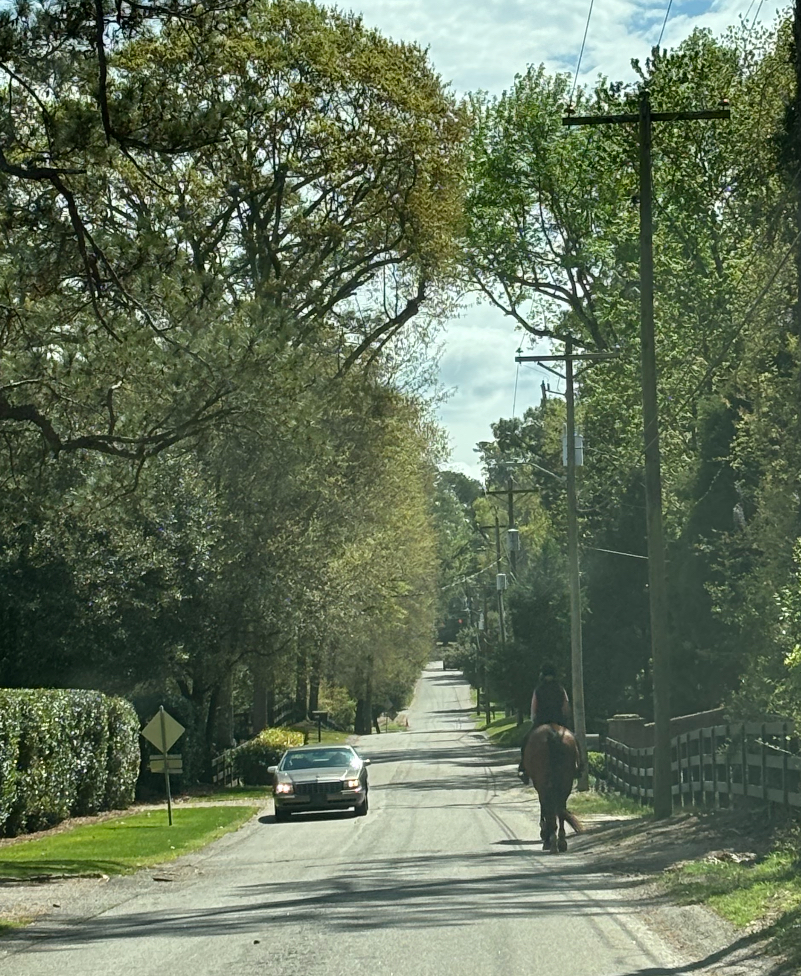
In Hitchcock Woods, on the dirt roads of Aiken’s Horse District or at one of Aiken’s many equestrian sporting events you may cross paths with horses. It’s an Aiken tradition!

Here is some information and examples to help everyone stay safe and happy during these encounters. Three key ideas:

  1. Think like a horse!
  2. Understand and respect the risks.
  3. Protect and enjoy Aiken’s special traditions.

Horses are docile animals that have been domesticated and serving humans for thousands of years. If given their choice, they’d be quietly grazing out in a big grassy field with a horse friend or two or napping under a shady tree.

Horse friends

Not long ago we depended on horses for work and transportation but now they are living in our modern world doing their best to serve humans for pleasure and in sport. We should never forget though; they are large animals with their own instincts and nature.

Many of us are more familiar with the nature of dogs and we understand that dogs can be obedient, or energetic, or aggressive, or passive. As with dogs, a horse’s age, training, and experience, as well as their own personality, makes each unique. Think of the difference between a mounted policeman’s horse and a racehorse.

The policeman’s horse must stay calm and remain steady and obedient even in a riot. A racehorse is expected to be dynamic with high energy. You can probably imagine a young thoroughbred racehorse prancing and cavorting on their way to the starting gate. That behavior wouldn’t be very useful to a policeman. When you encounter a horse out and about in Aiken, you may not be able to easily tell what type of horse it is.

Bad Queen’s Horse

Horses are not afraid of people or of the things they expect or are used to seeing. What they are afraid of is surprises, things they don’t expect that startle them, or things they do not understand and aren’t used to seeing. Each horse can have a different reaction, but given the choice between fight or flight, horses will choose flight. They will try to run away, but if for some reason they cannot escape they will fight.

Think of the rapid acceleration of a racehorse leaving the starting gate or of the power of a horse jumping over a large fence. Think of the agility of a polo pony. Horses can spin around very quickly. They can move in any direction, including sideways, easily covering 15 feet in one step. They can strike out with their front legs, kick out to the side with a back leg or kick out behind with both back legs. They can lunge and bite, or trample other animals or people. The average horse weighs 1000 pounds is seven feet tall at the top of its head and about 8 feet long. They are big, powerful, quick, and agile.

Balloon and horse

Most of us have seen the damage that occurs when a car hits a 150-pound deer. A vehicle and horse collision does not turn out well for anyone involved and the people in the vehicle can be killed as well as
the rider and horse. The best way to stay safe when you encounter any horse is to understand and respect the risks.

Here are three examples:

You are jogging with your dog in Hitchcock Woods, and you see a horse and rider approaching you.

Remember, it is unlikely that the horse is afraid of a person walking, or of a dog, but it might be startled if you suddenly appear where the horse did not expect to see you, especially if you are running. If your dog is not close to you and fully under your control it puts everyone, including itself, at risk. Speak to the horse and rider and stay where the horse can see you.

Walk! Say hello! Stay visible! Make sure your dog (or child) is next to you and fully under your control!

You can keep walking and speaking as the horse approaches you. Keep your eyes on the horse and keep a safe distance from it as you pass each other. Wait until the horse has moved well away from you before you start running again.

You are riding your bicycle (or golf cart) and you see a horse and rider ahead of you.

It is your responsibility to make sure that the horse and rider know you are there. The horse and rider may not hear or see you coming up behind them. If you startle or surprise the horse it could bolt forward or sideways or could kick or strike at you. Electric bikes are especially dangerous around horses because they are faster and make unexpected noise.

As you approach, slow down! Calmly call out to the horse and rider to let them know you are coming! Watch the horse and rider closely to be sure that they know you are there before approaching and passing. Allow as much room as you possibly can between you and the horse. The riders may signal to you. Keep everyone safe by following their directions.

You are driving your truck and towing a trailer and you see a horse being ridden towards you.

Now, if you were just driving your car, you should:

Slow right down! Keep a close eye on the horse and rider! Pass slowly and as wide as possible! The rider may signal to you with hand signals letting you know that it is safe to go past, or they may know that another car is coming or that they are turning off the road, or that it is unsafe, and they may ask you to wait. Keep everyone safe by following their directions.

However, if you are towing a trailer, it may make more noise and surprise or startle the horse. If your vehicle and is loud or surprising, like a bouncing banging trailer, or a motorcycle, you should:

Proceed very cautiously and expect the horse to react! It will be safest for you to stop and let the horse pass by you! Let the horse and rider get well away from you before proceeding slowly on!

We all get in a rush and sometimes you may not want to slow down, or you may see others are close to a horse and everything seems completely safe, but in all cases, everyone will be safest if you think like a horse and understand and respect the risks. Even the most predictable, docile horse can make a mistake.

Stay safe and help to protect Aiken’s special traditions.

Do you have a question on horse safety? Drop Lisa a line. Questions and answers may be published.

← Back

Your question has been sent