Category Archives: Equine

Horse Sense: Safety

Part One in an Ongoing Series
By Lisa Smith


In Hitchcock Woods, on the dirt roads of Aiken’s Horse District or at one of Aiken’s many equestrian sporting events you may cross paths with horses. It’s an Aiken tradition!

Here is some information and examples to help everyone stay safe and happy during these encounters. Three key ideas:

  1. Think like a horse!
  2. Understand and respect the risks.
  3. Protect and enjoy Aiken’s special traditions.

Horses are docile animals that have been domesticated and serving humans for thousands of years. If given their choice, they’d be quietly grazing out in a big grassy field with a horse friend or two or napping under a shady tree.

Horse friends

Not long ago we depended on horses for work and transportation but now they are living in our modern world doing their best to serve humans for pleasure and in sport. We should never forget though; they are large animals with their own instincts and nature.

Many of us are more familiar with the nature of dogs and we understand that dogs can be obedient, or energetic, or aggressive, or passive. As with dogs, a horse’s age, training, and experience, as well as their own personality, makes each unique. Think of the difference between a mounted policeman’s horse and a racehorse.

The policeman’s horse must stay calm and remain steady and obedient even in a riot. A racehorse is expected to be dynamic with high energy. You can probably imagine a young thoroughbred racehorse prancing and cavorting on their way to the starting gate. That behavior wouldn’t be very useful to a policeman. When you encounter a horse out and about in Aiken, you may not be able to easily tell what type of horse it is.

Bad Queen’s Horse

Horses are not afraid of people or of the things they expect or are used to seeing. What they are afraid of is surprises, things they don’t expect that startle them, or things they do not understand and aren’t used to seeing. Each horse can have a different reaction, but given the choice between fight or flight, horses will choose flight. They will try to run away, but if for some reason they cannot escape they will fight.

Think of the rapid acceleration of a racehorse leaving the starting gate or of the power of a horse jumping over a large fence. Think of the agility of a polo pony. Horses can spin around very quickly. They can move in any direction, including sideways, easily covering 15 feet in one step. They can strike out with their front legs, kick out to the side with a back leg or kick out behind with both back legs. They can lunge and bite, or trample other animals or people. The average horse weighs 1000 pounds is seven feet tall at the top of its head and about 8 feet long. They are big, powerful, quick, and agile.

Balloon and horse

Most of us have seen the damage that occurs when a car hits a 150-pound deer. A vehicle and horse collision does not turn out well for anyone involved and the people in the vehicle can be killed as well as
the rider and horse. The best way to stay safe when you encounter any horse is to understand and respect the risks.

Here are three examples:

You are jogging with your dog in Hitchcock Woods, and you see a horse and rider approaching you.

Remember, it is unlikely that the horse is afraid of a person walking, or of a dog, but it might be startled if you suddenly appear where the horse did not expect to see you, especially if you are running. If your dog is not close to you and fully under your control it puts everyone, including itself, at risk. Speak to the horse and rider and stay where the horse can see you.

Walk! Say hello! Stay visible! Make sure your dog (or child) is next to you and fully under your control!

You can keep walking and speaking as the horse approaches you. Keep your eyes on the horse and keep a safe distance from it as you pass each other. Wait until the horse has moved well away from you before you start running again.

You are riding your bicycle (or golf cart) and you see a horse and rider ahead of you.

It is your responsibility to make sure that the horse and rider know you are there. The horse and rider may not hear or see you coming up behind them. If you startle or surprise the horse it could bolt forward or sideways or could kick or strike at you. Electric bikes are especially dangerous around horses because they are faster and make unexpected noise.

As you approach, slow down! Calmly call out to the horse and rider to let them know you are coming! Watch the horse and rider closely to be sure that they know you are there before approaching and passing. Allow as much room as you possibly can between you and the horse. The riders may signal to you. Keep everyone safe by following their directions.

You are driving your truck and towing a trailer and you see a horse being ridden towards you.
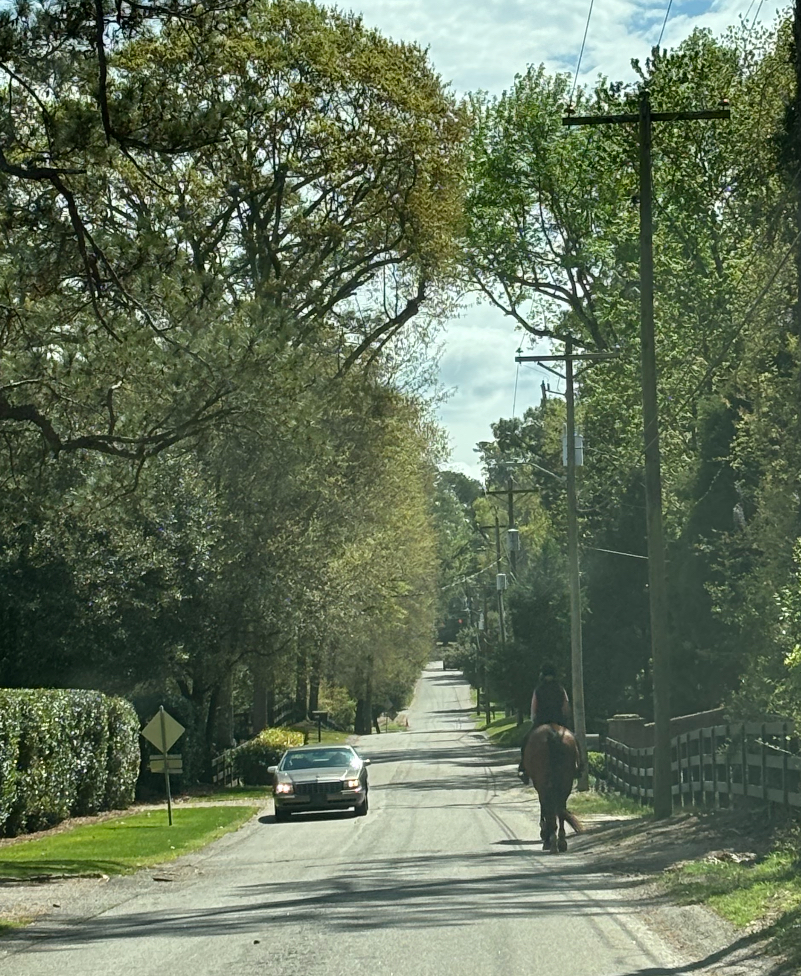
Now, if you were just driving your car, you should:

Slow right down! Keep a close eye on the horse and rider! Pass slowly and as wide as possible! The rider may signal to you with hand signals letting you know that it is safe to go past, or they may know that another car is coming or that they are turning off the road, or that it is unsafe, and they may ask you to wait. Keep everyone safe by following their directions.

However, if you are towing a trailer, it may make more noise and surprise or startle the horse. If your vehicle and is loud or surprising, like a bouncing banging trailer, or a motorcycle, you should:

Proceed very cautiously and expect the horse to react! It will be safest for you to stop and let the horse pass by you! Let the horse and rider get well away from you before proceeding slowly on!

We all get in a rush and sometimes you may not want to slow down, or you may see others are close to a horse and everything seems completely safe, but in all cases, everyone will be safest if you think like a horse and understand and respect the risks. Even the most predictable, docile horse can make a mistake.

Stay safe and help to protect Aiken’s special traditions.

Do you have a question on horse safety? Drop Lisa a line. Questions and answers may be published.

← Back

Your question has been sent

Performance Equine Delivers an Early Christmas Present by Providing Access to Life Saving Colic Surgery in Aiken


Colic. The very word strikes fear into every horse owner. Mild cases can often be managed medically and resolved without ever leaving the farm, but for cases that end up requiring surgery, time is the greatest enemy. Having access to a full-service surgery center nearby is one of the best chances owners can give their horses for a successful outcome. A surgical facility with a full-time equine surgeon capable of performing colic surgery is something that Aiken, despite its high horse population, has been sorely without until recently.

Dr. Sabrina Jacobs, owner and founder of Performance Equine Vets, is responsible for bringing these full-time surgeons to Aiken. Jacobs, who specializes in reproduction, opened Performance in 2004, and it has been expanding ever since. She employs board-certified surgeons, field vets, internal medicine specialists and veterinary assistants. The over 50-acre facility is home to a hospital and surgery center, a reproduction facility with neonatal intensive care and, most recently, a small animal department.

Prior to the recent addition of these full-time surgeons, the options for horses requiring colic surgery in Aiken were few. In the past, Jacobs would fly in a surgeon when available, but colics requiring surgery don’t wait, and the need for a full-time equine surgeon in Aiken was one she worked hard to fill. The only other option was referring and shipping the horses to either Tryon, North Carolina or to the University of Georgia in Athens. The three-hour drive to either facility can spell the difference in the outcome of a colic surgery, so having access to emergency surgery 24/7 in Aiken is a game changer.

The fragile nature of a horse’s digestive system and associated fear of colic shapes most horse owners’ daily choices for feed, hay, turn-out and supplements in constant efforts to prevent it, and “it” comes in many forms including sand, gas, an impaction, a strangulating lipoma and other causes. If the horse does not respond to medical management for colic, then surgery is the only life saving option left.

Two weeks ago my greatest fear was realized, as I arrived for evening chores and found my horse was down, cast on the fence, and thrashing in pain. I phoned a friend to help me extricate him from the fence, and I phoned Performance Equine, who immediately sent a vet on the way. My friend showed up and, on his way, he must have sounded the alarm because, within minutes, a small army of at least ten nearby concerned horse people surrounded us. They stayed to help until the vet arrived, and we waited what seemed like an eternity but was only about 35 minutes. Darkness fell on the pasture, but the collective energy pulling for this horse to survive was palpable, and I will be forever grateful for their support. The sense of community and shared love for our horses confirmed that, despite the battle with Aiken officials to save historic downtown over the last year, I had indeed made the right choice to make Aiken my new home.

The field vet and her assistant arrived, and, initially, my horse responded to treatment, but it didn’t last long. Two hours later he became uncomfortable again so he was transported to Performance for the remainder of the night to be treated there. By early the next morning, he was on the surgery table. Because we shipped him to the clinic when he became uncomfortable, he was already at the facility when the time came to make the decision for surgery. Not having to drive several hours to the nearest University helped give him the best chance of survival.

The continuum of care here is also extremely important, as it was already set up through the field vet that hauling him to the clinic would be the plan, should he become uncomfortable after her visit. There was no time wasted in a referral process. Friends called the clinic when we got him loaded and underway, and internal medicine vet, Dr. Rachelle Thompson, was waiting upon our arrival. She had already been briefed by the field vet, Dr. Hamrick, who initially treated him at the farm. Dr. Thompson oversaw his care throughout the night until the decision was made to take him to surgery when he was not responding to medical management — and while he was still a good candidate for surgery. Surgeon Dr. Stephanie Caston performed the surgery that would save his life. Internal Medicine Specialist Dr. Thompson stayed with him and assisted with the procedure, and then resumed his care upon recovery all the way through to his discharge. The transition from the field visit to hospitalization to surgery, all under one practice, contributed to a successful outcome and cannot be overstated.

A Rare Breed is Becoming Even More Rare

Equine vets, whether they be surgeons, specialists, or field vets have always been a different breed, a special breed. And they need to be. These vets put in long hours, in all weather, and it usually pays quite a bit less than their small animal counterparts can command working a 9-5 job spaying cats. Equine surgeons have always been in limited supply because of the extensive training they require, but today there is actually a documented shortage of all equine vets. A July 2023 article by Justin High, DVM in Quarter Horse News accurately describes the situation saying ” The expectations, standards and history within equine veterinary medicine were built by hard-working, task-oriented perfectionists who laid the ground work where few people these days care to walk.”

In today’s culture filled with millennials who want balance in their life, good old fashioned grit is becoming nearly extinct, and that appears to be one of the main reasons identified for the shortage. The internal medicine vet assigned to my horse (who didn’t even look old enough to be a vet) possessed that grit in spades. She was on call and working every day my horse was hospitalized and throughout the weekend. Dr. Rachelle Thompson is the stuff real equine vets are made of and a rarity of her generation no matter what profession they are in.

Staying IndependentPerformance defies the odds

The clinic is solely owned by Jacobs and in a time when veterinarian-owned facilities are becoming a rarity. Similar to the trend in human medicine, many veterinarian-owned practices are being bought up by much larger corporations. From a horse owner’s prospective, I feel the benefit to patients of having an independently-owned facility is the autonomy of your doctor regarding medical decisions. Corporate-owned facilities can shackle doctors by dictating cost-saving measures handed down by third parties whose job it is to mind the profit margin, and whose decisions might not always constitute the highest standard of care.

Hats off to Dr. Jacobs for bucking the current trend of corporately- owned facilities, for assembling a team of dedicated vets, and for raising the bar in Aiken by providing 24/7 access to life saving emergency surgery. As more horse people continue to find and migrate to Aiken the need for quality care only continues to grow, and Jacobs is answering the call.

Dr. Stephanie Caston (left), Dr. Rachelle Thompson (center), Dr. Sabrina Jacobs (right)

A big thank you to Dr. Sabrina Jacobs, Dr. Rachelle Thompson, Dr. Stephanie Caston, Dr. Brianna Hamrick, and to Technicians Cheyenne, Victoria, Emily and all of the staff at Performance for the best Christmas present ever — my horse’s life.

We were sidelined for this year’s Hoofbeats parade but thanks to Performance we are already looking forward to that stirrup cup in front of the Willcox next year.