Category Archives: March 2024

Looking Back: 35 Years of Headlines

Part 2 of Two
See Part 1: Looking Forward: What Kind of Future Could Project Sunny Buy?

If past is prologue, what can be said of a company that, on the one hand, gives generously of funding and efforts to causes and non-profits in its communities and, on the other hand, takes much from its communities?

Reading headlines from over the past 35 years leaves little doubt that both are true. An internet search for “House of Raeford donates” will produce an exhaustive gallery of images documenting the good deeds performed by this company.

Scratching a little below the surface, other headlines emerge with stories of a company whose record on violating environmental regulations and worker safety has been described as “abysmal.” This is not to single out House of Raeford. Similar histories exist among other major players in the poultry processing and slaughterhouse industry.

In the course of reading these stories, which span decades, certain patterns begin to emerge. Histories repeat. Issues that existed four decades ago persist to this day.

Below are some of the headlines from the past 35 years — stories that tend to pass like ships in the night until they personally affect us. Most of the of articles involve House of Raeford, whose stories are highlighted in gray.

1989

Inside the Slaughterhouse
From the 3-part series: “Ruling the Roost”
By Barbara Goldaftas. Southern Exposure. Summer 1989
Excerpt: “Perhaps the most serious threat at the processing plants, however, is the risk of disabling injury. According to the Bureau of Labor Statistics, poultry workers suffer higher rates of illness and injury — rates that are more than twice the average for all workers in the private sector. Poultry processing is ‘more debilitating than any industry I know,’ says Sarah Fields-Davis, director of the Center for Women’s Economic Alternatives, an advocacy group based in Ahoskie, North Carolina. ‘I have seen women without an arm or fingers, with half a hand.’”

”I feel what women feel”
An interview with Donna Bazemore,poultry worker turned organizer.
From the 3-part series: “Ruling the Roost.”
By Bob Hall. Southern Exposure. Summer 1989.
“….Once you go through the door, everything changes. Your whole attitude. When you come out, you’re like two separate people. It has to do with the stress and pressure they put you under.”

Chicken Empires
From the 3-part series: “Ruling the Roost.”
By Bob Hall. Southern Exposure. Summer 1989.
Excerpt: “With its gushing flow of profits, one wonders why the industry doesn’t have the “courage” — to use Don Tyson’s word — to slow down its processing lines, treat its workers with respect, give their contract growers a measure of security, and still produce a product people are happy to eat? Must Frank Perdue and the 47 other chicken kings treat the world as a competitive jungle forever? ‘Perdue showed everybody how to really market chickens,’ says Tex Walker, an organizer with UFCW during its unsuccessful campaign in Accomac. ‘Now somebody needs to show him how to treat people like human beings.’”

2000

River Park Planners Want Plant Relocated
By Bridget A. Sheldon. The State. December 29, 2000
Chicken processing facility occupies coveted site beside the Congaree River.

2006

Civil Action: Cally R. Forrest, Jrl, and Suzanne Forrest, Plaintiffs, vs. Columbia Farms, Inc., Columbia Farms Distribution, Inc., Columbia Farms of Georgia, Inc., And The House of Raeford Farms, Inc., Defendants.

2007

House of Horrors: Turkey Slaughterhouse Investigation Reveals Sickening Cruelty
Mercy for Animals. May 18, 2007.
Excerpt: A Mercy For Animals undercover investigation takes you behind the closed doors of one of the country’s largest poultry slaughterhouses — House of Raeford Farms, Inc. in Raeford, North Carolina. In January and February of 2007 an MFA investigator worked in the “live-hang” area of the plant (where live birds are snapped into shackles on the slaughter line), secretly filming egregious acts of animal cruelty with a hidden camera. 

Denny’s Suspends Buying Poultry
The State. May 23, 2007.
Denny’s, Inc. has suspended poultry purchases from house of Raeford Farms in North Carolina pending further investigation into allegations of mistreatment of animals before slaughter. The allegations had surfaced and a video shot and a house of Raeford facility by representatives of an animal welfare group, the restaurant operator said in a statement.

2008

Worker Abuse Documented Yet Again in the South’s Poultry Industry
By Sue Sturgis. Facing South. February 13, 2008.
The next time you pick up a House of Raeford product at the grocery store — Black Forest Turkey Ham, perhaps, or maybe some Chicken Tenders — you should stop and think about the human suffering that’s not listed among the ingredients. This week the Charlotte Observer is featuring an investigative series titled “The Cruelest Cuts,” examining the plight of workers at the poultry giant’s Carolina facilities. A team of reporters and editors spent almost two years analyzing documents and interviewing more than 200 poultry workers — most of them Latino, and many in this country illegally. The team found compelling evidence the North Carolina-based company failed to report serious injuries such as broken bones and carpal tunnel syndrome, plant officials often dismissed workers’ requests for medical care, and regulators failed to take action to protect the workers. 

Poultry Firm’s Safety Records Raise Questions About Workers’ Welfare
By Kerry Hall, Ames Alexander, and Franco Ordonez. The Charlotte Observer. February 10, 2008.
Excerpt: “In an industry rife with danger, house of Raeford Farms depicts itself as a safe place to work. Company records suggest relatively few workers are injured each year as they kill, cut and package millions of turkeys and chickens. But a Charlotte Observer investigation shows the N.C. poultry giant with S.C. plants in West Columbia, Greenville and Hemingway has masked the extent of injuries behind its factory walls.”

Poultry Production Has High Human Cost
By Kerry Hall, Ames Alexander, and Franco Ordonez. The Charlotte Observer. February 12, 2008.
Excerpt: “Five current and former House of Raeford supervisors and human resources administrators, including two who were involved in hiring, said some of the companies managers know they employ undocumented workers. ‘If immigration came and looked at our files, they take half the plant,’ said Caitlin Davis, a former Greenville plant human-resources employee. “

Painful realities
By Kerry Hall, Ames Alexander, and Franco Ordonez. The Charlotte Observer. February 13, 2008.
Excerpt: “When injured workers require treatment beyond first aid, employers also must record those injuries on federal logs; too many such injuries can draw scrutiny from workplace safety inspectors. In this environment, medical gatekeepers often face a choice: provide workers with the care they need or save the company money.”

Injured Sent Back to Work
By Kerry Hall, Ames Alexander, and Franco Ordonez. The Charlotte Observer. February 14, 2008.
Excerpt: “House of Raeford boasts that its Greenville plant has gone more than 7 million hours without a “lost time accident,”meaning no worker has been injured badly enough to miss an entire shift. But according to the company’s own safety logs, Vicente was among at least eight workers at the plant who suffered amputated fingers or broken bones— all during the time the plant claimed to have millions of safe working hours dating back to 2002. Managers have kept the streak alive by requiring injured workers to return to the plant — in some cases hours after medical procedures.“

Congress Takes on the Poultry Industry: Hearings called after newspaper put spotlight on worker safety.
By Kerry Hall, Ames Alexander, Franco Ordonez and Peter St. Onge. The Charlotte Observer. February 17, 2008.
Excerpt: “In a six-part series that began last Sunday, the Observer reported that House of Raeford, which has seven processing plants in the Carolinas, had masked the extent of injuries behind its plant walls. Employees say the company, which has plants in West Columbia, Greenville and Hemmingway, has ignored, intimidated, or fired workers who were hurt on the job.”

5 Supervisors Arrested
The State/McClatchy Newspapers. June 19, 2008.
Excerpt: Federal agents on Wednesday arrested a fifth supervisor at a house of Raeford Farms poultry plant in Greenville as part of an ongoing investigation into alleged immigration violations. On Tuesday, immigration officials arrested four other supervisors after finding what appeared to be false information on employment records kept at the company’s Greenville chicken processing plant, according to Kevin McDonald, first assistant US attorney for South Carolina. 

Poultry plant manager arrested.
The State. July 11, 2008
Excerpt: “A manager at a Greenville poultry factory under federal investigation was arrested Wednesday and charged with telling employees to use falsified immigration documents, according to court filings.”

Five More Workers Face Charges
Franco Ordonez, Kerry Hall, The Charlotte Observer. August 16, 2008. Excerpt: “In a February series on workplace safety in the poultry industry, the Charlotte Observer reported that some house of Raeford managers knowingly employed undocumented workers, according to five current and former supervisors and human resource administrators. Former supervisors have said the plant prefers undocumented workers because they are less likely to question work conditions for fear of losing their jobs or being deported.” 

Three more poultry workers arraigned
The State. Compiled from reports by The Greenville News, and The Charlotte Observer. August 30, 2008
Excerpt: “Three more house of Raeford Farms workers were arranged this week on charges of using fake IDs to work for the company’sGreenville plant, which continues to be at the center of an illegal immigration investigation. The men pleaded not guilty, and detention orders were placed on them because they were in the country illegally. “

Will next raid be at Columbia Farms?
Franco Ordonez. The Charlotte Observer. September 6, 2008
Excerpt: “This summer’s arrests of 11 House of Raeford workers in Greenville shocked its S.C. work force. Dozens of workers have since left their jobs. The company is hiring fewer, if any, Latinos and has turned to state prisons to fill its production lines in West Columbia and Greenville.”

Feds Hold 300, Probe Hiring
Ames Alexander, Franco Ordonez, Franco. The Charlotte Observer. October 8, 2008
Excerpt: “Federal authorities conducted an immigration raid at Greenville’s Columbia Farms plant Tuesday, detaining more than 300 workers and searching for evidence of illegal hiring practices. As shifts at the chicken processing plant were changing at about 9 a.m., about 100 agents with U.S. Immigration and Customs Enforcement and the Department of Homeland Security raided the facility. When agents arrived, workers began running down hallways crying and screaming, said Herbert Rooker, a janitor who wore a blue band on his wrist, indicating agents had determined he was in the country legally. Rocker said he had to duck into a bathroum to avond a stampede of people.

Gallery: Immigration Raid at Poultry Plant.
Agents of the Immigration and Customs Enforcement division of the Department of Homeland Security executed a search warrant at the House of Raeford’s Columbia Farms chicken processing plant in Greenville, S.C., Tuesday, Oct. 7, 2008. Federal agents detained more than 300 suspected illegal immigrants in the raid at the plant that has been under investigation for months.(AP Photo/Greenville News, George Gardner)

Poultry Workers Torn Apart by Arrests
The State/Associated Press. October 9, 2008
Excerpt: “A day after the raid, families waited to bear from loved ones at detention centers. Meanwhile, businesses and streets were vacant because those not rounded up stayed home, afraid agents would return.”

Greenville Area Residents Aid Families of Suspected Illegals.
Post and Courier/Associated Press. October 12, 2008.
Excerpt: “The Greenville News reported Sunday that the Alliance for Collaboration with the Hispanic Community and local residents have met to identify lawyers, counselors, educators and interpreters to help the families. They also are trying to raise money and find people to care for the children of the jailed workers.”

Illegal workers set for deportation.
Post and Courier. November 19, 2008. 
Excerpt: “Ten former workers at a Greenville poultry plant who were in the U.S. illegally have pleaded guilty in federal court. Prosecutors said three of the men pleaded guilty Wednesday to false use of a Social Security number to get jobs at the House of Raeford’s Columbia Farms plant.”

Poultry plant fined
The State. November 21, 2008
“North Carolina regulators have cited a chicken processing company for 49 serious safety code violations, many involving hazardous chemicals. The Charlotte Observer reported the $178,000 fine levied against House of Raeford Farms is significant for the state’s Occupational Safety and Health Administration.”

2009

South Carolina poultry plant manager faces immigration charge
Post and Courier/Associated Press. April 15, 2009.
Excerpt: “Prosecutors say Barry Cronic began hiring illegal immigrants at Columbia Farms in Greenville in 2000, and kept hiring them until a raid last October. The raid found more than 300 people working at the plant who were in the county illegally.”

Poultry Plant Official Pleads Not Guilty
The State. May 15, 2009.
Excerpt: “The personnel manager of a Greenville poultry plant has not guilty to knowingly harboring illegal aliens.”

Feds Indict Columbia Farms
The State/Associated Press. July 17, 2009.
Excerpt: “The company that runs a South Carolina poultry plant knew it man managers were hiring illegal immigrants at a facility rated in October, federal prosecutor said, and an indictment release Thursday.”

Poultry Plant Manager Enters Plea
The State/Associated Press. July 31, 2009.
“Columbia Farms Greenville plant chief pleads, not guilty in immigration case. “

10 Workers Sue Columbia Farms Plant.
The Greenville News. August 1, 2009.
Excerpt: “Ten former employees have sued the Columbia Farms chicken processing plant in Greenville, alleging the company refused to pay overtime that they worked and, in one case, fired a worker after accusing her of faking a workplace injury.”

OSHA Seeks to Get Better Handle on Injuries
By Kerry Hall Singe and Ames Alexander. The Charlotte Observer. October 5, 2009.
Excerpt: “An Observer investigation found that North Carolina-based House of Raeford Farms failed to record some workplace injuries.
The poultry company’s 800-worker plant in West Columbia reported no musculoskeletal disorders over four years. Experts say that’s in-conceivable. MSDs, including carpal tunnel syndrome, are the most common work-related injuries afflicting poultry workers. The company’s Greenville plant has boasted of a five-year safety streak with no lost-time injuries. But the plant kept that streak alive by bringing injured employees back to the factory hours after surgery. House of Raeford says it follows the law and strives to protect workers.”

Poultry Giant to Pay Fine.
By James Alexander and Franco Ordonez. The Charlotte Observer. November 4, 2009.
Excerpt: Columbia Farms will pay a $1.5 million fine and will be required to change its hiring practices under an agreement that will allow it to avoid a criminal conviction on federal immigration charges. The deal will also allow two indicted managers at the poultry company’s Greenville plant to avoid criminal prosecution, provided they enter a supervised program for a year. The agreement, finalized just hours before the start of the scheduled criminal trial in federal court in Greenville on Tuesday, will give N.C.-based parent company House of Raeford an opportunity to keep its record clean and hold on to valuable government contracts.

2012

North Carolina Poultry Processing Plant Convicted for Knowing Violations of Clean Water Act.
US-DOJ Office of Public Affairs Press Release. August 20, 2012. 
Excerpt:“Publicly owned wastewater treatment plants must be protected from companies that cut corners by discharging wastewater illegally,” said Maureen O’Mara, Special Agent in Charge of of EPA Region 4, which covers the southeast United States including North Carolina.  “The defendants in this case deliberately discharged turkey parts, blood and grease into the wastewater plant for over 16 months, bypassing treatment.  Today’s conviction sends the message that the American public will not tolerate companies putting profit ahead of compliance.”
See also: EPA Summary of Criminal Prosecutions

Poultry processor, House of Raeford, to pay fine for child labor violations at Teachey, North Carolina plant following US Department of Labor investigation.
Department of Labor press release. October 16, 2012.
Excerpt: “The U.S. Department of Labor has assessed a total of $12,400 in civil money penalties against poultry processor House of Raeford Farms Inc. following an investigation by the department’s Wage and Hour Division that found minors performing hazardous duties prohibited by the Fair Labor Standards Act’s child labor provisions. “Employers who hire young workers must comply with all federal and state regulations intended to keep our youth safe on the job,” said Richard Blaylock, director of the division’s Raleigh District Office. “This situation is particularly disappointing because the company previously was cited for the same type of violation. It is critical for employers to learn about and comply with the child labor provisions of America’s labor laws.”

Big U.S. poultry processor hit with fines over youth labor
By Ames Alexander and Franco Ordonez. The Charlotte Observer/McClathey News.October 17, 2012
Excerpt: “This is not the first time House of Raeford, one of the largest poultry producers in the country. has been caught employing underage workers. During a 2008 immigration raid of the company’s Greenville plant, federal officials found six juveniles, including a 15-year-old, working on the chicken line. One of those underage workers, Lucero Gayton, said in 2008 that she started working the night shift four months after turning 15. While most of her former classmates were playing sports and attending dances, Lucero said she was working 10-hour shifts, wielding a sharp knife, cutting muscles from thousands of freshly-killed chickens.”

2014

Man trapped, injured Tuesday night at chicken processing plant. .
By Anne-Kathryn Flanagan. The State. June 4, 2014.
A man was taken to the hospital after being trapped in a piece of machinery at the chicken processing plant for almost two hours, according to West Columbia Fire Chief Wyatt Coleman.
Injured House of Raeford Worker Recovering After Surgery
WATTPoultry. June 14, 2014
An employee at the House ofRaeford Farms chicken processing plant in West Columbia, South Carolina, wasinjured June 3 in a work-related accident. The 43-year old man was operatingfactory machinery and suffered severe injuries to his right leg, the company stated.

2017

ProPublica: Sold for Parts
The New Yorker: Exploitation and Abuse at the Chicken Plant
By Michael Grabell. Story co-published by ProPublica and The New Yorker. May 1, 2017.
Excerpt: Case Farms built its business by recruiting immigrant workers from Guatemala, who endure conditions few Americans would put up with.
[Note: While House of Raeford is mentioned on a graph in this story, this article is about a different chicken plant, Case Farms].

Pressure mounts on chicken factory to clean up or move
By Al Dozier. Post and Courier. July 16, 2017
Excerpt: The city of West Columbia is losing patience with House of Raeford Farms, a long-standing chicken processing plant on Sunset Boulevard.

Chicken Plant Doesn’t Fit with Riverfront Renaissance.
By Tim Flach. The State. August 27, 2017.
West Columbia’s riverfront has undergone a renaissance, with joggers and cyclists almost daily enjoying the riverwalk and two upscale neighborhoods opening in the last decade. But city leaders and nearby residents worry that continued development will be stymied by an increasingly unpopular neighbor – a 60-year-old chicken processing plant that produces 281 million pounds of meat a year. Residents complain mainly about frequent bad odors and chicken feathers.

Stench near W. Columbia’s popular Riverwalk may improve as city targets plant
By Tim Flach. The State. October 18, 2017. 
The City Council late Monday gave initial approval to a set of restrictions on “offensive” odors that disturb residents, with final adoption expected by mid-November. Complaints about stench from the 60-year-old plant on Sunset Boulevard are increasing as new neighborhoods and businesses develop nearby.Councilman Tem Miles called the proposal a message to the House of Raeford to end problems at the plant. “This is telling them to clean up their act, that the smells are no longer acceptable,” he said.

Why West Columbia chicken plant is getting a reprieve on tougher stench rules
By Tim Flach. The State. November 10, 2017.
West Columbia officials are giving a chicken processing plant more time to stop odors before they crack down on the stench. “We’re pushing it off for a while to see if they can come up with a solution for the problem,” Mayor Bobby Horton said of proposed limits on odors. City Council members gave initial approval Oct. 16 to a set of restrictions on “offensive” odors that disturb residents. They were set to give final approval next Tuesday but that is on hold for a few months, Horton said.

Who Would Pay $27,000 to Work in a Chicken Plant?
By Michael Grabbel. ProPublica. December 28, 2017
Chicken plants have recruited thousands of foreign workers in recent years through a little-known program to fill jobs they say Americans won’t do.

Wilde said immigration agents are questioning why white-collar Koreans would want to pay tens of thousands of dollars to cut chicken. “They are sacrificing themselves for the futures of their children,” she said. “That is no different than any other immigrants in American history.”

Based in Rose Hill, North Carolina — home of the world’s largest frying pan — House of Raeford ranks among Apple, Google, Microsoft and Amazon as one of the biggest sponsors of green cards. The chicken processor, which employs 4,300 people at seven plants, has applied for 1,900 foreign workers in the last three years, according to Labor Department data. The company also ranks among the most dangerous poultry processors in the country, according to a ProPublica analysis of safety violations, with many workers suffering crippling hand injuries.

2018

With chicken plant odor unders scrutiny, city lodges new way for public to complain.
WIS – TV. May 11, 2018.

Top broiler companies targeted in new lawsuit
WATTPoultry. July 2, 2018.
The largest broiler companies in the United States have again been targeted in a class-action lawsuit, alleging that the companies conspired to manipulate chicken prices.


Kenneth N. Young, Plaintiff, v. Columbia Farms, Inc., a division of House of Raeford Farms, Inc., Defendant.
CaseText: C/A No. 6:17-cv-01340-DCC  09-05-2018 
https://casetext.com/case/young-v-columbia-farms-inc
Plaintiff, an African-American, was employed from February 13, 2013 to October 6, 2016. Id. at 3. Plaintiff alleges that his supervisors regularly greeted him in the mornings with phrases that included, “How ya doing, my Niggas?” Plaintiff filed a complaint with the plant manager, and, while the supervisor stopped using the phrase, tension remained. On or about September 30, 2016, Plaintiff was threatened by another employee wielding a knife, and Plaintiff defended himself to avoid being stabbed. Defendant suspended Plaintiff for three days and then immediately terminated his employment upon his return. He was 61 years old at the time of his termination.

Environmental Integrity Project: Water Pollution from Slaughterhouses
October 19, 2018
Three Quarters of U.S. Meat Processing Plants that Discharge into Waterways Violated their Permits, 2016-2018


2019

Worker Dies in Accident at House of Raeford Plant
October 30, 2019.
WATTPoultry. A contracted worker who was cleaning equipment at the House of Raeford poultry plant in Teachey, North Carolina, was involved in a fatal accident at the plant on October 25.

2020


Meat plant workers say they were fired after protesting risks.
By David Travis Bland. The State. May 7, 2020
About a dozen workers at a chicken processing plant in West Columbia were fired Wednesday after protesting for better pay and working conditions amid the coronavirus, according to some of those who said they were fired. Workers at the House of Raeford chicken plant refused to work under what they consider hazardous conditions without pay to compensate for the increased dangers of the coronavirus, the protesters told The State as they congregated on the sidewalk across Sunset Boulevard from the plant.


Union Investigating Workers’ Complaints at West Columba Chicken Plant
By David Travis Bland. The State. May 9, 2020
The United Food and Commercial Workers Union is investigating complaints and a protest by workers at a chicken processing plant in West Columbia, according to a spokesperson for the union. On Thursday, a protest by a dozen or more workers asking for better pay and working conditions broke out on the sidewalk across from the House of Raeford chicken processing plant, sometimes called Columbia Farms, on Sunset Boulevard. The UFCW’s meat packing division is investigating the origins of that protest and whether the House of Raeford violated the union’s contract or federal labor law, spokesperson Valerie Barnhart said.

Union Files Grievance Against West Columbia Chicken Plant After Workers Fired
By David Travis Bland. The State. May 21, 2020.
The union for workers at a West Columbia chicken processing plant hit the company with an official allegation that the company broke its contract when about a dozen workers were fired after asking for better pay and better working conditions. The United Food and Commercial Workers Local 1996 filed the grievance against House of Raeford, which operates the West Columbia poultry plant sometimes called Columbia farms, after a May 6 protest by about a dozen workers. The workers wanted increased pay and better safety measures amid the increased risk of working during the coronavirus outbreak

Lawyers: Firing protesting workers at West Columbia chicken plant likely illegal
By David Travis Bland. The State. May 27, 2020.
Excerpt: “Supervisors at a West Columbia poultry processing facility may have violated federal law when they fired about a dozen employees who raised concerns about the facility’s safety and sought better pay amid the coronavirus outbreak, according to labor lawyers. On May 6, Naesha “Shay” Shelton and June Miller gathered with about a dozen other workers at the House of Raeford chicken processing plant in West Columbia to ask supervisors about getting hazard pay and better working conditions. More than ever, the job that involves cutting raw chicken by hand while standing next to co-workers seemed more dangerous because of the virus, workers said. Hearing news reports about the coronavirus swarming meatpacking workers across the country, Shelton, Miller and their coworkers felt their request for hazard pay and improved safety conditions were reasonable.”

Workers at SC Meat Plants Infected with COVID 19. Many Cases are in the Midlands
By Sammy Fretwell. The State. July 3, 2020.
Excerpt: “According to the agency’s statistics, about 58 percent of the 125 positive cases have occurred at Amick Farms and House of Raeford plants, mostly in the Columbia and Greenville areas. A total of 72 workers at Amick and Raeford facilities have been diagnosed with COVID 19, DHEC says.”

Investigation shows property, massive pile of dead birds in Sampson County site belong to House of Raeford.
WRAL News, Rose Hill, NC. February 9, 2022.
Heather Overton, a spokeswoman for the state Department of Agriculture and Consumer Services, said the dead birds and the site where the birds were temporarily dumped belonged to House of Raeford, a chicken processing company known for its bulk sales.

2022

2023

House of Raeford in NC taking part in USDA’s Modified Line Speed Waiver Program Participation to determine the impact of increased line speeds on worker safety. March 2023.

Latest settlement in poultry price fixing suit brings recovery to $284 million.
By Rachael Oatman. Meat+ Poultry. October 10, 2023.
A class of direct purchasers agreed to a $75 million settlement with two poultry processors involved in a consolidated antitrust lawsuit for allegedly conspiring to fix prices of US broiler chicken.House of Raeford Farms Inc. agreed to pay $27.5 million, and Koch Foods Inc. agreed to pay $47.5 million. With the settlement, the total recovery to date is over $284 million.

2024

House of Raeford reaches settlement and Price fixing case.
By Rachael Oatman. Meat + Poultry. January 5, 2024.
House of Raeford Farms agreed to pay $460,000 in a settlement of a chicken price-fixing lawsuit with Washington Attorney General Bob Ferguson. The attorney began his lawsuit against the house of Raeford and 18 other chicken producers in 2021. He alleged that the companies, which account for 95% of the broiler market, conspired to manipulate prices by restraining production and exchanging competitively sensitive information. 

Complaint: Milton Byrd, Plaintiff, Vs. House of Raeford Farms,, Inc. Defendant.

Violation Tracker, a database on corporate misconduct. House of Raeford entries from 2000 to the present.

_____________________

A Forward Look: What Kind of Future Could “Project Sunny” Buy?

Part One of Two

Project Sunny was not on last night’s City Council agenda, however, a number of speakers came to the podium during the non-agenda portion of the meeting to give statements on the project. As the Aiken community learned only two weeks ago, Project Sunny is the code name for House of Raeford — the chicken slaughterhouse and processing center that is looking to locate at the Exit 22 gateway to the City on US Highway 1 North.

The speakers in last night’s meeting raised a number of important concerns:

  • concerns about the capacity of the aquifer to support this industry;
  • concerns over the ability of infrastructure to handle both the water supply and the waste generated;
  • concerns over the City’s decision to site a chicken processing plant, rather than sorely needed retail, grocery stores and basic services, for existing residents on the northside;
  • concerns over the City giving priority to the profit of a private enterprise over the needs of existing residents;
  • concerns over the people who would be employed at this facility;
  • concerns over the wisdom of placing a chicken processing plant at the main gateway to Aiken — an idea one speaker described as “out of touch” with the vision that City Council has been projecting for Aiken’s future.

Local resident Winona Specht, a retired SRS scientist with a background in environmental toxicology, pointed out that House of Raeford has an “abysmal record when it comes to violating environmental regulations and violating worker safety issues” and has been fined over $1.5 million for violations going back many years. She recounted several specifics from the past 4 years, alone, including two serious environmental violations and two serious workplace safety violations, along with price-fixing and anti-competitive practices. 

A recurring theme among last night’s speakers was the lack of information provided by the City to citizens on a project that local leadership has been working on for months, if not longer. This same message has been echoing for the past two weeks in local social media threads. What do we know about Project Sunny, House of Raeford, and the chicken processing and slaughterhouse industry that our leaders have been working to bring to Aiken?

Some Basics

Chicken processing plants and slaughterhouses are, by nature, water-intensive, waste-producing, pollution-generating industries. They are also among the most dangerous workplaces in America. For this reason, the industry tends to site these facilities in areas where labor is exploitable, regulations weak, and water cheap. They find fertile ground in the South. 

The realities of water depletion go largely unimagined in the southeastern US. We’ve yet to see the repercussions of unfettered water consumption that are being realized in the midwestern and the western US, where water depletion is starkly viewed in the disappearing rivers, lakes, ponds and well-water. A recent New York Times story, “America is Using Up its Groundwater Like There’s No Tomorrow,” reported that, in some areas:

“So much water is being pumped up that it is causing roads to buckle, foundations to crack and fissures to open in the earth. And around the country, rivers that relied on groundwater have become streams or trickles or memories.”

Working from numbers provided by Aiken City Manager Stuart Bedenbaugh, Project Sunny will use about 34 million gallons of water per month, equal to about 15% of our surface water capacity. As if to reward such consumption, the City is incentivizing this company by offering to sell the water at a 50% discount. Similar discounts are being offered for wastewater discharge in a system already under stress to keep up with demand. As was recently pointed out in the Aiken Chronicles, Another Fifty-Percent Off Sale

“In both cases, the more water used, and the more industrial wastewater produced, the lower the prices. No other City water and sewer customer even comes close to using this much water, or discharging that much wastewater. The Project Sunny facility, or any other major water user, could consume as much water in one year as the capacity of the City’s spring-fed Mason Branch reservoir. It also has the potential to put a further strain on the County’s Horse Creek Wastewater Plant, which the County is working to upgrade to meet a projected future capacity that seems to keep increasing.”

The question is — given a choice — why would leadership in a city and in a state that is still fortunate enough to have adequate drinking water supplies give the keys to our water to such a water-intensive industry, and at BOGO prices? What are they thinking? 

Jobs, we’ve been told — 900 of them, with a starting pay of $18 per hour; just what the northside needs, we’ve been told.

There is also the matter of dollars brought to Aiken — a $183 million investment by House of Raeford and the $65k per month water bills to be paid by Project Sunny. The seduction from all these dollars requires we engage denial on the cost. The seduction depends on our ability to ignore the lessons being learned all over the US and the rest of the world: when the water’s gone, there is no amount of money going to refill those creeks, streams, rivers, lakes, wells and aquifers.

About Those Jobs

According to the City Manager Stuart Bedenbaugh, the starting pay is $18 per hour. Elsewhere, we’ve been told that $18 is the average pay, which could mean the starting pay may be only two-thirds of that amount. We don’t know. Accurate information is lacking.

Regarding the type of work in these facilities, according to OSHA and the Bureau of Labor Statistics, these are some of the most dangerous jobs in the country. According to the Executive Summary in an OSHA file dated October 1, 2023, a publication whose stated purpose was to “to reduce injuries, illnesses and fatalities related to workers’ exposures in poultry processing facilities”:

Click above text to enlarge.

The Overview on Poultry Processing at the OSHA website further elaborates:

“There are many serious safety and health hazards in the poultry processing industry. These hazards include exposure to high noise levels, dangerous equipment, slippery floors, musculoskeletal disorders, and hazardous chemicals (including ammonia that is used as a refrigerant). Musculoskeletal disorders are of particular concern and continue to be common among workers in the poultry processing industry. Employees can also be exposed to biological hazards associated with handling live birds or exposures to poultry feces and dusts which can increase their risk for many diseases.”

The work for the clean-up crew is no less hazardous, according to the earlier-mentioned October 2023 OSHA publication:

Click above text to enlarge.

According to this same OSHA publication, the Bureau of Labor Statistics (BLS) reports that “the extent of the problem may be far greater than the elevated risk reported by employers and seen in the BLS data due to under-reporting.”

This reality is borne out through the accounts of workers over the past 50 years of poultry processing history and at least 35 years of House of Raeford history. While the rates of worker injuries and illness have fallen somewhat over the years, it is difficult to ascertain how much of this is due to improved processes; how much is due to the ripple effects from the defunding of OSHA and other oversight and regulatory agencies; how much is due to under-reporting by industry; and how much is due to under-reporting by employees, themselves, who understand that the fastest way to getting fired is to get sick or injured. As the headlines and the stories tell, poultry industry workers know better than to take time off for gastrointestinal infections, lost fingernails, amputations and broken bones.

This history and the records of this industry will be explored in some depth in Part Two of this story, as told in 35 years of House of Raeford headlines.

____________________

NEXT: Looking Back at 35 Years of Headlines.

Another Fifty Percent Off Sale (For the Chicken Processing Plant)


An Update on Project Sunny and The Water Guzzler Ordinance.

by Don Moniak
March 11, 2024
(Updated March 12, 2024. As suggested in this story yesterday, Project Sunny is indeed a chicken processing plant. As reported by WFXG-Fox News reporter Abby Bradshaw, House of Raeford plans to locate a new plant in Aiken at Verenes Industrial Park. The project still has two public hearings remaining, one Aiken City Council in two weeks and one with Aiken County Council sometime in April.)

Summary

A City of Aiken attempt to amend its water and sewer rate ordinance to provide radical discounts for an unidentified company in an unidentified industry ran into flak from City residents in early February 2024. As a result, Aiken City Council took the ordinance off its meeting agenda, ostensibly due to citizen questions and concerns.

Throughout this time City Council, with the blessing of the City Attorney, refused to divulge any information about plant location, job creation, company investments, or environmental impacts.

One month later, the City has pivoted by abandoning the water and sewer rate amendment and opting for a new, reformulated ordinance that has more palatable language, but very similar results—discounts of 50 percent instead of 67 percent that disincentivize water conservation.

The latest effort coincides with Aiken County Council’s process, now two-thirds complete, for passing an ordinance providing a Fee in Lieu of Taxes (FILOT) arrangement for what is now known to be the same unidentified company in an unidentified industry.

Between the two processes, some information regarding economic benefits has emerged that City Council has asserted, just six weeks ago, must remain confidential: investment, location, and job creation. Information about any negative impacts remains confidential.

The new details about jobs, combined with high water use and sewage production and the presence of an extensive local network of poultry producers in the northeast portion of the county and neighboring Lexington County, suggests the possibility of another potential customer—a labor intensive chicken processing plant that requires high volumes of water and wastewater discharge capacity.

(The new ordinance will face its First Reading of the Public Hearing (1) for the replacement ordinance will take place tonight’s City Council meeting, which begins at 7 p.m. at City Municipal Building, 111 Chesterfield Street. A closed-door, Executive Session regarding Project Sunny is also planned prior to the Regular Meeting.)


Details

The City’s Water and Sewer Rate Incentives

As reported in The Water Guzzler Ordinance, on January 22, 2024, Aiken City Council moved one step forward towards amending its water and sewer rate ordinance in order to provide major discounts to any commercial customer outside of the city limits. At the time, Council claimed it was restricted from providing any details on the “potential customer” for whom the amendment was clearly being tailored.

The amended water rate ordinance proposed discount rates for customers that consumed at least 15 million gallons per month from the City of Aiken’s Northside water supply, and a deeper discount—up to 67 percent—if a customer used more than 30 million gallons per month. The same thresholds and similar rate discounts held true for wastewater discharge. In both cases, the more water used, and the more industrial wastewater produced, the lower the prices.

No other City water and sewer customer even comes close to using this much water, or discharging that much wastewater. The Project Sunny facility, or any other major water user, could consume as much water in one year as the capacity of the City’s spring-fed Mason Branch reservoir. It also has the potential to put a further strain on the County’s Horse Creek Wastewater Plant, which the County is working to upgrade to meet a projected future capacity that seems to keep increasing.

At its January 22nd meeting, only one potential user, referred to only as “the customer,” was identified. Although “the customer” appeared to have a strong link to a Western South Carolina Economic Development Partnership economic development effort for the City’s Verenes Industrial park, described only as “Project Sunny,” Aiken City Council refused to acknowledge the connection—a stonewalling that was encouraged by the City Attorney.

The rate amendment effort stalled after considerable concerns, questions, and outright opposition arose regarding both fairness to other customers and the impact on the water system and supply from a any water guzzling business.

After receiving numerous questions and complaints, City Council took the amended water and sewer rate ordinance off of its February 12, 2024 meeting agenda. Councilman and Mayor Pro Tem Ed Girardeau stated the reason was due to citizen concerns and questions, and a resulting need to consult with experts. He stated that:

It has been recommended that we amend the agenda to continue item number six under old business to a future meeting.  I know there’s a lot of interest here tonight, it’s the change in the water rate for a bigger industry. This week we’ve received a lot of questions, and they are good questions quite frankly. Some of them think you think you know the answer to, and some of them you don’t know the answer to. We’ve decided to bring in some experts and get some help to give us a little bit of background as we go forward.”

In spite of the deferral of the second public hearing, three citizens (1) still spoke up to raise concerns and objections to the ordinance. The issues were similar to those described in Water Welfare on Tap in City Council: water is a renewable, but finite resource; Aiken’s water supply is threatened by the proposed ordinance; the ordinance disincentives conservation; the discounts are unfair to existing residential and commercial users; the incentives will result in lost revenues that could be used for infrastructure maintenance; Aiken should not trade its water resources for unknown economic benefits.

Figure 1: Supporting memorandum for new water and sewer rate discounts for “Project Sunny.”


Meet the New Discounts, Almost the Same as old Discounts.

If City Council sought anything more than expert legal and policy advice, it is certainly not evident in its latest Project Sunny incentives drive.

Instead of continuing with the troubled amended water and sewer rate ordinance, the City of Aiken has pivoted to a new strategy—abandoning its rate ordinance amendment, and substituting it with an ordinance for a specific agreement with the single unidentified company in an unidentified industry.

In doing so, the City revealed information that just six weeks ago it claimed was confidential. The supporting memorandum (Figure 1) for the lightly modified approach indirectly describes the location (Verenes Industrial Park) by naming the company as “Project Sunny.” The memo also identifies an economic benefit of 900 jobs at a starting wage of $18 per hour and benefits; but not the economic investment itself; estimated by Aiken County to be $185 million.

The difference between the two approaches is minimal—a 50 percent discount for any water consumption above 15 million gallons per month. The previous offer ranged from 60 to 67 percent. (Table 1) In both scenarios, the more water use, the lower the price; disincentivizing water conservation.

Alongside the water rate discounts, the City is also offering discounts on wastewater discharges into the City’s sewer system—that eventually are treated by the Horse Creek Plant—that range from 30 to 45 percent. The discount proposed in the abandoned water and sewer rate ordinance was 58 percent. As with water use, more wastewater production means lower costs for the company; disincentivizing any wastewater reduction efforts.

Water Service 1/22/24
Proposed Rate per 750 gallons
3/11/24 Proposed Rate per 750 gallons Out-of-Town Commercial Rate
15-30 Million Gallons/Month$1.31$1.64$3.27
> 30 Million Gallons/Month$1.07$1.64$3.27
Monthly Bill 30M Gallons$43,610$65,616$130,810
% Discount 30M Gallons 67 percent50 percent N/A.
Table 1: Proposed Water Consumption rates for unidentified Project Sunny, The differences in rate discounts h are not identified are not identified in the City Manager’s supporting memorandum for the latest ordinance.


The Sponsor;” Aiken County’s Parallel Project Sunny Process

The City is also proceeding in tandem with Aiken County Council, which has already tentatively approved a Fee in Lieu of Taxes (FILOT) agreement with the Project Sunny company, only referred to in the County ordinance as “the sponsor.” The process is two-thirds complete, as Council approved the FILOT agreement during its Second Reading of the Ordinance in early February. All that is left is a Public Hearing, probably to be held in April once the City finishes its incentives business.

In the process, another detail emerged that City Council originally refused to disclose; that the Project Sunny “sponsor” company intends to invest up to $185 million over a thirteen-year period. Yet, the County inexplicably did not divulge the job creation numbers, opting only to state that the FILOT incentive agreement required that 125 jobs be created in the first four years of operation.

Both the City and the County predictably refuse to divulge the name of the company for fear of jeopardizing the deal and/or breaking any existing nondisclosure agreements. However, both entities also refuse to identify even the the industry that is involved, or any other pertinent information regarding potential adverse impacts.

The situation is both similar and dissimilar to Project Sabal. As reported in Is Google Coming to Aiken County, Aiken County Council passed a FILOT ordinance for an unidentified company hiding behind a another shadowy, shell holding company; another business with a tremendous appetite for water and a propensity for enormous wastewater production.

Although the County’s Project Sabal ordinance identified investment benefits while withholding environmental costs; it did at least name the industry: water intensive, hi-tech data storage centers.

The similar, but slightly different, Project Sunny approval process was subjected to objections and questioning by two county residents during the open public comment period at County Council’s March 5th public meeting; who reside less than six miles north of the proposed Project Sunny,

During a three-minute speech to Council, Vicki Simons cited the intent of South Carolina’s Freedom of Information Act to promote openness in government; the State Constitution’s provision that “all political power is vested and derived from the people only,” and the fact that “Aiken County Voters are at the top of Aiken County’s 2024 Organizational Chart, meaning that we are your bosses”

She then described a plant in Saluda County , one that the Western Carolina Economic Development Partnership touts in its promotional materials, with serious wastewater issues:

An August 17, 2023, article in The State newspaper reported a pet food plant (SC Pet Solutions) was polluting a popular clear-running creek into a slimy, foul-smelling stream with unsafe levels of bacteria. This was causing Saluda County residents to be distraught.
We absolutely must not have a repeat of this situation in Aiken County!”


She concluded by saying:

Because this is our backyard, Aiken County voters and taxpayers deserve to know regarding ‘Project Sunny:’

  • the true name of the company;
  • the nature of the proposed business;
  • why it could consume more than 15 million gallons of water per month; 
  • and what effect this company’s business will have on air and water quality in our county.

It is imperative that before Council has any further ‘readings’ or a Public Hearing on ‘Project Sunny,’ that Council reveals the company name, the nature and scope of the business, and its true projected impact on natural resources.”

Do you have any questions?”

In typical fashion, no County Council member commented or asked a question.

Michael Simons then raised further objections, asking in part:

What kind of business would require having access to that much water? It’s unheard of here in Aiken County.
Why would we want to have a business in our county that requires such an amount?”


Again, there were no answers, no comments, no questions.

Figure 2: The 146-acre City of Aiken owned parcel in Verenes Industrial Park. It is the largest undeveloped tract in the park.


What Industry? Another Possiblity.

What industry is associated with Project Sunny? Unlike the Sage Mill Industrial Park, one likely location (Figure 2) in Verenes Industrial Park is only a third of a mile from numerous residents along Shiloh Church Road, an area that has also experienced steady residential growth; where another large subdivision is planned near Shiloh Church and Highway 19. North.

As reported in The Water Guzzler Ordinance, two water intensive industries are hi-tech data centers and beverage producers.

Given the combined information provided by the County and City, a third possibility is a chicken processing plant. The meat processing and packing industry remains a labor-intensive industry that requires high volumes of water and produces high volumes of wastewater.

One example can be found about fifty miles away from Aiken. According to a November 2017 article in The State newspaper, the long-embattled, odorous House of Raeford chicken processing plant in West Columbia (Figure 3), which at that time had about 800 employees—just 100 fewer than the projections for Project Sunny—was a major water user:

The plant is also a moneymaker for West Columbia because processing chickens for supermarkets uses lots of water. City officials say the plant paid $1.2 million for water last year, about 10 percent of the city’s utility revenue.”

West Columbia’s existing water rate for in-town commercial customers is currently $3.70 per thousand gallons—considerably higher than that proposed for Project Sunny. Generating a $1.2 million dollar water bill would require approximately 324 million gallons per year—close to 30 million gallons per month.

Another factor to consider is the considerable network of poultry producers in north central Aiken County and neighboring Lexington County. Any chicken processing plant would have a local supply, although it would be competing with other area processors for that supply.

Whether it is a chicken processor, beverage producer, data center, or other industry, Aiken County residents have the right to know what water intensive, waste producing, and possibly odor emitting industry is being incentivized by their elected officials through tax incentives and discounted water and sewage service and tax incentives to locate here.

The City of Aiken, Aiken County, and the Economic Partnership group could reveal the Project Sunny industry without revealing the company; just as it did with Project Sabal. They just choose not to, putting the confidentiality demands of the “sponsor” over the concerns of county residents.

Figure 3: The House of Raeford Plant in West Columbia.

Figure 3: The House of Raeford Chicken Processing Plant in West Columbia. Although area residents complain about powerful odors from the plant, it remains a major employer and West Columbia water customer; there are no rumors or reports of it moving. However, a similar, more modern plant is a possiblity in Aiken County.

Footnotes:

(1) Technically, a City of Aiken public hearing consists of two “readings.” The proper phrasing is “First Reading of the Public Hearing,” followed by “Second Reading of the Public Hearing.”

In contrast, Aiken County conducts three readings for each new ordinance, but only one public hearing.

(2) From the Feburary 12, 2024 Aiken City Council meeting minutes:

Laura Bagwell.

Laura Bagwell stated she wanted to speak about the item that was removed from the agenda. She said she wanted to talk about why it is a bad idea to create a discount water rate for major commercial and industrial users. The science for this region does not support that idea. The city’s water comes from both ground water and surface water. These are renewable resources, but they are not unlimited resources.

Recent studies show that if this region continues to grow at a rapid pace, and when we experience another drought like 2002 that we are going to experience real shortages in ground water and surface water. This is likely to happen in the next two generations. Shaws Creek, which supplies 20% of our water, may have insufficient volumes for one or two months. Projections indicate that Groundwater levels may drop below the top of the aquifer near Shaws Creek. This poses a real risk of the ground sinking, dry wells and maybe permanent irreversible damage to our aquifer.

The new water treatment plant will not matter. It is like when a check account is overdrawn, it does not matter if you still have checks. The science is telling us that our water resources could soon be stretched very thin.

Financially this is a losing proposition. She asked if the city had really analyzed the true cost of supplying cheap water for big users. She noted that residential rates go up and up as more water is used. Our existing commercial rates already include a provision for a price break with increased use. In other words, the city already rewards commercial users when they use more water and now decide to give them an even bigger price break. She asked if this would be a permanent discount for the operational life span of this mystery business. She asked how many millions of dollars will the city miss out on by promising cheap water in exchange for coming here.

She asked how many permanent full time jobs will the new business provide. How can Council guarantee that this corporate give away will not place an additional burden on regular water customers who have already endured 7 rate increases in 14 years. She noted that the city has better tools to attract investment—infrastructure lines, tax breaks, a discount rate that sunsets, ideas but it is not permanent. Don’t use incentives to be over allocated resources.

Peter Kleinhenz.

Peter Kleinhenz, Executive Director of the Aiken Land Conservancy, stated the Land Trust’s mission is to serve Aiken’s character for present and future generations through advocacy and land protection. He said he was present to speak about the proposed tier water rate ordinance that Laura Bagwell spoke about. This ordinance, which as proposed incentivizes industrial and commercial development by offering reduced water rates seems, to attract both, presumably to foster greater economic development to our community.

He said he decided to look at what some of the fastest growing cities in South Carolina were doing. Charleston, Hilton Head, Columbia, Rock Hill and Myrtle Beach all charge industrial and commercial users more for increased water usage. The more water you use, the more you pay. They all do the opposite of what is being proposed. No one would argue that those communities are not economically viable for attracting development.

However, those communities likely understand that safeguarding a finite resource such as water avoids significant taxpayer incurred costs down the road. There are plenty of examples of water depletion leading to avoidable costs that taxpayers may get stuck with, including here in the Southeastern United States. Aiken Land Conservancy is pro-growth.

However, protecting one of Aiken’s most important natural resources from exploitive use is more important than that. We believe there are better means with which to attract growth the City of Aiken wants to see that does not involve the depletion of a resource that could become scarce and that everyone of us depends upon.

Meg Adams.

Meg Adams stated she wanted to provide her opinion from the perspective of someone who works in a local law firm that specializes in commercial transactions, specifically commercial real estate. She said she works every day in development. She said she is pro-development and understands the need for it, but she also understands the need for sustainable development.

She said she is also a conservationist. She said she had worked with a local non-profit water conservation agency, for about 7 years. She said she was here to tell Council there is a better solution to this than the major water rate tier for large water users. She said she understood the need to bring in new industry and to provide incentives for new businesses to come, and understands the need to bring in new jobs, but not giving away a natural resource that is already under extreme threat.

She noted this is not just environmentalists screaming that we need to hug more trees. The State of South Carolina has been under threat as far as our water resources for a long time. This is really a nation-wide issue. Giving away a resource that is already highly threatened is not a good idea. She said she just wanted to point out a few things that she found a little humorous when she was reading through the proposed ordinance as well as scanning through some stuff on the city’s website as far as water utilities go.

The city’s website says that water services provided by the city and residential rates are structured to encourage conservation and the more water one uses the higher the cost. She asked why this standard does not apply to commercial users. Commercial users already have a discount.

She asked if we would give them a second discount to use even more water, to use even more of the resource that is already under threat. It incentivizes them to use more water. She asked why the same standard did not apply to commercial users as to residential users. Also, on the city’s website and on the water bill is a list of ways for residential users to conserve water. There are several other things she could point out.

From Pest to Providence to Princess: A Brief History of South Carolina’s State Fruit

By Burt Glover
March 10, 2024

Throughout the ages, South Carolina has suffered through many a siege of non-native, invasive species — plants or animals introduced from elsewhere that outcompete native species and seem to just take over. Kudzu, fire ants, crabgrass, starlings, honeysuckle … the list grows every year. Spin the clock back if you will, way back to the time when the likely first non-native plant species stormed our state. Originally introduced into Florida by Spanish explorers in the mid-1500s was the tree they called el melocotonero. Like Bradford pear trees on steroids, these trees swept the entire Eastern Seaboard and beyond over the ensuing 100 years. The name we call these trees today is Prunus persica — the peach tree. 

The first fossil record of peach trees occurred in China around 2.6 million years ago. Fast forward to 6000 BC, and humans had already domesticated this fruit to a form similar to what we have today. Such a good thing could not be contained. It spread to Greece by 300 BC, and then to Persia. Ancient Romans, believing that it originated in Persia, referred to it as “malicum persicum”– Persian apple. This translated to “peche’ by the French. To the English, it eventually became the peach. 

It is speculated that the first peach seeds were brought to North America by none other than Spanish explorer Hernando de Soto in 1539. In addition to these seeds, it is said that he introduced two other organisms that would also rapidly spread — hogs and infectious diseases. Seeing the value and deliciousness of the peach tree fruit, indigenous peoples began planting the seeds around their villages and creating large orchards of trees. The fruit was eaten fresh and preserved, dried and pressed into cakes for future use. The seeds, and by extension the trees, spread widely along Native American trade routes, eventually working their way up to Virginia, then Maine. A similar history occurred simultaneously in the lands to the west, with the seeds arriving from Mexico into what is now New Mexico and Utah, where Navajos began successfully cultivating the trees.

On the eastern side of the country, the peach tree escaped its domestic plantings to invade fields and woodlands, usurping native plants and trees. Thomas Ashe, sent by King Charles II to survey his South Carolina colony in 1682 reported “The peach tree in incredible numbers grows wild.” John Bartram, deemed the greatest natural botanist in the world, assumed that, because of their great numbers, peach trees were a native of North America. John Lawson, naturalist, writer and explorer of the Carolinas in the late 1600s wrote, “We are forced to take a great deal of care to weed them out, otherwise they make our land a wilderness of peach trees.” In his visit to America, Italian scientist Luigi Castiglioni remarked, “Peach trees are so abundant in Virginia that often, upon cutting away a pine wood…. they cover the whole terrain.

It was perhaps providence that these trees were ubiquitous in the landscape during these years, as their fruit was said to provide an important source of food for escaping slaves during their northward journeys.

A flush of fruit on a “wild” peach tree

Nowadays, peach trees, like apple trees, are specifically bred cultivars that are grafted onto suitable rootstocks of hardy species. There is no mystery over the fruit that will be produced by these grafted cultivars. The trees are strictly pruned and subjected to vigorous pesticide regimes to create the perfect, unblemished fruit.

When these trees roamed wild, however, a seed planted from a wild-grown peach or apple tree might produce a small, bitter hockey puck, or it might produce a 13-inch circumference marvel of juicy deliciousness. For many years, Euro-American settlers viewed peach trees as weeds and had little use for their fruit, other than using it for animal feed or brandy-making. Indigenous peoples, meanwhile, were selectively choosing and breeding the most promising plants, creating many varieties that were superior to those found in Europe. Some of those varieties are still grown today; others are being brought back, the orchards having been slashed and burned by white European settlers during the extirpation of Native Americans.

During the mid-19th century, as horticultural advances led to improved cultivars, the peach gained new esteem. Read the accounts of the later 1800s, and you will see the peach tree acclaimed as the “Savior of the South.” Years of cotton monoculture had severely depleted the soils in much of South Carolina. Growers moved their vast cotton plantations westward to other states. With cotton yields dissipating, and profitability from row crops such as peanuts and asparagus being usurped by other states, many South Carolina farmers turned to growing peaches. Though Georgia claims to be the Peach State, in all actuality, California ranks number one in production in the US. South Carolina ranks number two, with Georgia producing only a little over one-third that of South Carolina in 2022. China is, of course, the world’s largest producer of peaches.

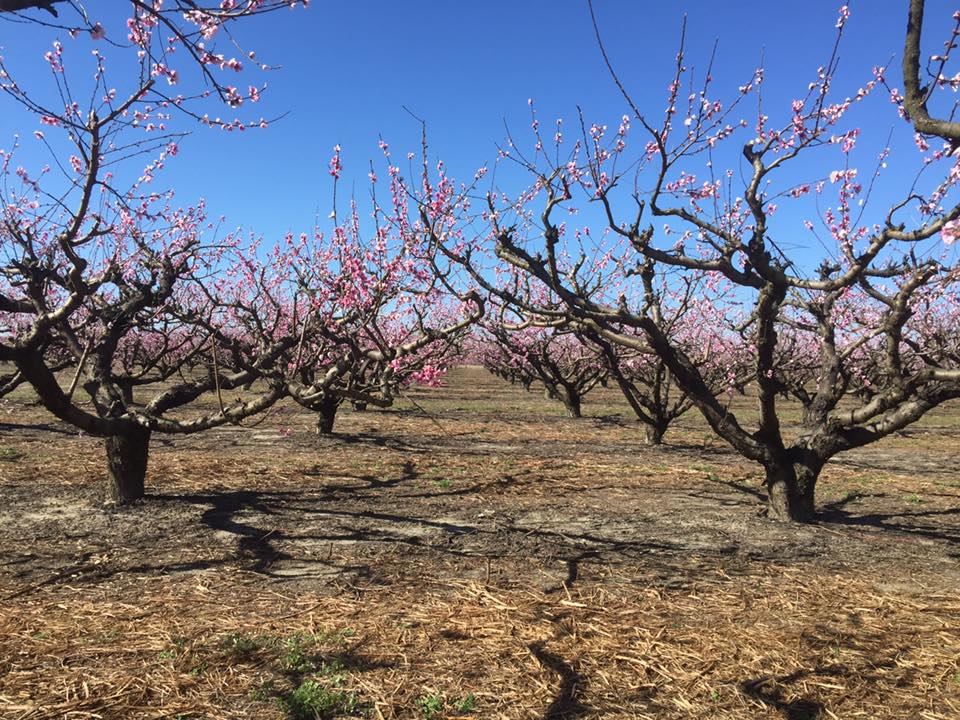
ABOVE: Local peach trees in spring and summer.

The Ridge section of South Carolina has been one of the most desirable areas of the state for growing peaches. The Ridge consists of the remnants of a sandbar from an ocean that existed long ago. Temperature plays such an important part in all of this. The elevation of the Ridge allows for cold air, which may damage the trees, to sink down to the valleys on either side. Peaches are also grown in the northwest Piedmont of the state, as well as the southeast coastal plain. 

There are hundreds of peach cultivars grown today. For the most part, they fall into two categories — clingstone and freestone, depending on how firmly the flesh attaches to the pit. The smaller clingstone varieties are usually the first ones available during the peach season, which begins around mid-May. The larger freestones ripen later, beginning around mid-June and continuing through mid-August. Red globe seems to be the favored freestone variety.

Peaches also come in white and yellow types. The white ones, typically Asian varieties, tend to be sweeter and less acidic than the yellows. Nectarines, by the way, are basically just peaches without the fuzz. They are genetically identical otherwise. It is unfortunate that many of the peaches (and nectarines) destined for sale in big grocery stores these days are varieties that have been bred for their firmness, red color, and shorter fuzz. As with tomatoes, shippablility and eye appeal trump good taste on the commercial market.  

Lest you take South Carolina’s peach future for granted, you must know that the trees have their peculiarities. First and foremost, they require a certain number of chilling hours in wintertime to be able to produce flowers and fruit in the spring. This has been an issue in recent years. Late freezes, hail, and too much or too little rain can also wreak havoc. Due to adverse conditions, South Carolina’s peach harvest in 2022 was down 50% compared to the previous year. In 2023, late freezes destroyed 70% of the crop.  At the Asheville Farmers Market, half-bushels were selling for as much as $60. These days, we should rejoice at each year’s production. 

Peach baskets in winter. Photo by Gary Dexter.

So what happened to all those wild peach trees that once overran the woods of the eastern U.S.? Like many non-native species when first introduced, peach trees were able to thrive due to the lack of natural enemies. They had quite a long grace period before natural pests, fungi, and bacteria found a way to harvest their own peach products. As with any monoculture, or any plant accumulated in abundance by humans, nature sometimes has a tendency to equalize. While wild peach trees are no longer ubiquitous, they still exist here and there, their presence marked by a splashes of color in the spring landscape.

Drive the backroads of South Carolina in mid-March, and you may see the telltale pink flowers of the wild peaches on the roadside or up in the woods. Here and there are also small thickets blooming among the ruins of old homesites. To see a really spectacular panaroma of flowers, however, you’ll want to drive up the Ridge — to places like Edgefield, Johnston, Ward, Ridge Spring and Monetta — and take in the seas of pink blossoms as far as the eye can see.

Peach blossoms up on the Ridge Photos by Gary Dexter.

Before you know it, May will be here, and the roadside stands and farmers markets will be flocked with customers eager to taste the first fruits of the season.

Peaches at a roadside stand up on the Ridge. Photo by Gary Dexter.

_____________________
Contributor Burt Glover became an accidental naturalist during his earliest childhood days exploring the dirt roads, backyards, polo field and barns of the Magnolia-Knox-Mead neighborhood of 1950s Aiken. Birds are his first love, and he can identify an impressive range by song alone. He asserts that he is an observer, not an expert, on the topics of his writings, which range from birds, box turtles, frogs and foraging, to wasps, weeds, weather and beyond.

Read More

Nature: Peaches Preceded Humans: Fossil Evidence from SW China
Smithsonian Magazine: The Fuzzy History of the Georgia Peach
National Park Service: How a Navajo Scientist is Helping to Restore Traditional Peach Horticulture

Aiken County’s Competitive Rowing Investments

Aiken County has spent millions of dollars redeveloping Langley Pond Park in the past five years. More than $2 million has been spent on competitive rowing infrastructure, where teams from mostly across the Southeast currently converge twice a year for regattas.

The investments have been made for economic reasons, to attract competitive rowing clubs, but not for local participation. Opportunities for County residents are not a priority. There is no competitive rowing program available in the Aiken County Public Schools; last year’s regattas did not feature a single team from Aiken County.

The County’s effort to attract spectators also lags. This week’s Augusta Invitational, which will close the pond to other users, was not publicized on any of the County’s social media pages until two days before the event.

by Don Moniak
March 7, 2024 (Updated March 8, 2024)

Aiken County’s Langley Pond Park is ideally suited for the challenging and rewarding Olympic-level sport of competitive rowing; the U.S. Olympic team trained there in preparation for the 1996 Summer Olympics in Atlanta.

It is also an exacting sport, one of the few that requires continuous feedback and coaching.  Teams have to operate in near perfect coordination.  Unlike in football where a missed block or tackle can be of little to no consequence, a single errant or missed stroke in a scull can easily change the results from being a medal contender to a mediocre finish.

The 285-acre pond’s 2,000-meter eight-lane race course was the venue for two annual regional rowing regattas prior to 2014. These events were placed on hold for nine years when the old Langley Pond Dam was found to be leaking, and unstable enough to warrant spending $13.5 million to replace the it, a process that closed the pond to public use for eight years (1).

The two regattas returned in 2023. This Saturday, March 9th, the Park will host the one-day Augusta Invitational Regatta. Another regatta, the two-day Master’s Southeast Regional, is scheduled for June 22-23rd.

Organized by the Augusta Rowing Club, the Invitational has 91 entries across 19 different events. At least 88 of these entries belong to five out-of-state clubs based in Peachtree City, Charlotte, Asheville, and two in Knoxville, TN. The Augusta Rowing Club represents the local rowing community; three other entries are listed as unaffiliated and from “anywhere U.S.A.”

This is a relatively small event. By comparison, the 2023 U.S. Rowing Youth National Championships held in Sarasota, Florida, drew 835 entries from 225 clubs; the 2022 Head of the Hooch in Chattanooga, TN, drew 2,037 entries from 171 clubs.

Aiken County has failed to publicize Saturday’s regatta in any meaningful fashion. The first notice on the County’s Langley Pond Facebook page was not posted until two days before the event. No notice is on the County’s home page or Facebook page. An answering machine greeted two efforts on Thursday to call the Parks, Recreation, and Tourism office for more information. There was no return call.

The $1.15 million Langley Pond Finishing Line Tower. The photo, taken from the Aiken County property database, was taken in June 2020, while the pond was still drawn down during the replacement dam construction.


The County’s Investments

Even before the new dam was completed, Aiken County officials were investing heavily (Table 1) in competitive rowing infrastructure in the hopes of drawing larger, more prominent tournaments. Since 2018–even before the new Langley Dam project was completed—the County has constructed a Finishing Line Tower (Figure 1), added anchor piles for the race course, installed a launch dock, and plans a 30-foot x 120-foot spectator dock.

Table 1: Recent Aiken County Langley Pond Rowing Venue Investments

DevelopmentBid Award Contractor Award Year
Finishing Line Driveway $33,420J.D. 2018
Finishing Line Tower*$1,151,580J.E. Stewart (Aiken) 2019
Course Anchors$77,650J.D. Gaskins (Aiken) 2020
Spectator Dock**$398,250Rowing America (Connecticut2023
Starting Docks**$225,720Rowing America (CT) 2023
Catamaran DocksCancelled
Total Costs***$1,886,620
Links are to procurement documents.
*The first procurement process in 2017 was cancelled “due to budget constraints.”
**Lowest Bid, only listed as recommended pending Council approval. The final award price is not listed on the county’s procurement webpage, and officials have yet to respond to questions about the final bid awards.
*** Total costs are for construction only, and do not include design and procurement costs

The ribbon cutting for the starting docks (Figure 2), whose installation this year closed the pond to public use for two weeks, is scheduled for this Friday at 3 p.m. The only visible notification of it was on County Council’s March 5th Work Session Agenda, titled “Ribbon Cutting for Fishing Docks.” (2)

Figure 2: Visual of Starting Line Docks at augustarowing.org website. The Finishing Line Tower is on the left-hand side at the top of the photo, 2,000 meters away.


Economic Impact, Not Local Participation

The impetus for these investments has always been the potential economic impact. In 2013, one county official claimed there was an “incredible economic impact” from two regattas that collectively drew a few hundred participants. “Exposure for the county” was another often cited rationale for investments in rowing infrastructure, which officials hoped would bring “2,000 or more” rowers to future events. These and other unsubstantiated claims were repeated without question by local media.

According to a 2016 Aiken Standard story, County officials claimed an estimated annual loss of revenues to County businesses of $2.4 million; and a speculated potential economic impact loss of $1.8 million from the loss of a single regatta. Those estimates were based on “direct visitor spending, which factors in the number of athletes and spectators attending Langley Pond events and the hotel rooms in which they would have stayed.”

However, multiplying the number of athletes and spectators by spending estimates does not equal revenues for only Aiken County businesses. For example, the Augusta Rowing Club’s website lists only two Augusta hotels offering group discount rates for this Saturday’s Regatta: the Marriot Crown Hotel on Stevens Creek Road and the Holiday Inn Express on Broad Street. The Rowing Club’s website has no link to Aiken attractions, restaurants, or hotels. (3)

The numbers are also suspect given the size of the events. By comparison, in 2021 the Aiken Standard reported that Hitchcock Woods Foundation Treasurer Larry Byers told a legislative Equine Industries Study Committee that the cancellation of the 2020 Aiken Steeplechase, considered to be the second largest annual sporting event in the CSRA, resulted in loss of “roughly $3.8 million.”

In contrast to its large and continued investment for economic impact, the County has invested minimally, if at all, in the development of local programs. Aiken County’s Public Schools have no current rowing programs or plans for any (4), even though the County’s 2014-2024 Comprehensive Plan called for collaborative parks and recreation projects with the Schools:

PRT may also wish to explore entering into agreements with the Aiken County Public School District for joint use of the District’s sports, playground, and recreational facilities.” (Page 107).

The potential for local programs at the Langley Pond rowing venue is considerable. This past Tuesday night, Aiken County Administrator Brian Sanders told Aiken County Council that the end result of the ongoing improvements will be a “world-class” rowing venue.

Yet, the spending to date has largely subsidized out-of-town rowing clubs and college teams; while offering little to County residents and failing to fund any development of homegrown talent.

At present, Langley Pond rowing is perhaps symbolic of local government, where taxpayers are more often mere spectators in decision-making processes. In this case, in the hopes of “incredible” economic impacts, the County has gambled $2 million of taxpayer money. Meanwhile, county residents are barely notified they can watch from the shore, and no consideration is given to investing in rowing equipment that could be shared by Aiken County’s public schools.

To add to the disparities, while millions are invested in the Langley Pond rowing race course, smaller County parks are neglected, and some are even scheduled to be closed (5).

Soon to come: Aiken County’s Disposable Parks.


Footnotes

(1) Aiken County took ownership, and the associated liability, of the Langley Pond Dam in 1994. In 2010, a SC Department of Health and Environmental Control (DHEC) dam inspector returned a “satisfactory” rating.

In 2012, DHEC reported cracks in the abutment/inlet structure and advised monitoring it and a crack in the ring wing wall at the emergency spillway; clearing trees adjacent to the spillway, and removing vegetation from the slopes.

In 2014, a man walking his dog observed discolored water seeping from the dam; and a leak was found indicating unstable conditions.

In 2015, the regatta events were cancelled.

In 2016, County Council approved a $12 million general obligation bond to replace the dam; and obtained a $2 million FEMA grant.

The project was completed in January 2021. One year later the redeveloped Park was dedicated.

(2) There are no “fishing docks” listed on the County’s procurement webpage. Inquiries made this week about “fishing docks” vs rowing ducks have so far been ignored by County officials.

(3) The County’s Langley Pond website has a link to Country Inn and Suites on Whiskey Road, but the link was inoperative this week.

(4) An inquiry to the Aiken School District, and response from the School District:


(5) At its March 5, 2024 County Council meeting, Council refused to require staff to answer the question as to how many parks, and which parks, are scheduled to be closed. The question was deferred to staff for a future answer. There has been no answer to a subsequent March 6th followup email asking if there is an implementation plan for divesting of parks and a list of parks scheduled to be closed.

The current Capital Project Sales Tax proposed project list only considers funding the facility needs for four parks (Roy Warner, Harrison-Caver, Langley Pond, and Boyd Pond).