
By Burt Glover
March 10, 2024
Throughout the ages, South Carolina has suffered through many a siege of non-native, invasive species — plants or animals introduced from elsewhere that outcompete native species and seem to just take over. Kudzu, fire ants, crabgrass, starlings, honeysuckle … the list grows every year. Spin the clock back if you will, way back to the time when the likely first non-native plant species stormed our state. Originally introduced into Florida by Spanish explorers in the mid-1500s was the tree they called el melocotonero. Like Bradford pear trees on steroids, these trees swept the entire Eastern Seaboard and beyond over the ensuing 100 years. The name we call these trees today is Prunus persica — the peach tree.
The first fossil record of peach trees occurred in China around 2.6 million years ago. Fast forward to 6000 BC, and humans had already domesticated this fruit to a form similar to what we have today. Such a good thing could not be contained. It spread to Greece by 300 BC, and then to Persia. Ancient Romans, believing that it originated in Persia, referred to it as “malicum persicum”– Persian apple. This translated to “peche’ by the French. To the English, it eventually became the peach.

It is speculated that the first peach seeds were brought to North America by none other than Spanish explorer Hernando de Soto in 1539. In addition to these seeds, it is said that he introduced two other organisms that would also rapidly spread — hogs and infectious diseases. Seeing the value and deliciousness of the peach tree fruit, indigenous peoples began planting the seeds around their villages and creating large orchards of trees. The fruit was eaten fresh and preserved, dried and pressed into cakes for future use. The seeds, and by extension the trees, spread widely along Native American trade routes, eventually working their way up to Virginia, then Maine. A similar history occurred simultaneously in the lands to the west, with the seeds arriving from Mexico into what is now New Mexico and Utah, where Navajos began successfully cultivating the trees.
On the eastern side of the country, the peach tree escaped its domestic plantings to invade fields and woodlands, usurping native plants and trees. Thomas Ashe, sent by King Charles II to survey his South Carolina colony in 1682 reported “The peach tree in incredible numbers grows wild.” John Bartram, deemed the greatest natural botanist in the world, assumed that, because of their great numbers, peach trees were a native of North America. John Lawson, naturalist, writer and explorer of the Carolinas in the late 1600s wrote, “We are forced to take a great deal of care to weed them out, otherwise they make our land a wilderness of peach trees.” In his visit to America, Italian scientist Luigi Castiglioni remarked, “Peach trees are so abundant in Virginia that often, upon cutting away a pine wood…. they cover the whole terrain.”
It was perhaps providence that these trees were ubiquitous in the landscape during these years, as their fruit was said to provide an important source of food for escaping slaves during their northward journeys.

A flush of fruit on a “wild” peach tree
Nowadays, peach trees, like apple trees, are specifically bred cultivars that are grafted onto suitable rootstocks of hardy species. There is no mystery over the fruit that will be produced by these grafted cultivars. The trees are strictly pruned and subjected to vigorous pesticide regimes to create the perfect, unblemished fruit.
When these trees roamed wild, however, a seed planted from a wild-grown peach or apple tree might produce a small, bitter hockey puck, or it might produce a 13-inch circumference marvel of juicy deliciousness. For many years, Euro-American settlers viewed peach trees as weeds and had little use for their fruit, other than using it for animal feed or brandy-making. Indigenous peoples, meanwhile, were selectively choosing and breeding the most promising plants, creating many varieties that were superior to those found in Europe. Some of those varieties are still grown today; others are being brought back, the orchards having been slashed and burned by white European settlers during the extirpation of Native Americans.
During the mid-19th century, as horticultural advances led to improved cultivars, the peach gained new esteem. Read the accounts of the later 1800s, and you will see the peach tree acclaimed as the “Savior of the South.” Years of cotton monoculture had severely depleted the soils in much of South Carolina. Growers moved their vast cotton plantations westward to other states. With cotton yields dissipating, and profitability from row crops such as peanuts and asparagus being usurped by other states, many South Carolina farmers turned to growing peaches. Though Georgia claims to be the Peach State, in all actuality, California ranks number one in production in the US. South Carolina ranks number two, with Georgia producing only a little over one-third that of South Carolina in 2022. China is, of course, the world’s largest producer of peaches.


ABOVE: Local peach trees in spring and summer.
The Ridge section of South Carolina has been one of the most desirable areas of the state for growing peaches. The Ridge consists of the remnants of a sandbar from an ocean that existed long ago. Temperature plays such an important part in all of this. The elevation of the Ridge allows for cold air, which may damage the trees, to sink down to the valleys on either side. Peaches are also grown in the northwest Piedmont of the state, as well as the southeast coastal plain.
There are hundreds of peach cultivars grown today. For the most part, they fall into two categories — clingstone and freestone, depending on how firmly the flesh attaches to the pit. The smaller clingstone varieties are usually the first ones available during the peach season, which begins around mid-May. The larger freestones ripen later, beginning around mid-June and continuing through mid-August. Red globe seems to be the favored freestone variety.
Peaches also come in white and yellow types. The white ones, typically Asian varieties, tend to be sweeter and less acidic than the yellows. Nectarines, by the way, are basically just peaches without the fuzz. They are genetically identical otherwise. It is unfortunate that many of the peaches (and nectarines) destined for sale in big grocery stores these days are varieties that have been bred for their firmness, red color, and shorter fuzz. As with tomatoes, shippablility and eye appeal trump good taste on the commercial market.
Lest you take South Carolina’s peach future for granted, you must know that the trees have their peculiarities. First and foremost, they require a certain number of chilling hours in wintertime to be able to produce flowers and fruit in the spring. This has been an issue in recent years. Late freezes, hail, and too much or too little rain can also wreak havoc. Due to adverse conditions, South Carolina’s peach harvest in 2022 was down 50% compared to the previous year. In 2023, late freezes destroyed 70% of the crop. At the Asheville Farmers Market, half-bushels were selling for as much as $60. These days, we should rejoice at each year’s production.

Peach baskets in winter. Photo by Gary Dexter.
So what happened to all those wild peach trees that once overran the woods of the eastern U.S.? Like many non-native species when first introduced, peach trees were able to thrive due to the lack of natural enemies. They had quite a long grace period before natural pests, fungi, and bacteria found a way to harvest their own peach products. As with any monoculture, or any plant accumulated in abundance by humans, nature sometimes has a tendency to equalize. While wild peach trees are no longer ubiquitous, they still exist here and there, their presence marked by a splashes of color in the spring landscape.

Drive the backroads of South Carolina in mid-March, and you may see the telltale pink flowers of the wild peaches on the roadside or up in the woods. Here and there are also small thickets blooming among the ruins of old homesites. To see a really spectacular panaroma of flowers, however, you’ll want to drive up the Ridge — to places like Edgefield, Johnston, Ward, Ridge Spring and Monetta — and take in the seas of pink blossoms as far as the eye can see.

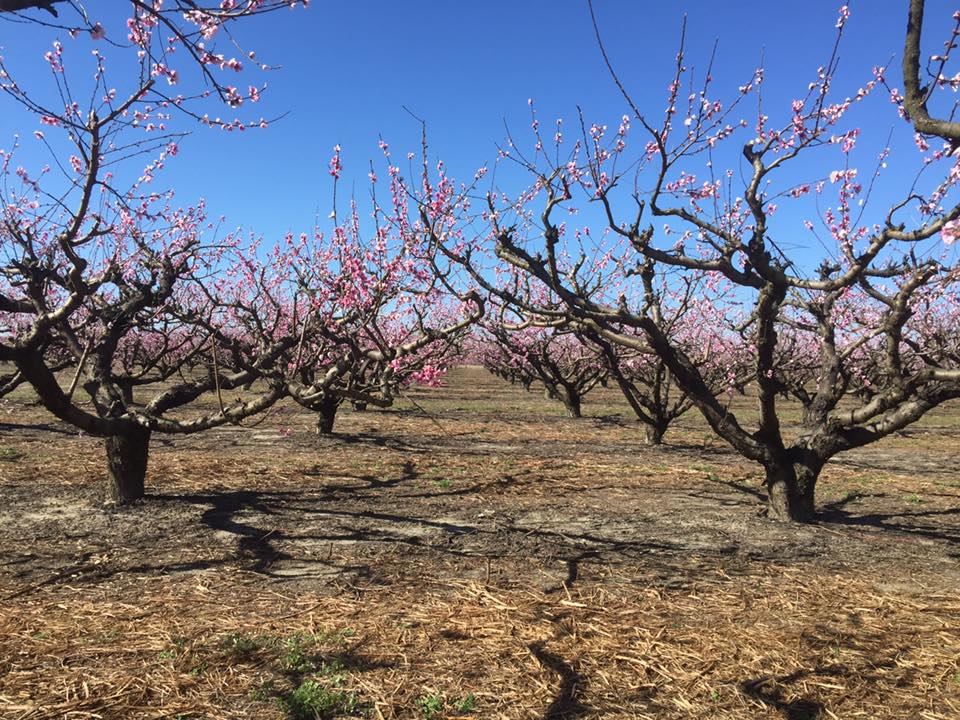
Peach blossoms up on the Ridge Photos by Gary Dexter.
Before you know it, May will be here, and the roadside stands and farmers markets will be flocked with customers eager to taste the first fruits of the season.

Peaches at a roadside stand up on the Ridge. Photo by Gary Dexter.
_____________________
Contributor Burt Glover became an accidental naturalist during his earliest childhood days exploring the dirt roads, backyards, polo field and barns of the Magnolia-Knox-Mead neighborhood of 1950s Aiken. Birds are his first love, and he can identify an impressive range by song alone. He asserts that he is an observer, not an expert, on the topics of his writings, which range from birds, box turtles, frogs and foraging, to wasps, weeds, weather and beyond.
Read More
Nature: Peaches Preceded Humans: Fossil Evidence from SW China
Smithsonian Magazine: The Fuzzy History of the Georgia Peach
National Park Service: How a Navajo Scientist is Helping to Restore Traditional Peach Horticulture
Great article! Can’t wait to share it…