
By Martin Buckley


By Martin Buckley


Presented here in the case of O’Briant VS. Moniak et al are the Original Summons, Amended Motion to Dismiss, and Motion to Strike.
Updated June 15, 2024
1. Plaintiff’s Original Summons, April 27, 2023.
2. Defendants’ May 26, 2023 Motion to Dismiss and May 30, 2023, Amended Motion to Dismiss.
The Amended Motion is 16 pages, and pages 20-82 are Exhibit A documents.
3. Plaintiff’s Motion to Strike.
4. Plaintiff’s Affadavit of Default directed against Defendant Eureka Research, LLC.
5. Defendant’s Response to Motion to Strike. June 26, 2023. (Not filed in case record but provided during discovery process. )
6. June 26, 2023. Answer by Defendants.
(Note: Not in the case file was a July 2023 agreement between both parties to withdraw all Motions and the Affidavit of Default without prejudice. No further filings ever occurred.)
7. November 3, 2023. Transcript of Deposition of Defendant Moniak.
(Note: The sealed deposition was posted to the case index on April 4, 2024
8. December 6, 2023. Notice of Alternative Dispute Resolution (ADR), a court-ordered action which set forth a 90-day deadline to enter into mediation.
(Note: Since 2016, ADR has been mandated by the South Carolina Supreme Court for civil actions. Trials can not occur without mediation first occurring, unless exemptions are granted.
The Plaintiff in this case failed to pursue the mandated mediation. Under ADR Rule 5(f), a case “shall not be on the circuit court trial roster until a Proof of ADR is filed.”
ADR Rule 10(a), Proof of ADR, states:
“If by the time required by these rules, no Proof of ADR has been filed with the Office of the Clerk of Court and the case has not been exempted or deferred from ADR by court order, the court may issue a Rule to Show Cause why sanctions should not be imposed, including the dismissal of an action without prejudice or the striking of a pleading. The court may also manage such cases through status conferences and/or scheduling orders.”
Because the Plaintiff indicated an intent to dismiss the case, and without any concessions by the Defendant, no Rule to Show Cause was issued, and no sanctions were imposed.)
9. Dismissal, with Prejudice, May 13, 2024.
(Note. There was no “settlement.” As noted above, had an agreement not been reached to dismiss with prejudice—thus preventing any retrying of the case—the Court could have dismissed the case without prejudice, which would have required refiling and allowed for counterclaims.)
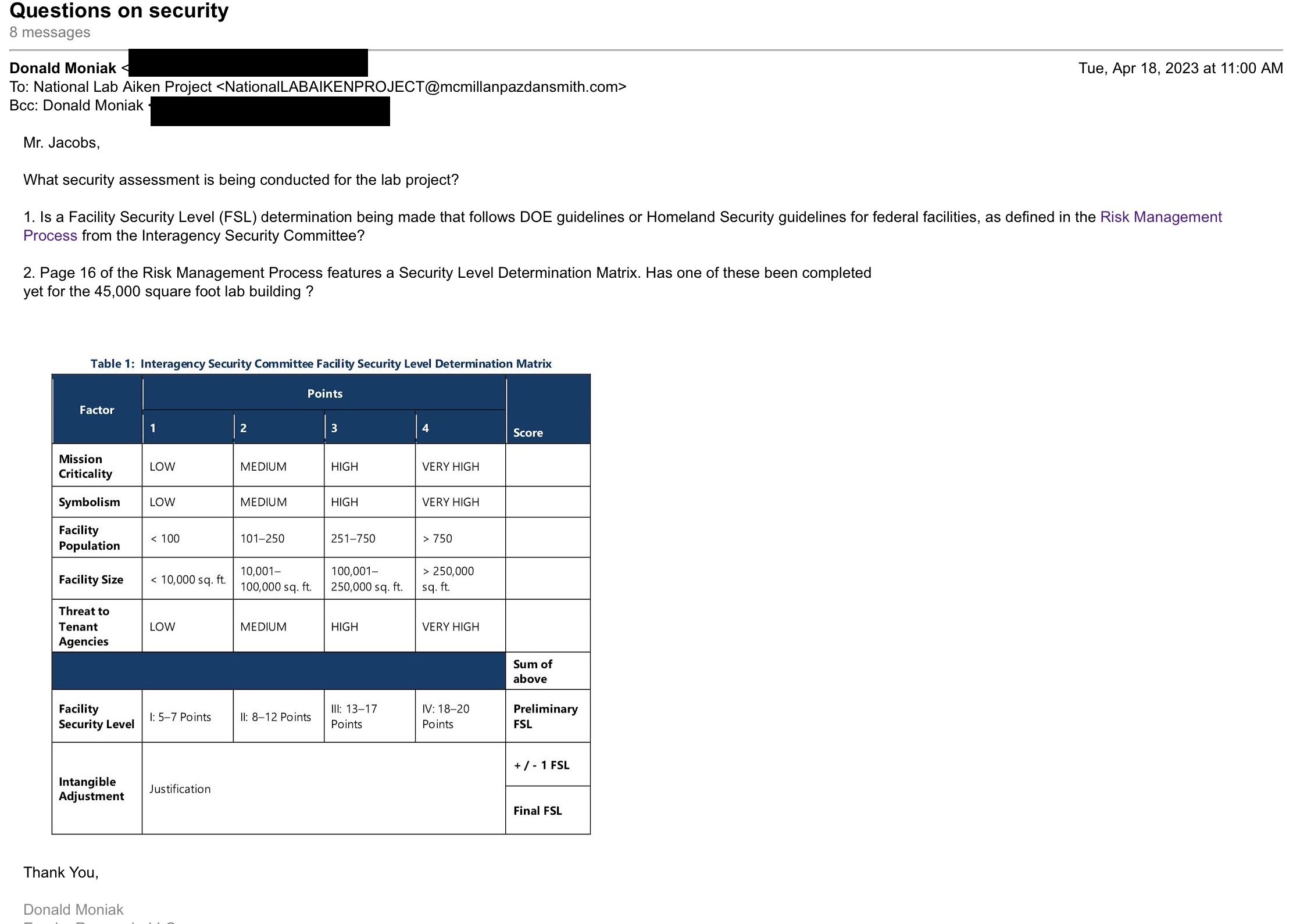
The following email (1) was sent by Don Moniak to Nationallabaikenproject@mcmillanpazdensmith.com on April 18, 2023.
No answer has been forthcoming.
NOTE: All federal facilities must go through the process including leased facilities and non nuclear Department of Energy facilities.
________________
| Donald Moniak | Apr 18, 2023, 11:00 AM |  | |
| to National | |||
Mr. Jacobs,
What security assessment is being conducted for the lab project?
1. Is a Facility Security Level (FSL) determination being made that follows DOE guidelines or Homeland Security guidelines for federal facilities, as defined in the Risk Management Process from the Interagency Security Committee?
2. Page 16 of the Risk Management Process features a Security Level Determination Matrix. Has one of these been completed yet for the 45,000 square foot lab building ?

Thank You,
Donald Moniak
____________________
( 1) The original email is below.
Part One: Aiken’s Early Parks and Recreation: A Historical Perspective
Next up: The Virginia Acres Question: 1962-1968
Newcomers to Aiken may not know that Virginia Acres Park was created atop a 55-acre subdivision called Virginia Acres. The City’s decision to purchase and demolish this subdivision was at the center of a controversy that played out in local headlines and editorial pages from 1962-1965.
Built during 1952-1953 at a cost of over $1 million dollars, Virginia Acres housed construction workers and early Savannah River Plant employees. The subdivision was comprised of 213 houses and duplexes over a 55-acre tract. Here, some local history is in order.
Between 1955 and 1970, the City of Aiken experienced a housing glut — specifically a glut of low-cost housing. Before the housing glut, however, there was a brief period of time (1951-1954) when there existed both a severe housing shortage and an explosive housing boom. In the wake were thousands of modest, two and three-bedroom homes built to house construction workers, service workers, and the soon-to-arrive employees — called “DuPonters” — of the new H-Bomb plant at Savannah River Plant (SRP).
These were unusual times. It would be difficult to overstate the enormity of the SRP project and the needs it presented during those earliest months and years following the Aiken Standard’s November 29, 1950 headline announcing the billion-dollar bomb plant coming to Aiken.1

The story also made front page news in the New York Times,2 where the potential for creating even greater destruction than that wrought by the 1945 bombings of Hiroshima and Nagasaki was being imagined for the new H-bomb plant:
“Scientists have estimated that a hydrogen bomb — if perfected — might produce 1,000 times the energy of the atomic bomb that was exploded over Hiroshima, Japan, and thus spread destruction over a much larger area.” — From the New York Times front-page article, “US Picks Site of Atom Plant to Help on Hydrogen Bomb,” November 29, 1950.
Of course, it was not the production of bombs to be attempted at the plant, but the production of materials for “super bombs,” as these H-bombs were being called. In charge of the design, operations and management of the plant was the explosives division of the E.I. DuPont de Nemours Company.
According to the Atomic Energy Commission’s 1951 numbers, (which turned out to be underestimates), the Aiken area could expect to see an immediate population rise of 25,000 workers and families. This was predicted to peak to around 100,000 in 1952, between the estimated 36,000 construction workers and the thousands of other workers including engineers, scientists, managers, clerical workers, and numerous other categories of workers necessary to support the myriad government and and commercial services during construction of the plant.3 This, in addition to about 5,000 people in the communities of Ellenton, Dunbarton, Hawthorne, Robbins, Leigh and Meyers Mill who were being displaced by the plant.
All would need places to live — some on a temporary basis, others on a permanent basis.
Eight thousand workers were expected to be hired in the first six months of 1951, alone. The burden for housing the initial influx was borne primarily by Aiken and Barnwell Counties, along with Augusta, Georgia. Trailer camps, both large and small, sprouted like mushrooms along the roadsides from Aiken to New Ellenton, and from Williston and Barnwell to Jackson, Beech Island, North Augusta and all points north, south, east and west in a 60-mile radius of Aiken.4 Aiken’s own Robbins Trailer City — located on Pine Log Rd in the area where Mallard Lake subdivision now stands — contained over 1200 trailers to house these workers.5
In the early stages of SRP construction, the housing shortage was so dire that some workers lived out of cars and tents. Others squatted in empty houses and outbuildings in the countryside. Rooms were rented out of private homes, and larger homes, including Banksia, were pressed into service as boarding houses. Aiken Housing authority even offered up the local projects, which had been built for poor people, to the Atomic Energy Commission, an offer that was declined.
Some workers commuted long distances over back roads each day. There were no interstates at the time, and a lot of roads had yet to be paved, so a 60-mile drive was a different matter than today. The urgent search for a house to rent or buy in the local market became almost a part-time job for some workers and their families.
Numerous starter-house type subdivisions began to spring up, their quickly-constructed, slab-foundation houses snatched up as fast as they could be built.
In Aiken’s northside Crosland Park, (which is where my family started out), there were 426 houses6 built. In the nearby Vanwood subdivision were another 53 houses7. There were 85 more houses in Silver Bluff Estates, 123 in Forest Heights, 244 apartments and duplexes in Governor Aiken Park,8 and 213 more in Virginia Acres9. These, in addition to numerous other subdivisions sprouting in North Augusta, New Ellenton, Williston, and other smaller towns throughout Aiken County.

Simultaneous was the need to provide better-grade housing for the permanent DuPont workforce, the bulk of which would arrive in 1953-1954. This resulted in the construction of yet more subdivisions — Aiken Estates, Edgewood Manor, Dartmoor Woods, Dunbarton Oaks, College Acres, Westmount, Aiken Heights, Kalmia Hills, and Highland Park, to name a few.
Beginning around 1955 — with construction phasing out, and with DuPonters moving out of starter homes and into more upscale housing — the starter homes began to empty. By 1959-1960, the Federal Housing Administration (FHA), which had originally insured the loans financing the construction of these houses — loans which were now going into default — bought six of the starter-home subdivisions: Vanwood, Crosland Park, Silver Bluff Estates. Forest Heights, Virginia Acres, and Governor Aiken Park.
Paradoxically, the same federal government that created this glut announced in 1959 that it was prohibited, by its own FHA rules, from selling these now-excess houses to private interests, so as “to prevent sudden flooding of a local real estate market.”10
Here, it must be pointed out that, even under the most ideal of circumstances, the official disposal of excess federal property, such as surplus houses, was, and still is, an arduous task. It appeared, however, that there was more than red tape binding the sales of these houses and transforming these subdivisions, recently bustling with life, into places described as dilapidated eyesores and ghost towns.
The disposition of each subdivision over the next ten years was handled a little differently. The 53-house Vanwood subdivision — earlier leased by the City of Aiken from the FHA for $1 per year — was purchased by the City in 1966 for $8,000.11 The Forest Heights homes remained on the rental market until annexation into the City in 1966, 12 after which the subdivision was put on public sewer, its streets paved, and the houses refurbished — all on the FHA’s dime — in preparation to be be offered up to “qualified buyers.” 13 The 500+ houses in Crosland Park and Silver Bluff Estates were the first to put on the market in 1961-62.
In 1961, Crosland Park houses were refurbished on the FHA dime and successfully marketed as a retirement community to draw well-to-do retirees from across the country. This was accomplished through ad campaigns run in both national-circulation magazines and metropolitan newspapers from Florida to New York and westward.
The local realtor handling the Crosland Park sales for the FHA said that the “major effort” was “to bring retired persons to Aiken from other parts of the country.” The lure was the attractive, reduced prices that were designed to attract a flood of interest. According to one account, there were some 8,000 queries received.
Of course, local retirees could also apply, as long as they could “meet the requirements established,” which included the ability to “show that they are in reasonably good physical condition in order to avoid burdening the local hospital” and that their retirement income was “high enough for them to live in order to avoid draining local welfare services.”14
In 1962, and on the coattails of the highly successful Crosland Park campaign, the houses in Silver Bluff Estates (the neighborhood behind today’s Home Depot store) were refurbished — also on the federal dime — and promoted for sale to retirees. As with Crosland Park, the realtor handling the sales was authorized to spend, “whatever is necessary to place each house in first class condition before it is sold.”15 Unlike Crosland Park — which lacked walking-distance access to grocery stores and churches — Silver Bluff Estates seemed to have it all: four churches and two shopping centers, (Mitchell Shopping Center and Virginia Acres Shopping Center), all in easy walking distance.
While the the majority of Crosland Park and Silver Bluff Estates houses were sold principally to retirees, these houses were also rented and sold to young couples and families who could afford the attractively reduced rents and/or low down payments, easy mortgage terms, low sale prices and other FHA-backed incentives to lure residents to these neighborhoods.
The histories on Governor Aiken Park and Virginia Acres played out differently than the other four FHA-owned subdivisions. By 1961, both were being variously described as run down, dilapidated, ghost towns. Were there not enough qualified buyers to fill these hundreds of homes? Or had the market for low-cost housing simply been tapped dry?
Throughout Aiken’s 15-year glut of low-cost housing, there existed, paradoxically, a severe shortage of housing for lower income people. This issue was compounded by a scourge of substandard housing throughout Aiken County, whose numbers began to be officially counted in July 1961, with the City’s passing of “the Housing Code Ordinance,” which set standards for housing, such as window screens, hot water, indoor plumbing and electricity.16

By the mid-1960s, the City of Aiken had a queue of condemnation and demolition orders, and an even longer queue of people on the waiting list for public-assistance housing.
Locally, several federal projects — all segregated by race — had been built to replace some of the substandard housing. In the early 1950s, an 80-unit project was built for Whites in Gloverville. By 1960-61, several more had been built for Black people in Aiken. 17
While substandard housing is primarily an issue of economic class, the barriers to decent housing were infinitely more formidable for Black people due to generations of federal, state and local laws and policies specifically designed to politically, socially, and economically disenfranchise Black people from education, employment, and housing.
Here, a long exposition could be written to detail the local effects of post-WWII mechanized agriculture in the cotton industry, plus the decline of the Winter Colony — two primary employers for local Black workers — along with the ongoing institutions of segregation and discriminatory hiring practices in textile mills and other area industries, including, and most prominently during these years, the local nuclear industry, whose well-paying jobs and housing windfalls didn’t spill equally onto everyone.
Another exposition could be written on the institutionalized segregation and discrimination created through zoning ordinances in towns across America and, at the federal level, through the establishment of the FHA in 1934 along with various housing acts and legislation (1932, 1933, 1934, 1937, 1940, 1942, 1947, 1948, 1949, 1953, 1954, 1955, 1956, 1959, 1961, 1964, 1965, 1966, 1968, 1970 and onward). The political architects designed this legislation to assist White people buy homes and to expressly prevent Black people from buying homes.
It wasn’t until the Civil Rights Act of 1968 — not to be confused with the Civil Rights Act of 1965 — that the words, “unlawful to discriminate in the sale, rental, or financing of housing,” appeared in one of these acts.
Until the Civil Rights Act of 1968, (which contained the Federal Housing Act), there was little to nothing protecting would-be home buyers from discriminatory laws and policies. One of the most effective and enduring barriers to home ownership was redlining — a banking industry policy enacted with the inception of the FHA during the 1930s New Deal era. Through redlining, the federal government worked in tandem with the banking industry to enforce segregation by preemptively disqualifying home loans in certain neighborhoods regardless of a prospective purchaser’s income.
To see how these policies worked in real-time, click the screenshot below to link to and explore an interactive map of circa 1940 redlining in nearby Augusta, Georgia.

While the Civil Rights Act of 1968 put an official end to redlining and reduced some of the barriers to Black home buyers, it also — as happened with all of the housing acts that preceded it — accomplished the opposite of its ostensible purpose. More on this later.
Generations of such laws and policies left disproportionate numbers of Black people at the whims of slum lords who rented drafty, vermin-infested, rubble for profit. Whereas a hardworking White person could potentially overcome the stacked deck and pull themselves up by the bootstraps, such measures were — by law, policy, and practice — largely forbidden to Black people.
In the 1950s-60s era of construction and operations at Savannah River Plant, Jim Crow was a prominent presence in the workplace. Locally, the stories spread primarily through word of mouth while, nationally, the story was told in senate subcommittees and in newspapers of record.
DuPont’s position on the matter, as quoted in a New York Times letter in 1951, was that “all employment policies will be determined by local project management, with due consideration to prevailing racial customs and practices.” 18
The Atomic Energy Commission’s position, as also stated in 1951, was, “When we hired the DuPont company, we hired their employment policies.” 19
That same year, the first accusations of discrimination were waged against DuPont, claiming that, while White people of all education levels were being trained and hired for well-paying government jobs, Black people were being denied these opportunities.
Black laborers’ skills were reportedly being downgraded, with these workers being shunted into menial labor jobs and for lesser pay than White co-workers doing the same jobs. According to Harold O. DeWitt, acting industrial relations secretary for the Urban League’s Southern Field Division, in 1951, the nine American Federation of Labor unions in the area were “undergrading qualified Negro workers and making promotions difficult.” DeWitt also charged that “provisions to train women clerical workers were not available to Negroes.” Urban Research investigations revealed that Black people constituted “53.6% of the total population in the six South Carolina counties and five Georgia counties in the hydrogen plant area.”20
Yet, according to DuPont’s own numbers, only 12%, of the estimated 25,000 workforce were Black, and, of these, fewer than 3% worked outside of the unskilled category. None had white-collar jobs. 21
While the DuPont construction contract with the Atomic Energy Commission contained a non-discrimination clause, DuPont would not hire construction workers without the recommendation of the local union. According to R.A. Brooks, then-head of the Aiken NAACP, the local union in Augusta was recommending only White workers.22
In December 1951, President Truman appointed a top level committee to enforce the non-discrimination clause but, according to NAACP testimony before a Senate Labor Management subcommittee in April 1952, Black people were still being frozen out of jobs. One cited example involved a bulldozer operator who thought he had a job, until the prospective employer saw his skin color. According to NAACP testimony, the “employment curbs thrown up against Negroes” were known by the “highest” officials in the Atomic Energy Commission. 23
In 1953, the NAACP was still lodging complaints of discrimination against DuPont, claiming that the company was training and hiring large numbers of White workers, but consistently giving “the runaround to coloreds seeking similar jobs.” 24 DuPont continued to deny that discrimination was taking place.
In 1954 — by which time much of the construction had wound down, and the construction workers moved away — the situation “improved.“ DuPont “removed all signs designating racial discrimination” 25 and they reportedly opened eating facilities and comfort stations at the plant to all employees.
In 1962, under President Kennedy, Civil Rights groups were still pushing for DuPont to comply with Presidential executive orders banning racial discrimination by federal contractors. 26 Kennedy signed yet another executive order to better enforce the previous executive orders. There were now five different executive orders in place, signed by four different presidents since 1941 — all of them forbidding discrimination in military and government workplaces.
In 1962 — as in 1942 and 1952 — it wasn’t a lack of rules to blame for keeping half of the local population from the well-paying jobs at the bomb plant, but a lack of will among those in power to enforce the rules.
_______________________
The above histories are incomplete, at best. The recording of racial histories, like so much history, has traditionally been piecemeal and only brought together, piece-by-piece and perspective by perspective, over time. I welcome further contributions to the history I’ve presented here.
____________________
This series is written in memory of my father, Arthur H. Dexter. His files on these histories led me to further research and to complete some of the stories he started, but didn’t have opportunity to finish.


