by Don Moniak
July 1, 2024
On November 3, 2023, I underwent a four-hour deposition by Attorney John Harte as part of the Plaintiff’s discovery process in the O’Briant vs Moniak defamation lawsuit.
It was an intense experience, at times humbling, at other times amusing, and at all times eye-opening. The deposition failed to produce much in the way of discovery because it was dominated by irrelevant lines of inquiry that functioned more to harass the Defendant than to prove the Plaintiff’s case.
The lack of discovery is illustrated by the paucity of exhibits introduced during the deposition—a mere six, of which three were already in the written record as part of the Defendant’s Amended Motion to Dismiss.
With no practical or legal justification, the deposition transcript was placed in the sccourts.org public case file on April 4, 2024. The posting of the transcript occurred 28 days after the 300-day and 90-day deadlines passed for entering into court-ordered ADR (Alternative Dispute Resolution, more commonly known as mediation).
South Carolina’s Rules of Civil Procedure mandate that mediation occur within 300 days of the filing of a lawsuit, and within 90 days after The Court issues an ADR order and assigns potential mediators. This requirement has been in place for all South Carolina counties since a 2016 South Carolina Supreme Court order. The mandate means that jury trials in civil cases can not occur in the absence of ADR—whether it be mediation or arbitration.
In O’Briant vs Moniak, The Court issued its Notice of ADR on December 8, 2023; creating a March 7, 2024 deadline for mediation. That deadline passed without any action. No Proof of ADR could be submitted that opened the case to a trial.
Under ADR Rule 5(f), a case “shall not be on the circuit court trial roster until a Proof of ADR is filed.”
In the absence of ADR, the Court can file a Rule to Show Cause that can lead to a dismissal of the case. ADR Rule 10(a) states:
“If by the time required by these rules, no Proof of ADR has been filed with the Office of the Clerk of Court and the case has not been exempted or deferred from ADR by court order, the court may issue a Rule to Show Cause why sanctions should not be imposed, including the dismissal of an action without prejudice or the striking of a pleading. The court may also manage such cases through status conferences and/or scheduling orders.”
In this case, no Rule to Show Cause was issued because, after the ADR period expired, the Plaintiff expressed their intent to dismiss the case.
Without filing of a “Proof of ADR,” and without a request for an extension, there was no longer even the possibility of a trial. It is highly unusual, if not rare, for a deposition transcript to be released that is not associated with a court filing. It is equally unusual to rare for a full transcript to be posted on the electronic public record, even within a court filing. It is close to anomalous for a deposition to be posted without any connection to a court filing, whether it be a pre-trial brief or a Motion. I have yet to encounter such a situation while perusing a few hundred cases in the past three years.
Rule 32 of South Carolina Civil Procedure states, in regard to the Use of Deposition, that:
”At the trial or upon the hearing of a motion or an interlocutory proceeding, any part or all of a deposition, so far as admissible under the rules of evidence applied as though the witness were then present and testifying, may be used against any party…”
In this situation, there were no trials or motions scheduled, and in fact no trial was even possible.
In my opinion, the public release of the deposition transcript was the final attempt by the Plaintiff to continue to try their case in the court of public opinion—in this case even after opting to avoid mediation. The Plaintiff failed from the beginning to pursue their allegations/complaint in any meaningful way within the courts.
But, since the deposition transcript is now publicly available, following are some personal insights into the deposition and the transcript as a whole.
1. Psychiatric background. Substantial time was dedicated to probing my psychiatric treatment background, probably an effort to stigmatize perceived and real mental health disorders (Pages 6-12). The questions harkened back to a darker time when mental health was a subject to be avoided; when a cloud of suspicion could accompany any patient undergoing psychiatric care.
There is no shame, especially in this day and age, to pursuing treatment for diagnosed, off-normal psychological conditions; and especially not for more severe mental health ailments. Our prisons are filled with people who went undiagnosed and untreated, and families are torn apart by the presence of undiagnosed conditions as much as they can be devastated by undiagnosed, debilitating or deadly physical ailments. On the other hand, an untold number of people thrive in spite of various conditions, again often undiagnosed and not medically treated, such as Bipolar Disorders (formerly known as “manic-depressive) and Attention Deficit Disorder.
I have lived with the conditions described in the deposition in all or part for more than forty years. In every situation the diagnosis was always a therapeutic revelation that served as a substantial part of a long-term monitoring and treatment plan. This is life.
I did not object to the line of questioning because as the questions continued I realized that how poorly the line of inquiry spoke to the character of the Plaintiff and his attorney.
2. Are you qualified to question government officials? An irrelevant line of questioning regarding my 42-year adult work history, dating back to 1979, took up nearly half of the deposition (Pages 14-87). The intent of the inquiry was clear, to discredit and diminish my work experiences, with several tag line endings to the effect of “what did that have to with city planning.” Here is just one example involving work performed in the late 1980s.

The entire line of irrelevant questioning functioned to achieve an irrevelvant and false conclusion: that nobody without specific experience or expertise is qualified to question those with experience and expertise, real or otherwise, whether it be in nuclear power and weapons policy and practices, or that of city planning.
In actuality, there are no minimum qualifications to question any government or corporate decision-making, planning, or policy that impacts our lives. The entire purpose of a public hearing is to hear public comments on a proposed action, and every federal rule making and environmental impact statements, as well as equivalent state documents, requires a public comment period. In all cases, there are no prerequisites to speaking at a public hearing or submitting comments to public bodies. Thus, my answer (page 70) that my qualifications are “I know how to read and write.”
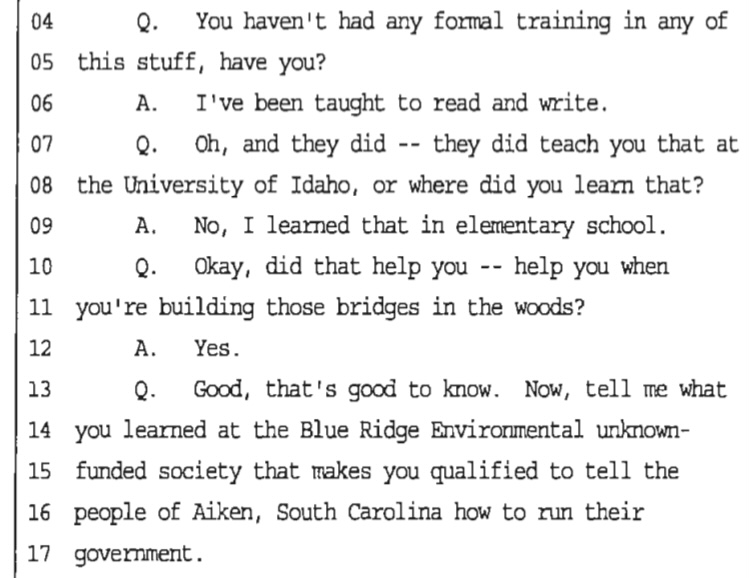
In fact, even the ability to read and write is not a minimum qualification to question the authority of government officials, as the First Amendment of our Consitution guarantees both the right to Freedom of Speech and the right to Petition Our Government for a Redress of Grievances. There are no qualifications listed in the constitution.
3. Circular moments. There were a few circular debates that felt like Abbott and Costello-style skits; i.e. “the appendices” (pages 78-82) and “definition of a liar” (pages 79-91). During the latter, the deposition went around in circles as to whether a liar is somebody who lies merely two or three times, or somebody who lies on a regular basis. Dictionaries do not make the distinction, but people do. If we all routinely consulted a dictionary before speaking or even writing, in order to avoid any threat of civil litigation, our dialogues and prose would be dramatically different.
As to the former, the appendices, Plaintiff’s Counsel attempted to distinguish the appendices in a multi-volume Environmental Impact Statement (EIS) from the body of the tome in which appendices were cited. It is true that my comments, submitted on behalf of STAND of Amarillo, led to the U.S. Department of Energy correction of a Draft EIS (see grainy screenshot below from 1998-1999 Surplus Plutonium Disposition EIS) that may seem minor, but was very important to the people around the Pantex Nuclear Weapons Plant (2).

4. The Fraudulent Checks. Pages feature a false and accusatory line of questioning pertaining to several fraudulently written Aiken Municipal Development Commission (AMDC) checks. Two were successfully cashed, and three were prevented from being cashed by the AMDC’s bank.
Plaintiff’s attorney introduced no evidence in support of his false contention that I was responsible for these transgressions. The arguably slanderous allegations are undermined by the following facts; which did not emerge during the deposition:
a. As webmaster of aikenmdc.org, around the end of March, 2022, Timothy O’Briant posted invoices and payment files containing associated AMDC checks whose routing and account numbers were not redacted, thus exposing the AMDC’s six-figure checking account to fraud.
b. On July 13, 2022, I alerted City Manager Stuart Bedenbaugh to the situation—as well as to the presence of another set of data on the AMDC website containing unredacted private business information of the Project Pascalis property tenants. I also posted a reference to the situation on the Do It Right FB group page, but redacted the checking account data (see below). An article on the issue, Toast of the Town, was published on July 28, 2022.

c. The next day that portion of the website was removed from public view.
d. The AMDC and its staff opted to keep the account open rather than reopen a new one, an inconvenient but common cautionary practice.
e. According to the Aiken Public Safety incident report, the first fraudulent check, written in late July 2022, was not detected until September 26, 2022; indicating that staff may have neglected to monitor the AMDC checking account for at least two months. (see below) Only then was the account closed and a new one opened.

5. The June 2022 COVID revelations (pages 144-148). One of the disputed issues within the litigation involved the motives for the decision to withdraw the Demolition Hearing request for five of the Project Pascalis properties. One motive provided by the Plaintiff was that the withdrawal was “Covid related.” As a result, the health status during that period of two individuals associated with the City of Aiken’s Design Review Board was introduced during the Deposition. The identifies of these individuals were revealed, quite unnecessarily. One of the identities was specific, the other incomplete.
These intrusive revelations occurred eight months after Tim O’Briant had written in an email that he could not reveal names or “private health data” of those affected due to “HIPPA protections.”

6. The surveillance video. The surveillance video that was allegedly obtained by the Plaintiff via surreptitious means, and definitely acquired through use of his official office, was introduced at the tail end of the Deposition (Pages 155-156).
The surveillance video content could be described as:
“People milled about Council Chambers after adjournment. O’Briant and Moniak could be seen having a short discussion. Moniak approached City Council and entered into a discussion. At the same time, O’Briant departed Chambers through the private door leading to the room where Council holds Executive Sessions. Shortly thereafter, two Aiken Public Safety Officers entered the room and one approached Moniak. Another brief discussion ensued between city officials, the officer, and Moniak; who could then be seen leaving peaceably.”
As is typical with much surveillance video, there was no audio content, a fact that appeared to catch the Plaintiff’s attorney by surprise—as did the length of the video.

Footnotes:
(1) Additional aspects of my work history from 1981 to 1996, while working in the natural resources fields, also included rare and endangered species surveys (Goshawks, Mexican Spotted Owls), botanical surveys, riparian area assessments and monitoring, timber stand exams, permanent timber plot surveys, fence building, livestock waterline trough installations, wildland firefighting, timber marking and cruising, and participation in the NEPA (National Environmental Policy Act) process. There was also an internship with The Nature Conservancy in the Winter and Spring of 1990.
Another seasonal winter job was as a cross-country ski area rental technician and instructor. Unfortunately, the opportunity did not arise during the deposition to compare those tasks with the questioning of government bodies.
Prior to being a paid-activist capacity from 1996-2003, I also did some occassional work as a free-lance writer, and was a volunteer activist working to challenge the U.S. Forest Service on several fronts—primarily U.S. Forest Service timber management policies and data interpretations across the National Forests of Arizona and New Mexico. This involved research into various archives as well as extensive use of Freedom of Information Act requests to the U.S. Forest Service.
The 1996-2003 period also included community organizing, research and writing, citizen training for public speaking and media relations; mostly focused on the U.S. nuclear weapons complex but also on proposed nuclear dumps in Texas. Again, research obtained via information in the public domain was supplemented by extensive use FOIA requests to federal government agencies and state agencies.
Plaintiff’s attorney never asked why my work history in the 1980’s and 1990’s was so varied and field-oriented. One answer would have been that, in the 1980s and 1990s, seasonal work was a way of life for many people in the West in the 1980s and 1990s—including those of us who had college degrees.
For many of us in the natural resources field, working in the field was a preferred choice. It was a seasonal lifestyle that enabled people to experience the grandeur and beauty of the Western United States—in my case Central Idaho, Southwest and Eastern Montana, the Northern Sierra Nevadas, Northern New Mexico, and the Mogollon Plateau of Northern Arizona.
In other words, we were paid to work in the kind of settings that many people have on their “bucket lists.”
This not something that many office jockeys could understand.
(2). My writings on nuclear issues include recent articles under the “Savannah River Site” section in AikenChronicles.com; older reports published by the Blue Ridge Environmental Defense League (BREDL) titled Plutonium, The Last Five Years, and Does America Need a New Atomic Bomb Plant), and two Petitions for Standing submitted more than two decades ago to the Nuclear Regulatory Commission’s Atomic Safety and Licensing Board for the MOX Fuel Fabrication Facility project and the Duke Energy’s McGuire and Catawba Nuclear Power Plant relicensing process). In both cases, BREDL achieved standing with the Licensing Board.