

Local Endorsements for Teddy Milner for Mayor of Aiken
The integrity of Aiken City Council meetings is often undermined by private, off-the-record communications, whether it be whispered side conversations or private text messages between Council members and/or Council members and staff.
In all likelihood, private text messages during public meetings constitute violations of both City code and the South Carolina Freedom of Information Act (SC FOIA).
This behind-the-back text messaging is also quite remarkable given the occasional lectures on “civility” from some Council members to audience members.
Statutes Governing Public Meetings.
Roberts Rules of Order are a century-old set of rules and and guidelines considered to be the standard for the deliberative process and group decision making. These rules are designed to promote civility, good conduct, and order in meetings.
A Cornell University simplified guide describes their three basic principles:
Aiken City code requires adherence to Roberts Rules of Order:
“Except as otherwise required by state law or this Code, all proceedings of the council shall be governed by Robert’s Rules of Order.” (Section 2-63)
The Mayor of Aiken acting as Presiding Officer (Chair) and the City Attorney acting as Parliamentarian are charged with monitoring and enforcing the rules of order and procedure. (Section 2-63)
The South Carolina Freedom of Information Act (SC FOIA) also governs the conduct of public meetings. SC FOIA prohibits private meetings and discourages closed-door Executive Sessions.
The legislative intent of SC FOIA is open government:
“The General Assembly finds that it is vital in a democratic society that public business be performed in an open and public manner so that citizens shall be advised of the performance of public officials and of the decisions that are reached in public activity and in the formulation of public policy. Toward this end, provisions of this chapter must be construed so as to make it possible for citizens, or their representatives, to learn and report fully the activities of their public officials at a minimum cost or delay to the persons seeking access to public documents or meetings.” (S.C. Code Ann. §30-4-15; emphasis added).
SC FOIA specifically prohibits surreptitious communications that also undermine the stated intent of the law and the integrity of public meetings:
“No chance meeting, social meeting, or electronic communication may be used in circumvention of the spirit of requirements of this chapter to act upon a matter over which the public body has supervision, control, jurisdiction, or advisory power.” (SC 30-4-70(c))
SC FOIA also requires meeting minutes that can include all discussion: Meeting minutes must contain “Any other information that any member of the public body requests be included or reflected in the minutes.” (SC 30-4-90(a)(4))
Private, Secretive Text Messaging
Private text messages between Council members and/or members and staff certainly violate the spirit, and likely the letter, of Roberts Rules of Order and SC FOIA. The communications are not shared with other members, and are not a part of the official audio record nor are they part of the meeting minutes. They function as impromptu, unannounced Executive Sessions that lack a quorum.
The extent of this practice is unknown but several known examples (1) include:
The first two known exchanges were between Councilwomen Kay Brohl and Andrea Gregory. The first messaging occurred after City Attorney Gary Smith announced he was requesting an informal opinion from the State Ethics Commission regarding potential conflicts of interest for the proposed dissolution of the Aiken Municipal Development Commission.
Councilwoman Brohl: “Why did Lessie wait until today to ask for this??”
Councilwoman Gregory: “Exactly! Not appropriate.”
Councilwoman Brohl: “Agree.”
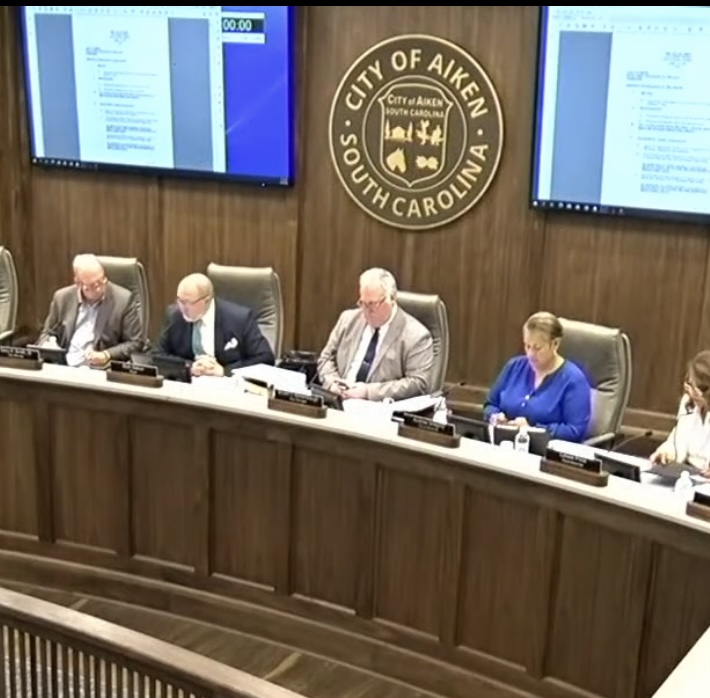
Above: Councilwoman Andrea Gregory and City Manager Stuart Bedenbaugh using their cell phones at 16:33 to 16:38 of the April 10, 2023 Council meeting. At the same time, Mayor Osbon and City Attorney Gary Smith appear to be having a private side conversation.
A second exchange between Councilwomen Gregory and Brohl occurred during the second public hearing to approve the allocation of $15.9 million of plutonium settlement funds for three well-defined projects (3) and to pay off the $9.6 million Project Pascalis bond debt.

Above: Councilwoman Kay Brohl using her cell phone at the 1:30:00 to 1:30:15 portion of the meeting.
The surreptitious messaging also occurred while Councilwoman Lessie Price was openly advocating an amendment to set aside $4 million for Northside neighborhoods within the City limits and for Generations Park.
Councilwoman Brohl: “I can’t believe her.”
Councilwoman Gregory: “What the heck!!!”
Ms. Price’s effort failed, and to this day zero funds from a $25 million pot of the City’s plutonium settlement funds are dedicated to the area between Richland Avenue and the northern city limits.

A third exchange occurred between Councilwoman Gregory and City Manager Stuart Bedenbaugh. Ms. Gregory advocated a Council discussion of the two relatively new agenda items called “public comment on nonagenda items.” The messaging took place during the second public hearing to approve a new hotel near Whiskey Road—which accounts for the reference to the Hampton Inn.
Councilwoman Gregory: “Please make sure we schedule a work session to update the ordinance regarding the 2nd session of public comment. We need to throw it on the agenda immediately.”
Mr. Bedenbaugh: “Ok.”

Ms. Gregory’s motivation behind an ordinance amendment is unknown. A July 21st email asking whether it is a matter of meeting length and/or a reluctance to face more public comment has not been answered. The work session was scheduled June 12th, and not immediately as requested. (4)
Whether or not this private text messaging communication during public meetings is nefarious, complimentary, or irrelevant, the communications are inappropriate. Such communications do not adhere to Robert’s Rules of Order or the South Carolina Freedom of Information Act governing Open Meetings.
Government officials should fully comply with local and state law and standard rules of order, emphasize decorum. Secretive communications during public meetings have no place in a public meeting. Government officials who share their thoughts secretly during public meetings should instead share those thoughts with fellow officials, and those at the top of the organizational chart—the citizenry.
FOOTNOTES
(1) Examples of cell phone use during meetings:
City Manager Stuart Bedenbaugh

City Attorney and meeting Parliamentarian using his cell phone

Councilwoman Andrea Gregory using her cell phone.

(2) The message followed the Mayor’s interruption of a speaker in mid sentence to dispute a known fact. The Mayor subsequentally apologized for his mistake. But if proper rules of order and procedure had been followed, the staff member would stand up, be recognized, and provide the correction for all to hear.
(3) The projects approved for the use of plutonium settlement funding were:
a. $3 million for reconstruction of the Fairfield Street bridge that has been closed by the SC Department of Transportation, due to structural problems, since 2016. The Union Street bridge that is one block away was closed this past January due to structural problems. The two closures leave a gap in access for vehicle traffic and emergency first responders.
b. $3.5 million for the “Northside Sewer Lift Station” to be constructed just north of Interstate 20, more than five miles north of city limits. The project is not an upgrade to old city sewer system lines that are prone to failure.
As reported in “Aiken Takes on Exit 18,” the project will facilitate expansion of the City’s sewer system to service new subdivisions and businesses near I-20’s Exit 18 along Hwy 19.
The only recent public meeting was held a month ago at Smith-Hazel Recreation and Meeting facility, which perpetuates the false perception that the project will benefit the Northside within city limits.
c. $400 thousand for the embattled Williamsburg Street Project at the Aiken Farmer’s Market. The block recently had seventy percent of the tree canopy removed, a planned but unpublicized action that incited so much outrage that the project is currently on hold.
The $400 thousand supplemented the project costs after the low bid was more than $500 thousand dollars over the $960,000 budget. Due to the funding shortfall portions of the project were deferred.
(4) The minutes of that meeting indicate a unanimous preference to reduce and restrict public feedback on non agenda items, although there was no unanimity on a new format.
Aiken City Council will have its first reading of an ordinance to approve a concept plan for a property at Neilson Street off Dougherty Road during its regular meeting at 6:30 p.m. Monday, August 14.
The owner of the property is Wellers Ridge SC, LLC. According to the first page of the memorandum, (found on page 40 of the 565-page agenda package for Monday night’s Aiken City Council meeting), the property is currently undeveloped with extensive tree coverage. The developer is proposing 60 multi-family rental units and a club house on this 5.91-acre parcel.
Concerns have been raised among area residents regarding overdevelopment, traffic congestion, and the potential effects of this development on existing issues of stormwater drainage and flooding. Citizens are organizing in opposition to more development in this area. Petitions are being drawn, signs being made, the media is engaged, and a large turnout is expected for Monday night’s meeting. Below are two letters received this morning from local citizens.

There is a continuance of aggressive building with no sign of relief. This one is an accident waiting to happen. As I sadly watched the concept plan progress to the City Council, I reached out to the people who were having issues, one being major flooding.
I spoke with the owner of University Medical Association first. I explained how I watched her at the meeting. I told her that I and Takin Aiken will stand with her. She passed my information on to the mother, Ann, whose property is on Dougherty Road. The storm in July had left her land (no structure on the property) submerged in water. I and other members of Takin Aiken met with Ann and her 2 children.
We looked at the property, the very old and neglected pipes, and the never-maintained retention pond. The property is County, but the retention pond is City. So, the failure to maintain the retention pond by the City, caused an overflow of water to block Dougherty Road and proceed onto the County property, which was under contract, but was canceled after the flooding. All of this excessive water now is a result of the under construction new build on Neilson Street.
There were many trees removed that helped, in the past, absorb a large portion of the rain water. Now the developer wants to add another 60 units with a club house on 5.91 acres, plus sandwich one neighbors property with two roads, one on each side. Never mind the additional traffic flow on Dougherty Road this will cause. The infrastructure MUST be addressed first before additional building of any kind takes place.
We will be at the City Council meeting on Monday, August 14, 2023 to oppose the concept plan of the 60 units and club house. How many more trees will be removed? How many more properties will be flooded? How long will Dougherty Road be closed? How much more traffic?
I hope everyone that reads this, and has had the opportunity to drive on Dougherty Road, understands that safety come first for the citizens of Aiken.
Mary Camlet-Agresta
Takin Aiken
Aiken, SC
____________________________
More construction and the lack of planning appear to be in the plans again —without concern for citizen’s safety or their well being. Businesses on Dougherty could be affected as well. Traffic on Dougherty is horrible now. Ask anyone who uses it, they’ll say the same. And yet, there are plans for two more streets to turn onto this crowded, narrow road. Can’t help but wonder if anyone on planning/zoning committee has traveled it.
Diane Salsitz
Aiken, SC
By day’s end after the Tuesday, August 8 mayoral primary, the totals were in: Rick Osbon received 1,506 (42.61%) of the votes cast; Teddy Milner received 1,070 (29.3%); and Kathryn Wade received 1,026 (28.09%). The processes that led to those numbers were less exacting.
In the afterglow of a primary that left nearly 72% of City of Aiken voters happy enough to see their candidate facing a runoff instead of defeat, there may be a tendency to leave well enough alone, however, “happy enough” may not describe the mood by day’s end on August 22, should the same snafus riddle the runoff. The accidental disenfranchisement of even one voter is one voter too many.
To understand how to get it right for the August 22 runoff, it is necessary to look at what went wrong in the August 8 primary election.
Throughout the day on Tuesday, stories were repeated across social media and in emails to the Aiken Chronicles about malfunctioning machines, spoiled ballots, and confusion among both voters and poll workers over polling locations.
Much of the confusion was due to (1) the temporary changes in polling locations for the mayoral primary, and/or (2) inadequate notification of this information to the public.
As a result, some voters didn’t get word on the new polling locations. Other voters went to the correct polling locations, but were erroneously sent away to a different location by the poll workers. Some voters left the polls unsure if their votes would be counted. At least one voter left the polls without voting at all.
Some of the comments from these voters can be read here. The publication of these comments is not to engage gratuitous grumbling, but to document that these incidents occurred and, more importantly, to understand how to avoid these same problems on August 22.
Unless you’ve moved to a different address since the last election, your precinct will be the unchanged from the last time you voted. Your polling location, however, may be temporarily changed for the mayoral election.
Find your precinct by looking on your SC Voter Registration card or by plugging in your information to this MySCvotes, which will produce a result similar to the image below, only with your unique information.

Once you confirm your precinct information, you’re ready to consult the chart, below, to find your polling location for the mayoral election.
Early voters. All early voters go to the Aiken County Government Building at 1930 University Parkway. Early voting will be held between 8:30-5:00 on Wednesday, Thursday, Friday of this week, (August 16-18). As with the August 8 primary, Democrats and Republicans alike can vote in the runoff election.
Runoff Election Day voters . Voters headed to the polls for the Tuesday, August 22 runoff will go to the polling locations for their precinct as listed on the chart below. Voting hours are 7:00 a.m. -7:00 p.m.
Click image below for full-size view.

Machine malfunctions and spoiled ballots can happen in any election and can cause delays. According to Aiken County Registration and Elections Director, Cynthia Holland, voters can be assured that their vote was counted by looking at the voting machine screen at the end of the voting process. The message on the screen should read something along the lines of, “Thank you for voting. Your ballot has been counted.”

Should this message not appear, voters should bring this to the attention of a poll worker. If there is still a problem, voters can call the Aiken County Election office at 803-642-2028.
Getting redirected by pollworkers to a different polling location: Double-check your precinct and polling locations, per the above chart. If you’re certain you are in the correct location, stay put and ask the poll worker to please consult their election materials. If there is still a question, call the Aiken County Elections office at 803-642-2082.
Voters in polling locations with multiple precincts, such as Odell Weeks, may run a higher risk of being erroneously redirected to another address, when they may only need to be directed across the hall.
For example: If, according to the chart above, you are in 66 Hitchcock, your temporary new polling location for the mayoral election is Odell Weeks. If a poll worker redirects you to, say, St. Paul’s Lutheran Church, you’ll want to ask them to please double-check their information and, if necessary, call the County Elections office at 803-642-2082 for confirmation.
Other issues: For any other issues not listed here, voters can call the Aiken County Elections Office.
NOTE: Corrections to the information in this article are appreciated and will be promptly updated.
Safety in Small Cities: Aiken Ranks Poorly in “Societal Costs of Crime.”
The Aiken Mayoral Campaign: Initial Ethics Disclosures
The Old Hospital Property: A Presentation by the latest Developer
by Don Moniak
August 11, 2023 (updated August 12th)
Safety in Small Cities: Aiken Ranks Poorly in “Societal Costs of Crime.”
A new public safety analysis by Money Geek is quickly making the rounds locally. The analysis, based on admittedly incomplete FBI data, identifies the City of Aiken as the 13th least safe small city in the U.S.A. in terms of crime costs—-with small cities defined as those with populations between thirty and one hundred thousand. Of the 660 small cities in the analysis, Aiken ranked a lowly 648th in terms of the societal costs of crime.

No matter how the data is viewed, The City of Aiken does not rank well. However, reporting measures to consider before repeating the number as an absolute are:
1. The report ranks small cities by “Crime Cost Per Capita,” which is a measure of economic costs and impact of crime, but not actual crime rates. The U.S. Department of Justice does consider crime costs to be a key measure of the impact of crime.
The University of Chicago Press reports the “aggregate cost of crime conveys the scale of problems from crime and the value of deterrence.”
A RAND Corporation study describes the crime costs in terms of a complex cost-benefit analyses involving trade-offs between more policing and more crime prevention programs. The report concludes that “as a minimum, it is important to recognize that returns on investments in police personnel are likely to be substantial.”
2. The crime rates measured by Money Geek involve a limited set of higher profile violent and property crimes, and not total crime rates. Among the exclusions are “white collar” crime such as fraud and embezzlement, lower profile violent crime such as “simple assault,” and crimes of morality such as illegal drug usage.
3. All crime rates reflect the reporting practices of individual jurisdictions. Reporting that is more thorough in any jurisdiction can result in a perception of a relatively higher crime rate. Vice-versa, a less thorough approach to reporting can result in the appearance of a relatively lower crime rate. For example, the reporting of the crime of rape is known to vary substantially across jurisdictions, and is considered by most reliable sources to be underreported.
4. Crime within city limits but occurring in property “donut holes” under the jurisdiction of the Aiken County Sheriff Department as an Aiken County crime. For example, the burglary and grand larceny at Floyd and Green jewelers in 2022 was in ACSO’s jurisdiction due to the fact the business has never been is annexed into the city. (updated 8/12)
Chronic staffing shortages found in places like the City of Aiken and Aiken County can result in a reluctance to report.
The most recent (June 30, 2023) City of Aiken Human Resources report to Aiken City Council identified twelve (12) vacant Public Safety Officer positions, while the 2022-2023 city budget identified eighty-four 84 full time equivalent positions.
Although Aiken City Council receives the Human Resources monthly staffing report within the Issues and Updates section of its public meeting agenda information packets. The information provided seldom provokes discussion from Council. In contrast, Aiken County Council reviews County staffing vacancy rates on a monthly basis during committee meetings.
The near absence of Aiken Public Safety’s reviews of new developments, particularly on potential crime, also routinely escape Council and the Planning Commission’s notice.
The Aiken Mayoral Campaign: Initial Ethics Disclosures
All three candidates for Aiken City Mayor filed on-time initial campaign contribution reports with the South Carolina Ethics Commission. This is only the Pre-Election filing, and subsequent filing(s) will update the donor list. (All donor mailing addresses beyond “city” are redacted in this article, not in the filings).
Incumbent Mayor Rick Osbon reported $2,200 in cash contributions from four parties, one of which is a personal $600 contribution. One donor from Charleston, SC, Harry Limehouse, is identified as being in the “Parking Solutions” business. One Harry “Chip” Limehouse III is a former State Representative from Charleston who was involved in one of the failed efforts to redevelop the County-owned Old Hospital property at 828 Richland Avenue, West.
A second donor, Aiken builder Todd Gaul, is also a fellow investor in several businesses represented by Aiken Attorney Ray Massey, including CTR, LLC (1), CTRK, LLC, and Aiken Alley Holdings, LLC, the business closely associated with former Pascalis project developer RPM Development Partner, LLC and a key player in the city’s attempt to privatize a portion of Newberry Street for the project.
Osbon earned 42 percent of the vote in the recent Republican primary election, and is now involved in a runoff election with fellow Republican candidate Teddy Milner. Since there is no Democratic Party candidate, the runoff election will determine who will be the next Mayor of Aiken.
The last election in which Rick Osbon raised funds was in 2015 during his successful campaign as Republican Party candidate to replace retiring Mayor Fred Cavanaugh. Osbon raised nearly $55,698 in cash contributions , including $8,000 in personal contributions, and $923 of in-kind contributions. Democratic Party Candidate and Aiken City Councilwoman Lessie Price raised $52,610 in cash contributions and $16,256 of in-kind contributions during that election.

Candidate Teddy Milner listed $6,000 in cash contributions from six individuals in her initial filing, with no personal contribution to date. All of the donors are from Aiken. In Ms. Milner’s first campaign for elected office she earned 29 percent of the vote in the recent Republican primary election, and earned a place in the August 22nd runoff election.

Candidate Kathryn Wade reported $1,600 in a single personal contribution. Wade earned 28 percent of the primary vote, trailing Milner by a mere 44 votes in her third place finish.

The Old Hospital Property: A Presentation by Potential Developer
(updated 8/12)
Tracey Turner is the latest potential developer of the Old Aiken Hospital and former Aiken County Administrator property at 828 Richland Avenue West. He presently has a $950 thousand contract with Aiken County to purchase the property, and has recently proposed to locate the Savannah River National Laboratory “Workforce Development” offices as part of the redevelopment.
On Monday August 14, 2023, Mr. Turner will make a presentation to Aiken City Council during a work session at City Hall, 111 Chesterfield Street, South.
The timing of the presentation is unknown due to a confusing Executive Session announcement.
An Executive Session is tentatively scheduled for 5 p.m. , but could occur before the 7 pm meeting or after the meeting. The subject of the closed-door meeting is a “pending appeal involving the City’s business license ordinance.“ (The ongoing Ed Woltz case is the only case that matches this description).
The work session is tentatively scheduled after the Executive Session, but might begin at 5 p.m. It will begin with an Aiken Public Safety and citizens briefing on the ”Virginia Acres Incident.” Mr. Turner’s presentation will follow that briefing.
Work sessions are open to public viewing but seldom to public participation; and are unavailable via live streaming on the City’s You Tube channel.


Footnote
(1) Mr. Gaul and Mr. Massey were listed as attendees (below) at a one-hour Aiken City Council closed-door Executive Session on January 24, 2022. (January 24, 2022 Meeting Minutes). The session was held to discuss the proposed sale of city property to CTR, LLC known as the “Brinkley Building.” The property, located at the corner of Newberry Street and The Alley, was purchased by the City in 2008 in the hopes of expanding the Municipal Building at 214 Park Avenue, West.

Massey is also Aiken City Attorney Gary Smith’s law partner, who was also listed as a meeting attendant. This proposed sale of city property is cited by the Plaintiffs in Paragraph 124 of the Blake et al vs City of Aiken et al lawsuit pertaining to Project Pascalis. Mr. Massey is named as a Defendant for his role with Pascalis project developer RPM Development Partners. (The latter stands for Raines, Purser, and Massey). Mr. Gaul is uninvolved in the lawsuit.
The proposed sale was on the agenda for that evening, but the agenda item was removed without explanation at the start of the public meeting. According to City Manager Stuart Bedenbaugh’s supporting memorandum (below), the purchase offer was $180,851 less than the price the City had paid for the property in 2008.


