Whose voices will be heard in this election? Below are more letters received from Aiken City residents hoping their voices — their votes — will be the ones heard in tomorrow’s mayoral runoff.
Updated 8/21/23 at 11:42 a.m. to add a fourth letter.
Jack Wetzel: Why I am Voting for Teddy Milner on August 22
It is no surprise that Aiken’s Association of Realtors endorsed Mayor Rick Osbon for re-election. Under his leadership, Aiken has seen flurries of developments approved, choking major roads and streets cutting across our burgeoning city. Realtors can hardly be expected to vote against the hand that feeds them their commissions.
The city infrastructure is increasingly unable to handle the growing lines of vehicles that accompany new housing construction, but Rick Osbon’s leadership has not resulted in solutions to the predictable traffic congestion. The Powderhouse feeder has slipped schedule and exploded in cost. The agonizing traffic disruption at the intersection of Silver Bluff Road and 118 bypass is another example.
At one point, work ceased there because of yet another contract given out by the Osbon administration to a company that did not deliver what their contract called for (shades of the trees destroyed along Williamsburg Street and behind the farmers market.) The Dougherty Road and Parker’s Kitchens are also examples of Osbon administration poor leadership.
It is not surprising that clusters of local, state and national politicians endorse Osbon’s re-election. Birds of a feather flock together.
For decades, Aiken has taken pride in and enjoyed its heritage of Winter Colony homes mixed with quaint cottages, a charming downtown ambiance, and a Southern lifestyle of quality along streets cut by wide green parkways.
Mayor Osbon has approved plan after plan that would change all that and convert our downtown into a metropolis of slick new buildings and organizations with no interest in what the taxpayers and residents want. Planning meetings discouraged public input. As an example, the Pascalis project would have demolished charming downtown historic structures and replace them with a large apartment building requiring an equally large parking facility and alteration of Newberry street where many of Aiken’s unique events are attended by thousands of residents and visitors to the city. That failed plan left the city with a debt exceeding $9 million.
Osbon also endorsed building a Savannah River National Laboratory downtown, again replacing old historic structures which add to the area’s leisurely ambiance. It would also result in traffic congestion nightmares. He has been a strong proponent of additional programs at the Savannah River Site which provides a portion of jobs in the city, but also places everyone in and around Aiken with health and safety risks.
In recent years, SRS cleanup of deadly radioactive waste, housed and leaking since the 1950s, was a Department of Energy priority. Incomplete, the cleanup priority moved aside for a dangerous program making Aiken a major target for any nuclear attack on the U.S. (pit production, or triggers for nuclear warheads). Aiken could be incinerated beyond the speed of Hiroshima. Mayor Osbon has not objected.
Teddy Milner opposes all that and supports growth stemming from public input and concerns; a community where progress and people are compatible. I am voting for Teddy Milner on Aug. 22.
Jack Wetzel Aiken
________________
Bill Reichardt: Aiken Evolving Toward “Anytown, USA”
Do you see Aiken as a special place and want to halt its headlong march toward mediocrity? If so, please vote for Teddy Milner.
Ms. Milner sees Aiken as a community where the distinctive qualities of the City merit respect. She appears to believe that all of the City’s neighborhoods have standing and deserve recognition and not just the immediate downtown area. She favors a moratorium on selected developments so that the City can take a long-overdue reassessment of its future as a place for all of Aiken’s constituents – in contrast to indiscriminate, nonstop, commercial sprawl.
Mr. Osbon, an obvious favorite of Aiken’s realtors, appears to favor virtually unchecked commercial growth, with Aiken’s character and future shaped largely by developers – rather than by the community.
In recent years, Aiken has been evolving toward “Anytown, USA”. During the April 24, 2023, City Council meeting Mayor Osbon said, in essence, that the City does not determine which developments take place and where; it is up to developers. At the first Republican mayoral candidates forum in July, Mayor Osbon rejected any notion that there should be a moratorium on development at the south end of Aiken – a truly reckless stance.
Given the dangerous Whiskey/Powderhouse/Stratford intersection (including numerous Whiskey Road problems cited by City staff twenty years ago), Mr. Osbon’s view of Aiken’s future is worrisome at the very least.
Certainly, Aiken must grow. It’s a matter of how.
Bill Reichardt Aiken, SC
________________
Jean Greenwald: It’s Time for New Leadership in Aiken
I voted for Teddy Milner because Aiken officials have gone off the rails — rails that they just earmarked $900K for, instead of spending that money on something more essential like, for instance, clean tap-water for city residents. The train-wreck of failed Project Pascalis has cost taxpayers millions. There has been no accountability for killing public trust and no accountability for killing the Farmers Market trees.
My first city council meeting under the leadership of Mayor Osbon was when, despite three neighborhoods of opposition, they approved a car wash in my backyard. They did not give notice to the public in accordance with their own rules, nor did they acknowledge the conditions that the parcel was zoned with, which included no car washes. Until recently it appears this council had become quite accustomed to running roughshod over their citizenry. I have attended many meetings since they saddled us with Lulu’s Car Wash, and I have seen other citizens cry out for things as simple as clean water, or for the police to show up when called, which appears to have fallen on deaf ears.
The current push to expand the city limits is really just a nice name for costly and often ugly sprawl, yet it appears the Mayor has not been successful in taking care of the city’s current backyard. He was successful at becoming the government landlord of his only downtown competitor’s business which is poor form at best.
It’s time for new leadership in Aiken.
Jean Greenwald Aiken, SC
________________
Lee S. Thornton: Towards a better city for all with renewed energy and collaboration
On the eve of tomorrow’s Mayoral election for the city of Aiken, I find I am increasingly feeling the need to make a plea to those able to vote that they realize the importance of their vote.
Hanging in the balance, teetering precariously, is a city under siege from within. While I am not sure exactly when this began I know that it is time for a new mayor, and thankfully Teddy Milner is up to the task and has the support of a great many of us who believe the incumbent is no longer working on behalf of the citizens to be a worthy custodian and steward of all of Aiken.
These concerned people include small business owners whose livelihoods depend on the city not allowing nearly an entire city block to become a lab/office for a government agency that could build elsewhere in town. Citizens, as well as tourists, who visit Aiken to experience the unique shops and restaurants, and who appreciate the overarching entrepreneurial spirit will be met with a town forever lost if the current mayor continues to be at the helm. His administration’s $9 million investment, which intended to demolish half a block of downtown buildings, now lies virtually idle, with surrounding rents continuing to become inflated, driving out more of what makes Aiken unique and possessive of the “best small southern downtown” distinction.
The drive to partner with SRNL and give the green light to an office/lab would move forward despite much objection. Gone would be the ambiance of a tree-lined, cared-for cityscape with a parkway and free on-street parking (rather than building a huge, unneeded parking garage). The cascade of dominoes would have the city folk wondering what happened. Joni Mitchell’s words would ring true, and it would then be too late.
This is what just happened at the Farmer’s Market. Plans were made behind closed doors to pave over and destroy all but a few trees. Barely any shade remains because nobody was given notice, and opposition could only happen after the fact, when it was too late. The city and current mayor lied by saying the contractor got the wrong set of plans, when there was only ever one set!
The current mayor is approving sewer extension to the outskirts north of Aiken and past Wire Rd to appease developers, when inside of Aiken proper the water is brown and reportedly making residents sick. The bridges remain in disrepair, and the hotel Aiken remains vacant and crumbling.
The list goes on, but thankfully Teddy Milner, a small business owner who has raised her family and helped to cultivate community with her restaurant on Hayne Avenue has stepped up to the plate to help at this critical time. If elected mayor she will open the doors again for dialogue, discussion, inclusion and renewed revitalization of Aiken to move into the next stage of her growth while maintaining the qualities that drew many of us to make it our hometown.
Tomorrow we have the opportunity to make the change and I stand strongly in favor of Teddy to help us turn the tide towards a better city for all with renewed energy and collaboration.
After spending too much of my summer energies mourning the tragedies of the latest US war, I’ve decided to put my time, my research skills, and my helplessness to better use: explaining the enchanting beasts that have been summering on the moonflower vine outside our kitchen window.
Of Physiognomy
I considered all possible lenses through which to view these moonflower enchantresses — the poetic, the literary, the philosophical, the scientific. I finally settled on them all, turning the matter over to the authority on each and every facet, Jean-Henri Fabre, the father of literary entomology.
It was Fabre who, during the 19th century, was born to this earth possessing the tongue of a poet, the soul of a philosopher, and an innate, yet uncanny fascination with insects. The scientific instrument has yet to be invented that could hope to replicate what Fabre observed with the naked eye. His gift to science endures today, not just because of the body of knowledge he left on each insect he studied, but because, in his words, “I cause itto be loved.”
Unlike many scientists, Fabre did not travel the world to discover the exotic, but found it within the kingdom of his own backyard. Gathering his subjects from nearby fields and woods, he assembled a menagerie that included fantastical Great Peacock Moths, Pine Processionary Caterpillars, Sacred Beetles, Cicadas and that veritable tigress of the insect kingdom, the Praying Mantis, about whom he eloquently observed:
She is not without a certain beauty, in fact, with her slender figure, her elegant bust, her pale-green coloring and her long gauze wings. No ferocious mandibles, opening like shears; on the contrary, a dainty pointed muzzle that seems made for billing and cooing…. Alone among insects, the Mantis directs her gaze; she inspects and examines; she almost has a physiognomy. Fabre, J. Henri, The Life of the Grasshopper , 1917, p. 115.
But Fabre was no romantic. He was nothing, if not shrewd in his observation of the Mantis, whose mating habits, he said, went “beyond the wildest dreams of the most horrible imagination. I have seen it done with my own eyes,” he wrote, “and have not yet recovered from my astonishment.”
I find, by themselves, a horrible couple engaged as follows. The male, absorbed in the performance of his vital functions, holds the female in a tight embrace. But the wretch has no head; he has no neck; he has hardly a body. The other, with her muzzle turned over her shoulder continues very placidly to gnaw what remains of the gentle swain. And, all the time, that masculine stump, holding on firmly, goes on with the business!
Love is stronger than death, men say. Taken literally, the aphorism has never received a more brilliant confirmation. A headless creature, an insect amputated down to the middle of the chest, a very corpse persists in endeavouring to give life. It will not let go until the abdomen, the seat of the procreative organs, is attacked. — Fabre, J. Henri, The Life of the Grasshopper , 1917, p. 144.
I, myself, have never witnessed this act, although we have been watching the Praying Mantises outside the window since July — watching them tranform from thin-waisted maidens, to fat, egg-laden matrons. Ours are neither the European Mantis (Mantis religiosa) of Fabre’s laboratory, nor the giant Chinese Mantis (Tenodera sinensis) whose manners gave birth to the Praying Mantis school of kung fu in 17th century China. The latter mantises are immigrants, which traveled to America aboard nursery stock around the time of the Spanish-American War and are now naturalized.
Our moon flower sisters are Carolina Mantises (Stagmomantis carolina), which are not only native to this land but are the official State Insect of my home state, South Carolina.
The moon flower vine was not my first encounter with the Carolina Mantis. Several years ago, in another house, a lovely she-Mantis lived in the Japanese ligustrum beside my front porch, where the two of us watched, in tandem, the passers-by. Here she is:
She was my first day-to-day, up-close encounter with a Mantis — the first Mantis with whom I exchanged eye contact and experienced that ethereal thing that Mantises do. Tracking my movement with that curiously pivoting head, she watched as I peered through the branches trying to find the best angle for viewing her. She watched me; I watched her. In utter silence, and each for our own reasons, we gazed.
During my reading, I’ve puzzled over the treatment of the Mantis by modern science. How is it possible to reduce such a fantastically-constructed creature to so much white noise? I’ll show you.
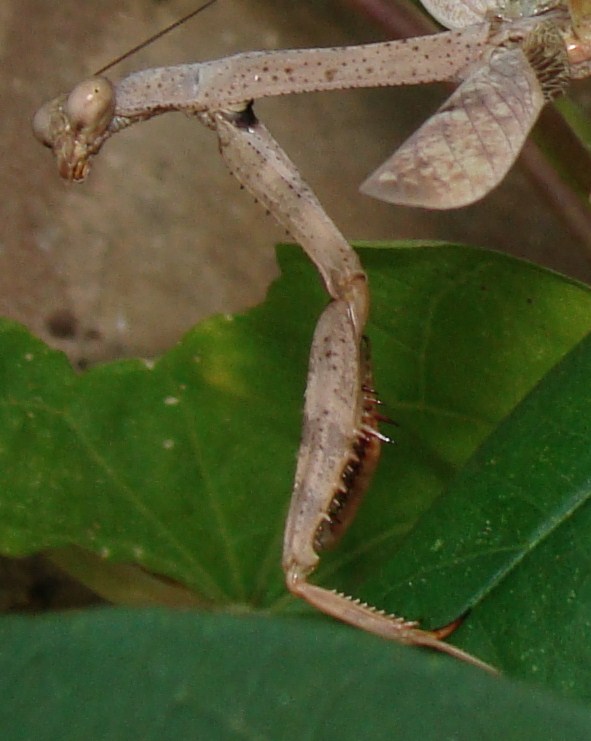
Compare the forelegs (seen in ‘prayer’ in the photograph above) with the photo, below, taken this summer. Then compare these photos to the following two descriptions — both quoted from scientific texts.
First, the “modern science” treatment:
“The mantid’s forelegs are raptorial with elongated coxae and femora with the presence of opposed rows of spines on the femora and the tibiae.” — Prete, Frederic R., Et. al,, The Praying Mantids, 1999, p. 21.
Imagine pages of such text. Is it any wonder that schoolchildren sometimes daydream of other worlds during science lessons? For Prete and company, that one sentence sufficed for those deadly arms.
Not so for J. Henri Fabre:
Those arms, folded in prayer, are cut-throat weapons: they tell no beads, they slay whatever passes within range…. Great, indeed is the contrast between the body as a whole, with its very pacific aspect, and the murderous mechanism of the forelegs, which are correctly described as raptorial. The haunch is uncommonly long and powerful. Its function is to throw forward the rat-trap, which does not await its victim but goes in search of it. The snare is decked out with some show of finery….
The thigh, longer still, a sort of flattened spindle, carries on the front half of its lower surface two rows of sharp spikes. In the inner row there are a dozen, alternately black and green, the green being shorter than the black. This alternation of unequal lengths increases the number of cogs and improves the effectiveness of the weapon. The outer row is simpler and has only four teeth. Lastly, three spurs, the longest of all, stand out beneath the two rows. In short, the thigh is a saw with two parallel blades, separated by a groove in which the leg lies when folded back.
The leg, which moves very easily on its joint with the thigh, is likewise a double-edged saw. The teeth are smaller, more numerous and closer together than those on the thigh. It ends in a strong hook whose point vies the finest needle for sharpness, a hook fluted underneath and having a double blade like a curved pruning knife. …
When at rest, the trap is folded and pressed back against the chest and looks quite harmless. There you have the insect praying. But, should a victim pass, the attitude of prayer is dropped abruptly. Suddenly, unfolded, the three long sections of the machine throw to a distance their terminal grapnel, which harpoons the prey and, in returning, draws it back between the two saws. The vice closes with a movement like that of the forearm and upper arm; and all is over. Locusts, Grasshoppers and others even more powerful, once caught in the mechanism with its four rows of teeth, are irretrievably lost. Neither their desperate fluttering nor their kicking will make the terrible engine release its hold. —
Fabre, J. Henri, The Life of the Grasshopper , 1917, pp. 115-118.
And so the long days of summer have passed among the leaves of the moon flower vine. I can only take Fabre’s word for what has commenced at night in the near-glow of our kitchen light. We’ve never witnessed it. Just the half-eaten remains the morning after — here and there a moth carcass, a scattering of legs and wings, a camel cricket reduced to mere junkyard salvage, its front-end picked of its choice parts, the headlights snatched from their sockets, its taut legs reduced to lifeless wires.
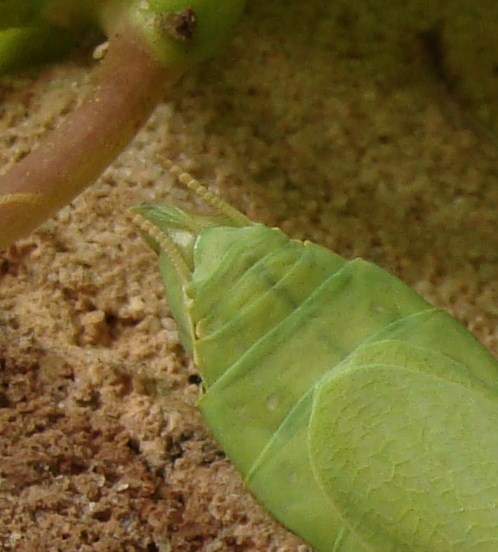
Too, there’s been the steady growth of the two sisters, their appearance as different as night and day. One is colored the precise green of the moonflower stems, each of her wings marked with a single, dark eye-spot, called a stigma, which not only mimics leaf blemishes and stem scars, but — with a mere unfurling of her wings — can double as fierce eyes to startle and fend off potential attackers. The other Mantis wears a simple mottled brown frock that depends on the kindness of dead leaves for camouflage.
Both are no doubt responsible for the mysterious disappearance of the ant trails that boldy paraded up and down the vines during early summer, using the vines as a superhighway between the azaleas and the kitchen window, inside which the ants stole to smuggle the stray sugar granules scattered about the coffeepot. We owe the Mantises a debt of gratitude for putting an end to these night marauders, even as our gratitude is tinged with remorse for any Sphinx Moths we unintentionally lured to their deaths by our decision to plant the moonflower vine in that location.
It is with a similar sadness that we see summer coming to a close. As each day of August winds to an end, we are one day closer to the conclusion of the Mantises’ life cycles. If they’ve not already done so, the femme fatales will release, any night now, their pheromones to draw the male Mantises — much smaller and thinner by comparison — who will fertilize the eggs that have so swollen their female’s abdomens. Throughout the courtship season, each female may receive many gentleman callers.
Contrary to popular myth, it is not a given that the male will be consumed during consummation. This practice varies greatly between Mantis species, with the European Mantis being more inclined to cannibalize her mate, and the Carolina Mantis being quite disinclined to do so — to the extent, in fact, that it rarely happens in the wild, unless she is very hungry.
In all cases, this practice is more common in captivity than in the field, where there is less likelihood of the artificial distractions and mis-directed visual cues, which are believed to scramble the sequence of events and trigger the predatory response in the female.
Within a week or so of mating, the female sows the seeds of their progeny. These will be secreted inside a tan, meringue-like egg case, called an ootheca, which she will affix to nearby vegetation or structure. This foamy concoction — measuring, give or take, an inch in length — will quickly set, its myriad tiny air bubbles providing the perfect insulation against the elements for the neatly arranged catacomb of eggs inside. According to Fabre, “the whole thing demands about two hours of concentrated work, free from interruption.”
If this confection doesn’t become the foodstuffs of lizards, wasps or ants during autumn and winter, it will bloom to hatching, come next spring, with 200 or so hungry and often cannibalistic nymphs. The mother may or may not spend the balance of summer watching over her egg cases. Regardless, the laying of the eggs is the beginning of her swan song. By the end of September, the beautiful enchantresses will likely be dead.
The Cyclopean Ear
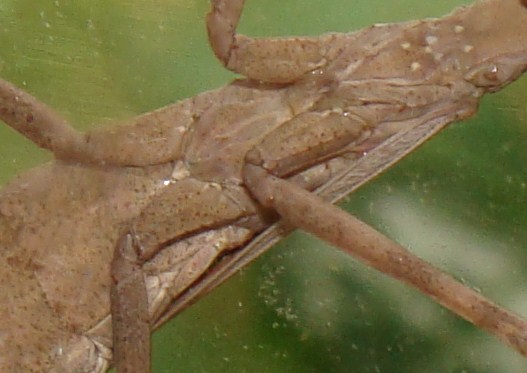
I apologize that our rudimentary camera skills do not offer a better view of the Mantis’ fascinating ear. Our best efforts at photographing the Mantises, which you see on this page, are testament to my daughter’s persistence with the camera. Below is the underside view of the brown Carolina Mantis on the kitchen window as viewed from indoors.
The single ear of the Mantis, which is unique to the Mantis kingdom — and, even then, to only certain species — is located on the metathorax. Look for it in the pinkish, fleshy area of the belly between the two pairs of legs, where it’s punctuated at its base with a whitish, tooth-shaped appendage, called a bifid horn or tooth, which is also part of the ear. This hearing organ — aptly called a cyclopean ear — has been much-studied by scientists to determine both its purpose and the advantages to its odd location.
Some Mantises, (although I cannot confirm this in the Carolina Mantis), have a second cyclopean ear — a mesothoracic ear — located higher up in the mesothorax, which is capable of hearing in lower ranges, below 10 kHz. I mention this because, to my eyes, there appears to a second ear structure in the photo, above. I hope to one day learn more about this.
In the female, the metothoracic cyclopean ear is little more than a vestigial organ — her hearing capacity diminished or entirely absent, as is the case with most, if not all, of the flightless mantids. Flighted males, on the other hand — who take to the air at night in search of the sirens’ pheromone perfume — need this ear to evade bats, one of their most formidable predators. As such, this ear is set to detect frequencies between 25-60 kHz with thresholds of 50 to 60 decibels— the precise range of bat echolations. At the first hint of this ultrasonic tuning fork, the Mantis stalls mid-flight, like a disabled bi-plane, instantly lowering his wings, which sends him into a freefall spiral toward the ground. Being a single ear, this cyclopean ear lacks the stereo perception necessary to pinpointing the direction of the sound.
Not so with the cerci. Both male and female Mantises (as well as myriad other insects) own a certain capacity for hearing through their cerci, that pair of beaded, antenna-like appendages near the very tip of their rear. Unlike the cylopean ear, designed to hear bats from a relative distance, the cerci are equipped to detect ‘near-field’ sounds — from the arrival of a suitor, to the arrival of prey or, alternately, a predator. In females, the cerci are also used in the delicate frothing and shaping of the ootheca. Studies suggest that the cerci also aid the flighted Mantis in fine-tuning the location of the bat.
I can add little more on the topic of hearing, having already suffered through reading what modern science has to say on its studies of the cyclopean ear and the cerci, which left me with sort of gut pain a person feels reading about human torture and other crimes of war. The modern scientific methods for studying these auditory organs invariably involve barbaric procedures, with much cutting and slitting of the Mantis’s body, including fullscale amputations and decapitations. From this point, the Mantis is wired with various sensors, and its hearing organs coated with wax or petroleum jelly, before being tethered in a laboratory room, to see how it interacts with a bat. If only Fabre were still alive to tutor these scientists in the art of observation.
You rip up the animal, and I study it alive; you turn it into an object of horror and pity, whereas I cause it to be loved; you labour in a torture-chamber and dissecting room, and I make my observations under the blue sky to the song of the Cicadas, you subject cell and protoplasm to chemical tests, I study instinct in its loftiest manifestations; you pry into death, I pry into life. — Fabre, J. Henri,“The Harmas.” The Life of the Fly, 1913, p. 3
Unlike the cyclops ear — the acuity of which increases, as a rule, in direct proportion to the wing-length — the cerci seem to exist in equal measure, regardless of flight abilities or the sex of the mantis. The cerci appear to work in conjunction with the Mantis’ eyes for surveying the surroundings. Mantises have five eyes in all: two large compound eyes with stereoscopic, color vision, that are adept at gauging distance, plus three simple eyes, called ocelli. Located in a triangular formation between the antennae, the ocelli are larger and better developed in males, and are believed to aid in discerning between light and dark. (An aside: to see excellent images of these eyes, plus the source for this information, click here: cirrusimage.com)
Even as the Mantis has excellent eyesight — capable of both sharp, near-distance vision, and the ability to detect movement up to 60 feet away — its compound eyes command only a 300° field of vision, just 60° shy of encompassing a full circle. It makes sense, then, that the Mantis would need compensation for this built-in blind spot, the cerci being the equivalent of the back-up camera in modern vehicles.
That males and female, alike, have well-developed cerci lends credence to the theory that the primary purpose of these organs is to alert the Mantis to approaching prey and predators in the bush, which is where the female Carolina Mantis spends the majority of her life.
This is because the wings of the female Carolina Mantis, in contrast to the male, are of little use for flying. Arriving late in life, and only after her final molt — the last of 7 to 10 molts she undergoes over her lifetime — these wings are too short for real flight and are of no use once her belly becomes too cumbersome for such lofty aspirations. The important thing, however, is not what she can’t do, but what she can do with these exquisite parasails.
An August Affair
The morning we took the photo, below, our attention had been drawn from our morning routines in the kitchen to the startling sight of the brown Mantis outside the window — her barbed forelegs waving about in a most un-prayerful manner, her wings unfurled like an exotic bird of paradise. Something was the matter.
Whatever the matter, it was pressing enough to render the nearby spittle bug inconsequential. The two Mantises spent the balance of the morning moving about the vine, much like boxers in a ring, only they inched further and further apart until, at last, the brown one removed herself entirely from the equation — creeping, brick by brick, away from the vine entirely and to the upper reaches of the window frame, where she took up residence.
From my reading, I suspect that the two sisters were involved in a standoff, which is not uncommon in mid to late August, as the females bellies become swollen with eggs. Witnessing this behavior in his laboratory, Fabre wondered if this were unique to confined females, or if it also occurred in the wild. Regardless, he kept his charges well-fed during this life stage, so that “should civil war break out, famine cannot be pleaded as the excuse.” Fabre’s description of this mysterious affair deserves reading:
At first, things go pretty well. The community lives in peace, each Mantis grabbing and eating whatever comes near her, without seeking strife with her neighbours. But this harmonious period does not last long. The bellies swell, the eggs are ripening in the ovaries, marriage and laying-time are at hand. Then a sort of jealous fury bursts out, although there is an entire absence of males who might be held reponsible for feminine rivalry. The working of the ovaries seems to pervert the flock, inspiring its members with a mania for devouring one another. There are threats, personal encounters, cannibal feasts. Once more, the spectral pose appears, the hissing of the wings, the fearsome gesture of the grapnels outstretched and uplifted in the air….
For no reason that I can gather, two neighbours suddenly assume their attitude of war. They turn their heads to the right and left, provoking each other, exchanging insulting glances. The “Puff! Puff!” of the wings rubbed by the abdomen sounds the charge….
Then one of the grapnels, with a sudden spring, shoots out to its full length and strikes the rival; it is no less abruptly withdrawn and resumes the defensive. The adversary hits back…. At the first blood drawn from her flabby paunch, or even before receiving the least wound, one of the duellists confesses herself beaten and retires. The other furls her battle-standard and does off elsewhither to mediate the capture of a Locust, keeping apparently calm, but ever ready to repeat the quarrel.
Very often, events take a more tragic turn. At such times, the full posture of the duels to the death is assumed. The murderous fore-arms are unfolded and raised in the air. Woe to the vanquished! The other seizes her in her vice and then and there proceeds to eat her, beginning at the neck, of course. —Fabre, J. Henri, The Life of the Grasshopper , 1917, pp. 138-140
If the green Mantis ever responded in kind — unfurling the fury of her battle regalia toward the brown Mantis — we missed it. To our observation, she never changed her prayerful pose, but instead moved carefully about the vine, her intent appearing to be no more complex than to keep a safe distance from the brown Mantis. During this fracas, she did something she never does — haplessly straying from the safety of her camouflage into bold sight, backdropped by tan brick.
An Inexplicable Peace
One July morning — long before the morning of the August spat — I’d gone out to the moonflower vine to spend a spell watching the green mantis. Until that morning, we were oblivious to the existence of the brown Mantis, even as we’d spent many long spells gazing into the leaves, tracing every inch of the vines trying to locate the well-camouflaged green Mantis.
Not so on this particular July morning. Right there, in plain sight, was the green Mantis, poised beside what appeared to be a molted skin, hanging upside-down from a stem. Curious, I was about to touch the skinwhen, to my shock, it moved! The skin quivered, as if being stroked by a small breeze, only there was none.
Looking closer, I realized that this was not the shed skin of the green Mantis, but a second Mantis, in the process of molting. I wondered, at the time, about the green Mantis’ presence. Not yet knowing any better, I wondered: Was this her mate?
Learning the answer to this question (“No”) only bred more questions — especially this: Why didn’t she just eat the brown Mantis?
Helpless and vulnerable, her molting sister couldn’t have been easier prey. It would have been effortless for the green one to reach over with a barbed hook and, yawn, snag the brown Mantis. Yet, she didn’t. Even more intriguing is this: If she wasn’t there to prey — as is the greatest supplication at this life stage of the Mantis — why was she there?
“Oh, the fierce beasts!” exclaimed Fabre. “They say dog does not eat dog. The Mantis has no scruples; she feasts on her fellows even when her favourite food, the cricket, is plentiful around her.” — Fabre, J. Henri, The Life of the Grasshopper , 1917, pp. 140-141.
While I acknowledge I may be projecting, there seemed to be an almost protective stance to her position. But why would she do this? I was unable to find the answer — not in the annals of Fabre, nor in more recent entomological studies. I only know that I’ve never again seen the two Mantises in such close proximity. Quite the contrary. Even before the morning of the spat, the two maintained fairly separate zones within the moonflower jungle.
My best guess is that, at that particular life stage — unlike the nymph stage, egg-laden stage, and the mating stage, all of which are prone to acts of cannibalism — there is some compulsion to preserve the species.
Alternately, there may be aspects of a Mantis’ nature, even if it’s nothing grander than the capacity for idle curiosity, that cannot be seen or measured, no matter how precisely laid the scalpel; no matter how sensitive the instrument. The tool has yet to be devised, for instance, that can quantify the existence of the human soul, much less qualify it. The same may be true of any creature on the earth. We just don’t know.
The Animal That Prays to God
The subjects of Fabre’s lab, Mantis religiosa, were known to the country folk as lou Prego-Dieu, which translates to “the animal that prays to God.” Fabre seemed somewhat amused by their naiveté on the habits of the Mantis.
Peasants are not particular about resemblances. They saw a stately-looking insect standing majestically on the sun-grilled grasses. They noticed her large delicate green wings hanging about her like a linen veil and her front feet, her hands so to speak, raised to heaven as if she prayed. That was enough for them; the thickets were peopled with prophetesses and nuns in prayer! — Fabre, J. Henri, The Life of the Grasshopper , 1917, pp. 113-114.
Humans seem to have been similarly named. The nomenclature, Homo sapiens, or ” wise man” presumes much. While it is true that, compared to other animals, our brains allow us specific capacities for abstract reasoning, language, artistic expression and a sophisticated use of tools, the term, “wise” implies that we, as a species, have somehow been elevated from the thick-skulled constraints of Homo erectus — as if there were more than window-dressing to our ability to wear a fine pair of trousers as we march off to war.
This is some of what I’ve been pondering this summer while watching the enchanting beasts on the moonflower vine, backdropped as they were by the unfolding carnage of human warfare. The politicians, the profiteers and their propagandists have been hard at work, issuing from their chambers and boardrooms the pious rituals of war; their pomp and circumstance always preceded in prayer, their jagged mandibles poised to pontificate and prey upon humanity.
Witnessing this has been, as Fabre wrote, “beyond the wildest dreams of the most horrible imagination. I have seen it done with my own eyes, and have not yet recovered from my astonishment.”
As centuries of recorded human thought can attest, we humans are evolved creatures. We can hardly blame our brutalities on instinct. Here, the Mantis poses a rhetorical question for us all. It could be that Homo sapiens are simply endowed with different measures of wisdom. The same may very well be true of the Mantis which, in my mind, I’ve adequately explained.
_____________________________
Epilogue: The Following Spring
There was more to the summer story of the Mantises, but I didn’t have the heart to tell it just yet. Shortly after finishing the above article, the suitors arrived. The last time we saw the green Mantis, she was with her sweetheart. The two of them had chosen, of all places, to become engaged in the middle of the tan brick wall. Lovely green Mantis, tan wall. We never saw her again.
The brown Mantis, on the other hand, lived out her entire natural life, which lasted through the month of September. She left behind two egg cases, each one neatly camouflaged in the mortar alleys between the brick.
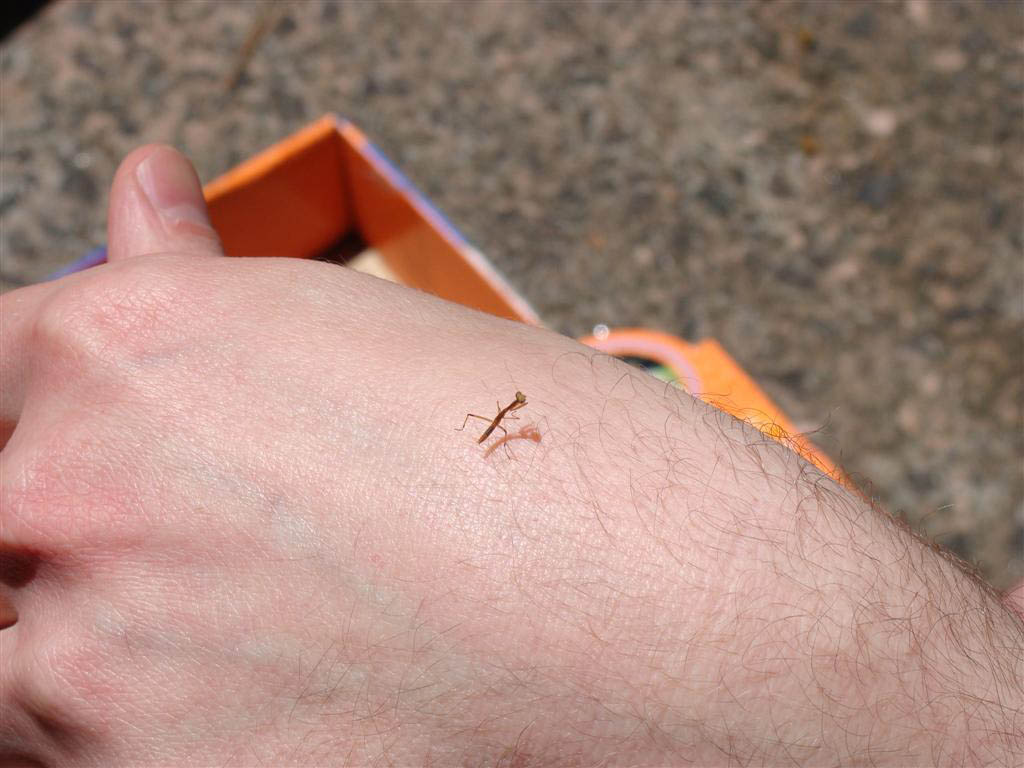
Today, a tiny being with legs not much larger than the hair on a human arm sprung into our lives. It arrived seemingly out of nowhere, within just a few feet from the old moonflower vines, and landed midway down my son-in-law’s terminal grapnel.
A joint statement from Laura Lance and Donald Moniak August 19, 2023
The Aiken Chronicles endorses Teddy Milner for our next Mayor of Aiken. We urge all registered City of Aiken voters to endorse Milner as a vote for change in the Republican Party runoff election on Tuesday, August 22. Since the Democratic Party again failed to field a Mayoral nominee, the victor in the runoff will be the next mayor of Aiken.
The Aiken Chronicles did not endorse a candidate for the August 8th Primary Election. Instead, we chose to submit a series of questions, compiled by contributors and readers to the candidates.
Only candidates Kathryn Wade and Teddy Milner opted to provide answers, which were reported in the Aiken Chronicles August 2, 2023Online Mayoral Forum.
Among the answers provided by Ms. Milner that led to this endorsement over incumbent Mayor Rick Osbon are:
A firm resolve to keep local government out of the commercial real estate business.
A courageous and principled willingness to work with the Aiken County Homeless Coalition to address Aiken’s growing population of unhoused citizens.
Simply put, a vote for Teddy Milner is a vote to restore public participation in the decisions that affect our lives; a vote to begin the process of returning Aiken to its citizens.
21st-Century Housing Developments in North Aiken and Recent Doses of Subsidies for Big Developers.
by Don Moniak
August 19, 2023
Jacob Klarman, the President of the Aiken Association of Realtors, wrote the following in an error ridden and insulting letter to the editor this week. The letter endorsing Mayor Rick Osbon for re-election claimed Mr. Osbon is the “only realtor friendly candidate.” But it was this stereotyping of the “Northside” that was equally noticeable:
“The mayor has helped secure utility service expansion to the Northside of Aiken which has led to three new housing developments. This is an area thatno one has made efforts to develop in decades.” (Aiken Standard 8/16/23)
First, the utility service expansion that was approved by Aiken County Council in December 2020 was primarily for an area north of Interstate 20. No new housing developments have occurred in the expansion area; the only commercial development is a 7-11 gas station/convenience store now under construction on the north side of Exit 22.
As for “This is an area where no one has made efforts and “decades,” is Mr. Klarman the realtor unaware of the history of 21st-century housing growth in North Aiken?
North Aiken area housing growth has occurred this century both within city limits and within a few miles of city limits. One new neighborhood, Trolley Run Station, is presently is already more than fifty percent developed than the combined sum of all newly planned and proposed North Aiken housing developments.
In addition to Trolley Run Station, Dupont Landing and Summer Lakes are two other large new neighborhoods initiated a decade before Rick Osbon was first elected City of Aiken Mayor in 2015. Between that period and Mr. Osbon’s election was a short era known as The Great Recession, a period characterized by a decline in new housing starts.
Trolley Run Station.
Trolley Run Station is the most significant of the three developments both in terms of size and future growth. The area is only a half-mile northwesterly of Aiken city limits, just around the corner from the University of South Carolina at Aiken (USCA). It is also only 0.7 miles from one of the three new housing developments in the county that were cited by Mr. Klarman for future “expansion” of city utility services (1).
Development began around 2005, and in 2008 the Market Street Station Apartments were completed. Single family homes and townhouses quickly followed.
Trolley Run Station has since grown into one of the largest new neighborhoods in Aiken County, and its residents have a substantial economic impact on the City of Aiken.
Well over a thousand homes, townhomes, and apartments are now spread across more than 400 acres. Another 150 acres is under development, and ~1,000 acres is planned for development. An additional thousand acres are planned for development.
If all the plans come to fruition, Trolly Run Station will stretch west almost to the Vaucluse community.
Like much of the City of Aiken, Trolley Run is situated in the upper Horse Creek Watershed. The Bridge Creek corridor, categorized as swampland by Aiken County, provides 130-acres of protected green space and bottomland within the development area.
Unlike most of the North Aiken area, Valley Public Service Authority provides Trolley Run Station with drinking water and sewer service. Perhaps because this largest new neighborhood in the North Aiken area is not serviced by the City of Aiken utilities and is highly unlikely to be annexed into the City in the foreseeable future, the area is not generally viewed as a part of the “Northside.”
But there is no clear demarcation of what is “Northside.” Some City Council members consider the Northside to stretch beyond Interstate 20. The City of Aiken has titled a key component of its sewer expansion near Exit 18 the “Northside Sewer Lift Station.,” even though the project location is north of Interstate 20.
Dupont Landing.
Dupont Landing is an affordable housing neighborhood near Aiken High School and within Aiken city limits. The Second Baptist Church of Aiken was the leader in the development, and some vacant lots and homes remain under ownership of Second Baptist CDC. Occupation of Phase I homes began circa 2010, a full five years prior to Mayor Osbon’s first election victory.
Summer Lakes
Summer Lakes is an upscale neighborhood 2.5 miles north of Aiken city limits. It is one of the more carefully planned new housing developments in the county. The first homes became occupied circa 2005, and the neighborhood now spreads across more than 150 acres.
Because it is on the City of Aiken’s water system, the neighborhood is subject to annexation when or if it ever becomes contiguous to city boundaries.
New Planned Housing Developments and Doses of Corporate Welfare
In addition to the three planned housing developments cited by Mr. Klarman are four more recently approved apartments, duplexes, townhomes, and single family homes in the North Aiken area. The City has reported a total of ~1500 new homes (2) to be built within seven housing developments approved in the past few years. Another large development by Beazley Homes along Wire Road is not a part of that calculation.
Some new developments were already inside City limits, others are recently annexed into the City, and the rest are subject to annexation if or when the city reaches their doorsteps. The developments span from Gregg Highway south of Trolley Run Station to Hwy 19 North.
Collectively, these housing starts occupy an area only two-thirds the size of Trolley Run Station development completed to date, and Trolley Run continues to grow westward towards Vaucluse.
In the past two years, Mayor Rick Osbon and Aiken City Council also approved substantial financial subsidies for two major developers responsible for three new, large subdivisions. A major regional housing construction corporation called Great Southern Homes has two subdivisions in site preparation stage. Augusta-Aiken area’s Beazley Homes has the other development.
As reported in “Dust Storm in an Incentive Zone,” Aiken City Council approved subsidizing Great Southern Homes’ Portrait Hills subdivision The subsidy is up to $112,000 for permit fees, business license tax fees, and water and sewer service tap fees. The company’s Palomino Oaks development off York Street was approved for up to $247,000 for the same costs. Thus, a major corporation is approved to receive taxpayer subsidies of up to $359,000.
North of Aiken, and just east of Summer Lakes, is a planned Beazley Homes subdivision. On February 27th of this year, Aiken City Council approved a subsidy of up to $674,322 for Beazley to construct a new drinking water line to their property along Wire Road 2.5 miles north of city limits.
Developments in place in blue , Developments planned in red. Sizes are approximate, locations are accurate.
Summary
The Aiken Association of Realtors controversial endorsement for a third term for Mayor Rick Osbon put forth a stereotype of Northern Aiken area growth. Mr. Klarman’s loyalty to Mayor Osbon—though admirable to some but certainly not all area realtors— is based on a false, or at best hyperbolized, premise.
The Aiken Association of Realtors has to be fully aware of the past and present real estate market in the North Aiken area, as their members have sold real estate in Trolley Run and Summer Lakes. The association should also recognize that existing housing growth in the North Aiken area involves large taxpayer-funded financial subsidies for major regional developers.
Image below
Footnotes:
(1) The areas cited already were in the city’s water and sewer district zone. With the exception of the Beazley Homes subdivision, the new housing starts do not involve is an expansion, but are only utility hookups. Information regarding the 2020 water and sewer district boundaries was reported inA Shrub Grows In Aiken and repeated here:
“The other interesting aspect of the equation is that in December 2020, Aiken County Council held the ‘Third Reading of an Ordinance Approving The Request Of The City Of Aiken To Expand Its Service Area Or District For Water And Sanitary Sewer Services To Include Certain Unincorporated Areas Located Generally North Of Interstate 20 Along U.S. Highway 1 And S.C. Highway 19; Between Wire Road (S-49) And Interstate 20; And West Of S.C. Highway 19 Near Interstate 20 As Are More Specifically Shown On The Attached Map.’”
In a letter to County Administrator Clay Killian, City Manager Stuart Bedenbaugh wrote, in part:
“We have received multiple inquiries from various entities over the last 18 months about water and sewer service availability for possible residential and commercial development in this proposed new area.”
The map shows a substantial expansion of the boundaries of the city’s water district, extending north of Exits 22 and 19 (below), which Aiken County Council approved by a unanimous vote after making amendments to protect existing, closer volunteer fire districts.
(2) Planned Northern Aiken housing developments approved for annexation and/or utility services between 2020 to 2024 are :
University Park Townhomes, A 53-acre gated community with on both sides of Lincoln Avenue north of University Parkway.
Aiken Village, a 50-acre rental community on the edge of Aiken city limits, along Rutland Avenue, and across from Aiken High School. (This was cancelled in favor of Rutland Place, which will contain both townhomes and single family homes, as well as 7 acres of commercial development.
Highland Bluffs, a 37-acre development with 226 housing units along Vaucluse Road. It is 0.7 miles from city limits and Trolley Run Station.
River’s Crossing, a 67-acre development with ~200 homes on Hwy 19 North and south of Shiloh Heights Road.
Parker in Aiken, a 30-acre Parker in Aiken apartment complex with 326 units along Gregg Highway near USCA. Approval for this plan included reducing the amount of open space in favor of more parking.
Portrait Hills, a 40-acre subdivision with 150 homes on Hwy 19 North behind the historic Northside Barber Shop.
Palomino Oaks, a 43-acre duplex development with 316 housing units on York Street across from Crosland Park. The plan is for duplexes.
Mayfield Drive subdivision, a 250 home development at York Street and
Below is a map showing roughly the location of housing developments in the North Aiken area where construction began pre-2010 and the location of approved subdivisions where only site preparation or no action at all has been undertaken.
According to this week’s Wednesday news, the incumbent in Aiken’s mayoral race boasts endorsements from politicians, including four of his fellows on City Council. His challenger, Teddy Milner, enjoys the support of everyday people, including some of the hard-working Aiken residents who have spend the past 18 months pushing back against destructive overdevelopment, money squandering, and a City leadership that has grown tone-deaf to hearing the concerns brought to them by the public. Whose voices will be heard this Election Day? Below are a few letters from local people hoping their voices — their votes — might be the ones heard this Election Day.:
____________________
Vote for Teddy Milner
Folks, it seems really clear to us what this election for Aiken Mayor is about: overdevelopment for greed and cronyism, versus the understanding and support of Aiken‘s special qualities of ethical and community-based governance in the interest of the common good. The current group of Aiken leaders has sold their souls for personal gain at our expense. Vote for Teddy, knowing she gets Aiken‘s worth in history, horses, and a haven for artists, musicians, and small businesses. We have known her for decades, and she is honest, forthright, and loves Aiken. We need a real change, and she can do it!
Connie and Jesse Young Aiken, SC
__________________
To Preserve “The Best Small Town in the South” Before it’s Too Late
Over the course of the last year, I have attended many city council meetings to save Aiken — the Aiken that I fell in love with, which includes her historic charm, her small-town vibe, and, of course, the love and celebration of all things equine. We still have horses on our city street signs and lamp posts. Horses are what draw visitors to Aiken, who often become part-time residents, then full-time residents.
The “bomb plant” might pay the mortgage (and the farrier bill) for some residents, but it’s not in the City, nor is it the heart and soul of what makes Aiken so special. Sadly our current officials appear to be blind to this as they push for a bomb plant lab on our beloved Newberry Street and at a huge cost to taxpayers. It should go without saying, but it’s the small, unique shops and restaurants downtown that everyone enjoys. “I want to go downtown to see the bomb plant lab,” said nobody, ever.
Who have I and other concerned citizens been fighting for the very soul of Aiken? Homegrown officials who seem unable to see the soul of Aiken as many of us on the other side of the City Council dias see her. Officials who seem to ignore South Carolina ethics rules, open meeting rules, and who often can’t even muster up enough political savvy to feign being respectful to citizens during public comment.
Under the leadership of Mayor Osbon, City of Aiken officials gave away part of Newberry Street to the City attorney’s law partner for now-failed Project Pascalis. Luckily, citizens clawed the street back. Officials have ignored the pleas of downtown residents for clean water — opting to leave the issue of brown tap-water unaddressed, while squandering the plutonium money windfall on things like paying for the failed Project Pascalis properties.
These same officials have shoved under the rug who was responsible for the “mistake” of the parkway tree murders at the Farmers Market. To date, not a single one of our Tree City “team members” has been held accountable.
In the last year, instead of spending my time enjoying Aiken — which is how I’d prefer to spend my time — I filed a lawsuit to appeal their Newberry Street decision. I have filed an ethics complaint with the South Carolina Commission on Ethics. I have written articles for the Aiken Chronicles and spoken at more meetings than I can count.
If you don’t read the Chronicles or read the meeting minutes of City Council, Aiken Corp, and AMDC meetings, you should.. That would tell you who NOT to vote for.
My decision on the best candidate in this race is a no-brainer, I support Teddy Milner for Mayor. Ms. Milner is a true stakeholder in our downtown, as she owns a small business, and has pledged to listen to all citizens before casting her vote on issues.
Aiken, as we know herm is under siege. Proposals to build “structured parking solutions” continue to get top priority, while the city-owned historic hotel continues to rot. No proposals on how to resolve the City’s brown-water issues have made the agenda to my knowledge. The executive sessions (secret meetings) will continue until the leadership is changed.
This election is an opportunity to preserve what others have rightfully crowned “The Best Small Town in the South” before it’s too late.
Kelly Cornelius
________________
What a Huge Difference Teddy Milner Would Make
As the election is upon us, I hope everyone sees what a huge difference Teddy Milner would make. She loves Aiken & wants to see many things, like the Aiken Hotel, stay the same. Teddy loves our trees and is opposed to cutting them down. She sees new projects arise that are not suitable for the area, mainly due to the ordinances. She acknowledges the homeless issues, which she will work on. She speaks to citizens with their concerns and sees areas that need to be addressed. I see a lot of reasons why Teddy Milner should be our Mayor. Vote for Teddy Milner!
Mary Camlet-Agresta Aiken, SC
________________
Wrong Way Rick
I am an Aiken native and have been a resident for most of the past 65 years, so I can claim a fairly grounded perspective on where we’ve been as a city — and where we’re going.
Where we’re going, at present, is a direction humorously portrayed in the 1987 movie, “Planes, Trains and Automobiles.” Some of us who have been vocal in trying to get City leadership to change course over the past 18 months can no doubt relate to this clip from the memorable “You’re going the wrong way!” scene.
How many hours have I, myself, spent over the past 18 months researching and following the stories, attending the meetings, drafting statements for City Council, and pushing back against one wrong-way plan after another? Multiply my hours times countless more hours spent by others — each one of us playing a part in rejecting the secrecy and the mendacity and demanding an end to the destruction and the wasteful money-squandering by the current City administration.
We’re the ones who helped bring down the ill-conceived $100 million-plus Project Pascalis endeavor-turned-boondoggle. It was everyday people who spent hours upon hours, for weeks and months on end, carrying the petitions, planting the signs, writing the letters and articles, attending the meetings, and waging the lawsuits to put a stop to the illegitimate processes that created this costly boondoggle.
We’re the ones who mourned the reckless, “accidental” destruction of a parkway full of trees at the Farmer Market this June. We’re the ones who have been pushing back against the disregard and destruction of small businesses in the downtown. We’re the ones pushing back against the incessant drive for yet more overdevelopment and sprawl on the southside. We’re the ones complaining over the raw sewage from the City’s chronically leaking, long-neglected infrastructure, and asking, “Why are you building new lines out to I-20 and beyond to draw residents into the system, when you won’t even take care of the lines for Aiken’s existing residents?”
We’re the ones raising our glasses of brown tap-water to our tone-deaf City Council and saying, “Really?”
We’re the ones who have spent the past 18 months riding along side our mayor and City Council as they barreled the wrong way down the road, pleading for them to simply follow the rules of the road, calling out to them, “You’re going the wrong way!”
Who are we to deign be so critical of City officials?
We’re the people who were born here. We’re the people who visited Aiken and loved it so much, we decided to stay and make it our home. We’re the people who work here, sleep here, shop here, play here, go to school here. We’re the people who open small businesses. We’re the people who pay the taxes. We’re your neighbors and friends. We’re the people who attend City Council meetings to make our concerns and needs — and your concerns and needs — known to our elected officials.
What we’ve received in answer to our concerns over the past 18 months has not been shared concern by local leadership, nor openness or accountability, or any of the other things that get promised during campaign season. We seen no end to the secrecy and the rule by fiat. What we’ve received, instead, are the suggestions we’re the sort of people who are opposed to everything, that we’re engaging in “unfounded negativity,” and simply have nothing nice to say.
My hope this election day is that the ballot boxes across town will be filled, not with official endorsements for more of the same, but with endorsements for Teddy Milner — a candidate who entered this contest at the specific behest of the people who live here, so that we may have leadership willing to work together with us to correct the wrong course the current leadership has set for us.