One of my favorite pastimes is sitting on my porch observing the individual facets of the surrounding landscape — the birds, lizards, the sky, plant life, and various insects, bees and wasps. I also watch people.
I try not to be judgmental when I see the neighbor “neatening up” his yard by chopping down the hedgerow of gnarly, volunteer saplings, weeds and vines on his property line. This hedgerow was once refuge and habitat for many of the neighborhood birds. I would watch the daily goings-on of the towhees, sparrows, brown thrashers, mockingbirds and cardinals as they cavorted in and out of this long hedge. These days, the now-tidy property line is still and quiet. The birds are gone. I wonder if my neighbor notices their absence.
Many days per week, while venturing outside, I can smell, not the scent of wildflowers, but the smell of the neighbors’ clothes dryers — the heavy odor of artificial fragrances that permeates the neighborhood air. I think of the 25+ volatile organic compounds pouring from the dryer vents that I and every being in the vicinity are inhaling.
Manufacturers of laundry products are not required to list their ingredients. Studies on the effect to human health, (which is all anybody seems to be concerned about), reveal that many of the chemicals contained in these products act as carcinogens, respiratory antagonists, endocrine disruptors, and more. If it affects humans on a moderate scale, then what is it doing to the more susceptible creatures inhabiting this space? Who is monitoring the proverbial canaries in the coal mine?
Speaking of laundry, and it is certainly too lengthy a subject to broach here, but there is the matter of particulates, of micro- and nano-plastics. Many of these are released from washing and drying our plastic clothing (polyester, nylon, acrylic fibers). Sixty-percent of modern clothing is composed of plastics. Released, as well, are the particulates of PFAS — the “forever chemicals” used as stain guards and water repellents. These particulates have been found from the tops of the Himalayas, to the Arctic ice, to our household air. Curious readers can do an internet search on the study that determined how each of us ingests, through ordinarily breathing and eating, the equivalent of one credit card worth of plastic per week.
These particles contain not only the chemicals from their point of manufacture (bisphenols, phthalates, flame retardants, etc.) but also from the pollutants they readily absorb from the atmosphere before these particulates — hundreds of thousands of tons of the stuff — settle onto waters and land. These plastics are making their way into plants, fish, insects, soil organisms and our bodies.
Sitting on my porch, I watch the towhees, phoebes, wrens, and chickadees picking through seemingly every square inch of my house perimeter searching for the spiders and insects that would hide there. And then I see the pest control truck at the next door neighbor’s house, dousing the entire lawn with pesticide, then fogging the air for mosquitoes.
Curious readers can do an internet search and learn about the “beneficial” (a purely human-centric term) ladybugs, spiders, butterflies, and many other non-target creatures that are sickened and killed on the wing and on plant surfaces by these pesticides.
Pest control companies offer lawn and perimeter “protection” to kill invertebrates on the ground, as well aerial fogging and misting to kill mosquitoes. Fogging and misting are two different methods. Fogging creates microscopic particulates that are designed to stay in the air for an extended period of time, whereas misting is designed to settle onto plants and other surfaces to kill the eggs, larvae and pupa.
An “advancement” in misting technology enables homeowners to have an automatic misting system installed, whereas, at regular intervals, the pesticides are sprayed through a series of nozzles strategically placed throughout the yard. For added convenience, there is a remote control feature to also produce spray on demand.
When these pesticides are doused onto the lawn or blown into trees and shrubs, they indiscriminately kill pollinators at various life stages; they kill earthworms and soil microbes critical to the web of life; they kill larvae, caterpillars, beetles, etc. that comprise the food supply for songbirds and their nestlings. Those surviving invertebrates that are merely sickened go on to potentially contaminate the food chain. This, in addition to the bioaccumulation and longer-term effects of these pesticides in toads, frogs, aquatic life and mammals, including humans.
Pesticide applicators are advised to wear respirators, as the spray is toxic. “Safe for pets and people,” they tell us, even as the studies and science on the effects to either can only be said to be in their infancy.
I sit, and watch and wonder. I’ve been doing this for enough years now that I can see the diminished numbers of bees, bats, toads and certain bird species. I read that bird populations have declined 30% since I was a teenager — 3 billion birds, gone. Insects have declined by as much as 40 percent, with one-third of the remainder in danger of extinction. Bees and butterflies are struggling. I am, of course, part of the problem. It’s all but impossible for a human to exist today without exerting negative impact on the natural world. I do try to mitigate the damages as I am able. I wish that my neighbors might do the same.
My mind drifts back to the words of a song of my youth. “With every mistake, we must surely be learning… .” But are we?
___________________
Contributor Burt Glover became an accidental naturalist during his earliest childhood days exploring the dirt roads, backyards, polo field and barns of the Magnolia-Knox-Mead neighborhood of 1950s Aiken. Birds are his first love, and he can identify an impressive range by song alone. He asserts that he is an observer, not an expert, on the topics of his writings, which range from birds, box turtles, frogs and foraging, to wasps, weeds, weather and beyond.
December 2022 Farmer’s Market Streetscape Project Bid Package Designated Four Trees as Protected, with Floodlights Planned Around Each Tree.
by Don Moniak
June 17, 2023 (updated June 18, 2023: correction; only three of the original trees remain, and the cited Permit Plan is dated 10/19/22, and contained in bid package dated 12/8/22)
In November 2022, the City of Aiken held a pre-bid meeting for prospective contractors seeking the $1.5 to $2.0 million Williamsburg Street/Farmer’s Market Streetscape project. The bid package dated December 8, 2022, included a “Tree Protection Plan” that would leave four residual trees out of the twelve on the block. The “Landscape Lighting Plan” indicates floodlights were planned to illuminate the four residual trees.
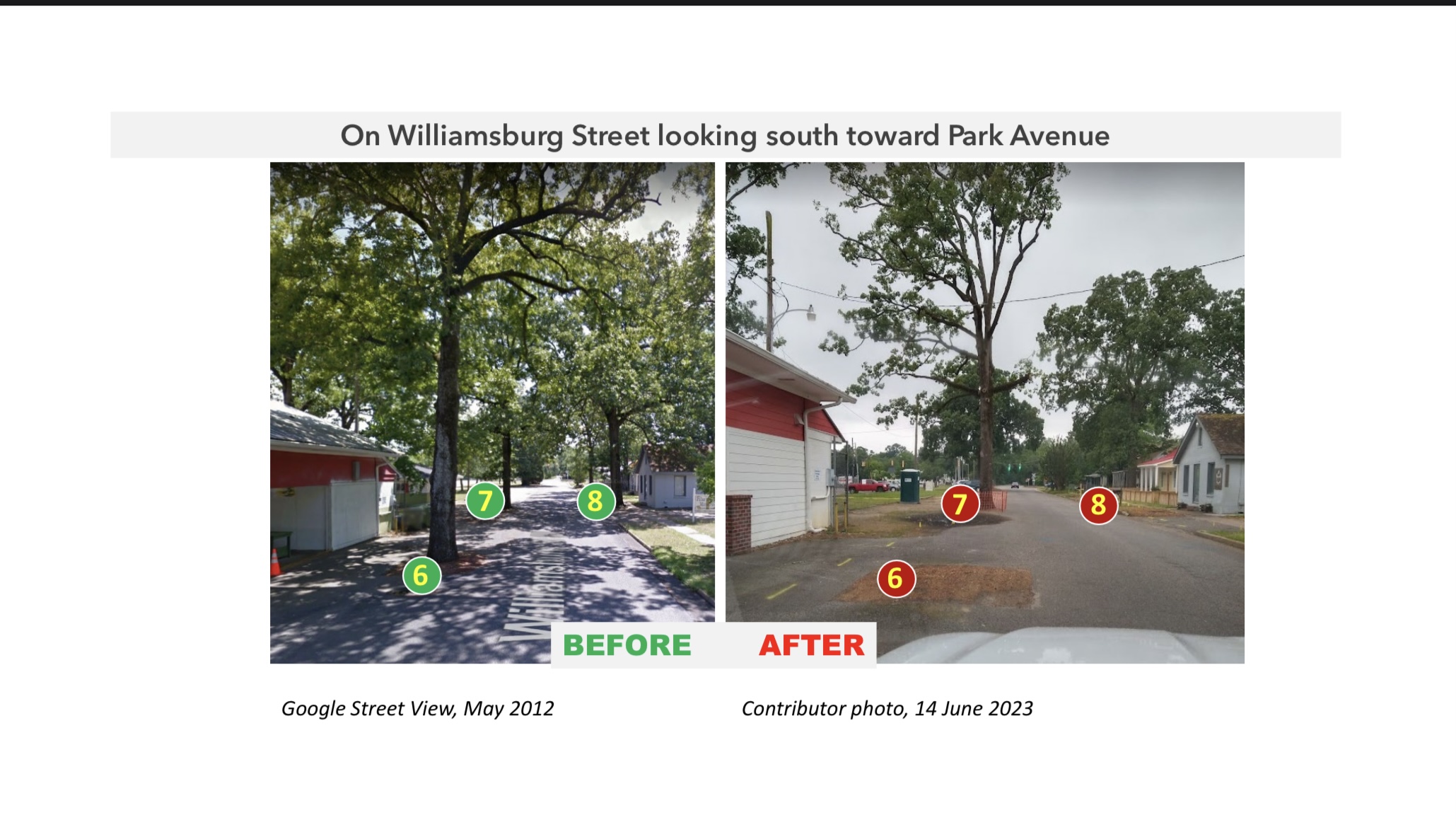
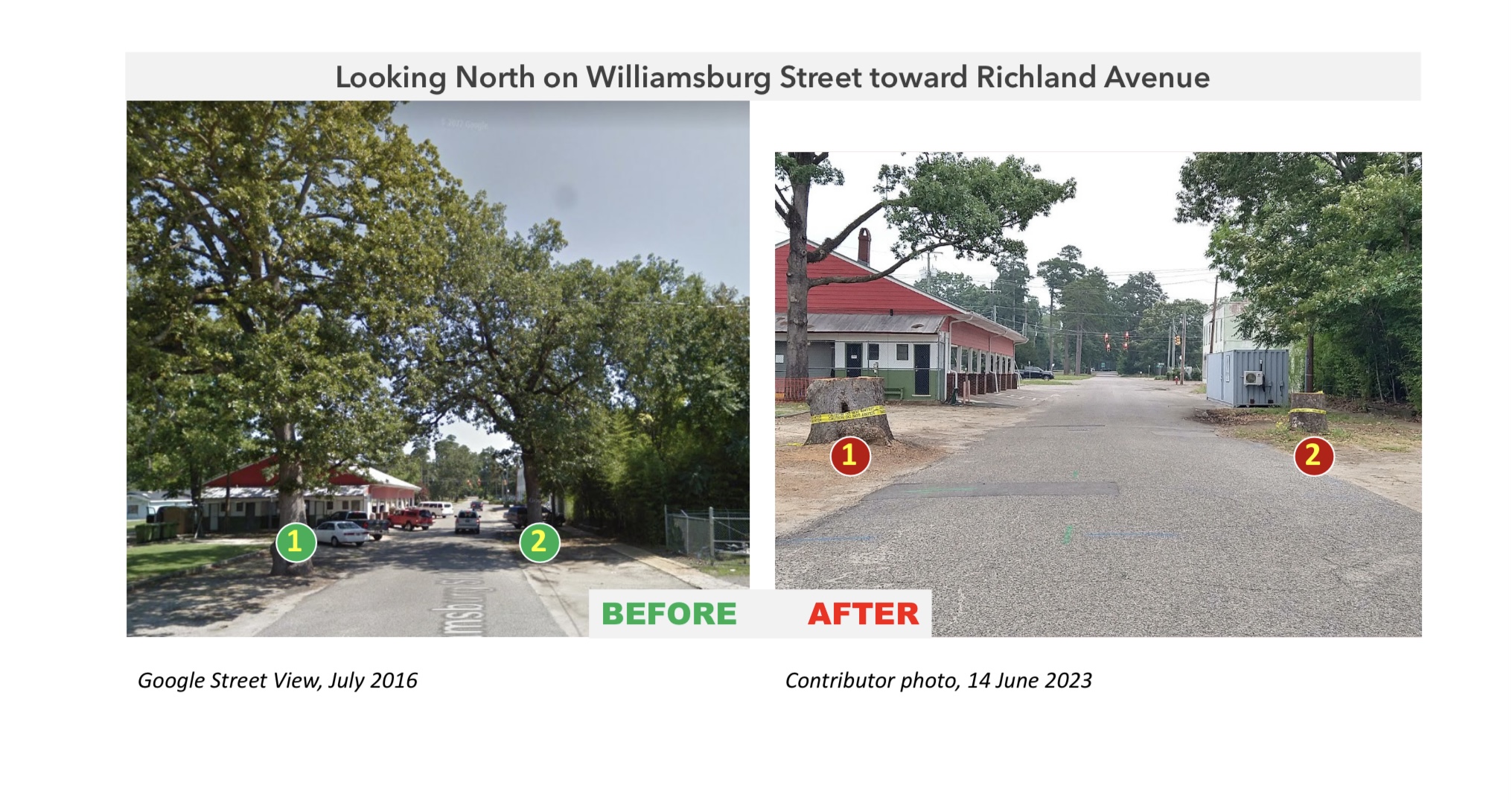
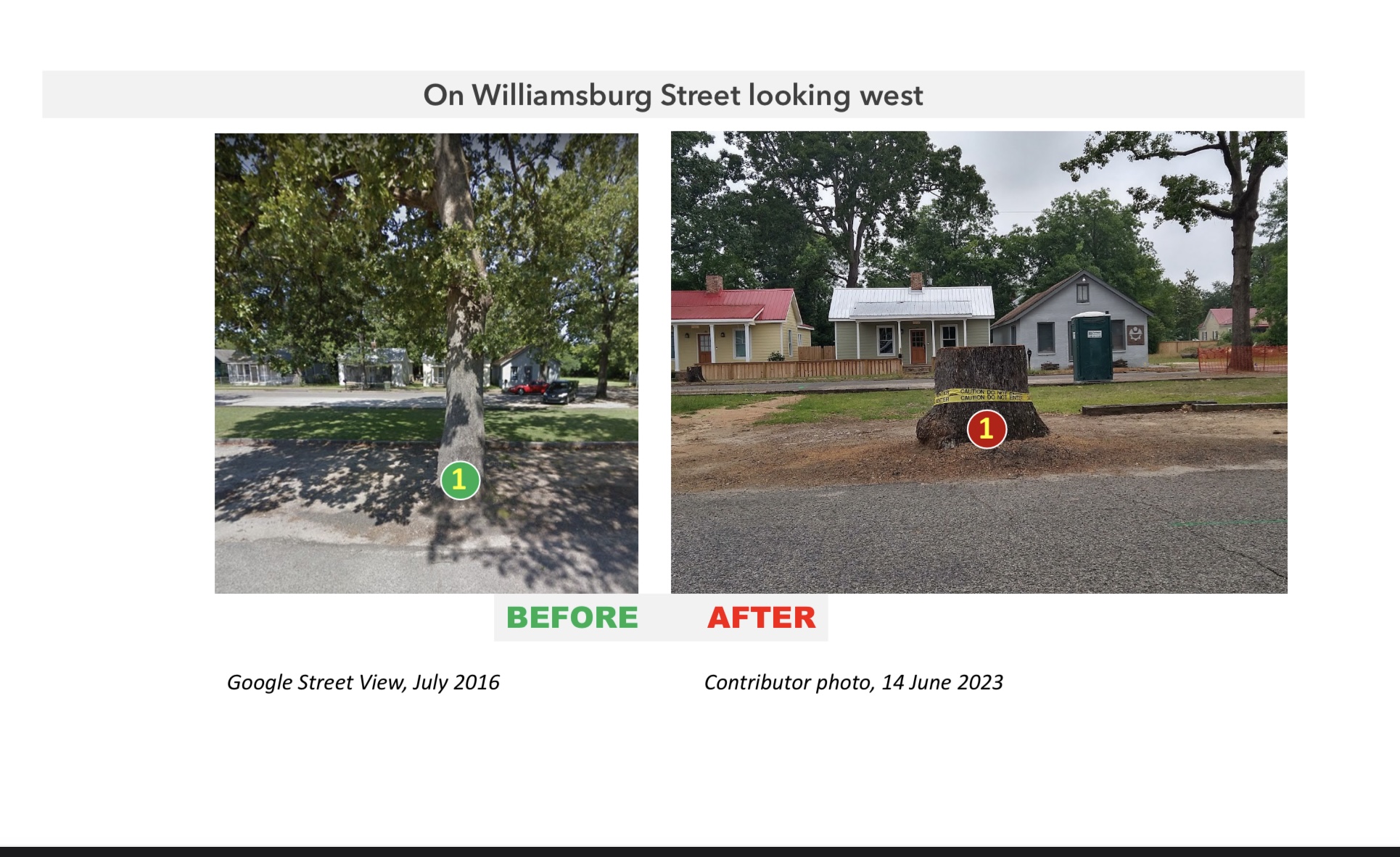
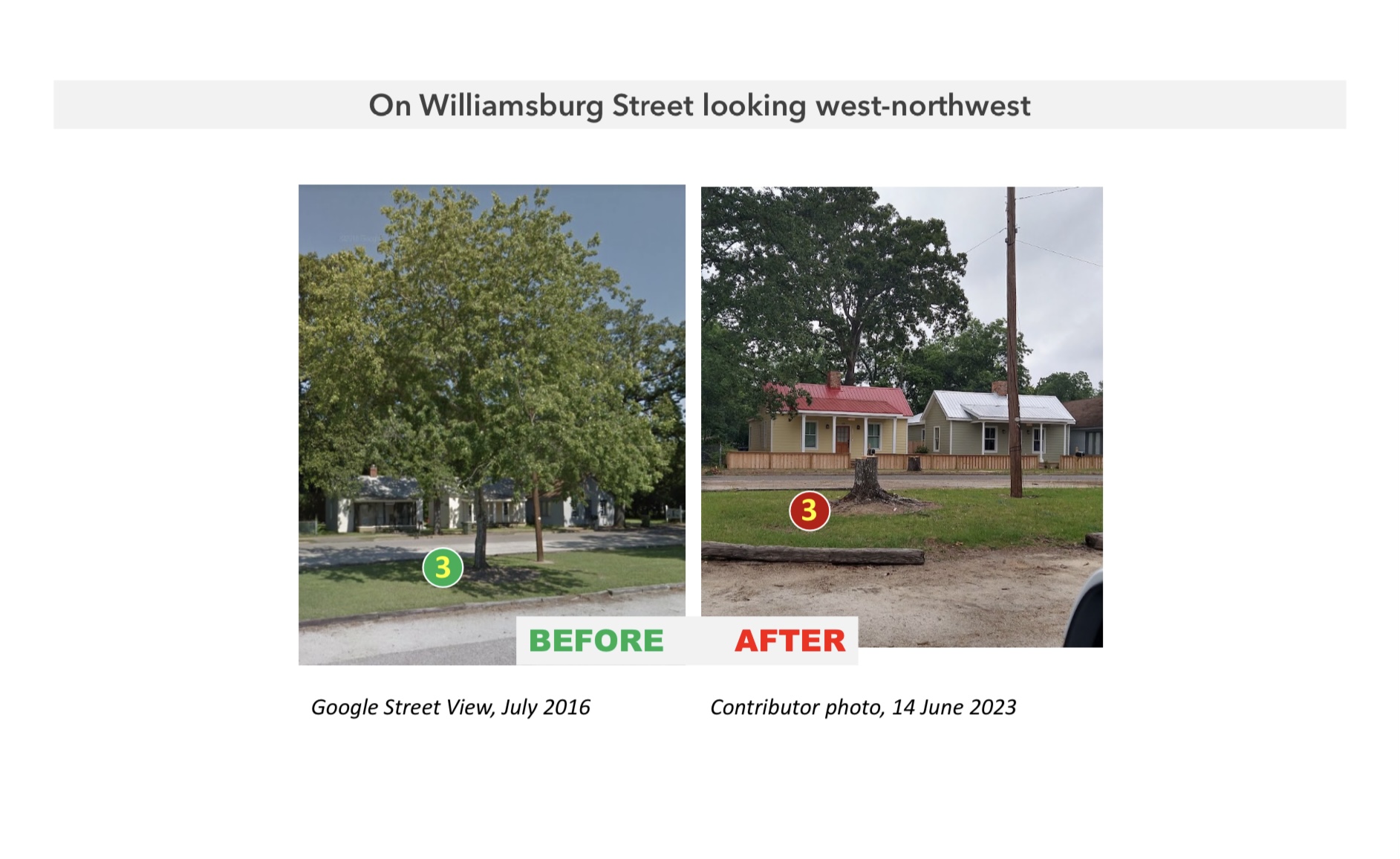
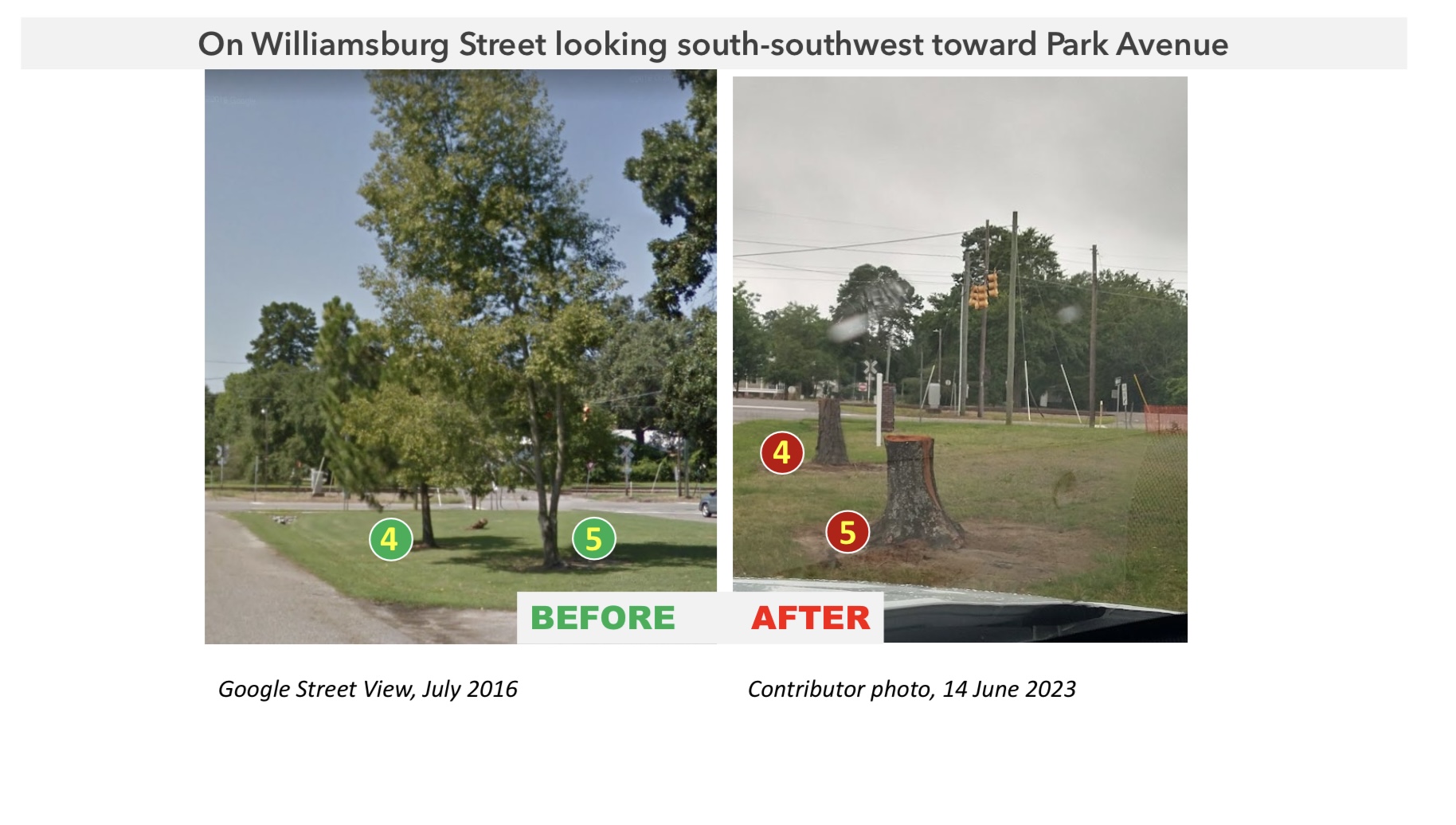
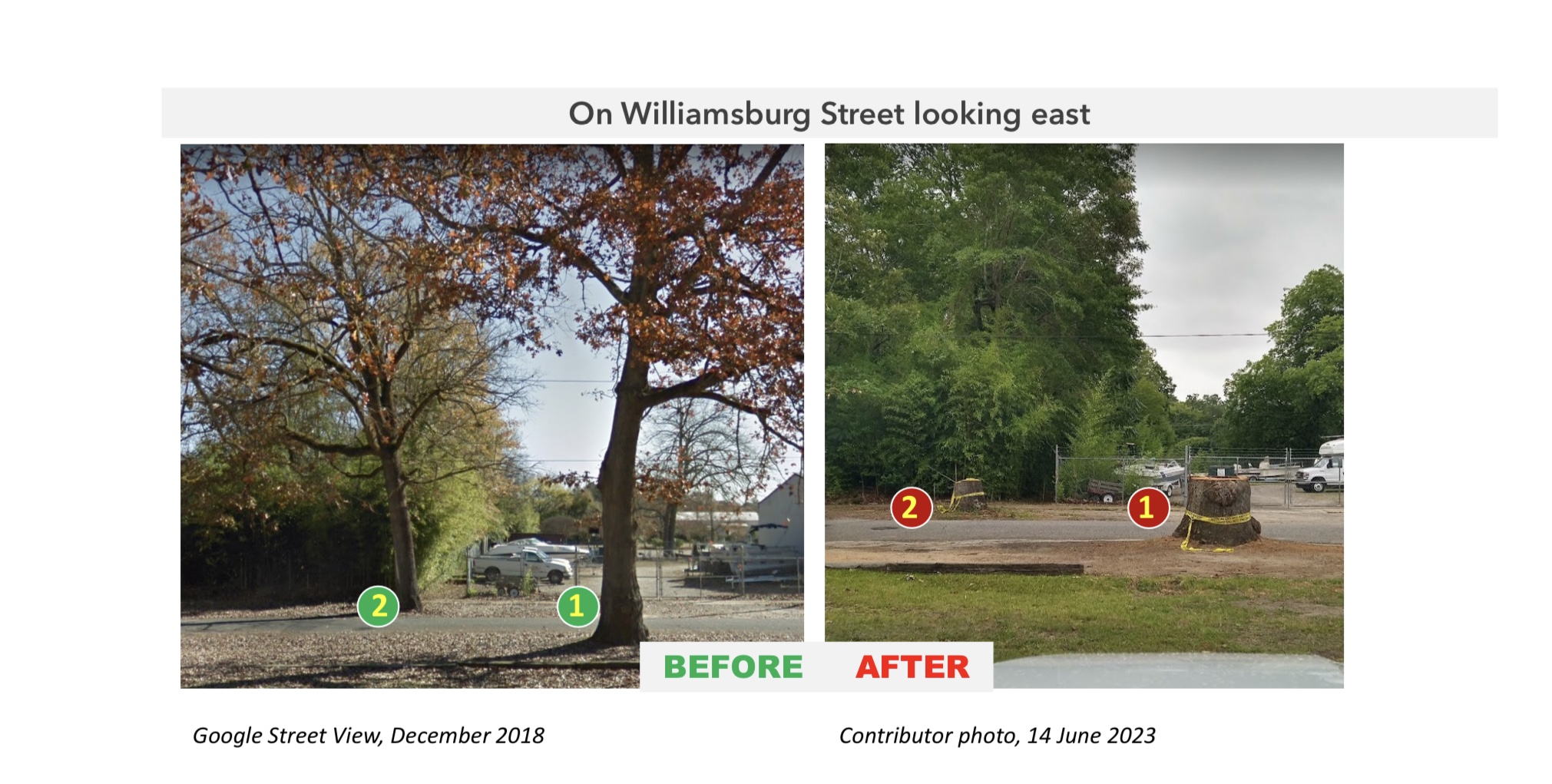
On May 30-31, 2023–the first two days of the project—eight trees were cut and removed, and three remained. The City of Aiken has yet to provide any updated plans or project change orders in support of its position that the felling of the eight trees was a mistake due to a mixup in project plans.
The Cutting and the City Council Meeting.
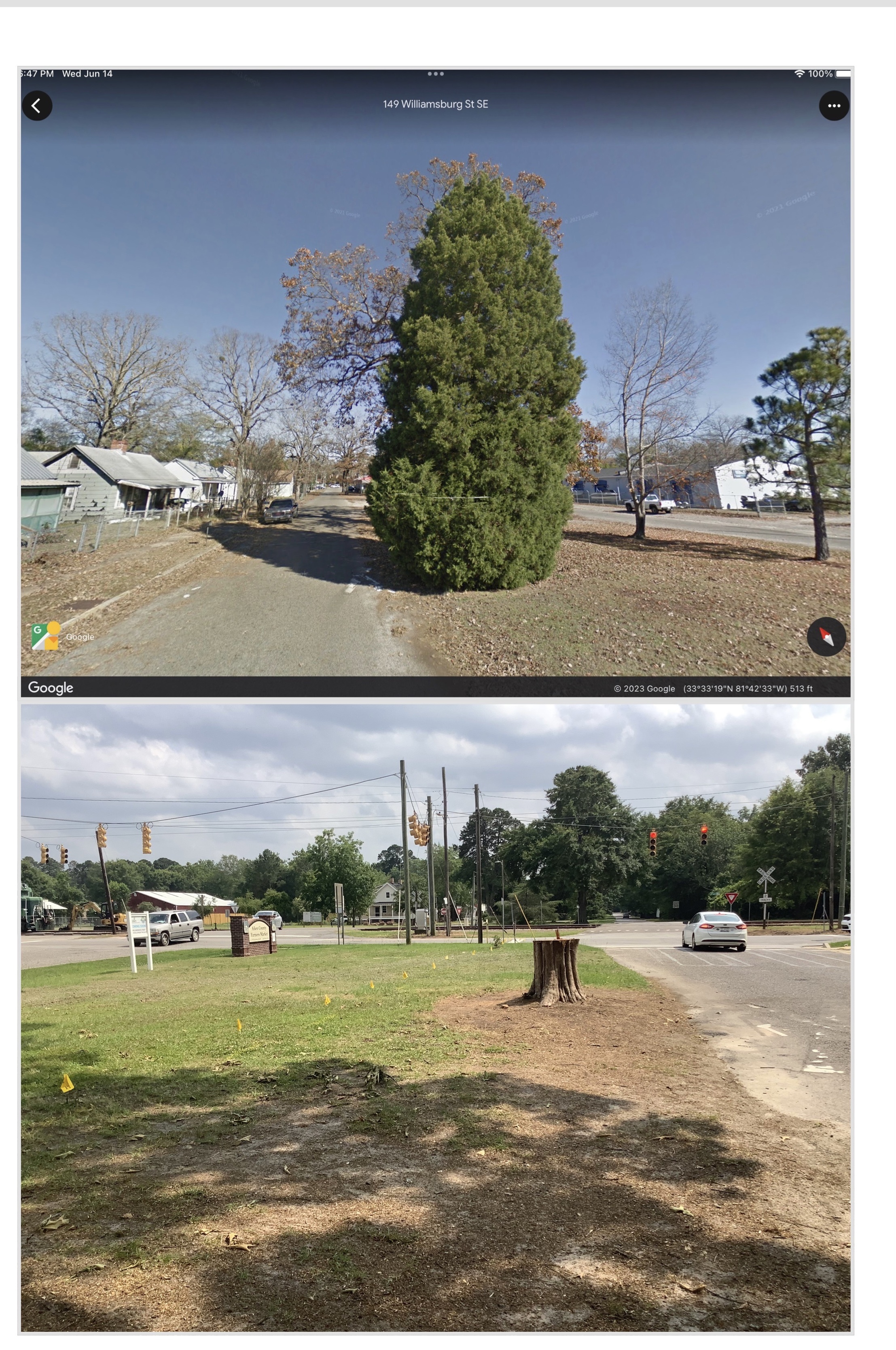
The nearly $2 million Williamsburg Street steetscape project surrounding the Aiken Farmer’s Market began on May 30, 2023. By May 31st, three-quarters of the trees in the Williamsburg Street Parkway had either been cut or were in the process of being removed. Two of the three remaining were heavily pruned.
In all, nine trees of varying age and size around Aiken’s Farmer’s Market were felled. Five were towering, dominant, veteran trees with wide spreading crowns that shaded the market area; and three were vigorous younger trees. Two of the three that are left are the most likely to drop branches or fall onto the market place, and both had lower crown ratios than the nine that were cut.
The heavy handed removal in a “Tree City USA” provoked a substantial uproar. The controversy was significant enough to be addressed at the next City Council meeting on Monday, June 12, 2023.
The issue was adressed before the first “public comments on non-agenda items,” The official responses included; “this should not have happened.” and “I want to echo the apology that this should not have happened.” (1)
Later in the meeting, during the second “public comments on non-agenda items,” (2) Aiken resident Valerie Wrobel’s persistent questioning flushed out more information. The official response in regard to fault was:
“It is not the contractor they followed the plans that the city gave them that should not have been given to them. The old set of plans were a set of plans that should not have been given to the contractor.”
Neither the old nor new set of plans that were referenced were publicly disclosed. The City of Aiken’s website contains no information about the final plans. Cranston Engineering, the contract project designer, was tasked with completing both a conceptual design and a final design. Neither is available on the city’s website.
The Bid Package
On November 17, 2022, the City of Aiken held a pre-bid meeting with five prospective contractors. Petersburg, Virginia based Quality “Plus”Services was awarded the contract on February 15, 2023, for $1,483,865.55. The company’s website states it “provides engineering, construction, mechanical, electrical and maintenance services for all major industrial sectors throughout the United States.”
On April 10, 2023, City Council approved allocating $400,000 of Savannah River Site plutonium settlement funds to the Farmer’s Market Streetscape Project.” The reason given was “the bids came in well over budget.” The final cost was not reported.
Within the Permit Plan, “Existing conditions and Demolition Plan” (page 4) documented twelve trees of varying age and size in or around the Parkway. (3). Note #4 mandated that tree protection be installed around “ existing trees,” and referenced a “Tree Protection Plan.”
The “Landscape Layout Plan” (Page 20) has a small note stating “TREE TO BE PRESERVED. QUANTITY 4 TOTAL IN PROJECT,” and again referenced a “Tree Protection Plan.”
The “Tree Protection Plan” is part of the “Landscape Enlargement Plans.” (page 22). The document indicates four residual trees (below). Three of these are featured in before and after photos taken after the cutting; three large oak trees, including the largest White Oak on the block. An unidentified hardwood was also a leave tree, but it ultimately was also cut.
The Tree Protection Plan. Each circle represents the canopy spread of the three residual trees (circled). The smaller one in the center was also removed.
Preceding the landscape plans is the “Landscape Lighting Plan” (page 19) showing four LED outdoor floodlights circling each residual tree. Lighting Plan Note #8 requires that the best locations be found to “illuminate tree canopy from four sides.”
The illumination plan for the 42 inch diameter residual White Oak. B = LED Floodlights.
That was the plan as of December 8, 2022, for the existing trees (3) surrounding the Aiken Farmer’s Market set amidst one of the most visited of Aiken’s forested parkways. Whether a project change order was completed between December 8, 2022 and May 30, 2023, is unknown.
Answering Questions
If a project change order was issued, or the project design otherwise changed prior to the start of work, the City of Aiken should publicly disclose the final project design documents (4), especially any updated “Tree Protection Plan.”
The City could also describe what went wrong in the contract administration process that involves close cooperation between the city’s engineering department and the contractor. (5)
Finally, the City of Aiken could ask if a public review process that included at least one public hearing might have prevented the major alteration of the Farmer’s Market tree scape and the subsequent apologies from city officials. This was an Aiken Municipal Development Commission project, and therefore required a public hearing and a legal redevelopment plan.
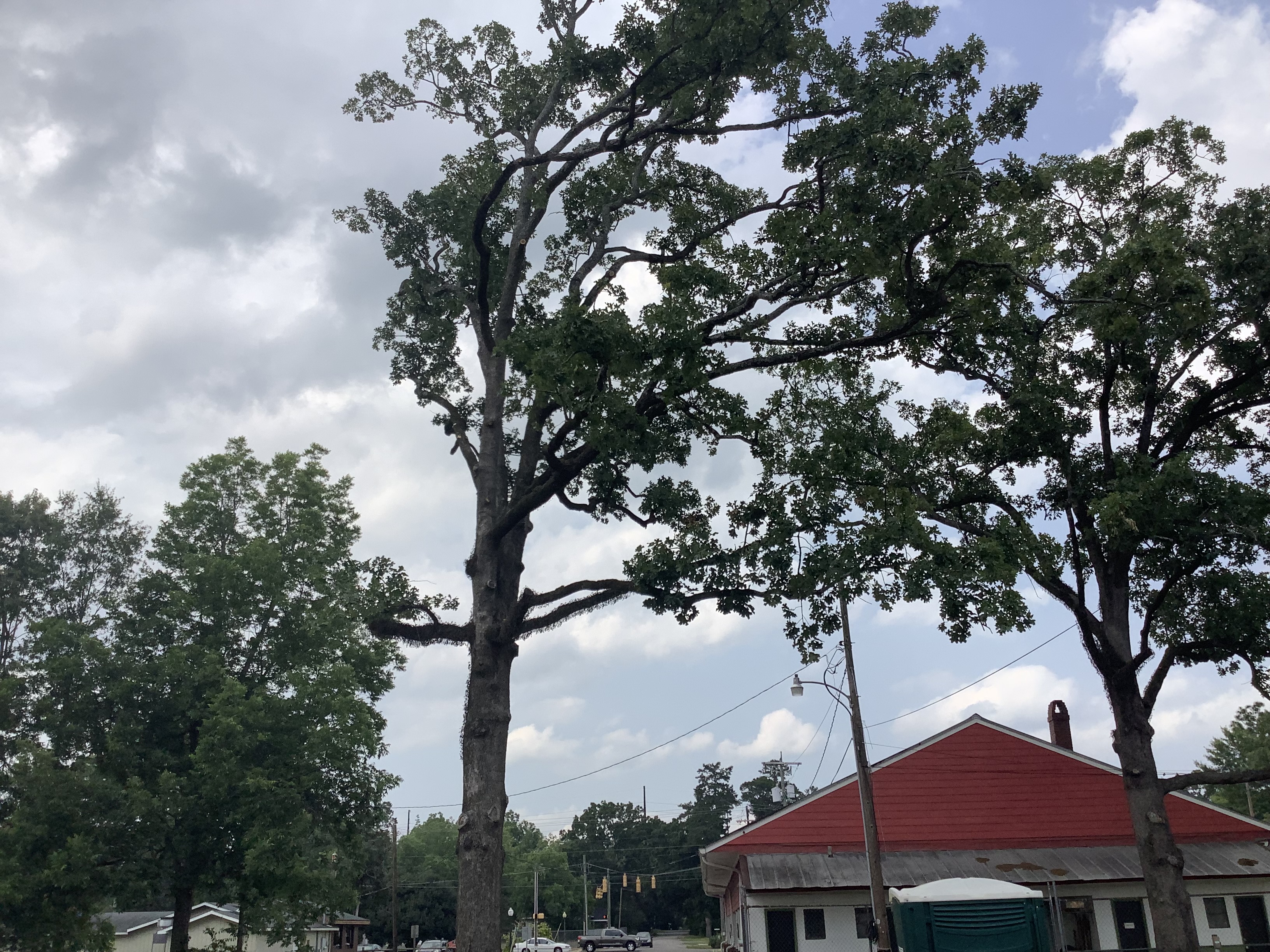
The 42 inch diameter, open grown White Oak in the background is one of four residual trees in the Farmer’s Market/Williamsburg Street Parkway. The tree was also moderately pruned. The plan is to illuminate it on four sides, with no regard to any wildlife foraging or nesting in the tree.
One of the two large veteran oaks remaining in the parkway has less than a 40 percent crown ratio and is susceptible to wind damage after the shelter provided by the larger stand of trees was removed. One conceptual drawing of the future Farmer’s Market area, featuring a poorly shaded landscape with most trees closer to the height of the market building. From the 2021 Site Analysis and Due Diligence for the Williamsburg Street Redevelopment. which was not the final conceptual design nor the final design.
The landscape plans do show the desired future tree scape, as well as the location of various shrubs. The plans call for 73 trees to be planted in the 2.3 acre project area, of which 47 are oak species. Ten of the trees are Serviceberries, which is more of a large shrub than a tree.
The plan also calls for 720 “shrubs” to be planted in tight clusters, with nearly half being Carissa Hollies (255) and Lorapetulam. Close to a third of the shrub list are perennial grasses and other herbaceous flowering plants.
Landscape Plan for Farmer’s Market Parkway. Largest circles represent four residual trees, mid sized circles represent trees to be planted, and the smaller circles represent shrubs and perennial flowering plants.
(4). Cranston Engineering of Augusta conducted conceptual design and final design of the project at a cost of just over $90,000. The Conceptual Design and and Final Design have been requested.
To date, that request has yielded only one page—-the “Existing Conditions and Demolition Plan” contained in the December 2022 Permit Plan. Any updated “Tree Protection Plan” has yet to be disclosed.
(5) The “Instructions to Bidders and Special Provisions/‘” section of the bid package contains numerous standard contract administration requirements that are designed to avoid mistakes by placing equivalent responsibilities on both the contractor and the city. Both sides are to check each other throughout the process. There is no provision for the city’s Arborist or contract Arborist to assist with inspections.
Part 19 of the bid package references “Working Drawings,” and states, in part:
“Working drawings shall consist of those detail drawings which may be required for prosecution of the work, but which are not included in the Contract Drawings. Six copies of all necessary working drawings shall be submitted by the Contractor to the Engineer for review; three copies shall be returned to the Contractor unless additional copies are included in the submittal.”
Two provisions follow:
(a) Check by Contractor: The Contractor shall check all working drawings for accuracy of dimensions and details, and for conformance with Contract Drawings and Specifications before submitting working drawings to the Engineer for review. The Contractor shall indicate that working drawings have been checked by affixing an appropriate stamp or notation on the face of the working drawings. Deviations from the Plans and Specifications shall be clearly and specifically called to the Engineer’s attention in a written statement accompanying the drawings.
(b) Responsibility for Accuracy: Review by the Engineer of the Contractor’s working drawings shall not relieve the Contractor of responsibility for accuracy of dimensions and details. The Contractor shall be responsible for agreement and conformity of working drawings with the Contract Drawings and Specifications.
Item #20, “Cooperation of Contractor” states
“ The Contractor will be supplied with five (5) copies of the Drawings and Specifications. The Contractor shall have available on the work, at all times, one (1) copy of the Drawings and Specifications. He shall give the work the constant attention necessary to facilitate the progress thereof, and shall cooperate with the Engineer and other contractors in every way possible.”
Items #22 and #23 provide the requirements of inspectors
22. Authority and Duties of Inspector: Inspectors shall be authorized to inspect all work done and all materials furnished, including preparation, fabrication, and manufacture of the materials to be used. The inspector shall not be authorized to alter or waive requirements of the Drawings and Specifications. He shall call the attention of the Contractor to failure of the work and/or materials to conform to the Drawings and Specifications. He may reject materials or suspend work until questions at issue can be refereed to, and be decided by the Engineer. The presence of the Inspector shall in no way lessen the responsibility of the Contractor.
23. Inspection: The Contractor shall furnish the Engineer with every reasonable facility for ascertaining whether or not the work performed and materials used are in accordance with the requirements and intent of the Specifications and Drawings. No work shall be done or materials used without suitable supervision or inspection by the Engineer or his representative. Failure to reject defective work and materials shall neither, in any way, prevent later rejection when those defects are discovered, nor obligate the Owner to any final acceptance.
Item #25 pertains to making corrections in the case of unclear drawings:
Corrections: Should any portion of the Drawings and Specifications be obscure or in dispute, they shall be referred to the Engineer, and he shall decide as to the true meaning and intent. He shall also have the right to correct errors and omissions at any time when those corrections are necessary for the proper fulfillment of the Drawings and Specifications.
On September 12, 2022, in the gathering ruins of the failed Project Pascalis — a public-private development scheme characterized by two years of closed-door meetings and a shuttering of citizen input — Aiken City Council added two public comment periods to their regular bi-monthly meetings for citizens to voice non-agenda concerns. This, after it was pointed out that City Council had been in violation of city code for years by not providing this comment period. Nine months later, City Council began laying the groundwork1 to walk back this policy, cutting back on what is essentially the only avenue for citizens in a city of 32,000 people and a county of nearly 175,000 people to publicly speak to City Council on issues of concern. City Council’s decision to cut back on allowances for public comment occurred on the immediate heels of the City’s destruction, sans public input, of the trees in the Williamsburg parkway behind the historic Aiken County Farmers Market. This destruction marked the kickoff to yet another closed-door, public-private development scheme. The need for citizen input in the decisions that affect our City only grows. A review of some history is in order.
It might surprise some people, (it certainly surprised this resident of 65 years), to learn that, once upon a time, the iconic parkways lining the Richland Avenue corridor running from the old Aiken County Hospital to Beaufort Street didn’t pause at the center of town, but actually extended the entire length from west to east
This is to say that there was once a parkway in the center of Richland Avenue between Newberry and Laurens Streets. Can you imagine looking out the windows of the Johnson Drug Store or the Commercial Hotel in 1935, (the date given for the vintage Commercial Hotel postcard at the top of this page), and seeing a grassy parkway of pines, cedars, oaks, magnolias, camellias, azaleas and yuccas?
Aiken’s parkways and magnificent trees and shrubs are the jewels in the crown of the Andrew Dexter and Cyril Pascalis 1834 plat for the Town of Aiken with its characteristic gridwork of boulevards and parkways. So when did this Richland Avenue parkway disappear from the center of town? And why?
The 1928 Destructionists
In 1928, the entire length of parkways from the hospital to York Street were threatened with destruction. The battle to save the parkways was led by the Aiken Civic League — a citizens committee composed entirely of women, who fought and ultimately helped win the battle to save these parkways.
The threat of destruction had arrived with the 1928 paving of Highway No. 1 from Augusta to Aiken, which raised the question over where to place the highway down the Richland corridor: straight down the center, or off to the side?
Twenty-three residents on Richland Avenue answered that question with a petition demanding the parkways be destroyed so that the road could be run directly down the center of Richland Avenue. Joining these “destructionists” as they came to be called, were two of the five commissioners the City had appointed to the task of studying and making the decision. The view of these destructionists was that running the road down the center was necessary for safety and future progress.2
Pushing against this idea were the Civic League and a large number of other citizens who signed the League’s petition. Also opposed to the destruction of the parks was the Aiken Standard, which featured a statement on its front page that read, in part:
“The Richland Avenue paving proposition is, we repeat, one which vitally concerns every citizen and property owner of Aiken. If Richland Avenue parks could be destroyed a dangerous precedent would have been established. It would naturally, and legally, follow that hereafter the parks on Park Ave., Barnwell Ave., , or any other street in Aiken, could be done away with in like manner….
“The Standard, together with what we believe to be a large majority of the people of Aiken, is concerned to retain the city’s parks intact, and to protect them from invasion or destruction, whether in the name of progress — and concrete paving is not always progress — or in any other manner. Our characteristically delightful parks mean more to Aiken than a stretch of concrete paving which any town can have.” 3
In the midst of the battle was also the matter of a bond issue for the road, which was up for a vote in June 1928. The Civic League demanded ironclad assurance that the parks would be unmolested, and they guaranteed that, without this assurance, the bond issue would be defeated by a strong show of citizens who would side with the Civic League.
“The women of the Civic League hold the key to the situation,” wrote the Aiken Standard. “They should not relinquish it, nor agree to destruction of the parks under any compromise conditions.”4
If not for the urgency of the bond issue, this battle might have dragged on, but the Civic League’s victory came quickly, within a month. It is not difficult to imagine, then, the level of dismay felt by Civic League’s members when, less than a year later, Aiken City Council made a motion to destroy part of the Richland Avenue parkway.
In retrospect, the situation could have been predicted. The birth of the National Highway System in 1926 had brought large federal dollars to fund the paving of a 300 year-old route to be named US Highway 1 that could carry automobile travelers from Fort Kent, Maine all the way to Miami Florida. It only followed that the highway would draw some traffic.
The 1929 Destructionists
It was the prosperity of the 1920s and Henry Ford’s assembly line that made automobiles affordable enough to create a boom in auto sales that, almost overnight, heralded the arrival of traffic jams to downtown Aiken. The problem with these horseless carriages — in addition to their noxious noise and fumes —was that, unlike horses, they couldn’t easily maneuver around low-hanging limbs while simultaneously dodging oncoming traffic and pedestrians. Too, there was no place to park automobiles without jamming up the roadway.
This confusion of cars converged in that particular block of Richland because, in addition its location in the heart of the business district, the recent paving of US Highway No. 1 had made Richland Avenue the primary route for vacationers and land speculators traveling through Aiken on their way to Florida, where another sort of boom was taking place. By 1929, the bottleneck in that section of Richland had grown untenable.
Stirred into all of this was a period of unprecedented prosperity. In 1929, Aiken was into its second year of “the biggest building boom in the history of the city,”5 ,6with millions of dollars being spent in land sales and the construction of new winter residences.
It was this prosperity that led to the construction and renovation of two hotels in adjacent blocks on Richland — the new Henderson Hotel and the existing Aiken Hotel. The renovations on the Aiken Hotel introduced scaffolding, trucks, and workman’s cars to the existing kerfuffle of traffic on the Richland block. This was further aggravated by an absence of traffic rules in Aiken, a concept yet to be born.
All told, it was likely the hotel construction in the spring of 1929 that brought the situation to a tipping point. This may have been what led Alderman H.E. Holley to make a motion7 in a May 1929 City Council meeting to have the Street Committee study the widening of that section of Richland Avenue. His motion was seconded and approved, beginning a series of events that pitted citizens and Council in a battle that would play out for a dozen years.
The Magnolias
Richland Avenue’s two-lane streetway had ample dimensions, thanks to the generous 150’ width provided in the Dexter-Pascalis design, and could easily accommodate the large turning radius needed by wagons, buggies and such. The center of that particular Richland Avenue block was occupied with a lovely and quite beloved park.
The citizens’ protest over widening the road, which would necessitate cutting into the parkway, was instantaneous, contentious, and divisive. On one side of the debate were the Aiken Civic League, the Park Commission, Richland Avenue property owner Walter Plunkett, and a group of local notables, including Winter Colony residents Louise Hitchcock and Hope Goddard Iselin,who were progressive in matters of landscaping, beauty, preservation, culture and education. The other side of the debate was headed by Aiken City Council, three-quarters of the Richland Avenue property owners, and a number of other progress-centric citizens.8
At particular issue were two very large, old magnolias with low, spreading branches that stood at either end of the parkway — one at the intersection with Laurens Street and another at the intersection with Newberry Street — both of which would have to be severely cut to accommodate this plan. 9
The Aiken Civic League was in attendance at the June 10, 1929 City Council meeting and read a letter of protest recommending a different approach than the one raised in Alderman H.E. Holley’s May motion. The Civic League recommended, specifically, to first try enacting and enforcing some rules for traffic and parking. 10. What seems commonsense today was still a novel idea at the time.
City Council overrode the citizen protest and voted to widen the south-side lane of the Richland Avenue block (fronting Hotel Aiken and Johnson Drug Store) by cutting 5 to 6 feet into the park.11
This was summertime, however, so the Winter Colony voices, which would have added weight to the protest, were not present. However, one such resident, Hope Goddard Iselin, who was a member of Parks Commission, (a legal body appointed by the mayor), did send a telegram to Mayor Henderson on June 12. “Had always considered any action that curtailed or interfered with parks a bad precedent and detrimental to Aiken’s best interests,” she wrote. “Hope you will give this question your earnest consideration.”12
In August, the Civic League, the Parks Commission and the Street Committee met and drew up an alternate approach. Their plan was to extend Bone Yard Alley (Bee Lane) across both lanes of Richland. This would be accomplished by cutting a 75’ foot strip through the treeless center of the park, creating an area that could accommodate parking and help relieve traffic congestion. The plan was unanimously agreed upon by all in the group.13
The group brought their alternate plan to the September 9, 1929 City Council meeting — a meeting heavily attended by 25 members of the Civic League, members of the Park Commission, Mr. Walter C. Plunkett, and other like-minded citizens. Several telegrams of protest from Winter Colony residents were read, and Mrs. Julian B. Salley spoke on behalf of the people of Aiken “to make a plea for the trees.”14 On the other side of the debate were three-quarters of the property owners in that Richland block, who brought a petition urging a widening of the street 10 feet into the park, sparing the trees if possible.
The Civic League’s plan was defeated in a 5 to 2 vote. Alderman Holley then made a motion that Richland Avenue be widened “not more than ten feet” into the park and to destroy “not more than one tree.” The motion passed with a 5 to 2 vote. 15 For the third time in three months, City Council had overridden a strong citizen protest.
Two days later, Walter C. Plunkett, a property owner in the Richland block, took out an injunction prohibiting the City from changing or altering the parkway. The Civic League and Parks Commission signed on. 16
Later that same month, on September 20, 1929, City Council held a special meeting wherein they decided to appeal the injunction. 17
A Change in Plans
Little could anyone know, but a stock market crash loomed in the near future. It took a while for the circumstances to filter through the layers of prosperity. The first to fall were those for whom scraping bottom was already a way of life — sharecroppers, farm hands and day workers, the latter of whom depended largely on the upper class for jobs building and maintaining homes and estates, and accommodating the lifestyles of these residents and their guests.
In 1930, newspaper stories of jubilee balls, drag hunts, and garden luncheons continued apace aside stories of the failure of the local Bank of Western Carolina and the stories of local joblessness and desperation. One such headline told the story of 375 jobless Black people, some of them “in suffering condition,” who had been called by local officials to assemble at the Aiken County Courthouse.18
These 375 people believed they’d been assembled to receive assistance but, as it turned out, they’d only been called so that their numbers could be counted. Afterward, officials expressed hope that churches, lodges and societies might help them, and that more new houses might be built to give them work, and that the federal government might look into the matter and devise some kind of plan. In the meantime, they were advised to go back to the farm where they could raise food to eat. They were further advised to not to get discouraged, but to trust in God, do right, be good citizens, and not think of robbing anyone or stealing anything.
“Many Colored People Now Out of Work,” The Aiken Standard, December 31, 1930.
The textile millworkers in Horse Creek Valley were the next to fall, as employers tightened their belts. The workers existing struggles were compounded by union strikes in 1932, which put upwards of a thousand people out of work, some of them claiming conditions of starvation for their families. 19 Editorials in the local paper, which tended to downplay the existence of local economic hardship in the earliest years of the Depression, disputed accounts of hunger. The reality of difficult of the Depression years for working-class people in Aiken County went largely unreported.
Cases are Heard
In December 1929, the temporary injunction of Walter C. Plunkett et al. was made permanent in a case heard before Judge W.H. Grimball.20 In October 1930, the City’s case was heard before the SC Supreme Court, which overturned the injunction. 21
The year 1930 was an election year, so the makeup of the City Council shifted slightly going into 1931. Too, the issue of traffic rules and enforcement had only grown more urgent. On January 14, 1931, with new Council members in attendance, a contentious debate took place before City Council over the “delinquency” of the police department in enforcing parking rules.
According to the fire department chief, parked automobiles had blocked the roadway during a recent fire and had to be moved just to allow the fire truck room to pass through. One alderman suggested an ordinance to prevent this in the future, only to be told by another alderman that there were already laws on the books to prevent such events, “But the police won’t enforce the law.”22
The mayor discussed the idea of installing traffic lights, to which another alderman said, “What is the use, no attention is now paid to the stop signs in the city, and no one will enforce the law.”23
During this same meeting, the women of the Civic League, putting the proverbial steel in the magnolia, presented the newly elected City Council with a resolution recently passed by the Civic League regarding the parks. Mrs. M.C. Lyon, the President of the Civic League, read the resolution to City Council before presenting them with a copy.
“Resolved, That in view of the recent decision of the Supreme Court reversing that of Judge William H. Grimball and setting aside the temporary injunction against the City Council of Aiken in the proposal to widen Richland Avenue between Laurens and Newberry Streets at the expense of the park in that street, the Civic League recognizes the right of the City Council of Aiken which has now been firmly established to alter or change the park system of Aiken whenever in its opinion it considers the same necessary.
Resolved, Further, that since the Civic League was moved to seek restraining action in this matter through no spirit of contention but only in the desire to protect the parks of the city and to retain their symmetry and beauty; and
Resolved, Further, that since the City Council which moved to alter the park in question has passed out of existence and has been succeeded by a new administration, the request is made of the City Council by the Civic League that, its right in the matter having been established, no action should be taken which would tend to destroy the beauty of any park in the City of Aiken or which would have the effect of engendering public feeling.
The Civic League, as does City Council, believes that Aiken’s parks are among the City’s chief assets.
THEREFORE, this Resolution is presented to the City Council.24
Despite disapproval of “many citizens,” 25 Council voted to widen Richland Avenue, cutting eight to ten feet into the park. No trees were removed.
The February 1931 Street report described the ensuing work in two sentences, an almost anti-climatic conclusion to the events of the prior 18 months: “Took out curbing on Richland Ave. from Laurens St. to Newberry St. Built up parking space with gravel.’
February 1931 Street Report, City of Aiken
For a few years, the bottleneck on Richland Avenue eased. Much of this was due to the reduced traffic on Highway No. 1, whose overall flow was reportedly reduced at one point by nearly 80% due to circumstances of national policy and economy. This relative lull allowed Aiken the necessary time to solve some of the newfound local dilemmas presented by the automobile— speed limits, minimum driving ages, rights-of-way, parking rules, and the hiring of a motorcycle cop.
The New Deal
By the mid-1930s, the impact of FDR’s New Deal programs began to be felt locally. Numerous facilities and projects were built — the Aiken Municipal Building, a new high school at the corner of Barnwell and Laurens, the new Aiken County Hospital, a waterworks plant out on Hwy 1, the federal court house on Park Avenue, and Aiken State Park to name just a few. The population of Winter Colony residents and guests swelled; the numbers of tourists and speculators to Florida resumed, and, with that, the Richland Avenue bottleneck returned.
In 1938, a group of citizens brought a petition a before City Council requesting the destruction of two parks: the park in the disputed Richland block, and the Laurens Street park between Richland and Barnwell Avenues. The petition read, in part, “Your attention is directed to the fact that said blocks are at times congested, making it a hazard to the traveling public.” Council — which had been deemed via the SC Supreme Court decision eight years earlier to hold the responsibility for ensuring the safety of the traffic on the streets — voted to have a survey made before giving the matter further consideration. 26
In 1941, twelve years after that first attempt by City Council to cut into the parkway, a motion was again made to destroy the Richland Avenue parkway. Two other parkways were also to be destroyed — the Richland Avenue parkway between Pendleton and Laurens Streets, and the Laurens Street parkway between Barnwell and Richland Avenues. 27
The fourth central block in the downtown — the Laurens block between Park and Richland (see photo below) — appears to have never featured a parkway. This brings up an interesting topic that was raised in the Aiken Standard’s account of the December 1929 injunction hearing with Judge Grimball.
The facts, as laid out in the hearing, stated that, on the original plat of the City of Aiken, the entirety of Richland Avenue had been dedicated to the public as a street with no areas set off as a park. It was only during subsequent years that City Council divided the 150-foot width of Richland Avenue into three parts, as follows: two 37-foot-wide highways for travel on either the north and south sides of the street; between the two highways was, “a park running parallel with the two highways and containing trees, grass and shrubbery.” 28
An 1890s view of the SW block of Laurens Street, before the arrival of the automobile.
The Wake
When the decision was made in 1941 to pave over the Richland Avenue park, 29the Civic League was no longer a voice. According to a February 8, 1933 article submitted by the Civic League to the Aiken Standard. “The year 1932 was a difficult year for everyone, and the Civic League found it so. All our funds were tied up in the Bank of Western Carolina, so that we began the year with an empty treasury.” 30
The Civic League had subsequently been obliged to relinquish their meeting quarters in the Opera House. Sometime during 1936-1937, and without fanfare, the Civic League disbanded. It is not possible to know today what direction decisions might have taken, what options might have been considered in 1941, given the benefit of input from the Civic League, the Park Commission, the Street Committee, and other concerned citizens. It may be that there were no other viable options.
Certainly, the disfigurement created by the destruction of the parkway in the Richland block is apparent, albeit subtle. Travelers new to the area, heading east on Richland Avenue, might wonder momentarily, as they enter that Richland block, how to best navigate the odd confluence of lanes. Locals learn to more or less go with the flow, however it leads at any given moment.
Still, the decision to destroy that Richland parkway was preceded by twelve years of debate and deliberation and — even at the eleventh hour, in 1941 — was preceded by “considerable discussion,” in a public City Council meeting plus an investigation by a committee appointed by the mayor. Pending the decision, the City painted large, white, four-foot stop signs directly onto the street in the business district in an attempt manage congestion.31 Democratic processes were at play.
Contrast this with the 2021-2023 decisions made by the City — without taking in so much as a word of citizen input — to demolish historic buildings in downtown Aiken, to give away Newberry Street to a developer and, just last week, to destroy the trees in the Williamsburg Street parkway behind the historic Farmers Market.
Mistakes Were Made
The City Council’s defense for the destruction of these trees is that it was some sort of accident; the City had given the wrong plans to the contractor. Citizens don’t yet know what the intended plan was for this parkway and these trees — perhaps they’ll tell us soon — but, according to City Manager Stuart Bedenbaugh, it was intended to be a “joyous occasion.”32
Once upon a time, City Council existed to serve Aiken’s citizens. There were always varying degrees of struggle between citizens and government to strike workable agreements and balance. That’s how it’s supposed to work.The advent of public-private development partnerships has radically shifted the balance of power away from the citizens to the extent that today’s decisions better serve the interests of developers, industry, investors, and speculators.
Citizens’ requests for public hearings to address important issues that affect our town — such as the City’s demolition, sans input, of historic houses — go unanswered. 33Decisions are made behind closed doors between the City and its business partners. Citizens are treated in public meetings like an inconvenience to be endured; made to feel like intruders, the enemy. Last month, the citizens’ “Do It Right” movement was arguably mocked in a meeting between the City, the Aiken Corporation, and the architects tasked with doing a feasibility study for the City’s latest public-private venture, the 45,000 square-foot “Labscalis.”34 Police are at the ready during City meetings, and have been summoned three times over the past year in actions that, lacking warning or explanation, seemed capricious. Citizens are the last to know of the City’s decisions to take a wrecking ball to the center of downtown, demolish old houses in historic neighborhoods, and destroy a parkway of trees.
Had a public-private development partnership been at the helm in 1929 and 1941 Aiken — with City Council meeting behind closed doors and suppressing and circumventing public participation in local government — the important decisions might have been drawn, not in concert with the taxpaying citizens who call Aiken home, but according to what would have best served the interests of those who profit from destroying parks, trees, and historic places and marketing their deeds as something called “progress.”
____________________
REFERENCE
Moniak, Don “Order of City Council Agenda,” Aiken Chronicles, June 12, 2023.
“Mr. Cannon in Error,” Aiken Standard, June 15, 1928.
“Mr. Cannon….”
“The Danger is Real,” Aiken Standard, June 8, 1928.
Building Permits for First Half of Year Aggregate $838,863.00,” Aiken Standard, July 4, 1928.
“Building Permits for June $284.530,” Aiken Standard, July 5, 1929.
Aiken City Council minutes, May 13, 1929.
“Protests Against Widening Avenue,” Aiken Standard, August 16, 1929.
“ City Council, A Hotel, and a City Park” Aiken Standard, September 27, 1929.
“City Council, A Hotel…”
Minutes Regular City Council Meeting, June 10, 1929.
“Protests Against…”
“City Council, A Hotel…”
Minutes Regular City Council meeting, September 9, 1929.
Minutes September 9
“City Council is Enjoined from Cutting into Park.” The Aiken Standard, September 13, 1929.
“City to Appeal Park Injunction,” Aiken Standard, September 25, 1929.
“Many Colored People Now Out of Work,” The Aiken Standard, December 31, 1930.
“Strike is Nearing Crisis,” The Aiken Standard, May 9, 1932.
“Grimball Denies Council Right to Widen Richland Avenue,” The Aiken Standard, December 25, 1929.
Case overturned
“Police Officers Urged to Action,” Aiken Journal and Review, January 14, 1931.
“Police Officers Urged to Action.”
“Police Officers Urged to Action.”
“City Will Cut Disputed Park,” The Aiken Standard and South Carolina Gazette, January 16, 1931.
“Citizens Want Street Widened,” Aiken Standard and Review, May 11, 1938.
“Council Asked to Widen and Pave Business Streets,” Aiken Standard and Review. June 11, 1941.
“Grimball Denies Council…”
Council Approves Paving and Removal of Parks,” Aiken Standard and Review, August 13, 1941.
“Years Activity of Civic League,” The Aiken Standard, February 8, 1933.
“Police Trying to Reduce Traffic Hazards in City,” Aiken Standard and Review. July 4, 1941.
Christian, Matthew, “City officials say farmers market tree removal shouldn’t have happened.” June 16, 2023.
“Mr Mayor, Answer our Letter,” Aiken Chronicles, April 3, 2023,
Smith, Lisa, “What is the Status of the Savannah River National Lab Building Downtown,” Aiken Chronicles, June 9, 2023.
Former 100 percent crowned tree. Looking north from Park Ave (top), Looking South towards Park Ave, the stump (bottom) , A residual oak with poorer crown structure that will now be more susceptible to wind damage (left/center). It is not just the loss of trees, it is the loss of a shade-scape that moderates temperatures in the late Spring, Summer, and early Fall months.
Transcript from archived You Tube video of June 12, 2023 Aiken City Council Meeting. Go to 18:36
City Manager Stuart Bedenbaugh: On May 30th work began on the Farmer’s Market project. What should have been the start of a joyous occasion was just the opposite. Eight eight trees were removed, which was very distressing to many residents and non-residents and I share that distress along with some indignation towards the situation. This should not have happened. Healthy trees cannot be repaired or replaced as one would a motor vehicle or piece of playground equipment.
While we cannot ensure that future city projects can save every tree the review process for our projects must conform to the same process as a private developer. As a staff we can do better and we’ll do better thank you so much for indulging me for a moment Mr Mayor.
Mayor Osbon: “ Thank you Stuart. I think many people probably felt the stress over that. I know council members did and you know we work hard with our Aiken streetscapes, we work hard with Aiken Land Conservancy for our trees. If its anything as a city we need to hold ourselves to a higher standard and we ask our our residents too so we certainly will be taking action. We can’t restore a full-grown tree I know.
But by the same token when some someone does that individually we ask them I think it’s a three tree to a one tree a grand tree that’s taken and we certainly intend to hold ourselves to the same if not higher standard than we would someone else who did that. So to the citizens I want to Echo the apology that this happened and we’re certainly looking at making sure that there’s steps in place that something like this does not happen again.”
At the 1:38:57 mark of the video the issue came up again. It is best to watch the whole exchange, as the following is a very condensed version by necessity.
Aiken Resident Valerie Wrobel; Regarding the trees who cut them who is somebody fired for this, did somebody get fined.? Who allowed it and hast person been fired, disciplined, and fined?
City Manager Stuart Bedenbaught; We’re still assessing, but the answer to your question at this moment is it was cut down by a contractor….It is not the contractor they followed the plans that the city gave them that should not have been given to them. The old set of plans were a set of plans that should not have been given to the contractor.
There were also discussions at the 1:20:27 and 1:33:30 marks of the video.
The concept plan from 2020 did show some significant tree removal and replacement with what looks like twisted crepe myrtles.
However, that was a concept, not a concept design or final. Cranston Engineering of Augusta conducted conceptual design and final design of the project at a cost of just over $90,000. The concept and final designs have been requested.
Cranston Engineering Final Invoice Summary. Obtained via a Freedom of Information Act request.
According to the Legal Information Institute at Cornell Law School, an “attractive nuisance’’ is a legal doctrine involving “a dangerous condition on a landowner’s property that may particularly attract children onto the land and pose a risk to their safety.”
As reported in Fencing After The Fact, in the earlier years of the Citizen’s Park Splash Pad there was an unfenced grate in the grassy area just 12-15 feet from the pad. A toddler wandered onto the grate in the middle of a scorching July day and suffered severe burns. The South Carolina Municipal Insurance and Risk Fund (SCMIRF), the City of Aiken’s “insurance company,” settled a subsequent lawsuit with characterized the grate as an attractive nuisance for $170,000.
Two of the attractive nuisances that exist in Aiken’s Parkway District include one that is privately owned, and one owned by the city. The private property is downtown and has “Unsafe Building” signs. The City property, which is in a residential area, has none.
‘The Aiken New Yorker.
The Aiken New Yorker building at 314 Park Avenue, Southeast, has been vacant for more than a generation. It is unoccupied, but it is not unsecured. There are three stout doors in the front that are tightly locked. The windows are thick and not cracked. It is not a building that invites vagrants or squatters. No child could break into it.
The back of the building is in rougher shape and, though still secure, an arguably poses an attractive nuisance.
The front of the Aiken New Yorker Building on Park AvenueThe rear of the Aiken New Yorker building.
On April 20, 2023, the building was designated as unfit for human habitation by the City of Aiken. Two official “UNSAFE STRUCTURE” signs were posted on two front doors and one in the rear. Any designation of unsafe structure triggers a legal process than can result in government demolition at one extreme and restoration at the other.
The two signs on the doors of the Aiken New Yorker building.
Jackson Petroleum Property
Five blocks away is the city-owned Jackson Petroleum property. It consists of three parcels at 102, 112, and 114 Williamsburg Street, SE, that were collectively purchased in March of 2021 for $175,000 by the Aiken Municipal Development Commission (AMDC). The AMDC sought to attract a developer who could turn the site into an apartment complex; as part of the larger Williamsburg Street/Farmer’s Market redevelopment effort.
The property consists of two old dilapidated houses categorized as warehouses, the old, vacant and blighted two story Jackson Petroleum office building, and three old open warehouses of various sizes. The combined area is just over two acres.
At one p.m. on May 8th, a 60-year old man was found dead in one of the buildings classed as a warehouse.
At Aiken City Council’s meeting that evening. Aiken resident Jacob Ellis inquired about the situation during “public comments on nonagenda items,” when citizens can comment on any city issues to Council.
According to the official meeting minutes, Mr. Ellis asked about “what was being done to hold the landlords accountable to seal up the buildings that are abandoned to stop people from getting in these buildings. He pointed out that there are a lot of buildings downtown,the south side,north, east and west sides abandoned. He asked what is being done to hold the landlords accountable to lock the buildings up so people can’t access the abandoned buildings.”
The official response included the fact the building is a city property (now that the AMDC is dissolved its property and assets were conveyed to the city), the entry to the building where the deceased man was found was forced open, and according to “the information we received”the properties were secured.
Exactly one month later on June 8th, the grounds of the Jackson Petroleum property arguably illustrated a classic example of an “attractive nuisance.”
The back of the old office building features a staircase, plywood boards on doors , and an open roof. One dilapidated home has a cheap rusting lock on the door, which can be pried open several inches and could be easily broken. The gate to the back was wide open, with a few old, easily accessible warehouses. All of this is in a residential area and across from Farmer’s Market.
Bottom photo; Wide open gate with a no trespassing sign. June 8, 2023 . Middle photo; rusty lock on low quality door. Top photos; open windows, stairs leading to open roof, and blighted building with rusted lock.
At the 32 minute mark of the June 12th Council meeting Mr. Ellis again spoke about the situation.
“I drove by it tonight. There’s broken windows, broken glass, the gate is wide open for anyone and everyone to go in there. My question to City Council is, what is actually being done to secure the abandoned properties and hold landlords and the city accountable when they don’t secure properties?”
Mayor Rick Osbon replied; “Yeah, I mean it just needs to be secured no question if it’s not. So you went by today?’
Mr. Ellis answered, ‘I went by five minutes before I got here and the gate is wide open,” before being thanked for speaking.No commitment was made to secure the property.
In spite of the obvious unsafe conditions, there are no “Unsafe Structure” signs stating the structures are unsafe for human habitation. The few “no trespassing” signs are easily overlooked. Even with the gate closed, there are still accessible unsafe structures. Even the front of the former Jackson Petroleum office building is considerably less secure than the Aiken New Yorker building.
As witnessed during the Pascalis project proceedings, when a shrub was left in a window on AMDC owned property on Laurens Street for ten months, there can be one standard for government owned structures and an entirely different one for private property.
Another unsafe situation outside the gate at the Jackson Petroleum properties.