
By Douglas Higbee
August 24, 2026
This August, I visited Peru with my son, on break from his Peace Corps duties in Ecuador. We spent a week in Lima and a few days each in the picturesque old colonial city of Cusco and the ancient Incan ruins of Machu Picchu.
Peru was great, with friendly people, fresh ceviche, grand cathedrals, and sublime mountain scenery. But there were less wonderful aspects. In Lima, we gringos were told to stay away from certain neighborhoods because of crime and gang activity. In Cusco, the oxygen already thin from the altitude, car exhaust would concentrate in the narrow, high-walled streets. In all parts of Peru, you were reminded not to flush toilet paper—the old sewage system can’t handle it—so instead you tossed it in the bathroom trash can. And the tap water was non-potable, so buying bottled water was a daily chore.
But what troubled me most was the ubiquity of street dogs. I first noticed them while walking around the central, historic district of Lima. We’d be in the main square, gawking at the cathedral and other national monuments, and then I’d see a scrawny-looking dog with no collar and no leash sauntering among the crowds, or one nosing through some garbage, or another lying on a doorstep. My heart would clench. They were no obvious breed, mixes of some sort, ranging in size from a Chihuahua to a Lab, but they all looked pretty scruffy. And they also looked rather lonely, a bit sad, and without any clear connection to a human.
In the tourist-friendly Miraflores section of Lima, where we stayed in a nice Airbnb apartment, I saw many dogs, but no street dogs. Here, owners and their dogs—many of them were golden retrievers, French bulldogs, and well-coiffed poodles—walked happily along the Malecon, the municipal greenway along the edges of the cliffs overlooking the Pacific, or along the sidewalks bordering the many cafes and restaurants. (Or in Kennedy Park, with its dozens of free-ranging cats regularly cared for by volunteers).
But outside of ‘nice’ districts like Miraflores, I’d see street dogs quite often. And the same was true of Cusco and Aguas Calientes, the tourist-trap town at the base of Machu Picchu. As a lifelong dog lover, this was painful to see. My son, having spent the last several months in Ecuador, had gotten more used to it. But in general we Americans share our homes, and even our beds, with our dogs, and treat them like members of the family. We volunteer at shelters, we foster dogs, we bond with other people over dogs, we watch endless internet videos featuring dogs and other cute animals. Even as I’m writing this article, I’m taking breaks to walk and play with a dog I’m sitting for, an adorable beagle mix.
I’d order extra food at a restaurant and, sitting at one of the outside tables, share some delicious lomo saltado or anticuchos de llama with a street dog that happened to be nearby. I’d buy a pack of hot dogs at a bodega and distribute them to dogs I’d come across during the course of the afternoon. Doggy bags were no longer merely a metaphor.
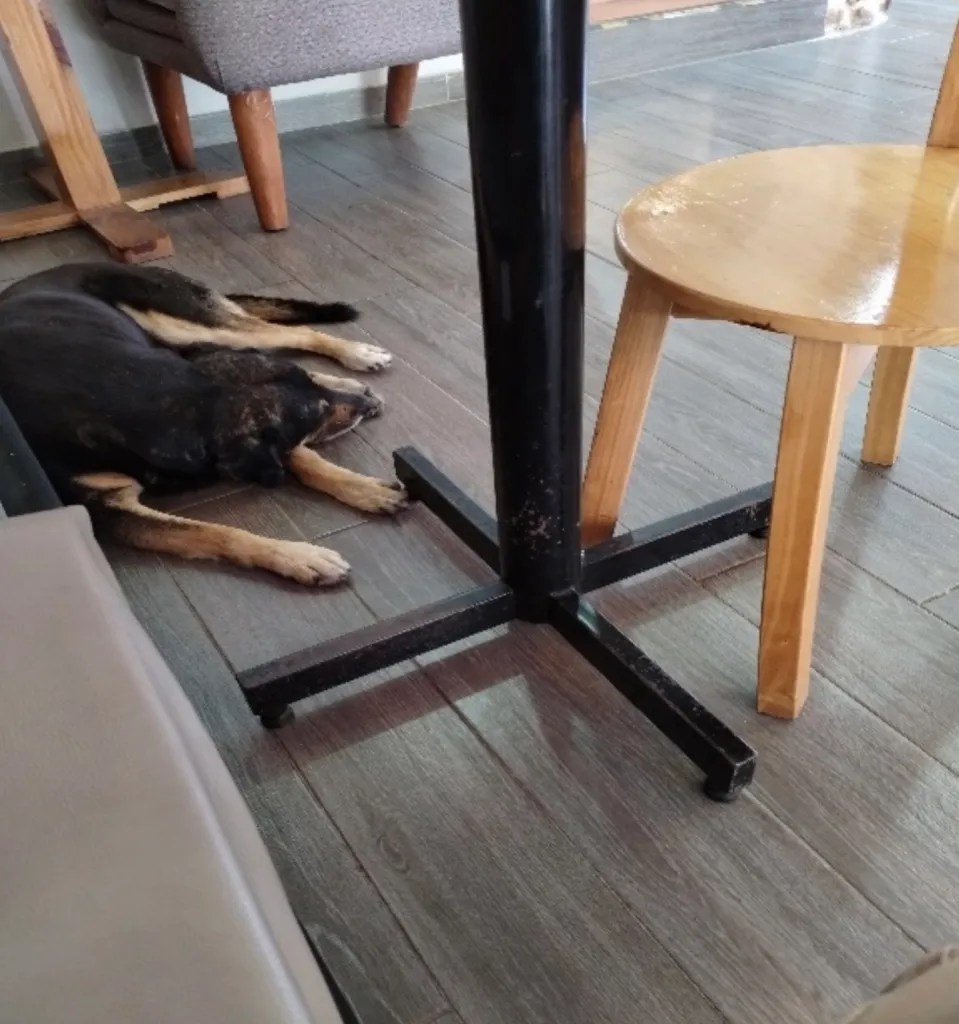
At a restaurant in Aguas Calientes
***
The first morning in Lima, I walked down the long stairway that leads from the town to the beach. Surfers bobbed in the water. Here and there, a ‘surf school’ student struck a bent-knee pose, arms out, imagining what it would be like to catch a wave. Sellers of snacks and touristy-knick-knacks hawked their wares, and a few ancient VW vans sat alongside the curb.
I breezed along the path that bordered the beach for a while. Then I saw him—a medium-sized, black-coated dog walking slowly in my direction. I sat down on a bench, and he approached, lying down at my feet. His ears were pointy, his feet were tipped white, and he had a swatch of grey on his muzzle. But he looked fairly healthy and well-fed. He just seemed to want some human company for a while.
After 10 or 15 minutes, I said adios and continued on my walk south toward Barranco, the pretty district just south of Miraflores. I had coffee at a café housed in a beautiful old colonial and strolled around, gawking at the colorful street murals and poking my head into a few local art galleries. Then I stopped at a market and bought a bottle of water for the walk back and some wet dog food enclosed in a squeezable Capri Sun-type packet.
I saw my new friend nearby, where I had first found him, on a small patch of grass between the street curb and beach, in the shade of a few palm trees. He was sitting on a rusty old chair topped with a stained yellow cushion. I sat in the chair next to him. “Hola, Señor.”
He raised his chin, acknowledged me with a glance, then put his head back down on his paws. I noticed a homemade dog house of heavy cardboard lined with strips of old cloth and carpet. A water dish sat next to the house. I squeezed out the dog food on some napkins, and he ate, taking his time. Though it was just one meal, I at least felt like I had done my good deed for the day.
I went back to visit Señor the next few mornings. He was always in his little area, usually resting, enjoying the ocean breeze. I’d bring him some ham or more dog food and sit with him for a while. Maybe this is not such a bad life for a dog, I wondered. The weather is very mild here—it never fell below 65, and this is winter for Lima. Plenty of fresh air and enough food, it seemed, to get by. Maybe this is even better than the lives many dogs lead back home in Aiken, the ones I would see (or hear) on my walks with my new friend Niles around the neighborhood—dogs behind windows or fences, dogs I never saw outside on a walk, dogs alone.
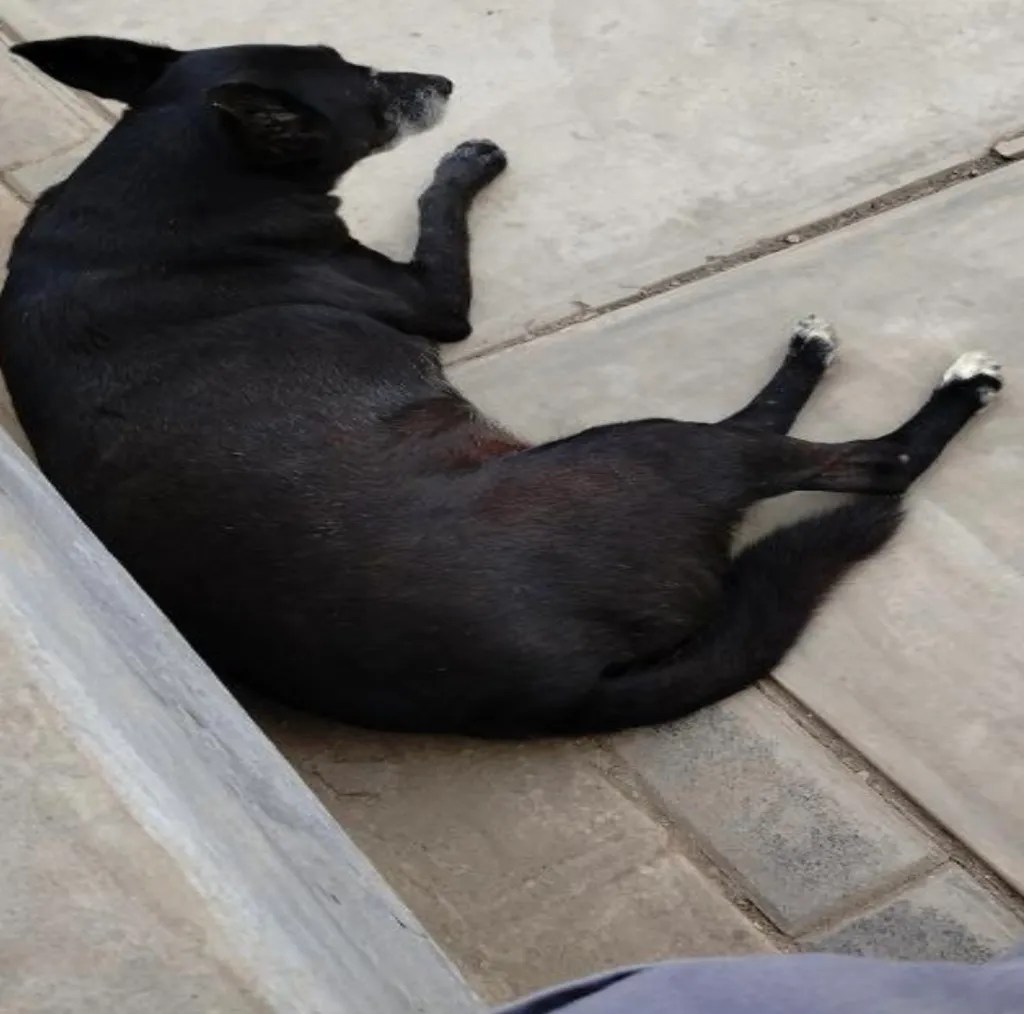
Señor
I stopped by Señor’s place the morning before my son and I took our flight to Cusco. This time someone was sitting in one of the chairs. I went up and introduced myself in my basic Spanish. Ernesto was a member of a city maintenance crew that covered the area that included Señor’s little spot. They’d bring him a little food and water, and stay with him for a while. Señor was lying on the ground at the foot of Ernesto’s chair. I leaned over and petted him. Ernesto and I had a good little chat—turns out Ernesto had lived in Boston for a few years, but decided he liked Lima better—and then I stood up to go. I dug a 50 sol bill—worth about $15 —out of my wallet, and gave it to Ernesto.
“Comida y agua, para el perro?”
Ernesto smiled. “Si, no problema. Muchas gracias.”
“Gracias, buenas suerte.”
I gave Señor a final pat on the back and went on my way. You have to trust somebody, I thought to myself.
Up in Cusco, the beautiful old city in the Andes, gateway to Machu Picchu, there also were many street dogs. Just in the Uber from the airport to the Airbnb, I must have seen 15 or 20 of them, lounging on doorsteps, loping along sidewalks, nosing through litter. Nearby our apartment, uphill from downtown, I spied a small, black-haired dog nestled in a patch of long grass. My heart clenched yet again. The mountain air was cool, and would fall into the 30s overnight. Our Airbnb had a clear no-pet policy. Smuggling the dog inside didn’t seem a good option. Instead, I bought a pack of hot dogs at a nearby bodega and gave one to the dog. He didn’t seem interested, so I laid it next to him on the grass. My son and I went on our way. I had a pint of the best porter I ever had at a brewery down the hill.
The next morning I went to check on the dog. He wasn’t there, but neither was the hot dog. A small success, hopefully. I took the rest of the hot dogs, then walked down to the main square and quickly found several other dogs. Sometimes they wouldn’t take the food from my hand but would eat it after I set it on the ground. After the hot dogs were gone, I visited the amazing Cusco Cathedral, built in the 1500s in the wake of the Spanish conquest.
***
In beautiful places, scars seem uglier. Peru’s food, architecture, mountains and Incan ruins are unlike anywhere else. Yet its poverty is pretty common for the still-developing world. For every upscale Lima neighborhood like Miraflores or Barranco, there’s a crime-ridden district like Callao or a shantytown like Villa El Salvador. In fact, there are far more Callaos than Barrancos. And the worse the conditions are for humans, the worse they are for animals—especially dogs, who, more than most other creatures, rely on humans both materially and socially. Perhaps a good analogy for Peru would be homelessness—the more homeless humans inhabit a locality, the more likely there will be numerous street dogs.
To South Carolinians, this will likely come as no surprise. There are umpteen small, rural towns where many folks are just scraping by, or worse. The 421 corridor between Aiken and North Augusta is just one example. And many of us know that South Carolina has long had a stray dog problem. Animal rescues are continually finding abandoned dogs—and then shipping them up north, where there is often a shortage of adoptable dogs (and less rural poverty, in general).
The endemic street dogs of Peru are therefore a symptom of a deeper human problem as much as anything else. And like the homeless person we might see holding up a sign along the road—we register their existence and then continue on our way—in Peru, street dogs are more or less part of the scenery. So while dogs like Señor seem to have a pretty good life—a great spot on the beach, plenty of fresh air and sunshine, people to keep an eye on him—he is the exception, unfortunately, just like Miraflores is an exception to the general living conditions in Lima. For the vast majority of street dogs, life is rather nasty, brutish, and short.

Señor at his beach spot.
___________________
Douglas Higbee is an English professor at the University of South Carolina Aiken.
Thanks for your column. I was in Peru also a few years ago. There was a park in central Lima near my hotel that was a home to a large colony of cats. They all seemed to be well fed and content, though I worried about the traffic. Then I began to notice that there were cat colonies at various churches throughout the city. I think that the priests cared for them.
Thank you for reading. Yes, there are many cats living in Lima’s Kennedy Park. They have little houses to stay in, and groups of volunteers to make sure they have plenty of food and water.