Sometimes the strongest memories aren’t found in photographs. They’re found in a familiar scent.
If I close my eyes, I can still picture standing in the kitchen as a child, waiting for my mother to pull a pie from the oven. In our home during the 1970s it was usually sweet potato or apple pie. The warmth of the kitchen, the flour dusting the countertop, the anticipation of that first slice—those are memories that never truly fade. But in the South, there is another aroma that has become part of family tradition.
Blackberry pie.
Long before I knew the details of York’s painful history, I came to understand that the smell of a pie baking has an extraordinary way of transporting us back to the people we love. Science tells us that smell and taste are among the strongest triggers of memory, capable of carrying us across decades in an instant. For many families, recreating a loved one’s recipe becomes an act of remembrance—keeping their presence alive one meal, one gathering, one conversation at a time.
That truth came back to me during a recent conversation with my dear friend, Deborah. Despite all she has endured, Deb does not speak with bitterness. More often, she speaks with longing. She told me what a wonderful baker her mother was. Some days, she said, she can still smell the pies baking.
For just a moment, she is a little girl again. Not the daughter whose mother became a headline. Not the daughter whose family was forced to relive unimaginable trauma. Simply a little girl remembering her mother’s kitchen.
That is how I hope we remember Lillie Belle Allen today.
Not only as the young African American woman whose life was stolen on North Newberry Street in York, Pennsylvania, during the racial unrest of the summer of 1969. Not only as a symbol of injustice.
But as a mother. A daughter. A woman with dreams of her own. A talented baker whose children still remember the aroma that drifted from her kitchen.
___________________
In July 2001, thirty-two years after her death, Lillie Belle Allen was exhumed from her resting place in Aiken, South Carolina, after the investigation into her murder was reopened.
She was transported to Aiken Medical Center, where an autopsy and full-body X-rays were conducted. Nearly five hours later, she was returned to the cemetery in a new silver casket that was carefully sealed within the grave vault. Waiting there was a simple basket of flowers. Attached was a card that read:
”Forever in Our Hearts.” — Samantha Dorm and Family
Silbaugh Memorial generously provided the first permanent grave marker placed in her honor. They were small gestures. But they were offered in love. In empathy. In the hope of showing the Mosley/Allen family that another side of York also existed—a community willing to acknowledge their pain and embrace them with compassion.
At the time, I was working in the York County District Attorney’s Office. My involvement with the Mosley/Allen family, however, was never about my profession. It was personal.
Their grief reflected the experiences of generations of Black families who had been told to stay quiet. To move on. To avoid making trouble. It is a pain that settles in your throat, where sadness and anger become almost indistinguishable. A pain that cuts deeply. Yet still…
We rise.
Growing up in York, everyone seemed to know some version of what happened in 1969, even during the years when there was no active investigation. After the trials and convictions, our community responded in different ways. Some sought healing. Others chose silence. Even today, in 2026, there are still voices that say we should simply “leave the past in the past.”
But history does not disappear simply because we stop talking about it. Its lessons remain. Perhaps the greatest lesson comes not from the violence itself, but from the remarkable resilience of Lillie Belle Allen’s children. They have endured the unimaginable loss of their mother and then, decades later, were asked to relive that trauma as the investigation reopened.
Through it all, Deborah has remained one of the most gracious people I know. When she talks about her mother, it is rarely about July 21, 1969. It is about the kitchen. The laughter. The love. The pies.
So this year, I have decided to honor Lillie Belle Allen a little differently. I invite you to bake a pie. Better yet… Bake a blackberry pie. Share it with your children. Take a slice to a neighbor. Deliver one to a friend. Offer one to someone you have never met.
And while you’re sharing that pie, have a meaningful conversation about how we can do a better job of loving one another—even when we disagree, even when our backgrounds are different, even when history challenges us.
If baking isn’t your gift, visit a local bakery. Support someone whose hands still carry on the tradition. When you carry that warm pie home, pause for just a moment. Breathe in its aroma. Let it remind you of Lillie Belle Allen. Because she was so much more than a woman whose life ended in tragedy.
She was someone’s mother. Someone’s daughter. Someone’s friend. Someone who filled a kitchen with warmth and the sweet fragrance of homemade pies. That is a memory worth preserving.
To Deborah, Michael, and the entire Mosley/Allen family—
We remember her today.
May the aroma of a warm blackberry pie forever remind us that love, family, and kindness have the power to outlast hatred.
In loving memory of Lillie Belle Allen July 21, 2026
In advance of the June 8, 2026 City Council meeting, I skimmed through the 437-page agenda packet, my attention drawn to the last item of business — a Resolution identifying 20 properties in the Project Pascalis footprint as abandoned building sites. Among them were 113 Newberry Street and 213 Richland Avenue —Warneke Cleaners and Taj Aiken, respectively.
Warneke Cleaners, a family business for 92 years and counting, was still open for business, as was the very popular and successful Taj Aiken restaurant, which first opened its doors in the Hotel Aiken in 2017 and has been located at 213 Richland Avenue for the past five years.
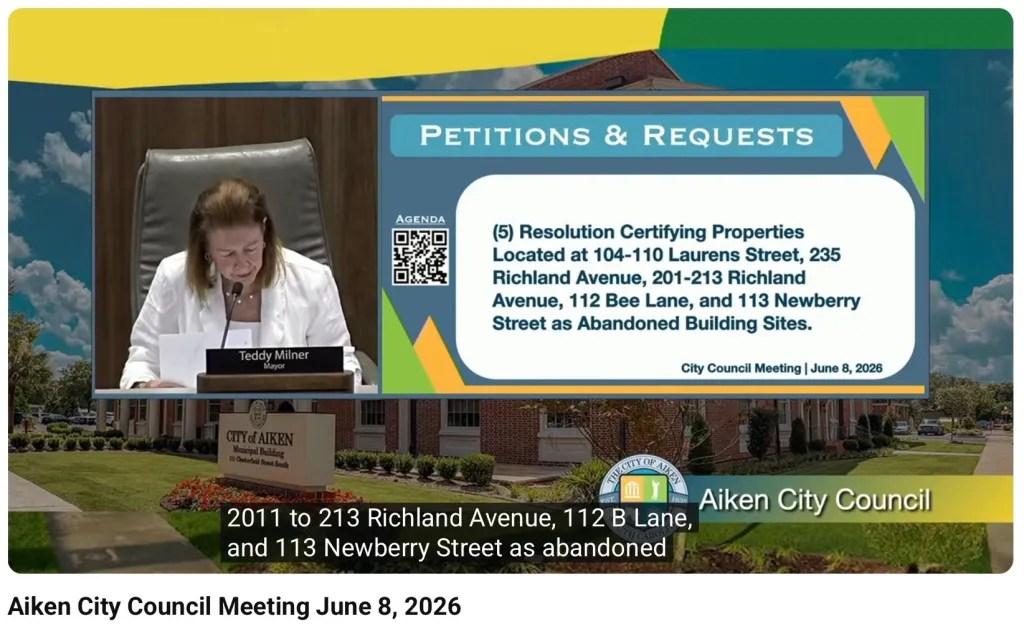
I was unable to attend the meeting but watched on video as Mayor Milner introduced the Resolution one hour and forty-six minutes into the meeting, a time when attendance typically dwindles to few. She read the title to the Resolution, which was also projected overhead on the wall.
Next, City Manager Stuart Bedenbaugh spoke, giving a precise definition of the term “abandoned building,” and the criteria by which a building can be certified as an abandoned property, citing the legal counsel of tax credit attorney Robert Lewis, who had confirmation that these 20 abandoned building units had been correctly identified. How did Taj Aiken, Warneke Cleaners, and the more recently occupied offices in the McGhee block qualify under this definition? That was the question of the hour.
The goal of certifying these properties as abandoned is to incentivize interested taxpayers to rehabilitate the buildings and receive tax credits under South Carolina’s newly amended Abandoned Buildings Revitalization Act. In his description, Mr. Bedenbaugh did not repeat the physical addresses listed in the Resolution, however, the addresses of the abandoned buildings were still projected onto the wall as he spoke.
At the conclusion of Mr. Bedenbaugh’s statements, Mayor Milner called for a motion to approve the Resolution, which was given by Councilwoman Price and seconded by Councilman Waldo. Next came the public comment period.
Mr. Kumar
Taj Aiken restaurant owner Alokkumar “Kumar” Akse, the only person who was to comment on the Resolution that night, came to the podium. His demeanor — courteous, thoughtful, kindly, respectful — is one of the first things you’ll often hear about from anyone who has met him. He began his statement by gesturing toward the image of the Resolution projected onto the wall. “So we show the 213 Richland Avenue is abandoned,” he said, “but it’s a functioning restaurant. I have the restaurant named Taj Aiken. So I am running a restaurant there.”
“Also,” he said, “the Warneke Cleaners is operational. You can go there and you can check that. It’s operational. So that’s the wrong information you have.”
No one spoke to him in response. I had hoped, by watching the meeting, to hear some of the obvious questions asked and answered. Mr Kumar had already answered one question with his presence. Clearly, his landlord, the City of Aiken, had not discussed the contents of this Resolution with him in advance of the meeting.
I had other questions, among them: Why was the City seeking to certify occupied buildings as abandoned? Tax credits, yes, but how was a business to operate out of an abandoned building? If Mr. Kumar was mistaken in his understanding of what we’d all just heard and read in the Resolution said, now was the time to clear this up.
Continuing in his statements, Mr. Kumar described some of the events of the past four years. He spoke of being treated differently from the City’s other tenants. He spoke of signing the lease (referring tothe 5-year lease he said he’d signed in February 2024] in front of the Mayor and the City Manager. He spoke of the City not completing their end of that lease. He spoke of being “threatened by the people, by the selling agent” to not come to the City meeting, and not to do anything. He spoke of being threatened to not go to an attorney. He spoke of being threatened by “Mr. Tim” to sign the lease [the Relocation Assistance Agreement that Mr. Kumar signed in 2022] and said, “I have all the proof that I can show you.”
Mr. Kumar also spoke of the various promises from the City — e.g. to help build his restaurant, and to have him sit him down with the developer — things that he said never happened. Toward the end of his statement, Mr. Kumar produced copies of letters from his attorney for all of the Council members to read. Copies of this letter had previously been provided to Mayor Milner and Stuart Bedenbaugh. Mr. Kumar finished by repeating that all he was looking for was “fair justice.” He said that two other tenants had gotten 5-year leases, but not him. “So I just want to ask you why am I getting treated differently?”
At this point Councilwoman Price asked him, “What is the address? I didn’t catch the address.”
City Manager Bedenbaugh broke in, his tone sounding more like a scold than an explanation. “Well, if you look on page 406 of the packet, it plainly states that his business is not abandoned so I want to clear up that misconception. I also want to clear up that the speaker is getting all of his rent back when he moves. That is unprecedented.”
Mr. Bedenbaugh repeated the word “unprecedented” several more times over the next few minutes, even soliciting confirmation from a commercial property owner in the audience that this was unprecedented.
Relocation Assistance
I cannot say what is or isn’t unprecedented, but I can offer information and excerpts on the topic from a letter Don Moniak recently sent to Mayor Milner and City Council.
For one, he did a simple internet search for “business relocation agreements,” a sample of which revealed (see below) that such private business arrangements are not unprecedented:
Relocation. Landlord, at its sole expense, on at least 120 days’ prior written notice to Tenant, may require Tenant to move from the Premises to another suite of substantially comparable size and decor in the Building or in the Complex. In the event of any such relocation, Landlord shall pay all the expenses: (a) of preparing and decorating the new premises so that they will be substantially similar to the Premises; (b) of moving Tenant’s furniture and equipment to the new premises (including Tenant’s data and communication wiring and cabling); and (c) that Tenant actually and reasonably incurs out-of-pocket (and which Tenant can document with written records) in connection with Tenant notifying its clients of such relocation, obtaining new letterhead and business cards, and other incidental expenses related directly to Tenant’s relocation.”
Mr. Moniak also provided thumbnail histories on all the Pascalis footprint tenants to the Mayor and Council, including this one on Warneke Cleaners and Taj Aiken:
No businesses have endured more uncertainty and false hopes that were generated by the City than Taj Aiken and Warneke Cleaners. These were the two most complicated and expensive businesses to relocate, yet they were only initially offered the rent reimbursement agreement that would have provided nowhere near enough funds to relocate had Project Pascalis moved forward.
In January 2023, four months after Project Pascalis was cancelled, the City proposed to keep both businesses in place as part of the downtown SRNL project. This included moving Warneke Cleaners to another location on the same block.
Mayor Rick Osbon would later write in an Aiken Standard op-ed that:
“Any local businesses potentially impacted if the current preferred site being considered is selected will be fully protected and made whole. Those highest of priorities include the Taj Aiken Restaurant, Warneke Cleaners, Newberry Hall, and the preservation of the Johnson Drug Store building at the corner of Richland and Newberry. “
The City also tentatively offered to move Taj Aiken to the Johnson Drug Store building.
When the City opted to put the lab building on Newberry Street, these commitments withered.
However, Taj Aiken was reportedly offered a five-year lease shortly after the city agreed to the other five-year leases. There has never been an explanation for why the City reneged on the offer.
Below is a copy of the March 2022 Relocation Assistance Agreement — the month-to-month lease that Mr. Kumar stated in a recent City Council meeting he was “threatened” to sign by “Mr. Tim.” This lease is not to be confused with the later 5-year lease that Mr. Kumar said he’d signed in February 2024, and which the City never signed.
According to social media chatter generated by the events of this week, there are some who believe that Mr. Kumar had three or four years notice to vacate the building. The record, as detailed in Part Two of this series, shows this to be untrue. There are also those who imagine the return of his rent money from 2021 onward is adequate to fund his relocation and other expenses necessary to make him “whole” as he was earlier promised by Mayor Rick Osbon. It should go without saying that those of us who have never opened or relocated a restaurant are not the best qualified to weigh in on this.
The Five-Year Lease
The five-year leases (technically four-year leases with an option for a one-year extension) have been a running refrain in this story. City Council meeting videos offer some insight into why Mr. Kumar has repeatedly asked why he’s been treated differently from the City’s other tenants in the Pascalis footprint, who were given a signed, 5-year lease by City Council in March 2024 (see video of proceedings below).
Most people, myself included, do not know enough about restaurant leases to fill a thimble, but anyone who’s ever managed a household, or leased an apartment, can imagine the difficulties of a month-to-month existence — and all the more difficult for someone planning, budgeting, staffing and growing a restaurant on a month-to-month lease.
So why, after all this runaround from the City would Mr. Kumar remain at 213 Richland Avenue with a month-to-month lease? Likely the years of promises and assurances by City officials that his future was secure in that address played no small part, but, as he’s consistently said in public statements over these years, including statements before Council, the Richland Avenue address has been a successful location for Taj Aiken. He likes the small town atmosphere in that part of the downtown, and so do his customers.
Throughout the past two-plus years, he continued to press the City to follow through on that five-year lease, or allow him option, as another tenant was given, to purchase his building. He has stated at least twice in meetings over the past two years his wish to purchase properties adjacent to Taj Aiken to possibly expand his business or open other shops and restaurants. He has bought the former Casa Bella restaurant building on nearby Chesterfield Street.
I can’t say if Mr. Kumar’s original plans were to move Taj Aiken to that location or open a second restaurant, but it looks like the decision, ready or not, may have been all but made for him with his City landlord’s order last week to vacate 213 Richland Avenue within 20 days. What will it take to accomplish this and relocate his restaurant to that house with its notoriously tiny kitchen?
The Not Abandoned Properties
In my pre-meeting reading of the June 8 agenda, I had noticed, in passing, some square footage tables in the attachments below the body of the Resolution, but only because their presentation seemed different from the rest of the materials. I returned to them after watching the June 8 meeting, curious to find where it “plainly states” on page 406 that 213 Richland Avenue is not abandoned.
It took me a moment, but I found on pages 407-408 — under the headings “Abandoned Building Units” and “Parking Garage Site” — a table listing Warneke Cleaners and “Indian Restaurant.” Beside these two business it said “Not AB,” apparently an abbreviation for abandoned.
If the City didn’t intend to certify 213 Richland Avenue and 113 Newberry Street as abandoned properties, why was a colorful graphic created, then read by read aloud by the Mayor and projected onto the wall of City Council chambers? Why didn’t the City simply correct the Resolution before presenting the document in a public meeting?
Also, while it is normal procedure to reference attachments in legal documents, the attachment on page 406 (sic) that Mr. Bedenbaugh cited was not referenced in the Resolution. An asterisk could have been provided to guide readers to this attachment. A key to the AB abbreviation would have helpful, too.
Discrepancies between the printed word and the spoken word reappeared in the City’s July 2026 Design Review meeting where, at meeting’s end, a motion was made and passed to partially demolish the historic Aiken Standard that houses the Taj Aiken restaurant.
July 7, 2026
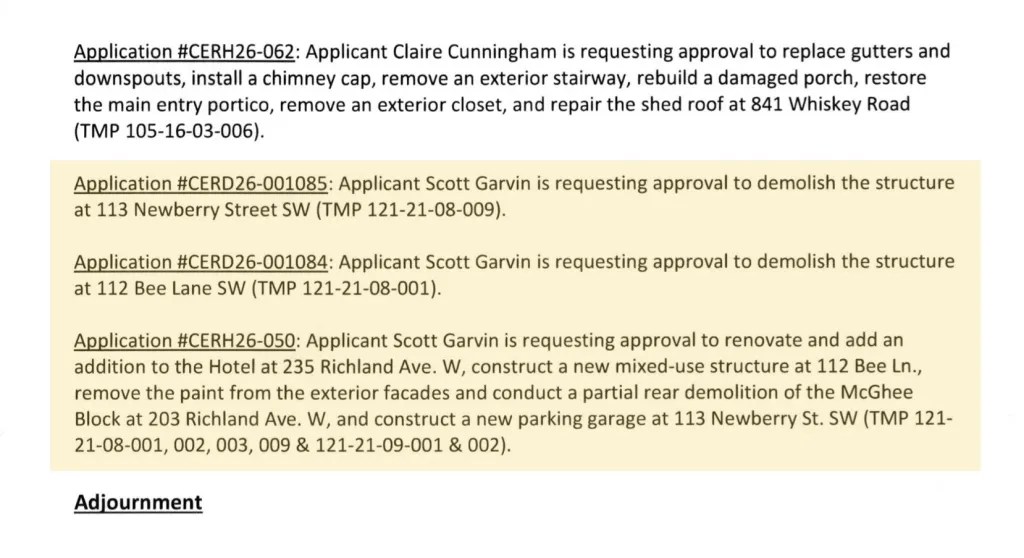
When the agenda for the July 7 Design Revew Board meeting was released, the last items on the agenda under “New Business” were three applications to (1) approve demolition of 113 Newberry Street (Warneke Cleaners), (2) approve demolition of 112 Bee Lane (Holley House Motel), and (3) renovate and add an addition to Hotel Aiken at 235 Richland Avenue; construct a new mixed-use building at 112 Bee Lane; remove paint from the exterior facades and conduct a partial demolition of the McGhee Block at 203 Richland Avenue; and construct a new parking garage at 113 Newberry Street (the Warneke Cleaners site).
There was no mention in the application of Taj Aiken or the historic Aiken Standard building that houses the restaurant. Nor was there mention of 211 Richland Avenue, nor the other storefront at 213 Richland Avenue that shares this same building. Why?
Mentions of this building and this business were scant to none in the agenda documents. Taj Aiken and 213 Richland Avenue were mentioned once in Staff Comments. The 211 Richland Avenue address shared with Taj Aiken was also mentioned in Staff Comments in the listing of the circa 1920 buildings on Richland Avenue.
Elsewhere, there were few mentions or images of 211 Richland Avenue or the Aiken Standard building, and most of these confused or conflated the Aiken Standard building with the next-door McGhee Block, whose address is 201-209 Richland Avenue — not 211 or 213. To be clear, while the Aiken Standard building is next-door to the McGhee block, it is not part of the McGhee block.
A Tricky Business
It is, of course, understood that the Aiken Standard building is listed in Aiken County property records as 211 Richland Avenue, just as the McGhee Block is listed as 203 Richland Avenue. What is not understood is why — throughout the processes of certifying the buildings in the former Pascalis footprint as abandoned, then making application to variously demolish and renovate them — the locations of both Taj Aiken and the Aiken Standard building have shifted to adjacent addresses.
The confusion Mr. Kumar spoke of in the both the June 8 meeting and the July 7 meeting is understandable. The matter of his address is, as he aptly stated at the podium, “a tricky business.”
After all, the address of his business was given as 213 Richland Avenue in his lease and square footage tables in the Resolution. In the same document, however, 213 Richland was subsumed into 211 Richland Avenue. A similar thing happened in the DRB hearing on July 7, as 211 Richland Avenue was variously confused or conflated with the McGhee Block.
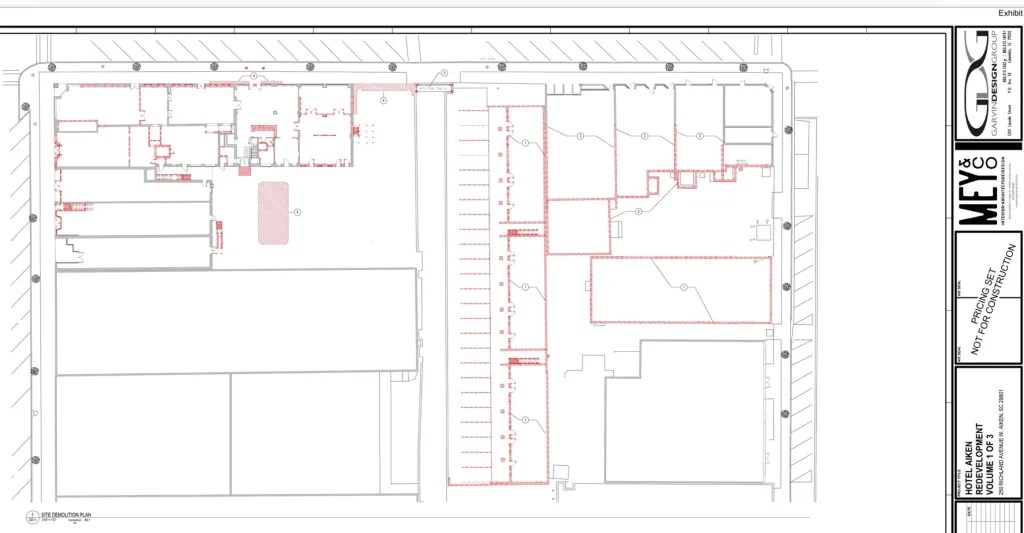
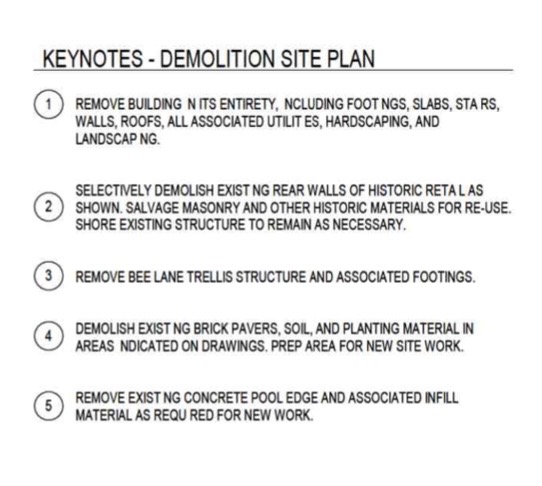
This conflation was carried forward to the motion at meeting’s end to approve demolition of, not only the post-1940 McGhee Block addition(s), (which had earlier been deemed beyond the era of historical significance), but also to demolish the back half of the next door Aiken Standard building — which, again, is not part of the McGhee Block. The plans for the partial demolitions of these buildings can be viewed in the Site Demolition Plan on page 825 of the agenda packet. Below are a few screenshot from this page.
The plan for a partial demolition at 213 Richland Avenue was known by the time Mr. Kumar came to the podium on July 7. Why didn’t his City landlord communicate matters to him before the meetings? Someone could have said to him, “Just a heads-up, Mr. Kumar, there is a Resolution in the upcoming City Council meeting agenda to certify your building as an abandoned property,” and “Just a heads-up — the building housing Taj Aiken is slated for partial demolition.”
This would have been a good time, too, to give Mr Kumar a heads-up that the City would not be following through on the assurances made by council members and former mayor since 2022 that he would be “included in all of this in some way, shape, or form,” and that he “would remain on Richland Avenue” and would be “full protected and made whole.” It would have been a kindness, if not a moral imperative, to communicate these simple matters of fact to Mr. Kumar in advance of the meetings. Being among the last to know of his impending eviction notice no doubt compounded his shock in receiving that 20-day notice.
Mr. Kumar
During the public comment period, Mr. Kumar came to the podium with his customary politeness. His politeness was answered in kind throughout the ensuing exchange with DRB chairman, Mr. Ben Lott. Mr. Kumar started by saying about the project, “I’m not opposed but have a couple of questions.”
The phrasing of his questions and concerns may have been difficult for some to follow, but the content was plain. “Nobody mentioned Taj Aiken,” he said early in his statement. “What’s the aim for Taj Aiken?”
He also pointed out the error in his restaurant’s address. “The address is 213 Richland Avenue,” he said, “I did see one mention in the agenda that it’s at 211, but that’s wrong.”
Mr. Kumar rephrased his questions several times as an effort, it seemed, to elicit answers on the future of his business. He asked if Taj Aiken would be shut down by force, and when the demolition might start.
Mr. Lott said, “I don’t know that we’re discussing schedule. We’re just talking about design features and the appropriateness of the request. And I’m not sure I understand your question other than the schedule question.”
Mr. Kumar said, “Yes, so the thing is, everyone is talking about the Warneke cleaners. I see the pictures of the Warneke Cleaners going to be demolished, but the Taj Aiken is behind that. Nobody talked about the Taj Aiken.” He pointed out that sometimes Taj Aiken is included with the McGee block, sometimes in the Aiken Standard building. “I’m confused,” he said.
Mr. Lott said, “So, yeah, I think my understanding is it’s part of the old Aiken Standard building, is the building you’re talking about, right?” to which Mr. Kumar responded, “Yes.”
Mr. Lott continued. “Okay, and so your question is, the front’s being preserved, but you don’t understand why the back’s not being preserved?”
“No, no. The thing is,” said Mr. Kumar, “I’m the owner of the Taj restaurant. So I have a restaurant over there.” He explained a bit more about his business, then said he wanted to know if Taj Aiken, the Aiken Standard building, is going to be demolished, too, and if he’d have to move. He wanted to know the future for the restaurant.
Mr. Lott explained that, as the lessee of the building, Mr. Kumar would want to take those questions up with the City, (his landlord), not the Design Review Board.”
In his closing remarks, Mr. Kumar once again told Mr. Lott that his address is 213 Richland Ave, not 211 Richland Avenue. Mr. Lott turned to staff and said, “Let’s check the type and see if there’s any typos on the numbers , later.”
Historic Preservation
Before Mr. Kumar came to the podium, Linda Johnson, president of the Historic Aiken Foundation (HAF) came to the podium to speak on behalf of HAF. In her statement, she laid out the Department of the Interior and HAF preservation standards by which a historic building could be demolished. She also quoted the City’s own preservation ordinance. Linda Johnson’s statement can be viewed here on the meeting video.
From this criteria, it would would be difficult to justify the partial demolition of the historic Aiken Standard building, as (1) it doesn’t pose a threat to public safety, (2) a case hadn’t been made that rehabilitation is infeasible, and (3) the DRB hasn’t established that there isn’t a reasonable alternative to demolition.
An Aside
In the field of historic preservation, there is something called “facadism,” whereby part of a building is demolished, and the facade and its architectural details are preserved. This allows for flexibility to overcome myriad challenges inherent to adaptive reuse of historic buildings and their surrounding properties. The facade is incorporated into a new building. The artfully preserved pillars of the old 1938 FDR-era Police Station in the Alley could arguably be offered as an example of facadism.
The intention to demolish at least part of the McGhee building was described in the application: “Along Richland Ave, the facades of the historic McGhee block will remain intact, while the rear will be partially demolished….” But facadism was not part of the discussion in the Design Review Board meeting, and the historic Aiken Standard building was all but absent from the discussion until the motion was made at the very end.
“And then, finally, the motion to construct several new buildings, remodel a hotel, and do a partial demolition of the McGee block, including the Aiken Standard buildings in there.”
Here in the City’s Design Review Board meeting, as in the June 8 City Council meeting, the spoken words did not match the printed words.
To Be Clear….
It should go without saying, but I want to be clear. Nothing in this editorial is to be construed as opposition to this project. Like most people, I’ve been saddened by the slow-motion decay of the Hotel Aiken, and I want to see it rehabilitated, rebuilt and made beautiful and functional again. I am glad to have been part of the 2022 effort to prevent the demolition of the Hotel Aiken, and I am glad to finally see this venerable old building getting the treatment it deserves. I simply wish the same for the small business owners in our downtown.
Those who would frame this story as a choice between having a beautiful downtown or taking good care of our small businesses have perhaps lost the plot.
The Elephant in the Room
At the heart of the difficulties in communications between Mr. Kumar and the DRB on July 8 may have been the simple fact that — for the purposes of discussing and approving demolitions of buildings — the businesses, the persons, and the lives inside those buildings didn’t exist. This is a difficult position to maintain when the person, or a proverbial elephant, is standing in the room asking questions. It was perhaps the same in the June 8 City Council meeting, as the existence of a thriving restaurant had been reduced to an entity on a piece of paper, a building that was alternately abandoned and not-abandoned, depending on which page you read. It was the same, we now know, for Mr. Kumar, whose decency, generosity and goodwill in the Aiken community have been repaid with something entirely different.
___________________
ABOVE: From Taj Aiken Facebook wall, the restaurant’s October 2024 food box giveaway in the wake of Hurricane Helene
For more reading and information on this evolving story, please see the letter, below, written by Don Moniak to Mayor Milner and the Aiken City Council. Included are his written comments and a timeline with references regarding the fate of the nine businesses affected by Project Pascalis. Other links and articles may be added in the coming weeks.
UPDATE: During yesterday’s July 13, 2026 City Council meeting, a scheduled executive session was held. (Click here to see the July 9, 2026 notice for the executive session). After the executive session ended, City Attorney, Gary, H. Smith III asked Mayor Milner to “pass a motion to authorize the City of Aiken to enter into contractual discussions with attorney, Lauren Martell [Mr. Kumar’s attorney] and to notify the tenant at 213 Richland Avenue West that he is required to vacate the premises in 20 days, and/or authorize the city to move forward with the appropriate legal action.” Mr. Smith’s full statement can be viewed here on the City of Aiken meeting video.
Part Two of a Three-Part Editorial
Prior to two confused actions by the City this summer — the first one listing the successful Taj Aiken restaurant building as abandoned; the second, opening the door to partial demolition of the building — there were four years of relentless back-and-forth. Plans were made, then changed; assurrances were given, then forgotten; promises were made and not honored. The recounting of this four-year history is not to open old wounds or re-plow old ground, but to give context to this summer’s events and perhaps incentivize a different way going forward.
The Pascalis Footprint
In November 2021, Alokkumar “Kumar” Akse, along with numerous other small business owners in the central downtown block, were informed that their buildings were to be demolished to make way for the Project Pascalis redevelopment project. They would need to move. Over the course of the next 56 months, this plan would change numerous times.
All of the business owners in this footprint were impacted. Disparities in the addressing of these impacts has been a feature. Some tenants were given five-year leases. One was given the option to purchase their building. Others were given funding to relocate. At least one described being effectively driven away.
Business partner Stacy O’Sullivan of Art and Soul, a successful, well-loved gallery and studio space for local artists, told some of their story for the Aiken Chronicles article Project Pascalis Includes the Alley. [Clarification: Stacy O’Sullivan and her business partner, Kim Rising, were part of the original Pascalis footprint, but never tenants of the City]. She also told the story in a July 2022 WJBF television news interview. telling Shawn Cabbagestalk, “We were invited to leave.” Citing issues of roof leaks, wood rot and unaddressed maintenance, she explained, “I think they would prefer for us not to be here because they would prefer to make three times the rent, and they’ve made that very clear to us in the beginning.”
Stacy O’Sullivan also described the City’s “disheartening” lack of communication and the fact that the huge redevelopment project didn’t take into consideration the small business owners who had already invested much “just by being there and conducting business.” Her words resonate today in the story of Taj Aiken, which has invested much, yet been left to spend the past four years in a state of perpetual limbo.
Irregularities
In June-July 2022, as irregularities in Project Pascalis began to surface, the demolition hearings were abruptly cancelled. The collapse of the entire project followed. With demolition no longer on the table, Mr. Kumar hoped to either buy his building from the City or sign a long-term lease.
Nearly half of Aiken’s central City block was consumed by the Pascalis footprint in 2021, with the hearings for demolitions scheduled in July 2022. Among the buildings scheduled for demolition was the historic McGhee Block, Warneke Cleaners, and Newberry Hall (pictured above), along with State Farm, Alley Holdings, Holley House, Hotel Aiken, Ginger Bee, Vampire Penguin, Beyond Bijoux, and the old Aiken Standard building..
In November 2022, as detailed in the article, PU Funds Con Game? the City requested and later received a $26.2 million allocation of the State of South Carolina’s $600 million Plutonium Settlement funds. There were a number of irregularities cited in the City’s application, among them, the mischaracterization of the Pascalis properties — from Newberry Hall, to Taj Aiken, to Vampire Penguin — as “blighted.” City Council then approved spending $9.6 million of the plutonium funds to pay off the Pascalis general obligation bond debt for the original purchase of the Pascalis properties.
In January 2023, the City announced that the Savannah River National Laboratory (SRNL) had plans to build a 45,000 square ft lab in the Pascalis footprint using $20 million from separate Plutonium Settlement funds that had been allocated to SRNL. Mr. Kumar was assured by City officials and by SRNL director, Dr. Vahid Majidi, that Taj Aiken’s future in that location was secure. As Mayor Pro Tem Ed Woltz described in his January 2023 State of the City address:
”The plan is to preserve the existing businesses on the Block, leaving Newberry Hall untouched, relocate Warneke Cleaners to the buildings at front of Richland Avenue. These retail buildings on Richland Avenue will be renting and upgraded as part of the project and the Thai restaurant [the councilman was referring to Taj Aiken, which features Indian cuisine] would remain on Richland Avenue.” — Mayor Pro Tem Ed Woltz, January 2023
Believing that he now had sound basis for hope, Kumar began making improvements to Taj Aiken.
Promises
Kumar’s hope was bolstered by promises delivered in June 2023 from an Aiken Standard newspaper guest column penned by then-Mayor Rick Osbon. Addressing the fate of the small business owners in the footprint of this large project, which he enthusiastically supported, Osbon wrote:
“All involved in these initial planning stages have been clear that any local businesses potentially impacted, if the current preferred site being considered as selected, will be fully protected and made whole. Those highest of priorities include the Taj Aiken Restaurant, Warneke Cleaners, Newberry Hall, and the preservation of the C.C. Johnson Drug Store building at the corner of Richland Avenue and Newberry Street.” — Mayor Rick Osbon, June 2023
In October 2023, with the SRNL’s commitment to the project mysteriously evaporated over the months, plans changed. The size of the building, the footprint of the building, the name of the building, and, even the location of the building — all changed. At one point, Kumar was told that he would need to move, after all, as the project would need some of his space. When plans changed again, with the SRNL project now moving a block to the north on Newberry Street, Mr. Kumar’s hopes were renewed for an extended lease or option to purchase the building.
In February 2024, in response to Mr. Kumar’s request for a lease similar to the ones recently extended to other tenants in the Pascalis footprint, City Manager Stuart Bedenbaugh created a 5-year lease for Kumar to sign, which he reportedly did in front of both Bedenbaugh and Mayor Teddy Milner. Paradoxically, the City did not sign the lease and, instead, advised Kumar to check back with them — which he did on a monthly basis.
Fourteen Months Later
In April 2025 — fourteen months after he’d signed the lease — Mr. Kumar attended a City Council meeting requesting that City officials sign the lease, just as they’d done with other tenants in the Pascalis footprint. A transcript of Mr. Kumar’s statement can be read in the article, “An Aiken Institution: Taj Aiken….” His statements can also be heard in the video clip from the meeting, beginning at minute 39:45, linked beneath the screenshot below.
Following Mr. Kumar’s statement was an exchange between Councilwoman Diggs and Jacob Ellis, a local citizen and former City Council candidate, who, describing Kumar as a pillar of our community, advocated for fair treatment of the restaurant. Councilwoman Diggs described her own witness of Mr. Kumar’s generosity as she watched him help out an elderly couple in the dollar store parking lot. Neither the Mayor nor the City Manager responded to Mr. Kumar’s questions on his lease.
Two Weeks Later
On April 28, 2025, Mr. Kumar returned to City Council chambers. Having received no response from the City on signing his lease, he inquired about the possibility of buying some of the buildings in the Pascallas footprint. He was prepared to do this. Mr. Kumar’s statement can be viewed here on the City of Aiken meeting video.
The responses to Kumar’s statement from others in attendance can be viewed in this same video at minute 46:15, linked here. Citizens Lisa Smith and Kelly Cornelius spoke, with Ms. Cornelius’ statement likely expressing the thoughts of many who had been following the story of Project Pascalis and the small business owners in its footprint:
“I think all of you know how passionate people were about saving those buildings, but it wasn’t just about saving the historic buildings. It’s about the small businesses that were housed in those buildings. And so, I would urge you to do whatever you can to keep somebody like Kumar in this community. And I would have that handled before you bring that sale forward. I mean, he asked why not give him a seat at the table. And why not give him a seat at the table?
“I don’t know if you’ve seen the online comments, but he has an amazing support group in this community. He’s just an outstanding member of this community and I would hope that you would see him for that. And that’s exactly the kind of business that we want to have downtown. And so I would hope that you would give him a seat at the table.” — Kelly Cornelius, April 28, 2025
Mayor Pro Tem Ed Girardeau responded at length in discussion with Lisa Smith, with some of his words responding to the concerns Ms. Cornelius had just articulated:
“I can’t imagine if one of these developers actually goes forward and does this that he won’t be included in that. He’s a successful businessman, a successful restaurant. That’s what they want. They’ll work it out. But I’m sure that Mr. Kumar will be included in all of this in some way, shape, or form.” — Mayor Pro Tem Ed Girardeau, April 28, 2025
Fourteen Months Later
On June 8, 2026, Mr. Kumar returned to City Council chambers, this time to bring his concerns regarding a Resolution that the City was bringing to the table that evening. With this Resolution, the City was prepared to certify 20 building units in the Pascalis footprint as abandoned properties. Included were 113 Newberry Street and 213 Richland Avenue, the address of, respectively, Warneke Cleaners and Taj Aiken. After four years of this, it should come as no surprise that the City of Aiken landlord had apparently not communicated this latest change with their tenant at 213 Richland Avenue.
_________________
NEXT:
Part Three: The events of June and July 2026 as the successful Taj Aiken restaurant at 213 Richland Avenue is listed as an abandoned property, then not abandoned, then approved for partial demolition.
Last month, the home of the highly popular and successful Taj Aiken restaurant, which is very much open for business, was erroneously listed as an abandoned building by the City of Aiken. Then it wasn’t. This month, the City’s Design Review Board called for a motion in its July 7 meeting to partially demolish the historic Aiken Standard building that has housed the busy Taj Aiken restaurant at 213 Richland Avenue for the past five years. What’s going on here? After 4 years of back and forth by City offices, this question deserves an honest answer.
Mention the restaurant, Taj Aiken, or the name of its owner, Alokkumar “Kumar” Akse, to anyone in Aiken, and you may hear an outpouring of stories about the generosity and goodwill of this small business owner and his restaurant’s support for the Aiken community.
Most recently, on July 4, 2026, Taj Aiken was in the local news after Mr. Kumar, as he is well known, extended a gesture of appreciation for the hard work and dedication of the Aiken County Sheriff’s Department officers by providing boxed lunches to the search crews working in those earliest hours of the Javeayah Harris tragedy.
Taj Aiken’s boxed lunches have been a staple of many such kind efforts over the years.
In June 2020, Mr. Kumar thanked our local first responders for their selfless service in the pandemic (“epic heroes,” he called them) by delivering “delectable meals” to them at the Aiken Regional Medical Centers.
There is also that annual Christmas tradition at Taj Aiken, where one day every December since 2021, the Aiken community has been cordially invited to stop by and pick up one of the hundreds of free boxed meals prepared by Taj Aiken. The December 2025 event, in which 550 boxed lunches were given away, was a collaborative effort to raise money for the Salvation Army’s Red Kettle fund.
There was also that time on October 2024, after Hurricane Helene tore through Aiken and left many without electricity and other essentials for days and weeks. Kumar rose to the occasion by providing free boxed lunches to the general public every day over the course of a week — and with special invitation to “lineman, police, health care and all front line workers who worked tirelessly to bring our lives to normal.”
There was also that time just a few weeks ago, on July 2, when Mr. Kumar visited Aiken’s Teen After School Center. As he described on the Taj Aiken Facebook page:
“Their work in our community is remarkable, and it’s clear that the kids are our future. We were informed that the center needs help from the community to create a dedicated space for students to study and more. While it’s impossible for one person to do everything alone, we firmly believe that together, we can make a difference. Taj is ready to contribute materials to this worthy cause. We appeal to the people of our town to join us in making this a reality. Your donation of materials, money, or skills will be instrumental in bringing this project to fruition.”
If the term “boxed lunches” conjures images of baloney sandwiches and bags of chips, a glance at the photos of the finely prepared, flavorful Indian cuisine in Taj Aiken’s boxes will quickly dispel that. These are some of the same flavors and scents that greet visitors to his restaurant at 213 Richland Ave.
Indian Fare “Kaleidoscopically Seasoned”
The deliciousness of Taj Aiken’s fare and the artistry of the spices has been the topic of local restaurant reviews at Augusta Magazine, the Aiken Standard newspaper, and online sites from reviewers like Michael Stern, whose superlatives on the food have included magnificent, stunning, and kaleidoscopically seasoned. Stir into this festive place the goodwill of a man like Mr. Kumar, and you might witness people transforming into a community.
This is why his restaurant has been described as “an Aiken institution” and why Alokkumar Aske has been described as “a pillar of the community.” This is also why some 1407 Aiken citizens signed an online petition calling for Mr. Kumar to be presented with a Key to the City in appreciation for his contributions to the Aiken community in the Hurricane Helene recovery, during which he opened his doors, his wallet and his heart to provide over 1900 free boxed lunches to anyone who wanted one. As one lunch recipient wrote on social media, “Taj Aiken was a beacon of light and hope during a very challenging time.”
While many of us know about the large efforts through news headlines and social media, not everyone sees the smaller efforts that commence without fanfare or mention. Councilwoman Diggs witnessed one such incident and described it during a City Council meeting. (More on that in Part Two in this editorial series).
Giving back, it seems, is a way of life for Mr. Kumar.
One might wonder (I did) what compels Mr. Kumar to these acts of generosity and goodwill. I was told by several of the regular patrons to his restaurant that it’s just who he is.
In Mr. Kumar’s own words, speaking at the 5th annual free boxed lunch giveaway in December 2025, he said, “I feel lucky to be able to do this for the people. I thank God for that He gives us something for us to give back. I like the festival. I like the Christmas tradition so we can give back and do something,”
One might also wonder, (I did), why the old Aiken Standard building that has housed Mr. Kumar’s restaurant for the past 5 years was declared “abandoned” last month by the City of Aiken, and why the City’s Design Review Board appears to have voted this past week, against its own preservation ordinance, to approve partial demolition of this historic building. I have asked these questions and come up empty. Perhaps others, reading this story, can make sense of it.
__________________
NEXT:
Part Two: The Pascalis footprint from 2022-2025 plus some testimonials from the podium.
Part Three: The events of June and July 2026 as the successful Taj Aiken restaurant at 213 Richland Avenue is listed as abandoned, then not abandoned, then approved for partial demolition.
The Department of Energy’s (DOE) National Nuclear Security Administration (NNSA) has put the brakes on the surplus plutonium Dilute and Dispose program and reassigned K-Area surplus plutonium processing capabilities to the plutonium pit production defense mission. The action marks the end of the latest effort to convert surplus military plutonium into a waste form that is impractical for reuse in nuclear weaponry. Thirty years have now passed since Savannah River Site was selected for long-term—up to 50 years—storage of various surplus plutonium oxides and “non-pit” metals without any meaningful disposition of the materials.
by Don Moniak July 12, 2026
Since the early 1990’s, when the U.S. declared that approximately 50 metric tonnes of military plutonium was surplus to national security needs (leaving about 45 as nonsurplus), the Department of Energy (DOE) and its “semiautonomous” National Nuclear Security Agency (NNSA, formerly known as “Defense Programs.”) have pursued various means to process the material into a form that is both inaccessible and much less usable for nuclear weaponry.
In January 1997, DOE decided to store all surplus plutonium not contained within plutonium pits at Savannah River Site (SRS)—a total ranging from 11-14 metric tonnes—for up to fifty years. By 2010 approximately 9.5 metric tonnes (1) of the material had been shipped from Rocky Flats and the Hanford site to SRS for storage in the old K-Reactor.
At the same time, DOE settled on a plutonium disposition plan called the dual track, one which involved converting two-thirds of the surplus into nuclear reactor fuel referred to as MOX (mixed-oxide) for use in nuclear reactors, and one-third into ceramic “pucks’ to be encased within the high level waste canisters produced at SRS’ Defense Waste Processing Facility (DWPF); a process called Immobilization.
DOE bailed out on the Immobilization path within five years and then attempted to proceed on the Pu/MOX fuel path alone. This path failed miserably, and in 2018 the final plug was pulled on the program, after a cost of more than $5 billion. Left behind was a shell of a hardened plutonium processing plant that DOE/NNSA is now converting into a plutonium pit production facility.
In 2018, DOE chose a new path, known as Dilute and Dispose, in which the plutonium oxide powder is mixed with a classified blend of “adulterants” that are said to denature the plutonium and make it much less reusable for weapons. The resulting waste material is then packaged and shipped to the Waste Isolation Pilot Plant in New Mexico for disposal in deep salt caverns. (For more information on the Dilute and Dispose program, see Offsite Insights 2022-1).
In August 2020, the State of South Carolina and the Federal Government agreed to a $600 million settlement agreement (2) due to the combination of the MOX fiasco and DOE’s failure to remove any significant amount of surplus plutonium to another state. The settlement now requires DOE to move the 9.5 MT that was shipped into SRS in the early 2000’s to another state by 2036. Failure to do so will result in unspecified fines, or probably an amended settlement agreement.
The Dilute and Dispose program was intended to resolve the issue. But the pace never came close to what was needed to satisfy the settlement, as only a single glovebox line was in place. That pace of work was scheduled to be increased with the addition of two more glovebox lines, but in 2025 DOE/NNSA put the brakes on that effort by shifting funds to the Savannah River Plutonium Processing Facility, a.k.a the Plutonium Pit Plant.
In a letter to the DNFSB regarding tritium safety at SRS, DOE/NNSA wrote that “The Tritium Finishing Facility project was one of three projects paused to redirect funding and personnel to higher-priority projects in the DOE/NNSA complex, including the Savannah River Plutonium Processing Facility (SRPPF), the Los Alamos Plutonium Pit Production Project (LAP4), and the Uranium Processing Facility (UPF), all of which require increased funding to remain on schedule.”
One of the other two projects with funding cuts was the dilute and dispose program. The program was to proceed with its single glovebox line.
In their May 29, 2026, weekly report, DNFSB staff reported that the K-Area Dilute and Dispose facility will undergo a transformation in support of “metal preparation” (3) for plutonium pit production, and recommit to three glovebox lines:
“K-Area Plutonium Metal Preparation (K-PuMP): The RIs received a briefing from SRNS andNNSA personnel on their plans to convert the Surplus Plutonium Disposition (SPD) project in K-Area to a Defense Programs mission (see 4/17/2026 report). The new mission, K-PuMP, will produce plutonium metal feed to support the future Savannah River Plutonium Processing Facility’s and Los Alamos National Laboratory’s pit production. The project will repurpose all three SPD gloveboxes for metal preparation while retaining process flexibility in one glovebox to have the ability to support future SPD mission scope if needed. The change to support plutonium metal preparation includes the addition of new equipment and changes to safety controls, including ventilation modifications, new fire dampers, inert glovebox and glovebox monitoring systems, and nuclear incident monitors for criticality.”
It is unclear whether any surplus plutonium will be reconverted to defense purposes, but the potential is there. SRS currently stores ~2.5 MT of weapons-grade Pu metals and 5.4 MT of weapons-grade Pu oxide powder in K Reactor
Meanwhile, the future of the ~9.0+ metric tonnes of surplus plutonium remaining from past Rocky Flats and Hanford shipments is now subject to new, advanced nuclear power options developed by industry and supported by federal government research and development, direct loans, and other subsidies.
In late May 2025, the Trump administration issued Executive Order #14302 titled “Reinvigorating the Nuclear Industrial Base.” One facet of the order involved the future of surplus plutonium contained within plutonium pits, as well as any other surplus plutonium not a part of the 9.5 metric tons involved in the South Carolina SRS/Plutonium settlement with the federal government.
Section 3(c) of the order states that:
The Secretary of Energy shall halt the surplus plutonium dilute and dispose program except with respect to the Department of Energy’s legal obligations to the State of South Carolina. In place of this program, the Secretary of Energy shall establish a program to dispose of surplus plutonium by processing and making it available to industry in a form that can be utilized for the fabrication of fuel for advanced nuclear technologies.”
In other words, DOE was still authorized to continue Dilute and Disposte for the 9.0+ tons covered under the settlement agreement. But DOE/NNSA’s decision to end the program for ALL surplus plutonium appears to contradict the provision “except with respect to DOE’s legal obligations to the State of South Carolina.”
In either case, the future of surplus plutonium storage at SRS is shaping up to be more and more like the original 1996 decision of not more than 50 years. South Carolina’s political leadership is more likely to be patient this time around since the future of surplus plutonium again rests in part in the nuclear power industry’s hands (4).
Various forms of plutonium metal. Photos from various open source websites.
Footnotes:
1. During the closure processes at Rocky Flats, approximately 3.5 to 4.0 tons of plutonium “residues” were processed with some form of Dilute and Dispose and disposed of at the Waste Isolation Pilot Plant in New Mexico, a.k.a the plutonium waste dump. This process greatly reduced the amount of plutonium scheduled for shipment to SRS.
2. For more information regarding the plutonium settlement, see
For information on the pace of Pu disposition at SRS relative to the settlement, the following was reported in We Will Have to Get Back to You:
“Since fully implementing a program known as “dilute and dispose,” in 2021, only 0.123 metric tons (MT) of the ~10.5 MT of surplus Pu stored at SRS has been processed into a waste form and sent to DOE’s Waste Isolation Pilot Plant (WIPP) in New Mexico for disposal.
Less than 0.3 metric tons per year are currently being processed at K-Area; much of it awaiting approval for shipment to WIPP. The processing pace is not expected to pick up until after 2030, and only if an $800 million project to add two glovebox processing lines is completed.
3. Section S.2.2. of the Draft Programmatic Environmental Impact Statement for Plutonium Pit Production describes metal preparation as a plutonium purification process:
“Plutonium Purification. Pit-derived (and other older) plutonium is not suitable for new manufacturing—it contains plutonium radioactive decay products (uranium, americium-241, and neptunium-237) and other undesirable characteristics. Therefore, the plutonium will be purified using pyrochemical (nonaqueous) recovery techniques, which generate plutonium-bearing residues that must be either recovered using aqueous techniques or disposed of as TRU waste.
The proposed purification techniques are well known and have been used successfully at DOE sites for many years.
Nonaqueous plutonium metal purification operations could include a combination of the following primary processes: (1) direct oxide reduction, which generally uses calcium metal to reduce plutonium oxide to plutonium metal; (2) molten salt extraction, which uses chloride salts to remove americium-241 from the plutonium; and (3) electrorefining, which uses chloride salts to remove other key impurities from the plutonium metal.”
4. A Request for Applications for usage of the surplus plutonium was issued in October 2025. As of June 2026, DOE’s Office of Nuclear Energy wrote that advanced negotiations are underway.
The RFA described 19.7metric tonnes of surplus plutonium as being available:
Screenshot
The breakdown in locations of these materials was not made available. Below is the 2019 breakdown of surplus Pu stored at SRS:
Screenshot
More information on this process is available from SRS Watch.