
Part Three of a Three-part Editorial
In advance of the June 8, 2026 City Council meeting, I skimmed through the 437-page agenda packet, my attention drawn to the last item of business — a Resolution identifying 20 properties in the Project Pascalis footprint as abandoned building sites. Among them were 113 Newberry Street and 213 Richland Avenue —Warneke Cleaners and Taj Aiken, respectively.
Warneke Cleaners, a family business for 92 years and counting, was still open for business, as was the very popular and successful Taj Aiken restaurant, which first opened its doors in the Hotel Aiken in 2017 and has been located at 213 Richland Avenue for the past five years.
I was unable to attend the meeting but watched on video as Mayor Milner introduced the Resolution one hour and forty-six minutes into the meeting, a time when attendance typically dwindles to few. She read the title to the Resolution, which was also projected overhead on the wall.
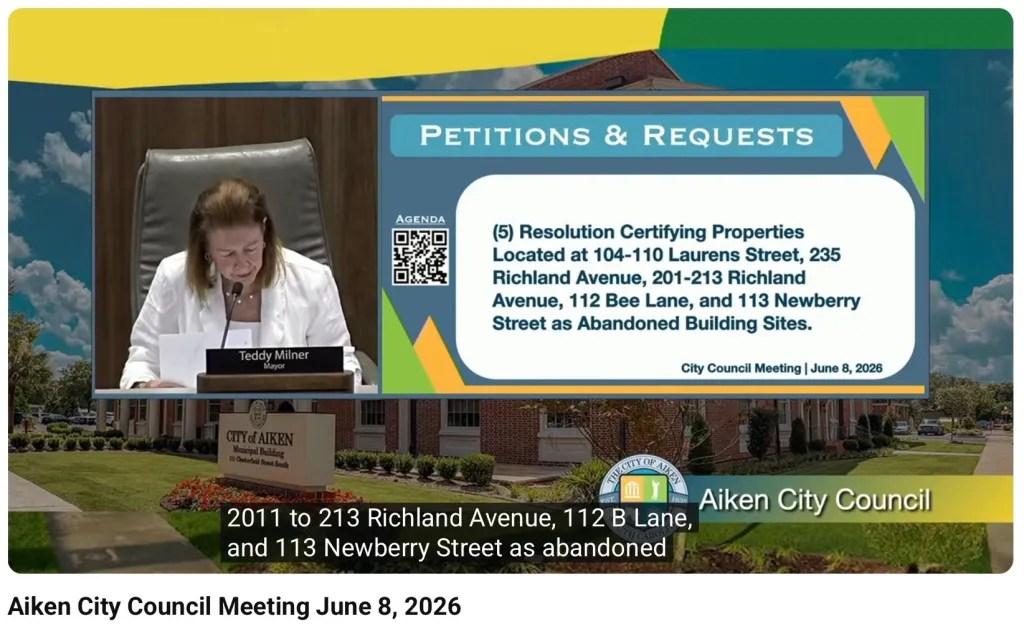
Next, City Manager Stuart Bedenbaugh spoke, giving a precise definition of the term “abandoned building,” and the criteria by which a building can be certified as an abandoned property, citing the legal counsel of tax credit attorney Robert Lewis, who had confirmation that these 20 abandoned building units had been correctly identified. How did Taj Aiken, Warneke Cleaners, and the more recently occupied offices in the McGhee block qualify under this definition? That was the question of the hour.
Video clip: Introductions and descriptions of the Resolution.
The goal of certifying these properties as abandoned is to incentivize interested taxpayers to rehabilitate the buildings and receive tax credits under South Carolina’s newly amended Abandoned Buildings Revitalization Act. In his description, Mr. Bedenbaugh did not repeat the physical addresses listed in the Resolution, however, the addresses of the abandoned buildings were still projected onto the wall as he spoke.

At the conclusion of Mr. Bedenbaugh’s statements, Mayor Milner called for a motion to approve the Resolution, which was given by Councilwoman Price and seconded by Councilman Waldo. Next came the public comment period.
Mr. Kumar
Taj Aiken restaurant owner Alokkumar “Kumar” Akse, the only person who was to comment on the Resolution that night, came to the podium. His demeanor — courteous, thoughtful, kindly, respectful — is one of the first things you’ll often hear about from anyone who has met him. He began his statement by gesturing toward the image of the Resolution projected onto the wall. “So we show the 213 Richland Avenue is abandoned,” he said, “but it’s a functioning restaurant. I have the restaurant named Taj Aiken. So I am running a restaurant there.”

“Also,” he said, “the Warneke Cleaners is operational. You can go there and you can check that. It’s operational. So that’s the wrong information you have.”
No one spoke to him in response. I had hoped, by watching the meeting, to hear some of the obvious questions asked and answered. Mr Kumar had already answered one question with his presence. Clearly, his landlord, the City of Aiken, had not discussed the contents of this Resolution with him in advance of the meeting.
I had other questions, among them: Why was the City seeking to certify occupied buildings as abandoned? Tax credits, yes, but how was a business to operate out of an abandoned building? If Mr. Kumar was mistaken in his understanding of what we’d all just heard and read in the Resolution said, now was the time to clear this up.
Continuing in his statements, Mr. Kumar described some of the events of the past four years. He spoke of being treated differently from the City’s other tenants. He spoke of signing the lease (referring to the 5-year lease he said he’d signed in February 2024] in front of the Mayor and the City Manager. He spoke of the City not completing their end of that lease. He spoke of being “threatened by the people, by the selling agent” to not come to the City meeting, and not to do anything. He spoke of being threatened to not go to an attorney. He spoke of being threatened by “Mr. Tim” to sign the lease [the Relocation Assistance Agreement that Mr. Kumar signed in 2022] and said, “I have all the proof that I can show you.”
NOTE: Mr. Kumar’s statement can be viewed here: Video clip of Mr. Kumar’s June 8, 2026 statements to Council.
Mr. Kumar also spoke of the various promises from the City — e.g. to help build his restaurant, and to have him sit him down with the developer — things that he said never happened. Toward the end of his statement, Mr. Kumar produced copies of letters from his attorney for all of the Council members to read. Copies of this letter had previously been provided to Mayor Milner and Stuart Bedenbaugh. Mr. Kumar finished by repeating that all he was looking for was “fair justice.” He said that two other tenants had gotten 5-year leases, but not him. “So I just want to ask you why am I getting treated differently?”
At this point Councilwoman Price asked him, “What is the address? I didn’t catch the address.”
City Manager Bedenbaugh broke in, his tone sounding more like a scold than an explanation. “Well, if you look on page 406 of the packet, it plainly states that his business is not abandoned so I want to clear up that misconception. I also want to clear up that the speaker is getting all of his rent back when he moves. That is unprecedented.”

Video clip: The City Manager responds to Mr. Kumar’s questions.
Mr. Bedenbaugh repeated the word “unprecedented” several more times over the next few minutes, even soliciting confirmation from a commercial property owner in the audience that this was unprecedented.
Relocation Assistance
I cannot say what is or isn’t unprecedented, but I can offer information and excerpts on the topic from a letter Don Moniak recently sent to Mayor Milner and City Council.
For one, he did a simple internet search for “business relocation agreements,” a sample of which revealed (see below) that such private business arrangements are not unprecedented:
Relocation. Landlord, at its sole expense, on at least 120 days’ prior written notice to Tenant, may require Tenant to move from the Premises to another suite of substantially comparable size and decor in the Building or in the Complex. In the event of any such relocation, Landlord shall pay all the expenses: (a) of preparing and decorating the new premises so that they will be substantially similar to the Premises; (b) of moving Tenant’s furniture and equipment to the new premises (including Tenant’s data and communication wiring and cabling); and (c) that Tenant actually and reasonably incurs out-of-pocket (and which Tenant can document with written records) in connection with Tenant notifying its clients of such relocation, obtaining new letterhead and business cards, and other incidental expenses related directly to Tenant’s relocation.”
Mr. Moniak also provided thumbnail histories on all the Pascalis footprint tenants to the Mayor and Council, including this one on Warneke Cleaners and Taj Aiken:
No businesses have endured more uncertainty and false hopes that were generated by the City than Taj Aiken and Warneke Cleaners. These were the two most complicated and expensive businesses to relocate, yet they were only initially offered the rent reimbursement agreement that would have provided nowhere near enough funds to relocate had Project Pascalis moved forward.
In January 2023, four months after Project Pascalis was cancelled, the City proposed to keep both businesses in place as part of the downtown SRNL project. This included moving Warneke Cleaners to another location on the same block.
Mayor Rick Osbon would later write in an Aiken Standard op-ed that:
“Any local businesses potentially impacted if the current preferred site being considered is selected will be fully protected and made whole. Those highest of priorities include the Taj Aiken Restaurant, Warneke Cleaners, Newberry Hall, and the preservation of the Johnson Drug Store building at the corner of Richland and Newberry. “
The City also tentatively offered to move Taj Aiken to the Johnson Drug Store building.
When the City opted to put the lab building on Newberry Street, these commitments withered.
However, Taj Aiken was reportedly offered a five-year lease shortly after the city agreed to the other five-year leases. There has never been an explanation for why the City reneged on the offer.
Below is a copy of the March 2022 Relocation Assistance Agreement — the month-to-month lease that Mr. Kumar stated in a recent City Council meeting he was “threatened” to sign by “Mr. Tim.” This lease is not to be confused with the later 5-year lease that Mr. Kumar said he’d signed in February 2024, and which the City never signed.
According to social media chatter generated by the events of this week, there are some who believe that Mr. Kumar had three or four years notice to vacate the building. The record, as detailed in Part Two of this series, shows this to be untrue. There are also those who imagine the return of his rent money from 2021 onward is adequate to fund his relocation and other expenses necessary to make him “whole” as he was earlier promised by Mayor Rick Osbon. It should go without saying that those of us who have never opened or relocated a restaurant are not the best qualified to weigh in on this.
The Five-Year Lease
The five-year leases (technically four-year leases with an option for a one-year extension) have been a running refrain in this story. City Council meeting videos offer some insight into why Mr. Kumar has repeatedly asked why he’s been treated differently from the City’s other tenants in the Pascalis footprint, who were given a signed, 5-year lease by City Council in March 2024 (see video of proceedings below).
Most people, myself included, do not know enough about restaurant leases to fill a thimble, but anyone who’s ever managed a household, or leased an apartment, can imagine the difficulties of a month-to-month existence — and all the more difficult for someone planning, budgeting, staffing and growing a restaurant on a month-to-month lease.
So why, after all this runaround from the City would Mr. Kumar remain at 213 Richland Avenue with a month-to-month lease? Likely the years of promises and assurances by City officials that his future was secure in that address played no small part, but, as he’s consistently said in public statements over these years, including statements before Council, the Richland Avenue address has been a successful location for Taj Aiken. He likes the small town atmosphere in that part of the downtown, and so do his customers.
Throughout the past two-plus years, he continued to press the City to follow through on that five-year lease, or allow him option, as another tenant was given, to purchase his building. He has stated at least twice in meetings over the past two years his wish to purchase properties adjacent to Taj Aiken to possibly expand his business or open other shops and restaurants. He has bought the former Casa Bella restaurant building on nearby Chesterfield Street.
I can’t say if Mr. Kumar’s original plans were to move Taj Aiken to that location or open a second restaurant, but it looks like the decision, ready or not, may have been all but made for him with his City landlord’s order last week to vacate 213 Richland Avenue within 20 days. What will it take to accomplish this and relocate his restaurant to that house with its notoriously tiny kitchen?
The Not Abandoned Properties
In my pre-meeting reading of the June 8 agenda, I had noticed, in passing, some square footage tables in the attachments below the body of the Resolution, but only because their presentation seemed different from the rest of the materials. I returned to them after watching the June 8 meeting, curious to find where it “plainly states” on page 406 that 213 Richland Avenue is not abandoned.
It took me a moment, but I found on pages 407-408 — under the headings “Abandoned Building Units” and “Parking Garage Site” — a table listing Warneke Cleaners and “Indian Restaurant.” Beside these two business it said “Not AB,” apparently an abbreviation for abandoned.

If the City didn’t intend to certify 213 Richland Avenue and 113 Newberry Street as abandoned properties, why was a colorful graphic created, then read by read aloud by the Mayor and projected onto the wall of City Council chambers? Why didn’t the City simply correct the Resolution before presenting the document in a public meeting?
Also, while it is normal procedure to reference attachments in legal documents, the attachment on page 406 (sic) that Mr. Bedenbaugh cited was not referenced in the Resolution. An asterisk could have been provided to guide readers to this attachment. A key to the AB abbreviation would have helpful, too.
Discrepancies between the printed word and the spoken word reappeared in the City’s July 2026 Design Review meeting where, at meeting’s end, a motion was made and passed to partially demolish the historic Aiken Standard that houses the Taj Aiken restaurant.
July 7, 2026
When the agenda for the July 7 Design Revew Board meeting was released, the last items on the agenda under “New Business” were three applications to (1) approve demolition of 113 Newberry Street (Warneke Cleaners), (2) approve demolition of 112 Bee Lane (Holley House Motel), and (3) renovate and add an addition to Hotel Aiken at 235 Richland Avenue; construct a new mixed-use building at 112 Bee Lane; remove paint from the exterior facades and conduct a partial demolition of the McGhee Block at 203 Richland Avenue; and construct a new parking garage at 113 Newberry Street (the Warneke Cleaners site).
There was no mention in the application of Taj Aiken or the historic Aiken Standard building that houses the restaurant. Nor was there mention of 211 Richland Avenue, nor the other storefront at 213 Richland Avenue that shares this same building. Why?
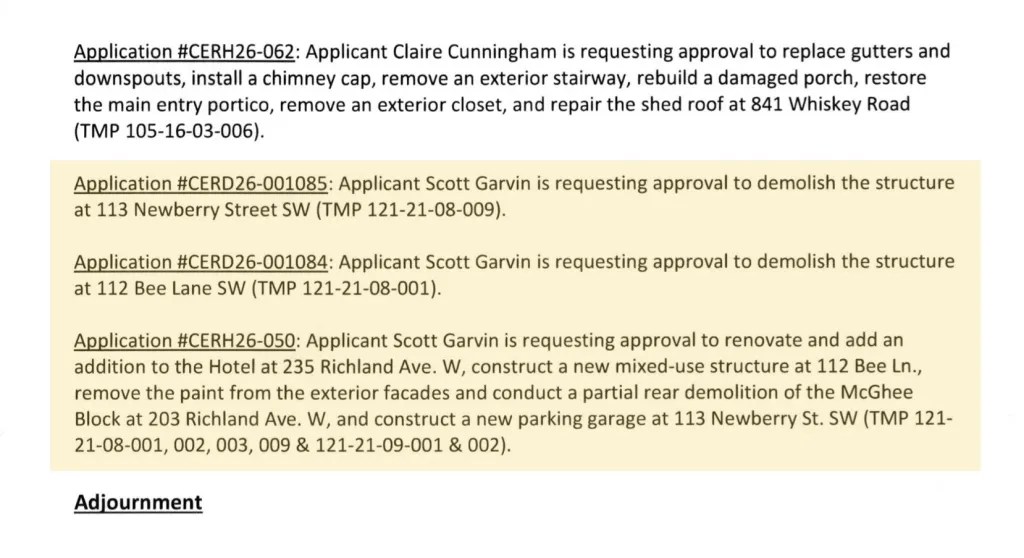
Mentions of this building and this business were scant to none in the agenda documents. Taj Aiken and 213 Richland Avenue were mentioned once in Staff Comments. The 211 Richland Avenue address shared with Taj Aiken was also mentioned in Staff Comments in the listing of the circa 1920 buildings on Richland Avenue.

Elsewhere, there were few mentions or images of 211 Richland Avenue or the Aiken Standard building, and most of these confused or conflated the Aiken Standard building with the next-door McGhee Block, whose address is 201-209 Richland Avenue — not 211 or 213. To be clear, while the Aiken Standard building is next-door to the McGhee block, it is not part of the McGhee block.

A Tricky Business
It is, of course, understood that the Aiken Standard building is listed in Aiken County property records as 211 Richland Avenue, just as the McGhee Block is listed as 203 Richland Avenue. What is not understood is why — throughout the processes of certifying the buildings in the former Pascalis footprint as abandoned, then making application to variously demolish and renovate them — the locations of both Taj Aiken and the Aiken Standard building have shifted to adjacent addresses.
The confusion Mr. Kumar spoke of in the both the June 8 meeting and the July 7 meeting is understandable. The matter of his address is, as he aptly stated at the podium, “a tricky business.”
After all, the address of his business was given as 213 Richland Avenue in his lease and square footage tables in the Resolution. In the same document, however, 213 Richland was subsumed into 211 Richland Avenue. A similar thing happened in the DRB hearing on July 7, as 211 Richland Avenue was variously confused or conflated with the McGhee Block.
This conflation was carried forward to the motion at meeting’s end to approve demolition of, not only the post-1940 McGhee Block addition(s), (which had earlier been deemed beyond the era of historical significance), but also to demolish the back half of the next door Aiken Standard building — which, again, is not part of the McGhee Block. The plans for the partial demolitions of these buildings can be viewed in the Site Demolition Plan on page 825 of the agenda packet. Below are a few screenshot from this page.
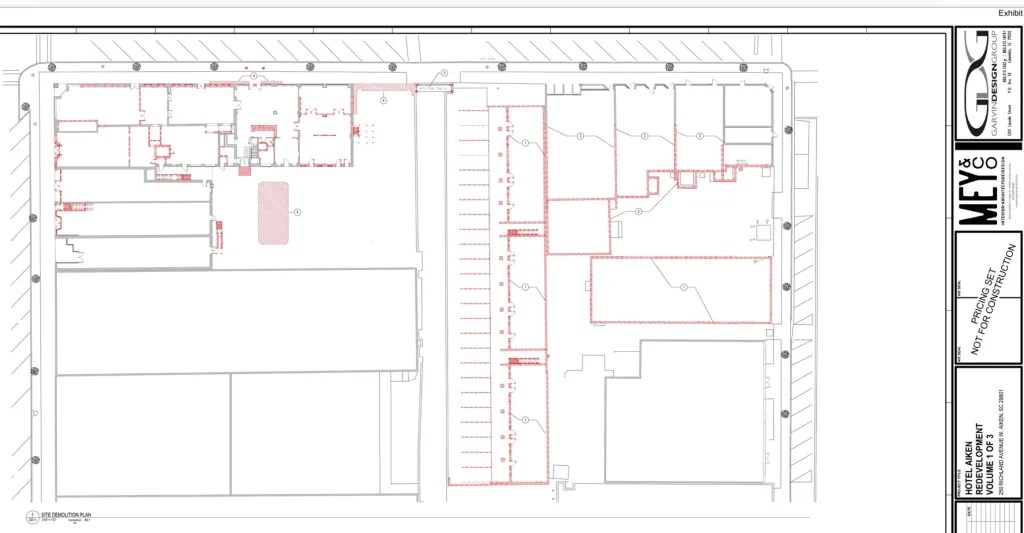
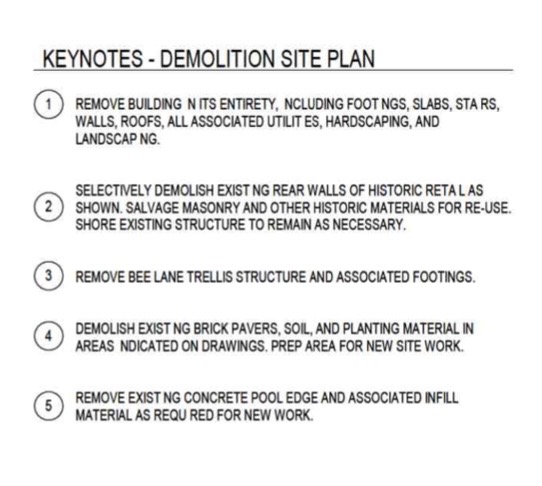

The plan for a partial demolition at 213 Richland Avenue was known by the time Mr. Kumar came to the podium on July 7. Why didn’t his City landlord communicate matters to him before the meetings? Someone could have said to him, “Just a heads-up, Mr. Kumar, there is a Resolution in the upcoming City Council meeting agenda to certify your building as an abandoned property,” and “Just a heads-up — the building housing Taj Aiken is slated for partial demolition.”
This would have been a good time, too, to give Mr Kumar a heads-up that the City would not be following through on the assurances made by council members and former mayor since 2022 that he would be “included in all of this in some way, shape, or form,” and that he “would remain on Richland Avenue” and would be “full protected and made whole.” It would have been a kindness, if not a moral imperative, to communicate these simple matters of fact to Mr. Kumar in advance of the meetings. Being among the last to know of his impending eviction notice no doubt compounded his shock in receiving that 20-day notice.
Mr. Kumar
During the public comment period, Mr. Kumar came to the podium with his customary politeness. His politeness was answered in kind throughout the ensuing exchange with DRB chairman, Mr. Ben Lott. Mr. Kumar started by saying about the project, “I’m not opposed but have a couple of questions.”

The exchange between Mr. Kumar and Mr. Lott can be viewed here on the meeting video.
The phrasing of his questions and concerns may have been difficult for some to follow, but the content was plain. “Nobody mentioned Taj Aiken,” he said early in his statement. “What’s the aim for Taj Aiken?”
He also pointed out the error in his restaurant’s address. “The address is 213 Richland Avenue,” he said, “I did see one mention in the agenda that it’s at 211, but that’s wrong.”
Mr. Kumar rephrased his questions several times as an effort, it seemed, to elicit answers on the future of his business. He asked if Taj Aiken would be shut down by force, and when the demolition might start.
Mr. Lott said, “I don’t know that we’re discussing schedule. We’re just talking about design features and the appropriateness of the request. And I’m not sure I understand your question other than the schedule question.”
Mr. Kumar said, “Yes, so the thing is, everyone is talking about the Warneke cleaners. I see the pictures of the Warneke Cleaners going to be demolished, but the Taj Aiken is behind that. Nobody talked about the Taj Aiken.” He pointed out that sometimes Taj Aiken is included with the McGee block, sometimes in the Aiken Standard building. “I’m confused,” he said.
Mr. Lott said, “So, yeah, I think my understanding is it’s part of the old Aiken Standard building, is the building you’re talking about, right?” to which Mr. Kumar responded, “Yes.”
Mr. Lott continued. “Okay, and so your question is, the front’s being preserved, but you don’t understand why the back’s not being preserved?”
“No, no. The thing is,” said Mr. Kumar, “I’m the owner of the Taj restaurant. So I have a restaurant over there.” He explained a bit more about his business, then said he wanted to know if Taj Aiken, the Aiken Standard building, is going to be demolished, too, and if he’d have to move. He wanted to know the future for the restaurant.
Mr. Lott explained that, as the lessee of the building, Mr. Kumar would want to take those questions up with the City, (his landlord), not the Design Review Board.”
In his closing remarks, Mr. Kumar once again told Mr. Lott that his address is 213 Richland Ave, not 211 Richland Avenue. Mr. Lott turned to staff and said, “Let’s check the type and see if there’s any typos on the numbers , later.”
Historic Preservation
Before Mr. Kumar came to the podium, Linda Johnson, president of the Historic Aiken Foundation (HAF) came to the podium to speak on behalf of HAF. In her statement, she laid out the Department of the Interior and HAF preservation standards by which a historic building could be demolished. She also quoted the City’s own preservation ordinance. Linda Johnson’s statement can be viewed here on the meeting video.
From this criteria, it would would be difficult to justify the partial demolition of the historic Aiken Standard building, as (1) it doesn’t pose a threat to public safety, (2) a case hadn’t been made that rehabilitation is infeasible, and (3) the DRB hasn’t established that there isn’t a reasonable alternative to demolition.
An Aside
In the field of historic preservation, there is something called “facadism,” whereby part of a building is demolished, and the facade and its architectural details are preserved. This allows for flexibility to overcome myriad challenges inherent to adaptive reuse of historic buildings and their surrounding properties. The facade is incorporated into a new building. The artfully preserved pillars of the old 1938 FDR-era Police Station in the Alley could arguably be offered as an example of facadism.

The intention to demolish at least part of the McGhee building was described in the application: “Along Richland Ave, the facades of the historic McGhee block will remain intact, while the rear will be partially demolished….” But facadism was not part of the discussion in the Design Review Board meeting, and the historic Aiken Standard building was all but absent from the discussion until the motion was made at the very end.
“And then, finally, the motion to construct several new buildings, remodel a hotel, and do a partial demolition of the McGee block, including the Aiken Standard buildings in there.”
Here in the City’s Design Review Board meeting, as in the June 8 City Council meeting, the spoken words did not match the printed words.

To Be Clear….
It should go without saying, but I want to be clear. Nothing in this editorial is to be construed as opposition to this project. Like most people, I’ve been saddened by the slow-motion decay of the Hotel Aiken, and I want to see it rehabilitated, rebuilt and made beautiful and functional again. I am glad to have been part of the 2022 effort to prevent the demolition of the Hotel Aiken, and I am glad to finally see this venerable old building getting the treatment it deserves. I simply wish the same for the small business owners in our downtown.
Those who would frame this story as a choice between having a beautiful downtown or taking good care of our small businesses have perhaps lost the plot.
The Elephant in the Room
At the heart of the difficulties in communications between Mr. Kumar and the DRB on July 8 may have been the simple fact that — for the purposes of discussing and approving demolitions of buildings — the businesses, the persons, and the lives inside those buildings didn’t exist. This is a difficult position to maintain when the person, or a proverbial elephant, is standing in the room asking questions. It was perhaps the same in the June 8 City Council meeting, as the existence of a thriving restaurant had been reduced to an entity on a piece of paper, a building that was alternately abandoned and not-abandoned, depending on which page you read. It was the same, we now know, for Mr. Kumar, whose decency, generosity and goodwill in the Aiken community have been repaid with something entirely different.
___________________

ABOVE: From Taj Aiken Facebook wall, the restaurant’s October 2024 food box giveaway in the wake of Hurricane Helene
For more reading and information on this evolving story, please see the letter, below, written by Don Moniak to Mayor Milner and the Aiken City Council. Included are his written comments and a timeline with references regarding the fate of the nine businesses affected by Project Pascalis. Other links and articles may be added in the coming weeks.