
Written in March 2023
By Laura Lance
A follow-up to the article, “Feral Cats.”
The topic of animal rescue is lined with good stories and bad — from ordinary people doing extraordinary deeds; to opportunists exploiting a lucrative, underground trade in animals; to organizations that alternately do and don’t address the complex problem of unwanted and homeless cats and dogs.
I could begin anywhere on this general topic but, because my most recent experience was with a stray cat, I will start there. And because we live in the county, I will begin on a short, but pastoral stretch of dirt road in Aiken county.
Where we live was considered countryside back in the 1970s when my Dad built our house. Development has since put hundreds more houses, condos and apartments in our vicinity, with the Aiken City Limit now just a stone’s throw from our front yard. Our backyard, on the other hand, is hemmed by a dirt road and, beyond that, fields and tracts of wooded acreage that will likely soon be paved with more houses, apartments, and condominiums.
For now, the dirt road has the look of countryside and serves as a magnet for pet owners seeking a stealth spot to dump their unwanted cats — their belief being, perhaps, that some kindly soul will take them in or, worst-case scenario, their cat will spend their days as a carefree wild cat, living off the fat of the land, what with all the songbirds, lizards, mice and crickets to eat.
Enter our property
My Dad’s guiding tenet when he built this small house — planting trees and gardens for self-sufficiency and adopting a simple, frugal lifestyle — was this: “To live simply so that others may simply live.” Toward this end, he also gave generously and selflessly to people and causes.
Over time, my father’s tenet has been consciously expanded to include the native wildlife around us that is being variously displaced, poisoned, and made homeless by development and other human incursions into their homes.
Toward this effort, we are mindful of providing healthy wildlife habitat and of keeping our yard free of pesticides and other chemicals that might find their way into the food chain and potentially sicken or kill the beetle, the bird, the mouse, the fox, the owl. Of course, we recognize that our several-acre lot is not an island.
Still, we have healthy populations of caterpillars, beetles, spiders, butterflies, frogs, toads, snakes, lizards, birds, squirrels, moles, voles, field mice, bunnies and more. In other words, a smorgasbord for a scared, hungry cat who has been dumped off by its owner.
To this ample food supply, add the shelter of the undersides of our outbuildings — a survivable habitat for an abandoned cat. We’ve seen a number of sad cases over the years, including mother cats with kittens who are living lives of quiet desperation. Over the 50 years on this property, we’ve taken a few strays to the shelter. As of 2016, this option ceased to exist, as the county shelter stopped accepting stray and feral cats. More on that in a moment.
Nine Lives
Most stray and feral cats that come to our property are only glimpsed. They pass quickly in the shadows, skirting from bush to bush, sometimes darting across the yard at twilight and daybreak. Close encounters are rare. Below are a few of the more memorable ones.
I
Our most recent experience, in September 2022, involved a mystery animal whose presence was detected by the odd growling sounds coming from under our barn. When we approached to get a closer listen and try to determine what the animal might be, a large orange tabby popped out and hurried toward us, loudly meowing as it gave chase. The cat was oblivious to efforts to shoo it away. Not knowing the cat’s rabies status, we were pretty unnerved. For the next hour, the cat yowled at us from outside the back porch door.
This was the day that I learned that Aiken does not have a clear-cut system for contacting authorities about a potentially rabid animal, especially outside of normal business hours — 9:00-5:00 Monday through Friday. .Should I find myself in this position again, I won’t spin my wheels for 15 minutes trying to call DHEC and Aiken County Animal Control. I’ll just call 911 dispatch for the Sheriff’s office to contact animal control.
Long story short, this cat was not rabid. Just the opposite. He was the sweetest, goofiest, most loving and lovable cat you can imagine. We only later learned that he is an Oriental cat, his wacky personality being characteristic for the breed. He was clean and seemed very healthy. Surely his owners were looking for him! We immediately posted ads, looking high and low for his owners. We received a lot of queries from owners of similar-looking cats, but none that matched his description. Meanwhile, he made himself right at home, lounging about the property. Whenever we went outside, he ran over and tackled us with loud meowing and demands for affection.

As we quickly learned, he was also an aggressive hunter and had a mind to catch our resident mockingbird. My daughter — patron saint of the hungry, the lost, and the unloved — came over and collected him, then spent 6 weeks getting him hundreds of dollars of veterinary care, including neutering. The lengthiness of the process was due to the long wait times for appointments caused by the ongoing shortage of veterinarians. She paid premium price at an upscale practice across the river to avoid the six-week wait to get the neutering done in Aiken.
Simultaneous to these efforts, my daughter composed and posted a lengthy and quite wonderful write-up at the only Adopt-A-Pet “Rehome” website to find just the right home for this unique cat. Not a single person responded.
Rufus Von Pouncey, as he is now known, has become a much-loved and integral part of their family, but also a stressor at times in a household that was already at pet-capacity and had zero interest last September in adopting a cat. Were he surrendered to the County shelter, he may or may not be euthanized. Returning him to our backyard to be a de facto TNR would be an act of cruelty and would likely be the death of our resident mockingbird and more That every cat abandoned could be recipient to the soft landing Mr. Von Pouncy found in my daughter’s home.

II, III, and IV
From 2013-2015, there was a spike in the cat population on the property. It seemed every time we looked out the window, we saw a cat. The most memorable, for a number of reasons, was a lilac point Siamese. She was quite lovely in 2013, the first year we saw her. We’d first assumed she belonged to a neighbor but soon realized she was on her own. We checked all the local lost-and-found resources, hoping to locate her owner. No luck.

She spent the summer living under our shed. She was skittish and utterly unapproachable. I borrowed a cage from Aiken County Animal Control, but the effort was a failure. We did manage to catch a possum at one point (yikes) and also attracted lots of fire ants with the bait, but not the lilac-point. After a week or so, animal control came and picked up the empty cage. As the summer wore on, she grew more bedraggled. I took photos of her from time to time and reposted to online lost and found sites. At some point, she seemingly disappeared.

One morning the following spring (2014), while drinking my morning coffee, I heard a thump at the front door. I looked out, and there was the lilac-point with two beautiful tabby kittens, who were scampering and playing on the front porch. I’ve always had a special fondness for gray tabbies, and these were especially pretty and with long hair.

I so hoped they might find homes, so we bought 3 cages to catch them. The experience of the previous summer was repeated and, in fact, the family seemed to disappear shortly after we put the cages out.
I did see two of them walking across the yard one evening — the mother and one of her kittens. It was really a quite lovely scene — this white cat moving across the lawn in gray twilight, her kitten walking by her side. Whenever the kitten fell behind, the mother would slow her pace, pausing from time to time to lick the kitten’s face and urge it on. As a mother, myself, I felt a certain kinship with her.
V, VI, VII
The following May of 2015, I was going into the barn and, out of the corner of my eye, I saw a tiny scrap of a shadow moving under a nearby bush. This was my first notice of the lilac-point’s return. Thankfully, my daughter was over visiting. She was able to grab the little kitten, who initially tried to spit and protest, but was barely strong enough to hold her head up, much less put up a fight. My daughter hurried her to the vet.

The kitten was emaciated, dehydrated, totally infested with fleas, and had an infection in one eye. She also had feline leukemia. The vet kept her overnight.

While all this was going on, I set out three traps. Right away, I caught the mother. This turned out to be as terrifying an experience for us as it was for her. She screamed and threw herself against the sides of the cage, feces flying, as her two other kittens, whose silhouettes were visible under the shed, watched from a near distance. This was a Thursday afternoon.
As it turned out, animal control was not able to pick her up and wouldn’t be able to until the following Tuesday. The other kittens did not enter the other cages, and we ended up letting the mother go at daybreak the next day, so she could tend to kittens. The three of them disappeared that morning, and we never saw any of them again. I suspect that local coyotes, sometimes heard in the fields across the street (before the arrival of a new subdivision) may have lowered the population of cats in our yard that year.
The lone, captured kitten was nursed back to health by a kindly vet tech, and a home was found for her.
VIII
In the summer of 2022, a cardinal family decided to set up house in a little ivy trellis on our front porch. Inside their next were two eggs. One midnight, I heard a kerfuffle on the front porch and looked out to see that a huge, long-haired orange tabby had halfway pulled over the trellis. I chased the cat off and uprighted the trellis. The next day, I saw that the cardinals were back and the nest intact. I collected over 100 longleaf pine cones and spread them about the perimeter of the pot. Then I crossed my fingers and hoped for the best. It took only a few nights for the cat to return and destroy the nest.

Other lives
I neglected to mention looking out the kitchen window one early morning in 2014, just in time to see the lilac point emerge from my Mother’s daylily bed. In her mouth was a large green lizard — the largest Carolina anole I’d ever seen.
The week before the killing of the anole, a mother cardinal and her nestlings in the camellia bush outside my mother’s window disappeared overnight. Poof! Just like that.
That same summer, over at my daughter’s house, both an indigo bunting and a blue grosbeak had been coming to the feeder. The well-fed neighbor’s cat was a recreational killer. Despite my daughter devising various devices and applying $40 worth of cat deterrents to protect the birds from the cat, one of the birds was killed.

In 2017, my brother had a hermit thrush that returned to his yard every year, its sweet song a treasured part of the spring landscape. That is, until the day he saw a cat running off with the bird in his mouth. It was a similar story that same summer with one of the bluebird parents raising young in my mother’s yard.
The Debate
The argument goes that there are enough baby bluebirds, cardinals, hummingbirds, lizards, tree frogs, butterflies, and bunnies to go around. As someone once said to me during a debate on the topic, “It’s called a food chain, dear.” The argument goes that dogs cannot survive in the wild, but cats can. The word “humane” is held aloft, as if anyone opposed to TNR is inhumane.
Merriam Webster defines the word, “humane” as “marked by compassion, sympathy, or consideration for humans or animals.” The Cambridge Dictionary defines it as “showing kindness, care, and sympathy towards others, especially those who are suffering.” By these definitions, I would say that TNR advocates and those opposed to TNR are a humane lot overall.
Upon closer examination of terms like “animals,” and “kindness” and “suffering,” certain questions arise such as, “Are other animals, besides cats, deserving of our humaneness?”
More to the point: Whose suffering are we concerned about? This is the question posed by some on the anti-TNR side of the debate, who argue that, by letting cats loose to kill the indigo bunting, the cardinal nestlings, the anoles, the swallowtail butterflies, we are in fact making the choice of who will live and who will die. If a bird is killed in the forest, and we don’t see it….?
Moreover, for the life of a feral cat, it’s not necessarily a question of life or death for that cat, but a question of a slow, suffering death vs. death by euthanasia.
My daughter and I, both cat lovers, have had our own missions, of sorts, over the years. In the 1980s, whenever I found a stray cat and/or litter, I took them for spaying/neutering and found them homes. At one point, we had a total of thirteen cats and kittens in the house, counting our two cats — a thankfully short-lived chaos.
In the early 2000s, my daughter would catch strays near her apartment in downtown Aiken for the trap, neuter and release program. More recently, she has handled the spaying/neutering on her own and found them homes, rather than releasing them into the wild. Before Von Pouncy, there was Inky the black cat, who took a few years to finally find a great home. Below are some of the pictures used in the long-term efforts to find Inky a home.


Two truths that TNR professionals and advocacy groups acknowledge, but don’t necessarily discuss in their promotions of TNR, are that, (1) it’s less expensive to do TNR than to euthanize, and (2) TNR cats survive an average of only two to three years in the wild.
Both of these points deserve deeper discussion, beginning with open acknowledgement of what survival looks like between the first day and the last of a cat’s existence in the wild. Turning a blind eye to this reality may ease the conscience of a humane observer, but it does nothing for the plight of a cat that has been introduced by humans into a habitat where she is assured of living a hardscrabble existence ruled by chronic starvation, parasites, sickness, human cruelty, and the treachery of cars and coyotes.
Here is a third truth that should be part of the discussion: cats don’t command the sort of prices in the rescue/adoption market that dogs command. Dogs sometimes fetch prices in the hundreds and even thousands of dollars, which has opened a black market in the rescue industry that is painful to read about. At what point does an industry that commodifies life cross the line from humaneness to … something else?
Going Forward
Wildlife faces enough hardship from deforestation, development, loss of habitat, vehicles, poisons and domesticated cats. Adding a “community” of an invasive species of diseased, flea-ridden, parasite-infested, chronically-starved cats to the mix places a cruel burden on an already struggling wildlife population. Feeding these cats is no insurance against their predation of native species.
Those among us who intentionally undertake the effort of providing healthy habitat for native species are disheartened to realize we’ve done little better than to lure these creatures to the feral cats’ smorgasbord.
Feral cats are furtive, circumspect. At best, we likely glimpse only a few that arrive to our property. Some are transients, some are more or less residents of the area. One day we’ll see a black cat slipping across the lawn from the direction of a flower bed. A week or two later, we’ll see a new cat slipping along the shadows in the hedgerow where the songbirds nest. We may look out one morning to see a familiar gray cat pooping in the vegetable garden. The next day, an orange tabby. A month may pass before we see the black cat again. They’re there.
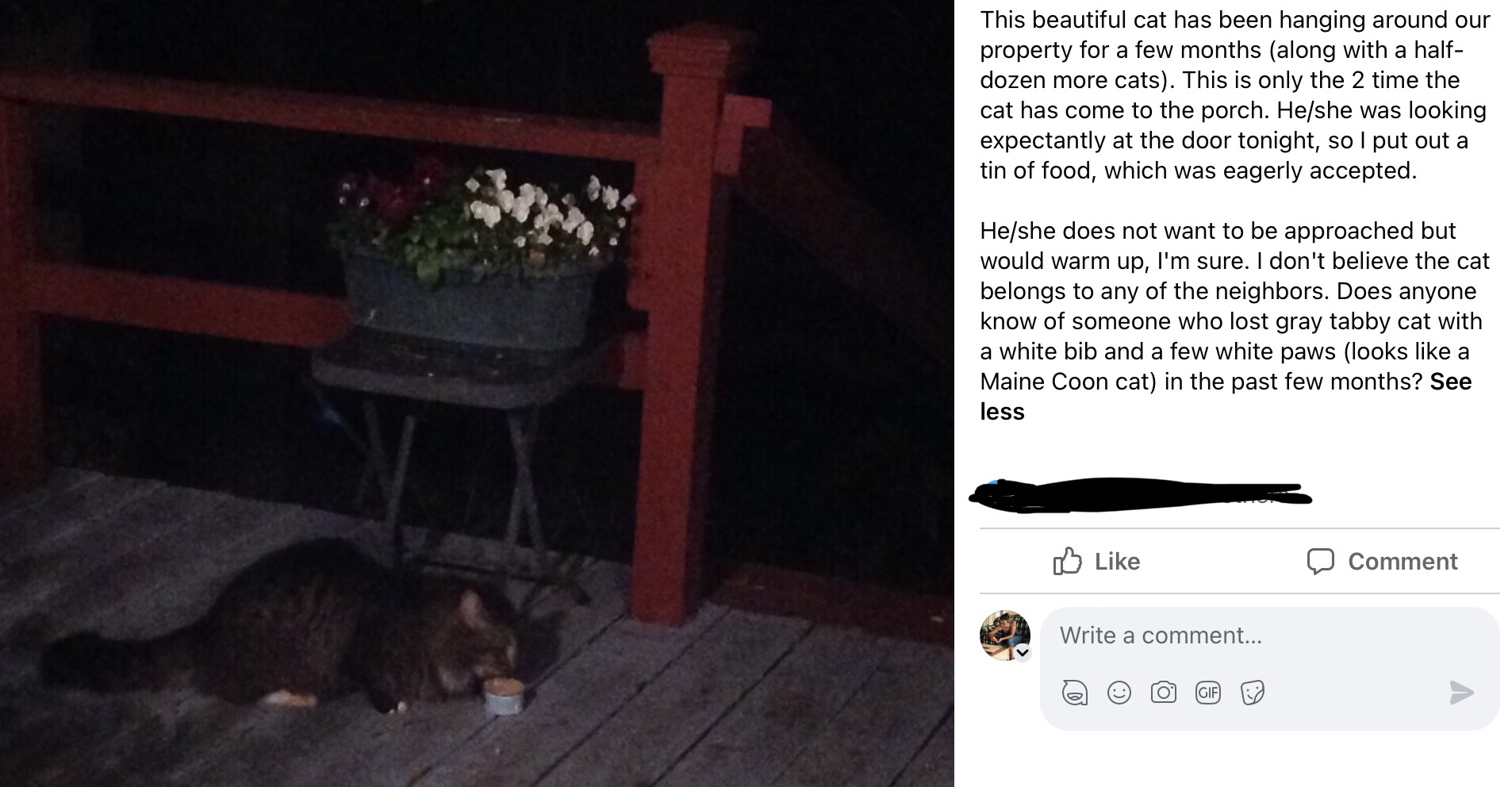
As has happened more than once, I may look out the door and see a beautiful cat staring back at me from the porch. These are the cats I suspect have been dropped off to live the rest of their “happy” lives in the countryside. Whenever I can, I get photos, put them up online, and pull an area-wide search to see if anyone’s reported a missing cat. I’ve yet to find a single owner.
The story of the lilac-point has been repeated a number of time over the years. I’ve seen the slow motion death from parasites, disease, and the hardship of the elements. A cat’s fur grows dull and ratty, their bodies kinked and knotted, their faces swollen and scarred. Rather than slipping from bush to bush, they limp in pain. Just the other night, I heard a cat on the front porch yowling the characteristic call of the mating season. Seems awfully early this year. And so the cycle continues.
__________________
Local services for feral and stray cats
First, some brief notes on terminology. A feral cat is a cat that has never been socialized with humans, or has become unsocialized. A stray cat is a cat that has been socialized with humans but is now homeless. A stray cat can become a feral cat. A surrendered cat is a pet that the owner turns over the the shelter. The information below was provided over the phone and in person by employees of the City and County facilities. This primarily addresses cats.
COUNTY RESIDENTS: According to the animal control officer who answered a call to our house, as well as staff spoken to on the phone, the Aiken County Animal Shelter does not accept stray or feral cats into the shelter. Period, full stop. They do, however, offer a free TNR (trap, neuter, and release/return) program for these cats. This service is for county residents and by appointment only. In other words, be sure to coordinate everything in advance with the shelter, as there are rules and limitations on (1) the number of TNR cats the shelter can accept per day, (2) the days and hours the shelter is open for intake of these cats, and (3) the assistance the county may or may not be able to offer, regarding transport, should you be unable to bring the cat to the shelter.
How does the process work? If, for instance, you have a stray or feral cat on your property, you will need to first catch or trap the cat (the county can provide traps). Next, you will need an appointment to deliver the cat. The Aiken County Animal Shelter accepts TNR cats on Tuesday, Wednesday and Thursday mornings, and by appointment only. Should you be unable to transport the cat, the county may or may not be able to help, and the days/hours for pick up are limited. Once the cat has been delivered to the shelter, it will be spayed or neutered for free. You are then to pick up the cat and release it where you found it. FOTAS, a privately run non-profit organization, partners with the county for the TNR prograam.
CITY RESIDENTS: For city residents, there is the Albright Center, which will accept stray and feral cats found within City limits. The City also has a TNR program. As with the county, you will want to coordinate these services in advance with the shelter, rather than just arriving with a cat.
Local services for surrendered cats
ADOPT-A-PET: An alternative to surrendering pets to a shelter is Adopt-A-Pet.com’s “Rehome” process, which offers a safe, no-cost way to rehome a pet without placing him or her in a shelter. If this option does not suit, the county and city offers services.
COUNTY RESIDENTS: Aiken County Animal Shelter will accept surrenders of pet cats (and dogs), with fees that can range from $15 for an adoptable pet to $50 for pets that have litters or are unadoptable or difficult-to-adopt, such as pets with special needs, behavioral issues, advanced age, etc. There is a possibility, not a certainty, that a surrendered cat will be euthanized. FOTAS partners with the County to provide an adoption services for surrendered cats.
CITY RESIDENTS: Surrendered cats are accepted on a limited basis as funding and space allow.
Financial Assistance for Spaying/Neutering
The county offers a voucher program to help lower income pet owners with the costs for spaying or neutering.
Lastly this
Someone reading this article may wonder, “Why don’t she get the feral and stray cats in her yard into the County’s TNR program? At least, that way, the cats wouldn’t keep breeding.” It’s because I no longer have the energy and good health to engage the level of hands-on humaneness I enjoyed in my younger years. It’s that simple.

Thanks, Laura Lance, for an excruciatingly well-composed and revelatory essay . It’s obvious that our throw-away society includes all manner of animals (non-human and human) in its stock of objects to be discarded. We are able to create horrendous problems, seemingly effortlessly. Solutions, however, are elusive, particularly when we deliberately avoid seeing them. I’ve added your father’s credo — “To live simply so that others may simply live” — to my collection of wise and noble expressions.
Thanks, much, for reading and giving thought to this, and also for your kind consideration of my father’s credo
.
Super sad situation all the way around. Humans are the first problem, unfortunately. Many people get a cat or dog and don’t get them spayed or neutered, thinking it’s cute to have pups or kittens and as you said, the cycle continues.
And for the people who just “drop” a pet off in the countryside….you just suck! That is the most heartbreaking thing to do to a family pet. Animals have feelings too, they get scared, get cold, need food, protection and love. Our society has gone downhill at a dizzying pace.
Thanks so much, Valerie, for reading and for your perspective. I wholeheartedly agree with everything you wrote.