A public drop-in style meeting is scheduled for Monday, April 22 between 5:00-7:00 p.m. at the USCA Convocation Center to gather public comment and provide information to the public on an ongoing study to identify solutions to issues of traffic congestion, traffic safety, and projected growth along the 1.6-mile section of the Robert M. Bell Parkway/SC Highway 118 from USCA to Vaucluse Road. The public has been invited to email comments to Aiken County Planning and Development or to place comments in the comment box at the meeting. The letter below is being published here to raise awareness of this meeting and the issues that compel it. See more details on the meeting at bottom of this letter.
To Aiken County Planning and Development:
We moved to the Gregg Park neighborhood off Trolley Line Road in 2014. The close proximity to amenities like shopping, USCA, the YMCA and nearby Gregg Park Civic Center drew us to the area. We especially loved the relative quiet of the neighborhood and the setting — surrounded by pine woodlands and a couple miles removed from the bustle of traffic. This has changed a lot in the past 10 years, but most profoundly in the past several years, due in great part to a mix of unplanned and poorly planned growth in this area.
The collateral effects from this growth — issues of traffic congestion, traffic safety and erosion — have been driven down Trolley Line Road.
The Gregg Park neighborhood. Click to view full size.
The issues between SC Hwy 118 and Trolley Line Road are threefold. First, there is the increased traffic. Second, there is the lack of infrastructure to safely accommodate the increased traffic. Third are the erosion issues that have been created by clearing forests and leaving stormwater to do what it will. I will address these issues one at a time.
INCREASED TRAFFIC
The expanding Trolley Run Station subdivision has brought, and continues to bring, more residents to this area. Many of these residents use Trolley Line Rd as a shortcut/speedway to connect to the Aiken-Augusta/Jefferson Davis Hwy, or as a route to access the I-20 interstate or to access local schools, as this entire neighborhood, formerly zoned for Area 1, was rezoned for Area 3 schools in 2019.
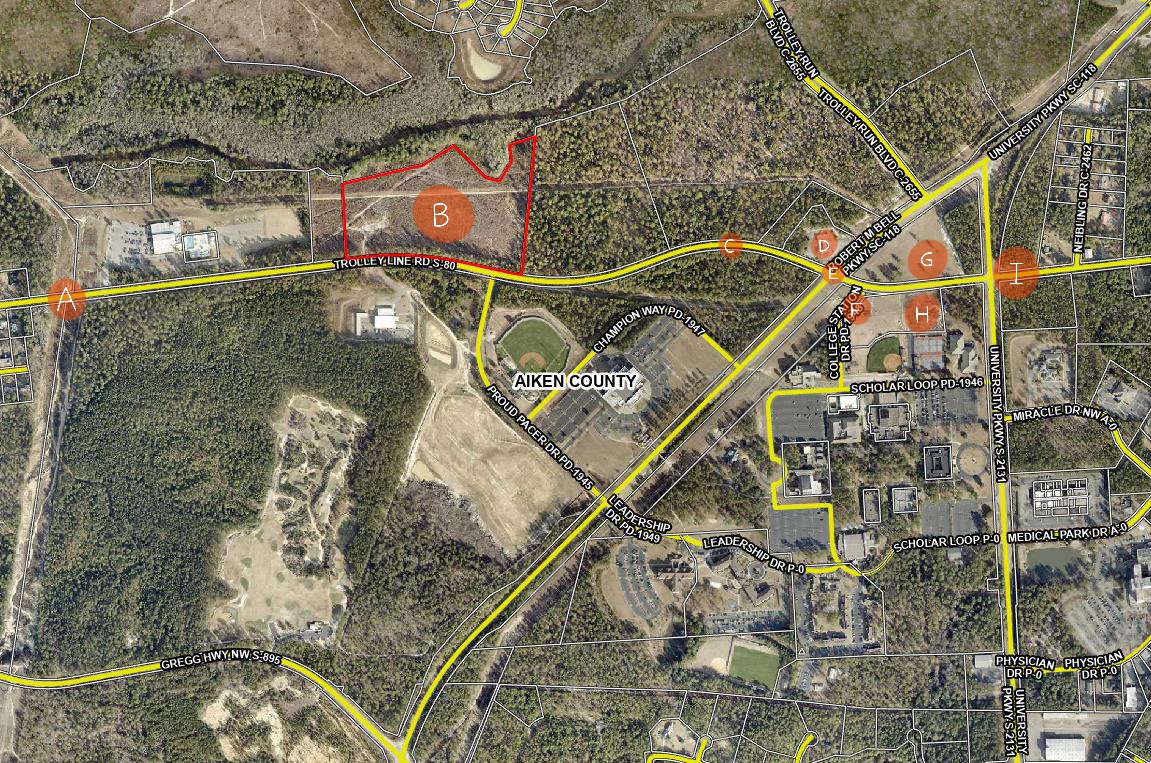
The upcoming expansion of 45 houses, (see marker B on map below) which will be sandwiched in the now-treeless acreage between Bridge Creek and Trolley Line Rd will send yet more traffic onto Trolley Line Rd.
Click image to view full size
Shortly to the east on on Trolley Line Road, next to USCA, are the Advanced Manufacturing Collaborative facility, (see marker H on map), which is currently under construction, and the adjacent, soon-to-be-constructed National Guard Cybersecurity Readiness Center and Dreamport (see marker G on map). Will these workers use the Trolley Line Rd shortcut to travel back and forth to 1-20, North Augusta, Augusta, Fort Eisenhower and SRS?
At present, drivers traveling west on Trolley Line, toward Graniteville, encounter a speed zone change from 45 to 35 mph as they enter the older, established Gregg Park neighborhood (see marker A on map). These signs are ignored, and with impunity, as there is no traffic-law enforcement. The heavy demand of hurried drivers has transformed this road into a high-speed thoroughfare. This was already a special problem area, with many neighbors posting signs imploring drivers, to no avail, to observe the posted speed limit.
The problem has grown exponentially worse over just the past few years. Drivers routinely exceed the speed at 50-70 mph, race up behind slower drivers, then cruise into the other lane, disregarding the double-yellow line and without regard for oncoming or incoming traffic. This has created dangerous conditions for the five streets and the 70-something driveways to the Gregg Park neighborhood homes (see top map) that front this stretch of Trolley Line Road.
Drivers entering Trolley Line from a street or driveway can get caught unaware by a driver speeding down the road at 70 mph who’s just decided to pass someone, threatening a head-on collision. Drivers attempting to make a turn off Trolley Line into a driveway or street can likewise be caught unaware of a kamikaze driver from behind, about to T-bone them in an attempt to pass. Averting rear-end and head-on collisions is a daily fact of life. This stretch of road has all the ingredients for a deadly crash.
Our teenage daughters drive this road daily to and from school and work. In the absence of traffic enforcement — and with laws prohibiting cameras to catch people who drive dangerously and in gross excess of posted limits — I wonder how we will regain safe access to the roads that lead to our home?
INFRASTRUCTURE
The infrastructure in this area has not grown to accommodate the volume of the increased traffic. The traffic-light intersection of Robert M. Bell Pkwy and Trolley Line Rd (see marker E on map) is especially hazardous for its non-existent rules.. Since there are no turn lanes, motorists are compelled to make their own rules, which results in games of chicken as no one can tell if the person opposing them is going straight or turning. Often, left turners just sit there stumped through the green light as to what they are supposed to do: who goes first?
Meanwhile traffic continues to back up to the east, as USCA students struggle to make the left turn onto Trolley Line Rd. from College Station Dr. (see marker F on map) — an intersection that would benefit from prohibiting left turns during posted hours — say, from 3:00-6:00 pm? After all, USCA has other exits into less trafficked areas on University Pkwy that would not add to rush hour congestion. As it stands now, the traffic at the light backs up during rush hour, with cars lined up from the light at Robert M. Bell Pky to University Parkway (see marker I on map). Heading east on Robert M. Bell Pky at rush hour, traffic may back up all the way to Proud Pacer Dr (at the Convocation Center). This makes a nightmare of our drive home. This intersection is dysfunctional and dangerous from every direction.
EROSION
The above issues are compounded by the further lack of planning for stormwater runoff. As the entire area continues to be clear cut tract-by-tract for development, little regard is being paid to how this concrete jungle will affect the low-lying sandy areas. Already you can see the effects, as vigorous rainstorms create extreme runoff that creates a stream of water and loose sand across Trolley Line Rd. (see marker C on map). The river of runoff sand is visible alongside the road in this area.
This runoff is also causing hazards at the entrance to the Circle K (see marker D on map) at the corner of Robert M Bell and Trolley Line Rd., where sinkholes deep enough to break an axle continually emerge, then get repaired, then re-emerge. Drivers turning into Circle K from Trolley Line are sometimes forced to come to a complete stop, which creates a bottleneck at this spot as they try to ease their way around these holes to avoid damaging their cars.
How much more runoff-absorbing plant-life will be removed? Seeing the lack of planning in the lands east of the Gregg Park neighborhood the 118 bypass and Trolley Line Rd , our family lives in fear of potential development in the wooded hillside between the Gregg Park neighborhood and Gregg Hwy (see map at top). Were similar deforestation to take place in this area, the runoff to Laurel Drive and the Gregg Park neighborhood would be catastrophic. We’ve already reaped a sneak preview of that from minor tree removal up in that hillside.
Larger overview of this area
In the 10 years we’ve lived in the Gregg Park the quality of life has markedly diminished as we’ve watched the woodlands around our neighborhood disappear. One by one, swaths of old-growth, longleaf habitat have been destroyed and paved over with expanding residental development, a golf course, and expansions to the USCA complex. The felling of trees has been followed by the burning of huge piles of refuse wood, leaving the air choked with thick smoke for weeks at a time. Future growth should take into account both soil erosion and air quality when making decision about clearing forests.
All of this is to say that future growth in this area does not take place in a vacuum up on SC Hwy 118. The surrounding roads and neighborhoods are a part of the equation and should be taken into account.
My hope is that, by shedding some light on the issues that have arisen in the development along the Robert M. Bell Parkway and Trolley Line Rd, measures will be taken to mitigate some of these issues and to not repeat these mistakes in future development in this area.
To reiterate:
There need to be turning lanes in on both sides of Trolley Line Rd at the Robert M Bell Pkwy.
The erosion and runoff at the Circle K and further down Trolley Line (see map point C) need to be addressed.
The speeding issues on Trolley Line Rd. need to be addressed, particularly in the Gregg Park neighborhood area where speed-limit signs are ignored and no-passing lines are disregarded. With the numerous driveways and streets entering the roadway, the recipe has been written for deadly accidents.
During a March 11, 2024, closed-door Executive Session, the company behind “Project Sunny” made an informational presentation to City Council that was described as “flowery” by two Council members.
Prior to the Executive Session, the fact that Project Sunny involved a House of Raeford chicken processing plant was not publicly disclosed within the City Council’s meeting agenda information package. This vital information only emerged after the closed-door session. The City chose not to properly disclose the true nature of its proposed water and sewer services ordinance written on behalf of House of Raeford, thus avoiding considerable citizen objections.
The six House of Raeford representatives who attended the Executive Session chose not to speak during the regular Council meeting, instead leaving City Council members and a few audience members to speak on their behalf.
The South Carolina Freedom of Information Act (SC FOIA) has no exemptions to its Open Meetings laws for generic informational presentations from prospective businesses. As the House of Raeford presentation to Council should have been made in a public forum, the closed-door meeting arguably violated SC FOIA, at least in spirit.
by Don Moniak
(March 28th updated timeline: City Council announced on Monday, March 25th, that it would not proceed with a second public hearing on its Ordinance to provide water and sewer to House of Raeford until AFTER County Council acts on its Resolution to provide a Fee in Lieu of Taxes (FILOT) tax incentive to the company. County Council still has two votes on that matter, the first tentatively scheduled for April 16th, the second for May 7th—which is also the date for a public hearing to be held by County Council.
May 3, 2024 update: On April 16, 2024, Aiken County Council did not move forward on its FILOT tax incentive Ordinance. More details of that event can be found inSewage Capacity Makes the News.)
Original article: March 25, 2024
As detailed in Executive Session Backgrounder, the open meetings clause of South Carolina’s Freedom of Information Act (FOIA) allows public bodies to hold closed-door Executive Sessions under certain conditions—but under no condition are closed-door meetings absolutely mandated. The State’s two highest elected officials have made it clear that if there is doubt about whether a meeting should be closed, then it should be open.
The backgrounder cites one example of Aiken City Council conducting a meeting behind closed doors on September 11, 2023, to hear an informational presentation from Aiken Corporation subcontractor McMillan Pazdan and Smith. The presentation by a publicly funded organization obviously should have been made in a public forum, and was arguably a violation of the state’s open meetings law.
Six months to the day after that questionable closed-door Executive Session, Aiken City Council appears to have met yet again in a closed-door Executive Session to hear a mere informational presentation that should have been presented in an open public forum.
Figure 1. Probable location of House of Raeford chicken processing plant. The first reported location was Verenes Park, which is due south of a higher income neighborhood and closer to the city’s water supply, Shaws Creek, as well as a proposed multi-million dollar Greenway bicycle and walking trail. (From Aiken County land database).
History of Project Sunny Closed-Door Sessions
This was the third Executive Session involving Project Sunny, which is now known to involve a House of Raeford chicken processing plant to be located near I-20’s Exit 22 (Figure 1 above); five miles north of Aiken city limits, but within the City of Aiken’s water and sewer district.
The North Carolina-based company, and Project Sunny “sponsor,” is seeking to access more than 30 million gallons per month from the City of Aiken’s surface water supply—approximately 45 percent of the City’s surface water capacity.
The company’s chicken processing plant will also produce similar amounts of wastewater that will enter into the City’s sewer system, ultimately to be processed at Aiken County’s Horse Creek Wastewater Treatment Plant—which is already undergoing capacity issues.
As reported in Another Fifty Percent Off Sale, Aiken City Council, so far, seems to be very willing to help incentivize the company’s project by providing considerable discounts on both water and sewer rates.
The first two closed-door meetings to discuss these incentives were held on November 27, 2023 and January 8, 2024. Project Sunny representatives were not listed as attendees at either of the two meetings.
The March 11th Closed-Door PR Presentation
On March 7, 2024, the City announced the third closed-door Executive Session, to be held at City Council’s March 11th meeting. The notice read:
“City Council will go into Executive Session pursuant to Section 30-4-70(a)(2) and (5) of the South Carolina Code for the discussion of negotiations incident to proposed contractual arrangements and the provision of City services to encourage the location of a new business.
Specifically, City Council will discuss the following: A discussion regarding the provision of City services to a new business to encourage the location of that business. This project is currently known as ‘Project Sunny.’” (1)
This past Thursday, March 21st, the City released the list of attendees at the March 11th closed-door session; it included “six representatives from Project Sunny.”
Based on the meeting minutes and video archive, at least a portion, if not the entirety, of this closed-door session did not involve a discussion of “contractual arrangements and provision of City Services” and at best only peripherally involved “provision of services to encourage the location of (the) business.”
Instead, a large portion of the closed-door meeting appeared to have involved an informational, public relations presentation by House of Raeford representatives to encourage Council members to accept the business; a presentation that should have been made in full public view.
To make matters worse, prior to the March 11th meeting, the City had declined to publicly disclose the Project Sunny company or the nature of its business. Only after the closed-door session did the City reveal that Project Sunny is a House of Raeford chicken processing plant. The City’s withholding of information from area residents proved to be an effective method to avoid public scrutiny during the first public hearing on its discounted water and sewer services ordinance written on behalf of the company.
The PR Presentation Aftermath
During the regular public meeting, which can be viewed here beginning at the 42:35 mark, not a single House of Raeford representative addressed the audience.
Instead, City Council members relayed the messages from the company’s presentation, with two members describing it as “flowery,” another describing it as “fluff,” and one describing millions of dollars of annual charitable giving from a company that is simultaneously seeking about a few million dollars a year in water and sewer rate discounts.
Councilwoman Gail Diggs initiated the testimonials, stating that:
“I had some questions. We all did. We had a good presentation tonight and we’re pretty pleased with the project, especially how they reach into the community and provide different programs for our young people.”
(The meeting minutes reflect that Ms. Diggs described the presentation as being held during the Executive Session, even though that was not stated specifically.)
Councilwoman Kay Brohl followed with a more glowing review, stating in part:
“Madame Mayor, may I add on to what Councilman Diggs had just said? This company, it’s unbelievable what they give back to the community. There was a high school prom that could they couldn’t afford, this company underwrote the whole prom. They’ve taken 75 kids to DC and paid for all of their expenses. They’re very involved with the Junior ROTC. They took some 26 kids on the anniversary of Pearl Harbor to Pearl Harbor. So far this year they’ve given six and a half million back to the community, that’s a pretty large commitment.”
Councilwoman Lessie Price was the first to describe the presentation as “flowery,” and added, in part, that:
“We had a great meeting, a very informative meeting with the owners. Once we passed the flowery things,some of the things that I personally was concerned about was theenvironmental things that, as Laverne (Justice) mentioned that you’ve got to be careful about. I believe based on my interaction that they were pretty upfront and honest with what they knew and could determine or predict environmental concerns…They were not afraid of answering honestly with these questions and often times you can tell that someone will give you all the flowers but the details are what we have to look at when it comes to environmental concerns.”
Councilwoman Price also expressed the desire to “visit some of their locations to see what is there. She said she would report her findings.”
Councilwoman Andrea Gregory spoke last. While she also used the word “flowery,” she later added the presentation involved “fluff” and asked for more environmental information before casting the only dissenting vote on the ordinance. She stated, in part, that:
“I want to thank Project Sunny personnel from House of Rayford for coming and presenting to us. I got tonight probably the bulk of the information that I have received since the beginning, a lot of it was very flowery. I would say a lot of fluff, good fluff, good community supporters. And that’s always nice but it has to do with the business aspect of the details.
At the end of the day, we have a very valuable resource that we need to make sure that we are upholding, and so that’s where bulk of questions are.
I would love to follow up with you guys to see what what is done for Batesburg, Monetta, and what specifically is done for West Columbia because I didn’t hear about any of those communities and they’re our neighbors….Council took a lot of time to to invest in the Brunswick tract and we need to preserve it, we need to make sure it’s clean. “
She finished her speech by adding:
“I appreciate your presentation with all the fluff but I want to know the specifics as far as the environment is as well.”
Figure 2: City Council members on a tour of a House of Raeford chicken processing facility in North Carolina. Puddles of water can be seen in the photo, part of the process of keeping the facility clean and sanitized that reflects part of the need for the company’s high demand for city water. Chicken parts, blood, and other product line waste must be washed into the facility’s wastewater plant. Photo by Bill Taylor posted to Facebook.
The Chicken Plant PR Trip
Less than two weeks later, Councilwomen Diggs, Brohl, and Price did visit a House of Raeford chicken processing facility in North Carolina, along with State Representative Bill Taylor (and others who have yet to be identified).
Representative Taylor, who also worked for decades as a “media consultant,” was the first to publicize the trip by posting a glowing review on a newly created Facebook group page created to address project issues. The posting included a photo of the Raeford family (Figure 3 below), workers in the break room, the chicken drumsticks processing line (Figure 2 above), and a photo of the building exterior. According to Taylor, there were “no feathers and no odor” at the plant.
Because the tour only involved a minority of City Council, the City did not have to be announced in advance. But a few questions that immediately arise about the fact-finding public relations tour include:
Who decided on which three Council members would attend?
Was Councilwoman Gregory, the only Council member to express concerns and a desire to learn more about local facilities before casting the lone dissenting vote on March 11th, invited on the tour?
Why has Councilwoman Price, who routinely champions “community meetings” on controversial issues, not yet advocated such a meeting before any tours and final votes, in order to gather community input and questions?
Commentary
As the timeline (3) for Project Sunny shows, rollout of the House of Raeford project has had all the markings of a typical large economic development project vigorously pursued by local government and involving government subsidies: a decision is made, local officials help mount a public relations effort on behalf of developers, and then citizens are offered heavily filtered information. The closed-door presentation and subsequent North Carolina chicken plant tour had all the markings of the elitist, invitation-only, Project Pascalis “Influencer Meetings.”
For this project, people were informed there was a Project Sunny, and that it would involve access to massive amounts of city water. Less emphasized by city government was the copious amounts of sewerage production.
In this latest instance, City officials first attempted to pass a more generic “water guzzler” ordinance to favorably amend water and sewer rates for any high-volume customers—without mentioning Project Sunny by name.
After that effort ran into stiff community resistance, the City pivoted to an ordinance to offer water and sewer services and discounted rates only to the potential Project Sunny customer.
Officials then knowingly withheld vital information about the true nature of Project Sunny until after a closed-door session to hear the “flowery,” “fluffy” presentation by House of Raeford representatives, held prior to the announced public hearing. In doing so, City Council avoided, for the first public hearing, the inevitable objections to a large chicken processing plant to be located within a quarter mile of community residents who have no vote, and often no voice, in City business.
The City has also has yet to announce the exact location of the business to which it intends to provide water and sewer service, a remarkable departure from normal city policies and planning procedures.
For its part, The House of Raeford opted only to speak to Council behind closed doors, but not to the community, and allowed City Council members to act as the company’s public relations surrogates.
In doing so, all but one Council member devoted the bulk of their efforts to lauding the company’s community profile instead of describing their corporate, environmental, and safety record. In fact, no evidence exists that Council has yet conducted any real due diligence on the company’s record.
The fundamental role of government is to protect the health and welfare of its citizens, not to promote corporate projects based on the company’s public relations literature. To date, Aiken City Council, as well its counterpart in the County, has yet to show any evidence of its primary role, but has put forward ample evidence of its assumed role of chicken plant project promotion.
Figure 3: Councilwoman Gail Diggs and Kay Brohl viewing a portrait of the Raeford Family. Photo by Bill Taylor posted to Facebook.
Footnotes:
(1) The full text of the cited SC FOIA public meeting exemptions are as follows:
SC 30-4-70(2): Discussion of negotiations incident to proposed contractual arrangements and proposed sale or purchase of property, the receipt of legal advice where the legal advice relates to a pending, threatened, or potential claim or other matters covered by the attorney-client privilege, settlement of legal claims, or the position of the public agency in other adversary situations involving the assertion against the agency of a claim.
SC 30-4-70(5): Discussion of matters relating to the proposed location, expansion, or the provision of services encouraging location or expansion of industries or other businesses in the area served by the public body.
(2) In a parallel effort, Aiken County Council has proposed a Fee in Lieu of Taxes (FILOT) resolution to negotiate a tax break to House of Raeford.. The ordinance authorizing a FILOT agreement— which is now standard for larger projects—with the Project Sunny “sponsor” has already been approved, “in title only,” during the First Reading of the Ordinance (Figure 3).
Figures 4 and 5. Title of Resolution and Body of Resolution approved on First Reading on February 20th.
On March 19th, in response to public comment by Aiken County resident Vicki Simons, Chairman Gary Bunker announced the second reading is tentatively planned for April 16th; and the public hearing and third reading is scheduled for May 7th.
Aslo on March 19th, nine area residents spoke to Council about the project. Their speeches can be heard around the 30 and 42 minute marks, and after the 56 minute mark, on this audio recording of the meeting.
(3) Summary of the Timeline of Project Sunny.
Unknown date through November 2023. The the Western South Carolina Economic Development Partnership secretly negotiated, as per normal modern economic development procedures, with The House of Raeford to locate a new chicken processing plant in Aiken County.
November 27, 2023: Aiken City Council held a closed-door Executive Session to discuss Project Sunny. The location was identified as Verenes Industrial Park. Neither the company nor the nature of its business was identified.
January 8, 2024; Aiken City Council held a second closed-door Executive Session to discuss providing city water and sewer services for Project Sunny. Verenes Park was not identified as the location, and neither the name of the company nor the nature of its business was revealed.
January 22, 2024: Aiken City Council held the FIrst Reading of the Public Hearing for an ordinance to amend city water and sewer rates to provide major discounts to any business or industry that used more than 15 million galllons per month of city water. The ordinance passed unanimously, with only one citizen asking questions during the public comment period. Additional information known at that time is available in The Water Guzzler Ordinance.
February 13, 2024: Aiken City Council removed the Second Reading of the Public Hearing from its meeting agenda, citing citizen concerns and questions Three area residents still expressed concerns and questions about the proposal during the nonagenda public comment period.
February 20, 2024: Aiken County Council voted to unanimously approve, on its first reading, a proposed resolution (Figure 4 above) to authorize execution of Fee in Lieu of Taxes (FILOT) for the “sponsor” of Project Sunny. New information was provided in the draft resolution that the project involved a potential $185 million investment; but it did not identify the project location, the name of the company, the nature of its business, nor the potential number of jobs.
Aiken County Council later entered into closed-door Executive Session to discuss three economic development projects, of which one was likely to be Project Sunny.
March 7, 2024: The City of Aiken released the agenda for the March 13th Aiken City Council meeting, and announced an Executive Session regarding Project Sunny. The agenda included a new ordinance to provide discounted water and sewer rates, but only for a single customer that was only identified as Project Sunny. The potential number of jobs, 900, was identified; but not the investment amount provided in the proposed County ordinance, the location, the name of the company, or the nature of its business.
Morning of March 13, 2024; Aiken Chronicles published Another 50 percent Off Sale detailing the known status of Project Sunny. City Council was emailed a link to the article and a series of questions, including whether the project was a chicken processing plant similar to that in West Columbia.
Evening of March 13, 2024: Prior to its regular meeting, Aiken City Council held a one-hour long closed-door Executive Session to discuss Project Sunny. Attending the session were six representatives from “Project Sunny” who provided Council with a presentation about the company.
During the regular meeting, City Manager Stuart Bedenbaugh disclosed that the Project Sunny company was The House of Raeford and the nature of the business was a chicken processing plant—information not provided prior to the meeting. After some discussion, Council voted 6-1 to approve the First Reading of the Ordinance, with Councilwoman Andrea Gregory casting the sole vote of dissent.
March 19, 2024: Eight Aiken County citizens traveled to Aiken County Council’s regular meeting to express their strong concerns about the project during the period allotted for public comment on nonagenda items. One citizen traveled to the meeting to support the project.
Week of March 18th: Three members of City Council joined an entourage to view a House of Raeford chicken processing plant in North Carolina.
March 21, 2024. The City of Aiken released the agenda for Aiken City Council’s March 24th meeting. The Project Sunny water subsidy ordinance was not on the agenda.
April 8, 2024: Tentative date of Aiken City Council’s Second Reading of the Public Hearing for the ordinance to provide House of Raeford with discounted prices on more than 30 million gallons of month of city water, as well as acceptance of similarly high levels of wastewater into the city’s sewer system.
April 16, 2024: Tentative date of Aiken County Council’s Second Reading of its Resolution to execute a Fee in Lieu of Taxes (FILOT) agreement with House of Raeford. If the City does not approve the water and sewer provision ordinance, the County is unlikely to proceed.
May 7, 2024: Tentative date of Aiken County Council’s Public Hearing on the Project Sunny FILOT Resolution, followed by a vote on the Third Reading.
(Post Approval: Wastewater and air permitting processes with SC Department of Health and Environmental Control (DHEC). )
In recent months, the City of Aiken has demonstrated a capacity for making very wise decisions regarding the management and conservation of natural resources. The City’s acquisition of the 2500-acre Brunswick Tract and the perpetual conservation of the Mason Branch Preserve (in partnership with SC Conservation Bank and the Aiken Land Conservancy) are two compelling examples. Similarly, the City is building a new water treatment plant on Shaws Creek and has obtained grant funding to help offset the cost of this new infrastructure. I commend City leadership for their thoughtful foresight and bold progress in these areas.
What a shock it is, therefore, that our City now proposes to leverage water resources as a bargaining chip to entice economic investment in north Aiken. The City is being courted by a potential utility customer that wishes to locate in Verenes Business Park. To close the deal, the City has proposed a new two-tier rate structure that will provide water at a significant discount to this new customer (and to other “major commercial/industrial users” that may locate in the City in the future). This new water customer may likely use more than 30 million gallons each month. For reference, the City’s Mason Branch Reservoir, which is a supplement for Shaws Creek, has an entire storage capacity of about 340 million gallons.
The City has said that this favorable rate for major commercial/industrial users “would not affect regular (interpreted to mean existing) water customers.” But such a promise is difficult to believe in light of the City’s tendency to frequently raise water rates — seven separate rate hikes since 2010. It may be impossible to prove, but residents and small business customers will interpret future price increases as the City’s way of subsidizing this “industrial water welfare” scheme.
The risk that smaller consumers will end up carrying the burden for this thirsty new water customer is particularly insulting opposite the City’s stated water policy, which reads: “residential rates are structured to encourage conservation, and the more water that you use, the higher the cost.” Further, by selling our water at a cut-rate price, the City is missing out on potentially millions in revenue over the lifespan of this project. That will be a bitter pill for customers who have been putting up with decaying pipes and broken valves for years.
This proposed scheme is filled with inequities that will inevitably be a burden and a raw deal for citizens. But there are multiple other reasons to reject the City’s proposed ordinance. Our water comes from groundwater and surface water; these are renewable resources, but they are not unlimited. Scientific models for this area show that, in high-demand scenarios (such as the growth we have been experiencing since 2010), we can expect real surface water and groundwater shortages in this region in the next two to three generations, possibly much sooner. In Aiken County, projections indicate that groundwater levels may fall below the top of the McQueen Branch aquifer near Shaws Creek. That condition poses real risks, such as land subsidence, reduced well yields, dry wells, and permanent compaction and loss of storage capacity in the aquifer. Further, a repeat of the 2002 drought is predicted to cause surface water shortages for one to two months in the Edisto River and Shaws Creek area.
Natural resources that may soon be in short supply should not be sold at a discounted price to entice commercial/industrial development. The City has other ways (e.g., tax incentives, FILOT, and loans) that it can use to entice economic investment.
I hope your readers share these concerns, and I hope they will attend the City Council meeting at 7pm on Monday 12 February, where this issue is on the agenda for second reading and public hearing.
Laura Bagwell Coalescent Consulting, LLC Aiken, SC
The City of Aiken has proposed destroying nearly half of the tree canopy at Smith Hazel Park, and they appear to be using the same formula that would apply to developers on a private project. Shouldn’t a public project in a city park in “Tree City” be held to a higher standard?
Imagine having $506 in the bank and heading out on the town in Aiken and spending $230 of that and still having $494 left in the bank! That’s the math formula City officials have used for the destruction of the Smith-Hazel trees. Let’s break it down.
The above document and its curious tree match were included in the agenda package for the Sept 11th 2023 Workshop for the Smith-Hazel plan.
According to the “Existing Conditions and Tree Replacement Calculations” document, above, the trees in the park total 506 inches of DBH or Diameter at Breast Height (393 +113 =506). The city proposes to destroy 230 inches (nearly half) leaving 276 inches, and here is where the city’s math gets sketchy, as it appears that they give themselves double credit for 247 of the 276 remaining inches simply because those remaining inches come from an “approved list” (see line B above).
The bottom line is by replacing ZERO trees they still give themselves a 494 inch tree-save credit, when they actually would destroy 230 inches.
Who in the city thought this tree math was appropriate? I’ll take Developer Math for 500 Alex. Surprisingly, this formula is actually in one of the city’s tree ordinances:
The cumulative caliper of replacement trees shall at least equal the cumulative DBH of the Grand and Significant Trees removed except that the DBH of any Grand or Significant Trees on the Approved Tree List saved or approved trees newly planted may count as double replacement inches under this provision.
As the citizens of Aiken fight to protect one of her greatest assets, the trees, this formula certainly deserves questioning. I called Cara Specht, pictured below, who is listed as an Urban Forester with the South Carolina Forestry Commission to see if she could help shed light on this math formula. She returned my call and was extremely helpful. She was one of the few professionals I have spoken with about who was willing to go on the record. She was not, however, familiar with the current formula being used.
She was also kind enough to send the forestry document listing the benefits of urban trees, and this one in particular should be reviewed by officials regarding the current plan to pave a significant portion of Smith-Hazel and put in a retention pond.
You can see the full document here and a link to their website here.
I also contacted Aaron Campbell, who is listed as the city’s Arborist/Horticulturist, via this form on the city’s website for an explanation of this formula and to see if this double credit formula is a standard practice and if the formula even has a name. At the time of this writing, he has not responded. A FOIA request has been submitted for “Any and all reports on the trees at Smith-Hazel Park from December 2022 -present from city arborist Aaron Campbell.”
This is not the first time citizens have questioned the city’s tree standards in recent months. From the 10/23/2023 minutes:
“Don Moniak stated it was admirable that the City of Aiken has a Tree Preservation Ordinance which dates back to 2005. The Tree Preservation Ordinance focuses on grand trees and not forest canopy. That is an unsustainable approach because large trees do get old and decay. As a result, they are labeled as nuisance trees or hazard trees, and they get cut down. If you don’t replace them, you end up with no forest at all. He suggested that at some time that Council revisit that ordinance. He also noted that the formula for determining how many trees stay is very confusing, and it does not resemble anything that is taught in any forestry school in America. He pointed out that forest canopy is what is really important because that is essential to any stormwater management process.”
While Aiken tree math is sketchy, one thing is becoming very clear, and that is that Aiken officials have some work to do when it comes to Aiken’s biggest assets, her trees. Citizens are calling for a public hearing for Smith-Hazel project. Process is important because what happens to one city-owned tree can happen to any of them. There appears to be no established process or specific protections to city-owned trees on public parcels over privately-owned trees. Recent mistakes resulting in the absolute butchering of the Farmer’s Market trees, and now a proposed leveling of 68 trees, have many of us wondering what could Tree City officials be thinking?
The need for a Tree Advisory Board as recommended by Tree City standards is becoming more and more apparent, as is the need for separate ordinances regarding city-owned trees vs developer ordinances for a private project.
After being known for all things equine, Aiken is widely admired for her trees. The revered South Boundary Oaks have graced the cover of magazines and posters nationwide. Our beautiful parkways, thoughtfully and sustainably designed without the need for irrigation, make you feel at one with nature, even in an urban setting. Downtown itself is nestled around the Hitchcock Woods, the nation’s largest urban forest. The City of Aiken also boasts an Arboretum Trail and the city-owned Hopelands Gardens whose first line on their website reads:
Wrapped behind a serpentine brick wall, under a canopy of ancient oaks, deodar cedars and magnolias, is Hopelands Gardens.
Trees are Aiken’s Crown Jewels, and the city has enjoyed the Tree City title for the past 38 years.
Sadly, recent events including the “accidental” destruction by the City of the Farmer’s Market Parkway trees, and now a city-proposed plan to destroy 68 trees in the historic Smith Hazel Park, have once again put citizens in a battle with the city to save an integral part of what makes Aiken special, her trees.
Despite requests from community leaders, including Bill McGhee, President of the Schofield Community Association, and a vote from the Recreation Commission to recommend pausing this project that would destroy these 68 trees, City Manager Stuart Bedenbaugh charged ahead, informing the Aiken Standard that the project would move forward. Mr. Bedenbaugh was quoted saying the city “has held several public meetings to discuss the upgrades and tree removal, including a Sept. 11 public hearing,” but, as reported inWhat Public Hearing that does not appear to be the case at all.
There was a City Council Work Session on Septembr 11, 2023, however, as any city official knows, public comment is not permitted in work sessions. To date, city officials have not responded to email and FOIA requests for evidence that a public hearing ever occurred.
Citizens opposed to the proposed destruction of the trees undertook an online letter writing campaign that, within the first four days, saw over 1000 letters sent to the Mayor, City Council and the City Manager. To put that into perspective, more letters have been sent than the number of votes some of our council members garnered to win their seats. Excerpts from some of these citizen letters were posted by the Aiken Chronicles. One letter read:
“If not for Aikenites who said no, our downtown parkways would all be paved. Be the leaders today who our children and grandchildren will one day thank.”
To her credit, newly elected Mayor Teddy Milner responded, inviting some letter-writers to meet with her at the Smith Hazel Park on Sat Feb 10 at 9:30 am. It isn’t a public hearing but it is a first step in the right direction.
What Does It Take To Be Named A Tree City?
The Tree City title comes with four standards. In the wake of the Williamsburg Street “wrong plan”where 11 mature trees in the parkway were mistakenly destroyed last summer — and now a city-proposed plan that will destroy 68 trees in a City park — it’s time to review those standards. What protections are currently in place? And who has the final say over the fate of City-owned trees? Is Aiken living up to Tree City standards?
According to Standard 1, “The public will also know who is accountable for decisions that impact community trees.” Both the Mayor and the City Manager were emailed with a question of who is this board? No response to the question to date.
According to later language in Standard 2, “Importantly, a public tree care ordinance protects public trees at all times, not just during the development process. In other words, the policies for tree planting, care, and removal of trees codified in the ordinance must be continuous, not triggered by an event like landscaping requirements or the land development process.”
The city of Aiken does have several tree ordinances, however, they appear to give top authority to the Planning Director.
Removal. No Grand Tree may be removed unless the Planning Director determines there is absolutely no alternative because of unavoidable grading or because of the required configuration of paving, essential utilities, or buildings. No more than 80 percent of the DBH inches of Significant Trees may be removed unless the Planning Director determines there is absolutely no alternative because of unavoidable grading or because of the required configuration of paving, essential utilities, or buildings.
This authority is of great concern, considering the nod our planning director has given to developers. Below is a video of current Planning Director, Marya Moultrie, working here in conjunction with City Attorney Gary Smith to pave the way for a car wash on a parcel of land that was conditioned to exclude Car Washes.
Should a city planning director be given sole authority to make determinations about our City’s grand and significant trees? And shouldn’t city owned trees in a park enjoy greater protections than ordinances used for a developer on a private project?
Going Forward
In the short-term, City Council should immediately schedule a true agenda-item public hearing on the Smith Hazel plan before 68 trees are destroyed. In the larger picture, City Council should establish and appoint a Tree Advisory Board as suggested in the Tree City standards to make clear who has authority over public trees and to provide greater protection for publicly-owned trees in City parks, parkways and the Arboretum Trail.
What happens to one city-owned tree can happen to any of them. Here, it should go without saying that tree companies and others who profit from the cutting and removing of trees should not be appointed to the advisory board.
__________________
Credit: Feature photo, “Chainsaw Piggy” used with permission from local artist Martin Buckley.