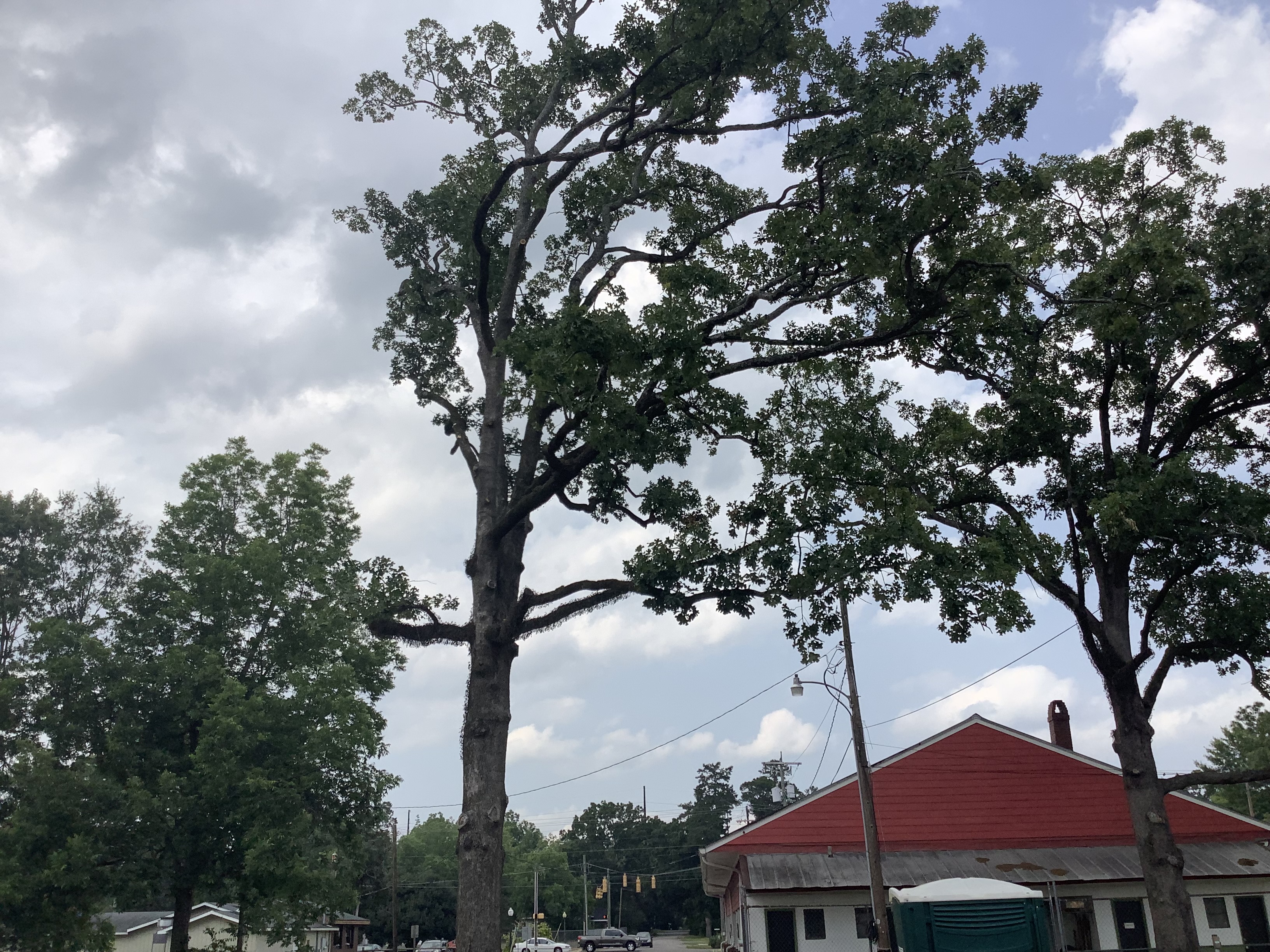
Sixty-eight trees are slated for destruction in a plan devised without opportunity for public input on the fate of this historic park.
After thirteen months of asking, the City finally answered the question via email on Friday afternoon, January 12: sixty-eight. That’s how many trees the City of Aiken plans to destroy in a project intended to improve the parklands at the five-acre Smith Hazel Recreation Centerin the historic Schofield neighborhood.
Two weeks later, on Friday, January 26, another answer arrived, this time via the local newspaper: No, the City is not going to hold a public hearing to give Smith Hazel neighborhood residents, park-goers, and the larger community opportunity to provide input on the future of the Smith Hazel park and its trees.
ABOVE: From the Aiken Standard newspaper, January 26, 2024
The largest among the Smith Hazel trees once shaded the grounds of the Aiken Graded School that formerly stood here — a school built in 1924 by contractor W.M. McGhee on 8 acres of land purchased by the hard work and effort of Aiken’s Black community of that era, including Messrs. W.M. McGhee, A.B. McGhee, George Ball, and Dr. C.C Johnson; a school where Mrs. Josie Smith Hazel once taught; a school that, despite the efforts of the northside community to save it, was closed in 1969, the year the Aiken schools integrated, and 1demolished by the City in 1973, as it was deemed too expensive to maintain. This history and these trees are part and parcel of this place.
A historic marker for the Aiken Graded School located at the northwest corner of the Smith Hazel Park.
And it’s not just the grand trees that matter. All of the trees matter; all are integral to the lovely, natural, parkland setting and the quality experience of this park.
April 2023 views of Smith Hazel. The ribbons on dozens of the trees, as was later learned, were intended to tag trees to be spared from demolition.
The decisions on each and every tree have deserved thoughtful consideration and our best efforts to preserve them where possible. This is why Smith Hazel park-goers and neighborhood residents spent the past thirteen months asking questions about the fate of the trees and pushing the City to allow them input. These citizens deserved, above all, the opportunity for at least one public hearing over the past thirteen months, so that they could help steer the course of Smith Hazel’s future. In the end, however, the fate of the park and its trees was seemingly decided by fiat.
How did we get here?
Below is an attempt to answer that question through a compilation of information gathered piecemeal over the past 13 months. The following is broken down into three sections — an overview, a timeline, and a list of points for further thought. Each section is expandable to allow for an optional, abridged account. This article will likely be updated as more information becomes known.
FAQs
What is the project? Smith Hazel is slated for improvements to the indoor and outdoor facilities at the center. This article will address only the outdoor improvements, which include:
The demolition and replacement of the two existing tennis courts.
The demolition and replacement of the playground equipment and the addition of artificial turf.
The closure of the existing basketball court to be replaced with two new basketball courts.
The addition of a second picnic shelter.
The resurfacing and rerouting of the existing 1/4 mile walking trail.
So far, so good. It would appear that, with the exception of the second basketball court and the second picnic shelter, the footprint of the improved park would be similar to the footprint of the existing park.
So why are 68 trees slated to be removed? A few explanations have been heard piecemeal over the months and been repeated anecdotally, including (1) that areas of the park will essentially be bulldozed to provide “clear lines of sight” for security reasons, and, (2) that the sloping elevations of the existing walking track is not ADA compliant, so the terrain will have to be leveled, requiring regrading of the earth and the removal of many trees.
Who is funding this project? The funding came from a Land and Water Conservation Fund (LWCF) grant awarded to the City in October 2022. The City matched this with Capital Project Sales Tax IV funds, bringing the total money for the project to $900k.
What is being funded? This particular grant is for outdoor recreation area only. No indoor work. The terms of the grant provide for, specifically, the replacement of existing amenities. For example, it will replace the two old tennis courts with two new tennis courts. It will replace the old playground with a new playground. Artificial turf is being added to the playground which will compound drainage and stormwater issues at the park. This is only one of a number of topics suited for a public hearing.
Why, then, are two basketball courts being installed to replace the one existing basketball court? The City was reportedly able to secure additional funding to install a second basketball court as part of this project.
Why is the baskeball court being relocated from its existing spot? As is the case with some other parks in Aiken, parts of the Smith Hazel property are located on SCDOT right of way land. The existing basketball court is in the SCDOT right of way. The LWCF grant can only be done on City property, which means the basketball court must be relocated to another part of the park.
What will happen to the existing basketball court? This area will be incorporated into the creation of approximately 40 parking spaces that are planned for a future project.
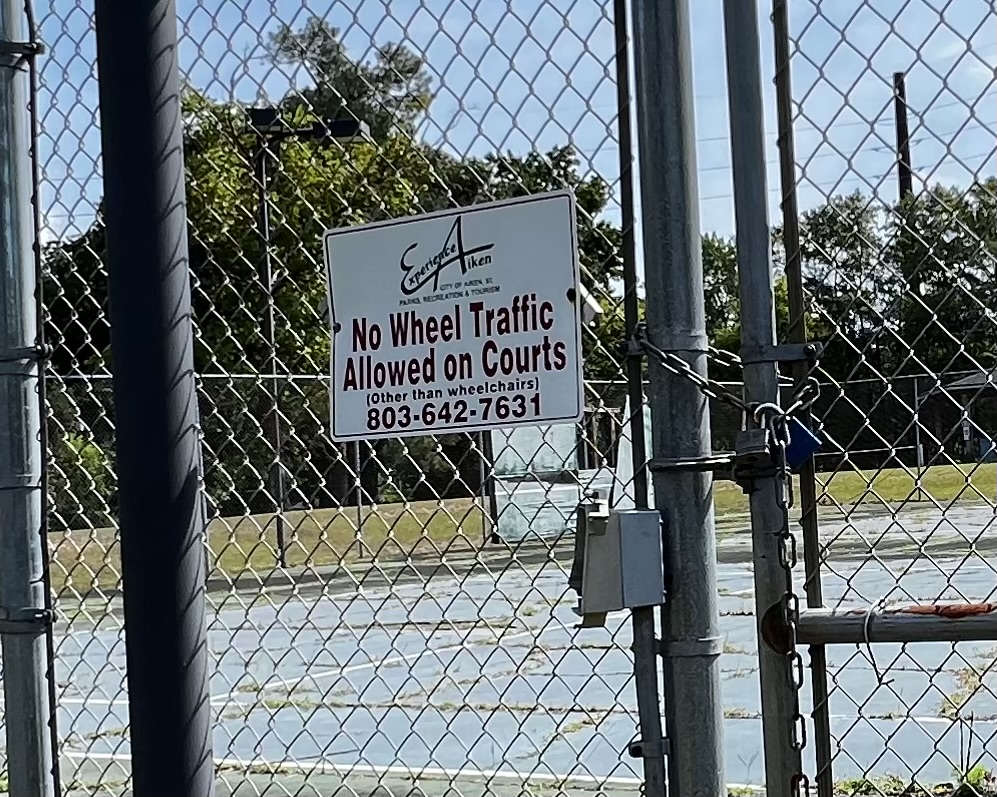
Why are the tennis courts being replaced when no one ever uses them? For those unfamiliar with this park, the tennis courts were formerly used, but have been padlocked for years and off-limits to the public due to their hazardous condition from years of disinvestment by the City of Aiken in the Smith Hazel Recreation Center.
The tennis courts at Smith Hazel have been padlocked for years.
What will happen with the existing 1/4 mile walking track? The plan is to reconfigure the track to be ADA compliant. As was learned by those who attended the September 21, 2023 monthly meeting of the Schofield Community Association, the sloping terrain prevents the track from being ADA compliant. Leveling the elevation — which will require earth-moving equipment and the removal of a large number of trees — is seen as necessary to making an ADA compliant track on the 5-acre Smith Hazel park. Were other alternatives considered? Could a future, second walking track be created across the street at the 25-acre Perry Memorial Park? The potential is there for an even longer track. Might this be preferable to destroying the historic, Smith Hazel parkland to make it ADA compliant? A public hearing with public input could have integrated such questions, ideas and potential solutions into the process.
TIMELINE: December 2022 through January 2024
December 8, 2022 A meeting had been called by the City of Aiken at the Smith Hazel Recreation Center. This was described as a “public input meeting for local community residents to review Smith-Hazel Park design options.” Attendees arrived believing they would be providing input on the newly-announced, outdoor improvement project which was set to begin within just a few months. The presentation was given by Aiken Parks, Recreation and Tourism Director, Jessica Campbell.
As the meeting progressed, it became clear that input was not actually being sought for this project, or “phase one,” as it was being termed, but for other, future projects. At approximately minute 18:00 of the meeting, (per a citizen-recorded audio of the meeting) a citizen spoke up and asked Ms .Campbell if the citizen input being solicited by the City was for the current project or for future projects. Ms. Campbell confirmed that the input was for projects “down the road.” She said, “The idea is to have a concept plan for future development.”
In other words, the concept plan for the current project (below) had already been drawn up by Cranston Engineering, and there was no public input sought either before or after this plan was drawn.
ABOVE: A photo of the concept plan for the present-day project, which was posted at the December 8, 2022 meeting. In a peculiar twist of plot, attendees were not asked for input on the current project, as seen in the above drawing but, rather, were being asked for feedback on potential projects down the road.
Citizens had been called together to comment on ideas for potential future projects, illustrated by Option A and Option B.
ABOVE: Photos of the other two drawings present in the December 8, 2022 meeting. The public had been brought together to vote on Option A or B, not to give input on plans for the current project.
When asked if any trees would be disturbed by the project, Jessica Campbell stated that they did not yet know, as the final course of the walking track hadn’t yet been determined.
April 2023 After citizens observed ribbons on dozens of the trees in the Smith Hazel park, Aaron Campbell, the City horticulturist, was contacted. He stated his shared concern to spare as many trees as possible during the project. He stated his belief that the tagged trees were those NOT be cut. He assured the caller that there would be opportunity for public input on the trees before any action was taken.
April 10, 2023 Two citizens spoke at the regular City Council meeting about the trees at Smith Hazel and wondered if the ribbons were intended to mark the trees slated for removal. According to the minutes of the non-agenda comment period, Laura Lance, “noted that she understood that the matter would be before Council at some future date where the public would have an opportunity to talk about removal of the trees. She pointed out the importance of the tree canopy in Aiken. She asked when there would be opportunity for the public to know what is going to happen and have some input.”
PRT Director Jessica Campbell, also present at the meeting, responded that the flags were for the trees not to be removed. According to the minutes, Ms. Campbell, “pointed out that those trees marked have been identified as substantial, high importance, high-priority to remain as is. she said the trees that are marked so the engineers can look and make sure the footprint of the amenities that are to be placed on the property fit within the landscape and does not create the removal of any of those marked trees.”
September 11, 2023 City Council held a work session on September 11, 2023, during which the topic of tree removals went undiscussed. There were, however, two items in the agenda package pertinent to the trees.
ABOVE: The two agenda items pertinent to the Smith Hazel outdoor improvement project. At this time, the precise number of inches of trees slated for removal was known, yet the number of trees slated for removal could not be given.
During the regular City Council meeting following the work session, Luis Rinaldini spoke to City Council about the above agenda items and on need for clarification on the matter of the trees:
“I would just like to comment on the agenda item that was included in the work session regarding the Smith Hazel renovation. It has a map and it has a page… referring to trees being cut down. But it really doesn’t give a lot of information. The information it gives us is confusing. There are something like 500 inches worth of trees, I’m not sure how that’s measured and what it means And 230 inches to be removed, which sounds like, to the uninformed person, that half of the trees in that area are going to be to be cut down. So I think that, rather than just let it sit at that, we ought to get clarification and get a map that shows what trees are being affected, and why. Because, as you know, we’ve had some not great situations with trees, And I think it’s important that we change the way we look at those things, and we change the way, we approach things, reducing the number of trees that get cut down in our activities.”
Bill McGee also spoke at this meeting. Referring to earlier mention in the meeting that some trees would have to be removed at Smith Hazel, Mr. McGhee stated that they (the SCA, or Schofield Community Association) have requested the City to come to the next SCA meeting on September 21, 2023 to discuss with the community the plans and exterior of Smith Hazel. He said he hoped the tree issue would be included in the presentation.
September 21, 2023 Attendees at the SCA’s regular monthly meeting received, from Mary Catherine Lawton,* Capital Projects Manager, what may have been the most comprehensive explanation by the City through the entire 13 months on the Smith Hazel park project. Even at this, the specifics on the numbers and locations of trees slated for destruction were not given. A video of this meeting can be viewed here, with the discussion on the outdoor improvements beginning at minute 22:35, starting with a citizen question on the any public input that went into the project. The answer provided Ms. Lawton was not quite clear.
*Correction: an earlier version of this story incorrectly identified the Assistant City Manager as the speaker at this event.
November 27, 2023 Bill McGhee, president of the Schofield Community Association, wrote to the City horticulturist, Aaron Campbell, requesting “a walkthrough of the plans for the trees involved in the project.”
December 5, 2023 Aaron Campbell responded to Mr. McGhee via email at 8:49 a.m. saying, “We are available to meet today at 1pm or Friday, December 22nd at 1pm.”
December 9, 2023 Bill McGhee sent notice that a meeting had been arranged with Aaron Campbell for Dec 22 “to have a SCA group review the exterior SH renovation plans and the status of the surrounding trees.”
December 12, 2023 Notices of the upcoming meeting were posted at the Aiken Chronicles and on social media including the Do It Right and Schofield Community Association Facebook pages.
Notice posted at the SCA webste on December 12 for the Dec. 22 walk-through at Smith Hazel.
December 14, 2023 Beatrice McGhee emailed notice of the meeting to the SCA membership
December 22, 2023 The meeting convened with over a dozen in attendance. Landscape architect Lance Cheeley, with Cranston Engineering, was in attendance and indicated, without further specifics, the plan to remove “many trees” including two significant pine trees and one significant oak. There was no actual walk-through, however, nor tagging of the trees, nor identification or total numbers of the trees slated for removal. There was reportedly discussion among some attendees that a factor in the tree removal was the need for a “clear line of site” for security purposes.
December 26, 2023 Bill McGhee emailed a recap of “The Smith Hazel Tree Walk-through” to the SCA membership, with this update on the trees:
“The draft RFP includes the removal of two ‘significant” pine trees, one ‘significant’ oak, and many other non-significant trees. No trees were tagged. The many trees to be removed were not specifically identified. It was stated that the tree removal and replacement plan complied with the city’s landscape/tree maintenance policies.
January 8, 2024 Bill McGhee emailed Aaron Campbell requesting a copy of the City’s tree inventory of the Smith Hazel trees to review for discussion.
January 10, 2024 Aaron Campbell responded that he could not give this information.
January 12, 2024 (Friday at 3:20 p.m.) Aaron Campbell emailed Bill McGhee a pdf (see image below) of the Cranston’s “Tree Removal Exhibit” for the park, with the following note: “Attached is the plan from Cranston engineering showing what trees are slated for removal. Please let me know if you have any further questions.”
TOP: The Cranston Engineering “Tree Removal Exhibit” dated November 10, 2023. BELOW: The total number of trees to be removed.
A total of 68 trees are slated to be removed according to the Cranston drawing. This drawing is dated November 10, 2023. The drawing was only emailed to Mr. Bill McGhee on January 12, 2023. This was the first time that the City divulged the total number of trees to be destroyed.
January 15, 2024: (Monday holiday, Martin Luther King Day)
January 16, 2024: — Bill McGee left a message with Aaron Campbell to give him a call. Mr. McGhee’s call was never retuned. — Bill McGhee put out a notice urging attendance at the 5:30 p.m. meeting that evening of the City Recreation Commission on Banks Mill Road. A total of six SCA member/tree preservation advocates attended: Bill McGhee, Linda Johnston, John Howard, Lee Doran Thornton, Lisa Smith, and Laura Lance. All gave their perspectives on this project regarding the shocking number of trees slated for removal and the frustration over the lack of public participation in the process. A public hearing was requested. The Recreation Commission respectfully listened and responded by making and approving two motions: (1) to recommend to City Council that a public hearing be held to allow for public input on the Smith Hazel trees, and (2) that ribbons be attached to the trees slated for removal so that the City, SCA and all interested parties could see what is planned for the park. — At 10:43 p.m. that night, local park advocates began a social media campaign to “pause the project.” Public interest and comment was robust.
January 25,2024 Bill McGhee submitted a FOIA request for a listing, from the City’s tree inventory, of the type of grand and significant trees slated for removal at Smith Hazel and the dollar value assigned to each tree.
January 26, 2024 The local newspaper announced online that the Smith Hazel project is going to go forward without “more” public input, stating:
“The City of Aiken doesn’t intend to pause plans to make long-awaited upgrades to the Smith-Hazel Recreation Center, despite a community group and city board asking for a brief stoppage to have more public input on the project.”
POINTS FOR FURTHER DISCUSSION
— Why is the City using the term, “more public input”? Given that the City has provided no opportunity for public hearing for public input on this project, the word “more” isn’t applicable.
— Cranston Engineering had already drawn the concept plans for the this project before the December 8, 2022 meeting. Why was there no public hearing for public input on this plan either before or after the plan was drawn up?
— Why was the public given opportunity during this same December 8, 20220 meeting for input on hypothetical future plans for future projects of the park, but none for the current project, as shown in Cranston’s concept plan?
— Why were dozens of trees at Smith Hazel tagged with different color ribbons in April 2023? Who decided which trees would be tagged to be spared and which would be destroyed? And by what criteria? Does this mean that the City knew as far back as April 2023 how many trees would be destroyed? Why wasn’t the public included in at this stage of planning?
— Why did the city refuse the recent requests by citizens and the recommendation by the Recreation Commission in the wake of January 16th 2024 meeting to have to have the trees marked with ribbons to show the public and the city the trees slated for destruction?
— Why did the City Council not discuss the number of trees slated for destruction in its September 11, 2023 work session? And why didn’t the City take the opportunity of Mr. Rinaldini’s call for clarification in the City Council meeting that night to state how many trees will be removed?
— Why did the City hold a work session, (which only allows the public to attend as spectators), rather than a public hearing on September 11 to accommodate public input in the discussions?
— Were alternate plans considered to reduce the destruction of trees, and, if so, what were these plans and where is a record of them?
— Why did the City — knowing how important this topic was to advocates for our City’s parks and the trees — repeatedly fail to provide the requested information on the trees for all these months?
In Closing
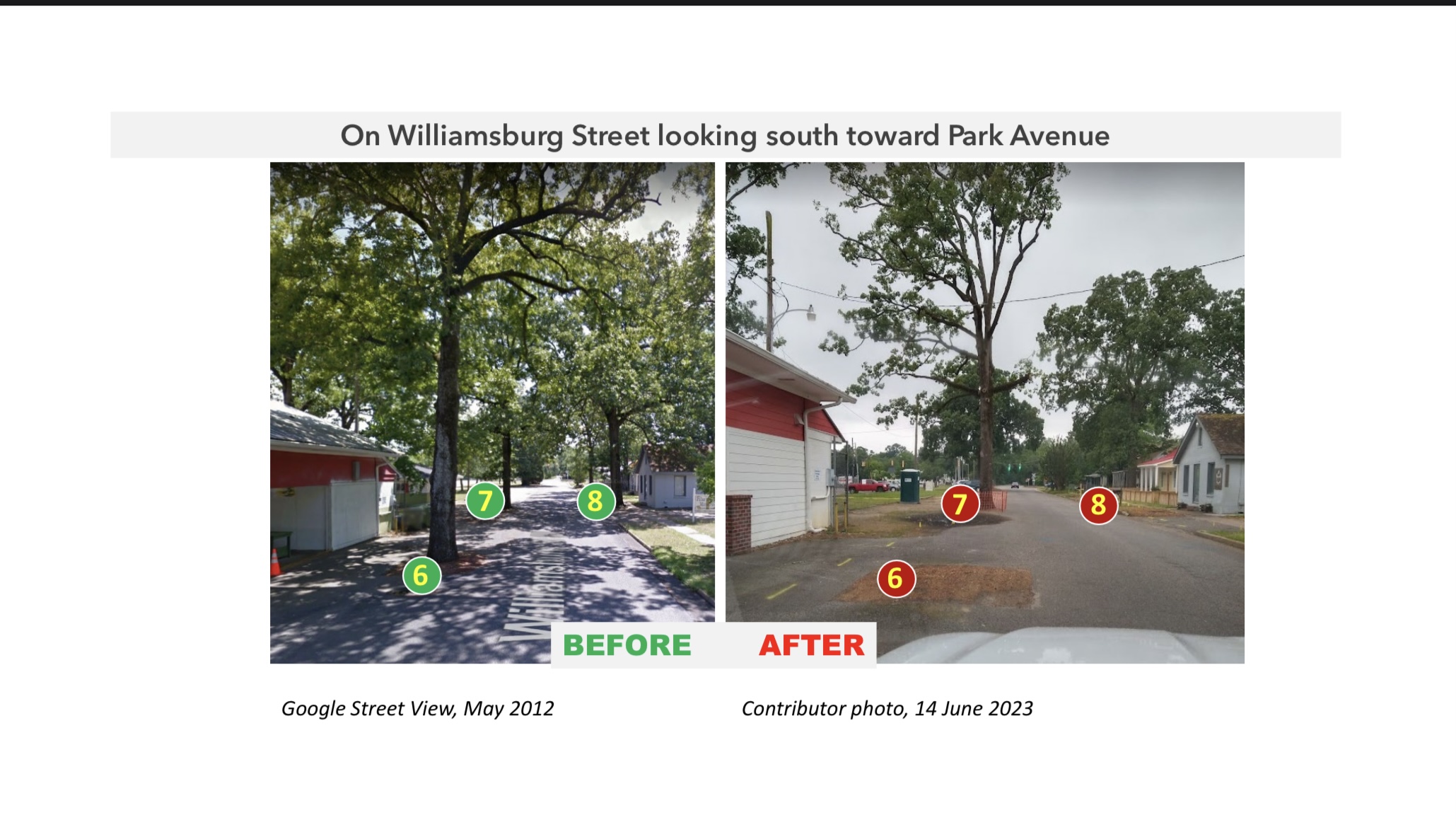
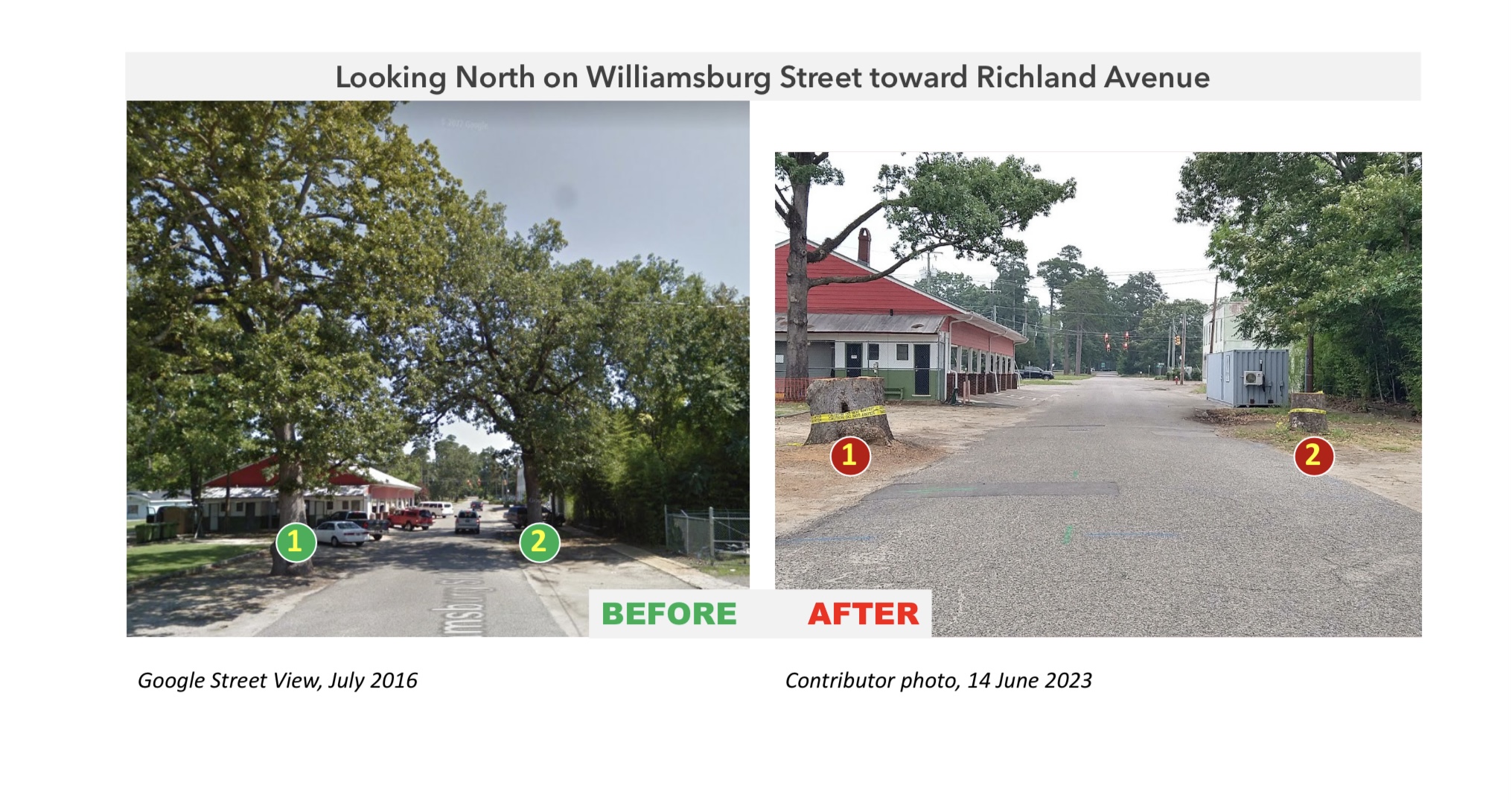
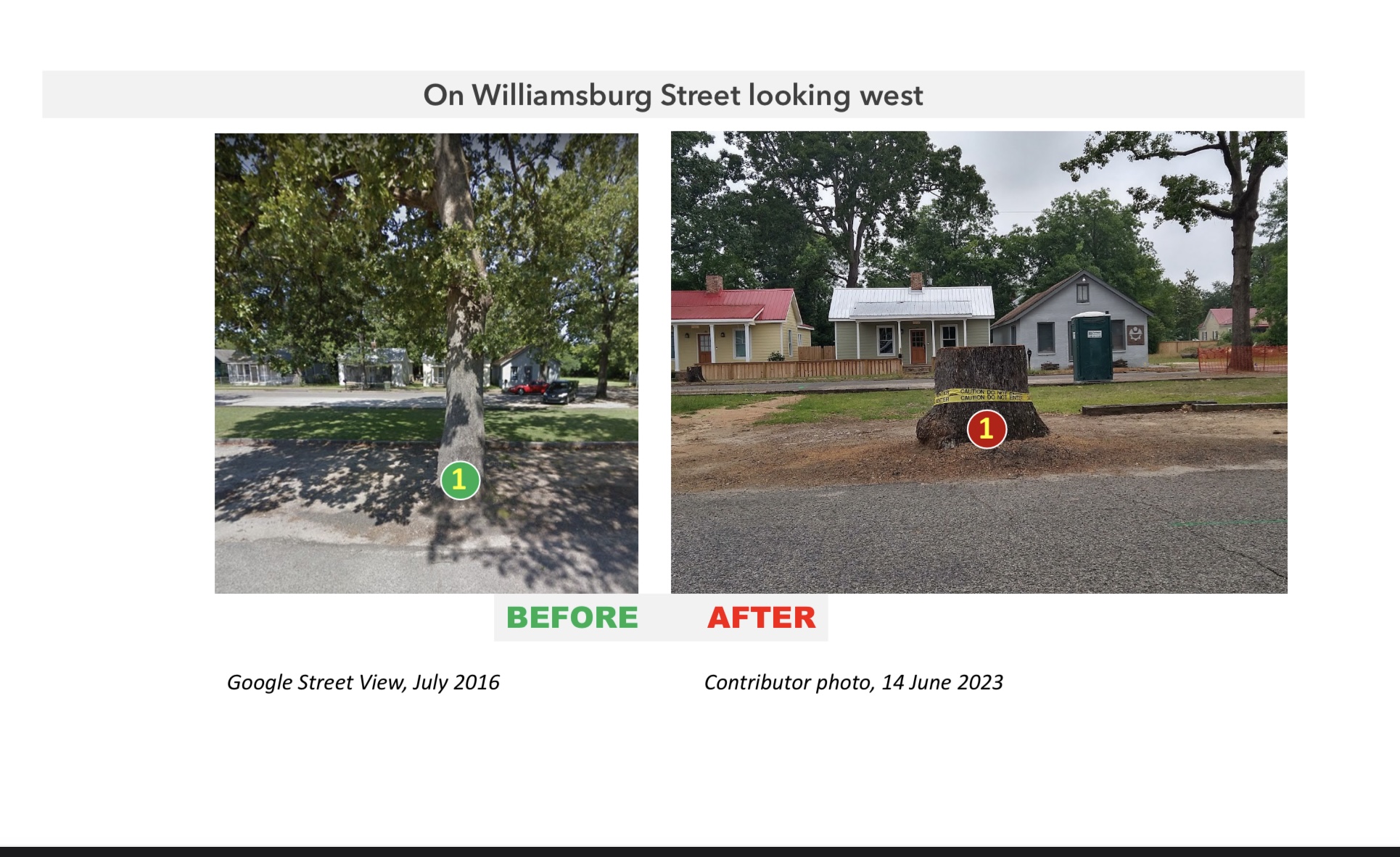
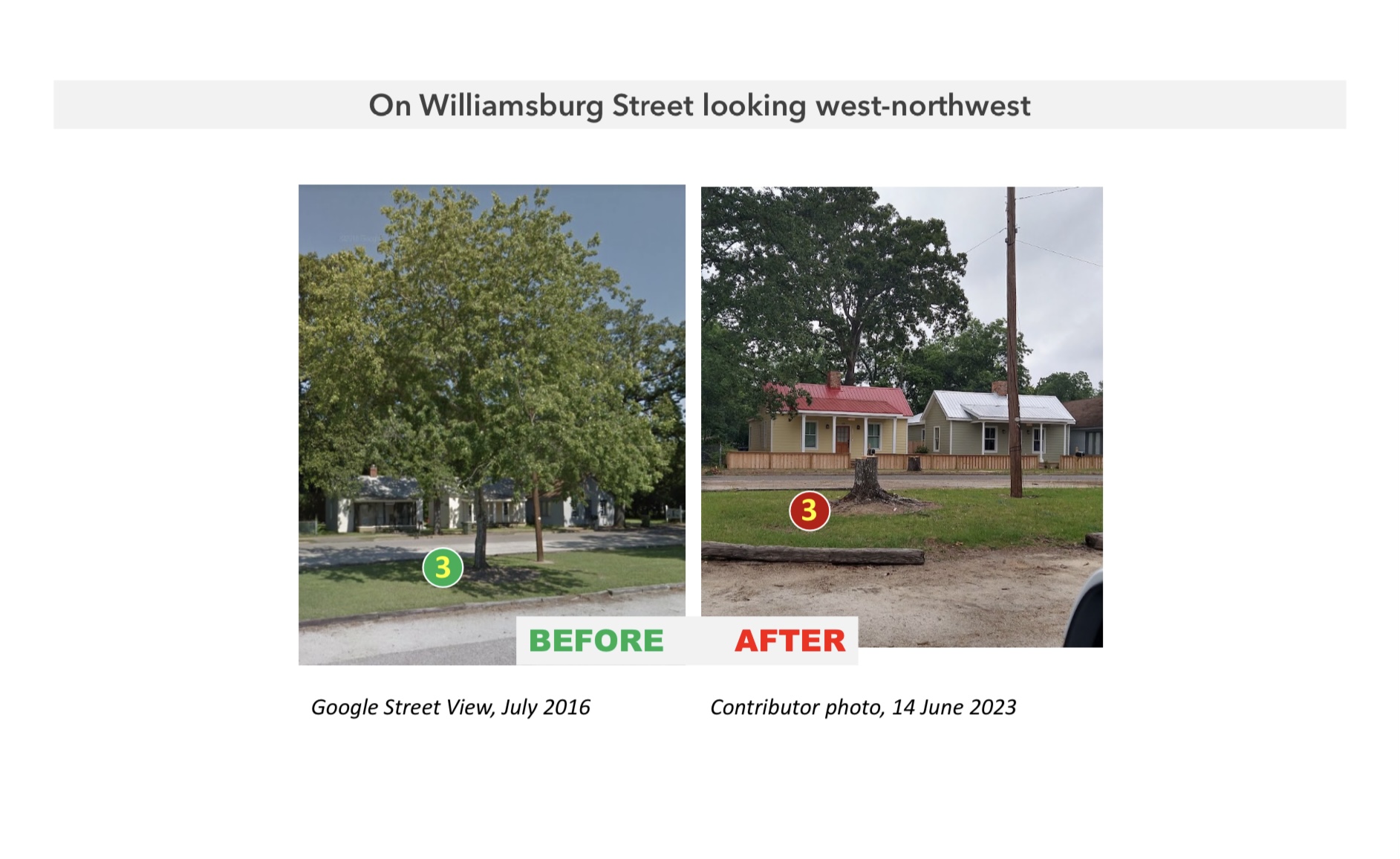
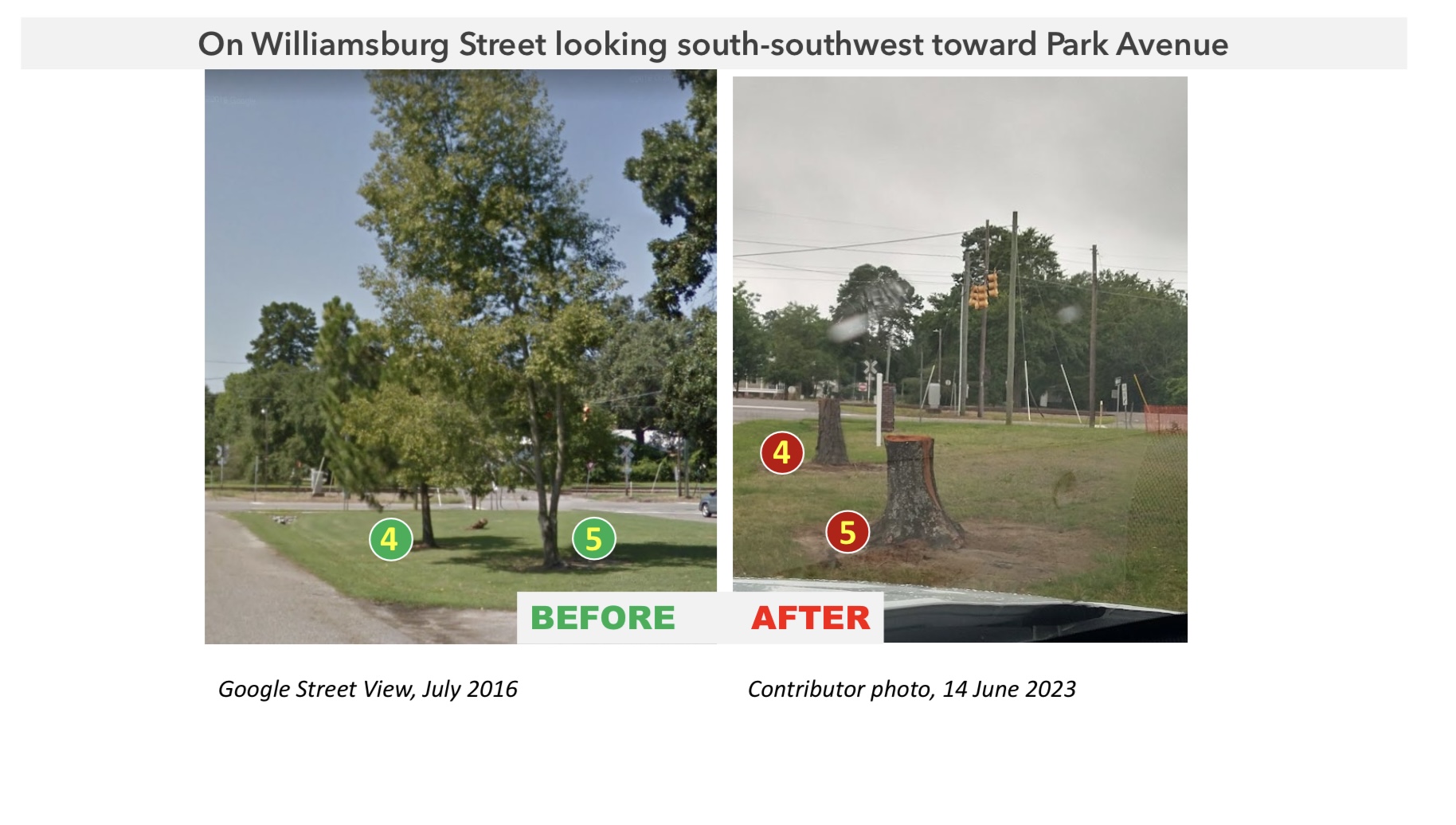
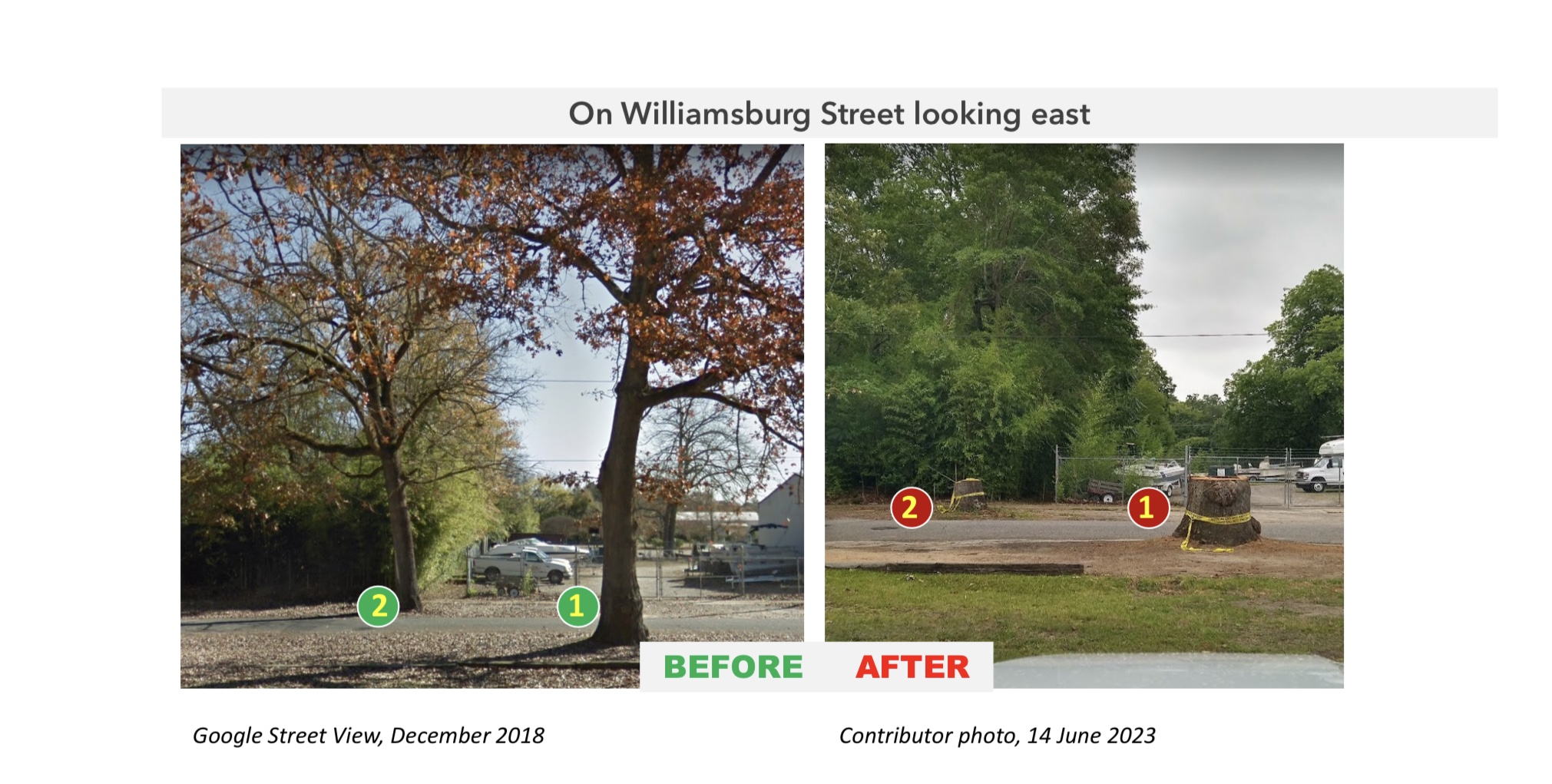
One marked similarity in the Williamsburg Street and Smith Hazel stories is the lack of a public hearing for pubic input on a project that would radically change a public parkland. Another is the stealth manner in which the demolition of trees was planned and kept from the pubic. A less obvious similarity is what almost appears to be the staging of a felled, hollowed tree, as if this might justify the destruction of all.
An important difference in the two stories is that is that the destruction of the 11 trees on Williamsburg cannot be undone today. The planned destruction of 68 trees at Smith Hazel can and should be undone.
The issue at hand is not about being pro or anti-progress. Nor is it about an inability or refusal to acknowledge that reality that trees sometimes need to be removed in the course of development. No, this issue is about the need to follow good faith governance and established processes. Those among us advocating for our trees and our parks are merely asking that processes be followed, and that these processes be open, transparent, fair, lawful, and available to all.
Visible in the distance is a walker on the Smith Hazel walking track.
1Correction: The date of the Aiken Graded School demolition was incorrectly given as 1969 in an earlier version. This has been correct to reflect the school was closed in 1969, the year the Aiken schools integrated. The school as then demolished in 1973.
Some stories regarding this week’s Aiken City Council agenda, and an update on a development.
by Don Moniak
September 11 City Council MeetingAiken City Council will convene 7 p.m. on Monday, September 11th for its regularly scheduled meeting at the new City Hall at 111 Chesterfield Street, South.
The agenda includes public hearings on the city’s updated Comprehensive Plan, budget amendments to allocate a budget surplus, and a critical Memorandum of Understanding involving the Powderhouse Road Connector project.
The Aborboretum
First, some good news. The Second Public Hearing for the City of Aiken Comprehensive Plan update is near the top of the agenda. After first being omitted from the plan for years, the uniquely managed and Arboretum, which is situated within and around the City of Aiken, has been recognized as a unique resource in the plan’s cultural resources chapter.
Deep in the agenda is a Resolution Authorizing the City of Aiken to Enter Into a Memorandum of Understanding (MOU) with James S. Watson and Powderhouse Parters, LLC. This MOU is critical to the success of the long-planned and highly-debated, $38 million Powderhouse Road Connector project.
Although marketed as a Whiskey Road traffic congestion relief project, the Connector Project will facilitate, and encourage, major residential developments across the project area. At least 2,000 new residences are anticipated across an undeveloped three-hundred acre area outside of city limits. Read more in “Development Road.”
Lab Project Meetings
Two meetings regarding the proposed downtown Savannah River National Laboratory (SRNL) office complex are planned this week. One meeting is closed to the public, the second meeting is open to the public. Read more in “Secret Meeting, Open Meeting.”
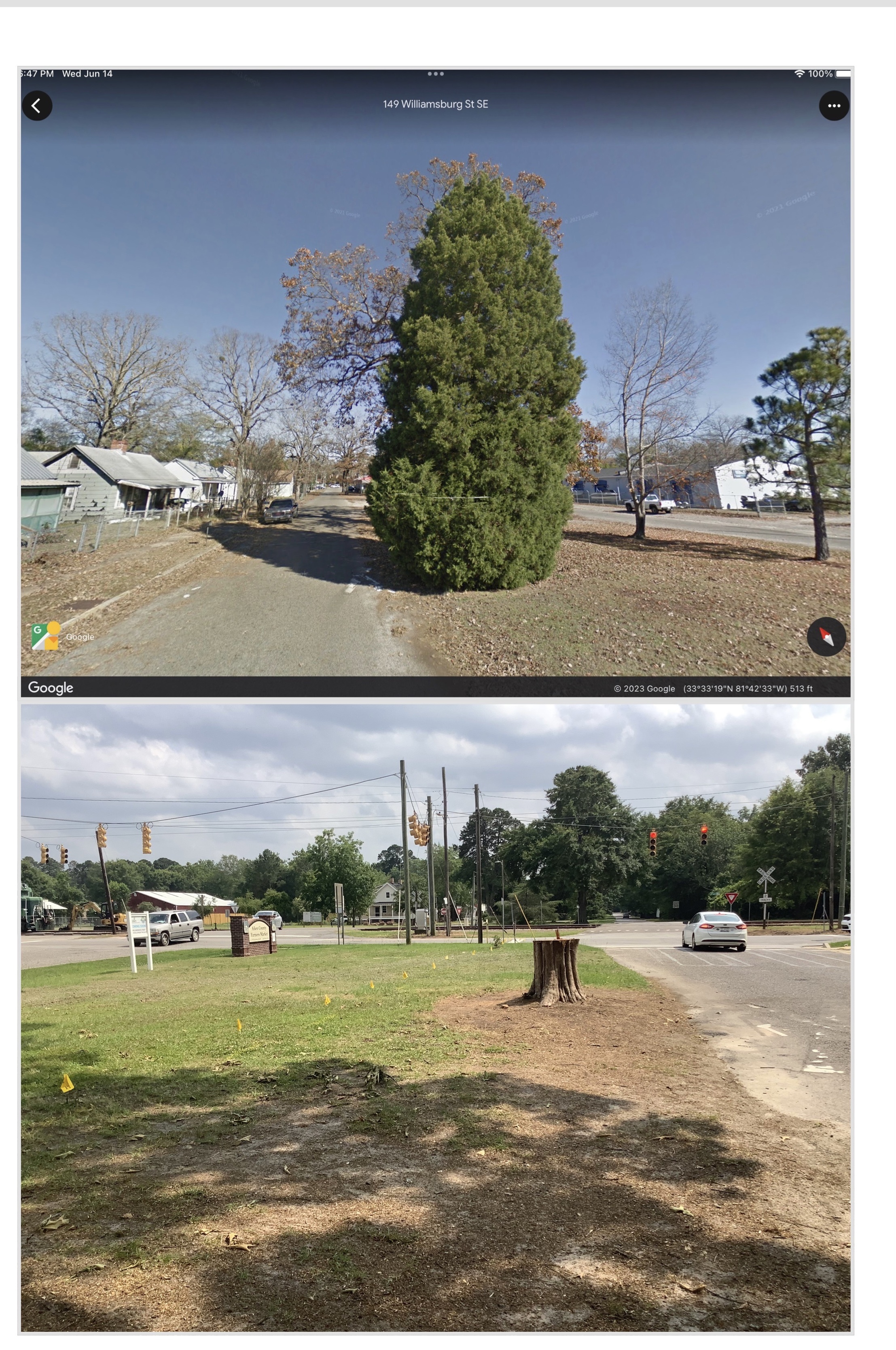
Former 100 percent crowned tree. Looking north from Park Ave (top), Looking South towards Park Ave, the stump (bottom) , A residual oak with poorer crown structure that will now be more susceptible to wind damage (left/center). It is not just the loss of trees, it is the loss of a shade-scape that moderates temperatures in the late Spring, Summer, and early Fall months.
Transcript from archived You Tube video of June 12, 2023 Aiken City Council Meeting. Go to 18:36
City Manager Stuart Bedenbaugh: On May 30th work began on the Farmer’s Market project. What should have been the start of a joyous occasion was just the opposite. Eight eight trees were removed, which was very distressing to many residents and non-residents and I share that distress along with some indignation towards the situation. This should not have happened. Healthy trees cannot be repaired or replaced as one would a motor vehicle or piece of playground equipment.
While we cannot ensure that future city projects can save every tree the review process for our projects must conform to the same process as a private developer. As a staff we can do better and we’ll do better thank you so much for indulging me for a moment Mr Mayor.
Mayor Osbon: “ Thank you Stuart. I think many people probably felt the stress over that. I know council members did and you know we work hard with our Aiken streetscapes, we work hard with Aiken Land Conservancy for our trees. If its anything as a city we need to hold ourselves to a higher standard and we ask our our residents too so we certainly will be taking action. We can’t restore a full-grown tree I know.
But by the same token when some someone does that individually we ask them I think it’s a three tree to a one tree a grand tree that’s taken and we certainly intend to hold ourselves to the same if not higher standard than we would someone else who did that. So to the citizens I want to Echo the apology that this happened and we’re certainly looking at making sure that there’s steps in place that something like this does not happen again.”
At the 1:38:57 mark of the video the issue came up again. It is best to watch the whole exchange, as the following is a very condensed version by necessity.
Aiken Resident Valerie Wrobel; Regarding the trees who cut them who is somebody fired for this, did somebody get fined.? Who allowed it and hast person been fired, disciplined, and fined?
City Manager Stuart Bedenbaught; We’re still assessing, but the answer to your question at this moment is it was cut down by a contractor….It is not the contractor they followed the plans that the city gave them that should not have been given to them. The old set of plans were a set of plans that should not have been given to the contractor.
There were also discussions at the 1:20:27 and 1:33:30 marks of the video.
The concept plan from 2020 did show some significant tree removal and replacement with what looks like twisted crepe myrtles.
However, that was a concept, not a concept design or final. Cranston Engineering of Augusta conducted conceptual design and final design of the project at a cost of just over $90,000. The concept and final designs have been requested.
Cranston Engineering Final Invoice Summary. Obtained via a Freedom of Information Act request.
How the Absence of an Inexpensive Safety Fence Led to a $250,000 Payout by the City of Aiken
by Don Moniak
January 2, 2023
On the afternoon of July 2, 2019, with temperatures in the mid 90’s (F), an eighteen month old child under the care of her mother stepped onto a grated metal hatch covering a mechanical equipment vault that sits ten to twelve feet away from the Splash Pad at the City of Aiken’s Citizens Park. The child suffered second degree burns on both feet.
Burn injury photos submitted in January 29, 2021 Court of Common Pleas complaint.
In a personal injury lawsuit filed January 29, 2021, on behalf of the minor child and mother, as guardian, Lexington Attorney Melissa Mosier wrote that the mother:
“turned around to check on the other two children with her at the splashpad when she heard a child cry out, and turned back to find her daughter H.N.P.M just a few feet away, standing on the metal hatch screaming. She ran to her child, who was stunned and crying out in agony, and a crowd gathered to try to assist this mother and child.
H.N.P.M. sustained serious injuries, including second degree burns (blistered burns) on the bottoms of both of her feet. This required her to be placed under general anathesia in an attempt to repair her wounds. See photographs of H.N.P.M.’s feet, noting the grate pattern.”
The claims made in the initial complaint included:
It was foreseeable that a child would wander to the nearby mechanical system and hatch, which posed “an attractive nuisance for children.”
The City of Aiken took no steps to “keep children away, protect them, or advise their parents of the dangers posed by the equipment vault or the hot metal surface concealing the mechanical equipment.”
“The City was on actual notice of the particular hazard posed by the unguarded and un protected equipment fault by virtue of a prior burn injury at the park – and despite this it failed to take any steps whatsoever to remedy the danger or even warn against it.”
In regard to the prior injury, Mosier contended the city was negligent for violating “its duty of reasonable care to fix known defects and hazardous conditions within a reasonable amount of time after notice;” and that the cost of fencing the hazard would be less than $1,000. That amounts to about 1/400th of the Splashpad site’s insured value. (1)
At the time, as seen in the photo below, there was no fenced area within the fenced splash-pad and grassy area. The metal hatch covering splash pad equipment, another grate, and an electrical juncture box had no signs indicating them as hazards, were not fenced separately, and were a part of the play area.
Citizen’s Park Splash Pad. Circled area shows location of metal grates in play area. (Photo from Google Earth)
In the response on behalf of the City of Aiken, Columbia attorney Daniel Plyler either denied all allegations or demanded more information; and offered a total of sixteen defenses. These included a standard, generic defense asserting full negligence by the mother, as well as Plyler’s standard “Fifth Defense” for personal injury negligence complaints against the city, the “natural disease process:”
“Defendant would allege, upon information and belief, that any injuries or damages sustained by Plaintiff were due to and caused by the natural disease process over which Defendant had no control and, as such, Defendant pleads such a natural disease process as a complete bar to this action.” (1)
In August, 2021, Plyler filed a Motion to Compel a response to submitted discovery requests regarding the mother’s life and work history, whether she had “ever received counseling or treatment for alcohol or drug addiction or use,” or used social media.
In October, 2021, Mosier answered with another Motion to Compel to answer Plaintiff’s discovery requests. Sometime between the lawsuit being filed and the latter Motion to Compel, the City’s Parks and Recreation Department had opted to fence the hazards that were in dispute, leading to question 21:
When was the fencing installed around the metal grate and who directed the installation of the fence?
Citizen’s Park Splash Pad with added interior fence around play area hazards. (Photo: Don Moniak)
“The City of Aiken denies any liability for the injuries but, through its insurance carrier, the South Carolina Municipal Insurance and Risk Financing Fund, respectively, proposes to compromise and settle the claims. The terms of the settlement of the sum of One Hundred and Seventy-Five Thousand Dollars ($175,000).”
The terms of the settlement involved a “payment directed to Independent Assignment Company for payment of periodic payments upon the minor child reaching maturity.”
The settlement also required the city to pay attorney fees:
“IT IS FURTHER ORDERED that attorneys’ fees of $70,000.00 and the costs incurred in handling this action are reasonable, and they are hereby approved.”
In total, the City of Aiken and its insurance fund paid out $245,000 for a settlement and for Plaintiff attorney costs. The cost of the city’s defense is presently unknown. The accident that led to the settlement was avoidable and preventable, but no action was taken to mitigate safety risks until after a lawsuit was filed. The settlement that may have doubled the city’s liability costs (3) over a one year period was not reported in Aiken’s newspaper of record.
Footnotes
(1) The Splashpad’s insured value, including the restroom, is $405,410. the City pays an annual insurance premium of $636 for the facility that includes liability coverage.
From City of Aiken 2022 Coverage Contract With the SC Municipal Insurance and Risk Financing Fund
(2) Thirteen of the defenses were generic in nature, word for word identical to the defense made in 2021 to another lawsuit involving a child’s injury at Virginia Acres park in 2019. In that case, a minor child fell over an electrical box and sustained unidentified injuries. The case was dismissed in February, 2022; and no settlement was noted in the available court records.
The same set of generic defenses were also made in the case of another personal injury/premises liability lawsuit against the city and SC Dot involving an adult who suffered an injury on Boardman Road.
(3) In terms of liability, according to the The City of Aiken Annual Comprehensive Financial Report for Fiscal Year Ended June 2022, the city “participates in two self-insurance plans whereby the self-insurance funds from other members of South Carolina local governments are pooled together for investment and administrative purposes. These pools accumulate assets and assume risks for the following: 1. Property and liability coverage with a limit of liability for the pool of one million dollars.” (Pages 83-84)
From City of Aiken Annual Financial Report for Fiscal Year Ending June 30, 2022.
The report also described litigation as a contingency in the budget, but did not address any underlying safety culture issues that might contribute to liability claims:
“The City is involved in several pending lawsuits. Liability, if any, which might result from these proceedings, would not, in the opinion of management and legal counsel, have a material adverse effect on the financial position of the City.”
At the twenty-eight minute mark of Monday night’s Aiken City Council meeting, City Manager Stuart Bedenbaugh announced:
“In talking with the PRT (Parks, Recreation and Tourism) director the daily fees for children or individuals eighteen and under starting November 1st will be removed.”
The only caveat added to this statement was the necessity of a liability waiver form on file and signed by a parent and guardian.
The announcement was made during the first portion of “public comments on nonagenda items,” a new fixture in Aiken City Council meetings first implemented on September 12, 2022. Mr. Bedenbaugh related the fee waiver decision following questions by Aiken resident and city parks advocate Laura Lance regarding recreation fee policies for children and the city’s “Fun Funds” program:
“In part of tonight’s agenda (packet) there was an answer given to concerns and complaints about the two dollar fee for basketball for kids to go and use the facilities. The response in ‘Issues and Updates” reads ‘as has been the case since 1995 Fun Funds have been available for all eligible youth which waives the fees.’
“I don’t think that’s correct. If I am not mistaken Fun Funds are intendedfor classes….summer camp or a basketball team, then they might waive their fifty dollar fee. But I don’t think the Fun Funds are intended for one or two dollar fees that kids are being charged just to go to these facilities. To apply for those funds requires a twenty dollar registration fee….Something is not matching up.”
The announcement that daily fees for children were being eliminated was met with applause and some relief—less than two months had passed since Aiken resident Laverne Justice had first voiced objections before Council to the $2 per day policy.
Status of Adult and Annual Recreation Fees
However, at least two questions regarding the city’s recreation fees linger.
1. What is the status of fee increases implemented on April 1, 2022, but in apparent violation of city procedures?
As reported in “Taking $2 From a Child to Play a Game,” fee changes must be approved by City Council. Section 2-261 of the City of Aiken’s Municipal Code states:
“All fees, rentals, admissions and other charges made to the public for the use of city recreational facilities shall be recommended by the director of parks and recreation, reviewed by the city manager and approved by the city council.”
Fee increases were implemented in April based on recommendations from the Parks, Recreation and Tourism Department to the Recreation Commission. Although it has no authority to change fees, the Recreation Commission voted to do so.
According to the document “Fee Proposal Changes” presented to the Recreation Commission on February 1, 2022–but never made public (1)—the maximum original annual fee was $125. At the urging PRT Director Jessica Campbell, the Recreation Commission voted to raise membership fees to as much as $400 for a family of four. According to the most recent edition of “The Park Bench,” these annual “Wellness Membership” fees remain in place.
From: “Fee Proposal Changes,” Feburary 1, 2021 Presentation to City of Aiken Recreation Commission. From: “Fee Proposal Changes,” Feburary 1, 2021 Presentation to City of Aiken Recreation Commission.
2. Even though the change in youth fees is welcome, the question remains: who is in charge of finalizing recreation fees? At the August 16, 2022 Recreation Commission meeting, at least one commissioner acknowledged it was not in their purview to change rates:
“Commissioner Wallace reminded members that they are expected to make recommendations to City Council, but are not in a position to approve or disapprove of changes.”
Footnotes
(1) The original Parks, Recreation and Tourism (PRT) “Fee Proposal Changes” document was presented to the Recreation Commission during its special meeting on February 1, 2022; a meeting for which there was no proper public notice. No record of that meeting was publicly available until mid September.
The “Fee Proposal Changes” were not included in the Feburary 28, 2022, “Issues and Update” memorandum in City Council’s Meeting Agenda Packet that served as notification to City Council of fee changes. The document was not publicly available until a Freedom of Information Act (FOIA) request compelled the city to post it. It is now buried in the city’s Laserfiche document repository at
FOIA Request #254-2022, filed on September 20, 2022, requested:
“1. A copy of the “ draft copy of the Parks, Recreation, and Tourism (PRT) Fee Change Proposal” provided at the February 1, 2022 Recreation Commission meeting. Meeting minutes for that meeting indicate this document was provided. This document was requested on September 16, 2022 in a letter to PRT Director Jessica Campbell and City Manager Stuart Bedenbaugh. The document should be readily accessible. 2. A copy of the final PRT Master Plan Report and Needs Assessment by Clemson University professor Bob Brookover. Please advise if there is no final copy and whether the draft that was provided in City Council’s January 10, 2022 Workshop agenda packet is the current version. 3. A copy of the online survey cited in the Master Plan Report. 4. A copy of all park usage data provided to Professor Brookover and his research associates during preparation of the report.”
The “Fee Change Proposal” and a clean copy of the PRT Master Plan were provided on October 4, 2022. They are currently in the city’s Lasefiche ecodoc repository.
_______________
City Solicitor Laura Jordan’s response to #3 and #4 of the request was as follows:
“For Item No. 3, the requested item is an online survey. The survey is no longer active online and the City is not in possession of a copy of the survey.For Item No. 4, Professor Brookover was provided the link to the Monthly Reports, which are available at the City of Aiken’s Document Repository (LaserFiche). Once the Laser Fiche page has been accessed, click on the “Browse” link in the upper right hand corner. From there, click on the “Parks and Recreation” Folder and then then “Monthly Reports” Folder.’”