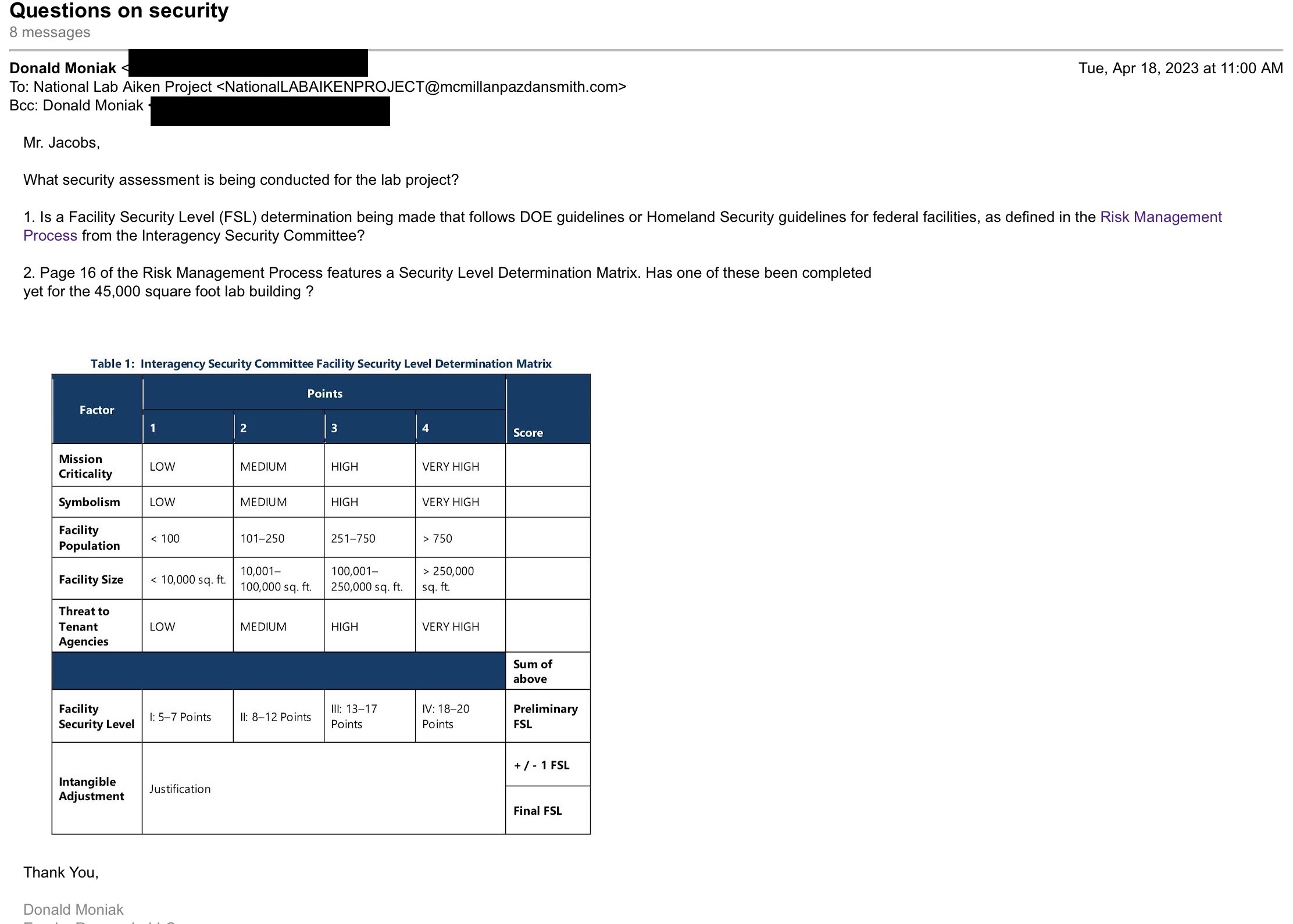
The following email (1) was sent by Don Moniak to Nationallabaikenproject@mcmillanpazdensmith.com on April 18, 2023.
No answer has been forthcoming.
NOTE: All federal facilities must go through the process including leased facilities and non nuclear Department of Energy facilities.
________________
Donald Moniak
Apr 18, 2023, 11:00 AM
to National
Mr. Jacobs,
What security assessment is being conducted for the lab project?
1. Is a Facility Security Level (FSL) determination being made that follows DOE guidelines or Homeland Security guidelines for federal facilities, as defined in the Risk Management Process from the Interagency Security Committee?
2. Page 16 of the Risk Management Process features a Security Level Determination Matrix. Has one of these been completed yet for the 45,000 square foot lab building ?
Newcomers to Aiken may not know that Virginia Acres Park was created atop a 55-acre subdivision called Virginia Acres. The City’s decision to purchase and demolish this subdivision was at the center of a controversy that played out in local headlines and editorial pages from 1962-1965.
Built during 1952-1953 at a cost of over $1 million dollars, Virginia Acres housed construction workers and early Savannah River Plant employees. The subdivision was comprised of 213 houses and duplexes over a 55-acre tract. Here, some local history is in order.
Aiken’s Atomic Boom
Between 1955 and 1970, the City of Aiken experienced a housing glut — specifically a glut of low-cost housing. Before the housing glut, however, there was a brief period of time (1951-1954) when there existed both a severe housing shortage and an explosive housing boom. In the wake were thousands of modest, two and three-bedroom homes built to house construction workers, service workers, and the soon-to-arrive employees — called “DuPonters” — of the new H-Bomb plant at Savannah River Plant (SRP).
These were unusual times. It would be difficult to overstate the enormity of the SRP project and the needs it presented during those earliest months and years following the Aiken Standard’s November 29, 1950 headline announcing the billion-dollar bomb plant coming to Aiken.1
The story also made front page news in the New York Times,2 where the potential for creating even greater destruction than that wrought by the 1945 bombings of Hiroshima and Nagasaki was being imagined for the new H-bomb plant:
“Scientists have estimated that a hydrogen bomb — if perfected — might produce 1,000 times the energy of the atomic bomb that was exploded over Hiroshima, Japan, and thus spread destruction over a much larger area.” — From the New York Times front-page article, “US Picks Site of Atom Plant to Help on Hydrogen Bomb,” November 29, 1950.
Of course, it was not the production of bombs to be attempted at the plant, but the production of materials for “super bombs,” as these H-bombs were being called. In charge of the design, operations and management of the plant was the explosives division of the E.I. DuPont de Nemours Company.
According to the Atomic Energy Commission’s 1951 numbers, (which turned out to be underestimates), the Aiken area could expect to see an immediate population rise of 25,000 workers and families. This was predicted to peak to around 100,000 in 1952, between the estimated 36,000 construction workers and the thousands of other workers including engineers, scientists, managers, clerical workers, and numerous other categories of workers necessary to support the myriad government and and commercial services during construction of the plant.3 This, in addition to about 5,000 people in the communities of Ellenton, Dunbarton, Hawthorne, Robbins, Leigh and Meyers Mill who were being displaced by the plant.
All would need places to live — some on a temporary basis, others on a permanent basis.
Eight thousand workers were expected to be hired in the first six months of 1951, alone. The burden for housing the initial influx was borne primarily by Aiken and Barnwell Counties, along with Augusta, Georgia. Trailer camps, both large and small, sprouted like mushrooms along the roadsides from Aiken to New Ellenton, and from Williston and Barnwell to Jackson, Beech Island, North Augusta and all points north, south, east and west in a 60-mile radius of Aiken.4 Aiken’s own Robbins Trailer City — located on Pine Log Rd in the area where Mallard Lake subdivision now stands — contained over 1200 trailers to house these workers.5
In the early stages of SRP construction, the housing shortage was so dire that some workers lived out of cars and tents. Others squatted in empty houses and outbuildings in the countryside. Rooms were rented out of private homes, and larger homes, including Banksia, were pressed into service as boarding houses. Aiken Housing authority even offered up the local projects, which had been built for poor people, to the Atomic Energy Commission, an offer that was declined.
Some workers commuted long distances over back roads each day. There were no interstates at the time, and a lot of roads had yet to be paved, so a 60-mile drive was a different matter than today. The urgent search for a house to rent or buy in the local market became almost a part-time job for some workers and their families.
Numerous starter-house type subdivisions began to spring up, their quickly-constructed, slab-foundation houses snatched up as fast as they could be built.
In Aiken’s northside Crosland Park, (which is where my family started out), there were 426 houses6 built. In the nearby Vanwood subdivision were another 53 houses7. There were 85 more houses in Silver Bluff Estates, 123 in Forest Heights, 244 apartments and duplexes in Governor Aiken Park,8 and 213 more in Virginia Acres9. These, in addition to numerous other subdivisions sprouting in North Augusta, New Ellenton, Williston, and other smaller towns throughout Aiken County.
1953 Crosland Park house. From our family photo album.
Simultaneous was the need to provide better-grade housing for the permanent DuPont workforce, the bulk of which would arrive in 1953-1954. This resulted in the construction of yet more subdivisions — Aiken Estates, Edgewood Manor, Dartmoor Woods, Dunbarton Oaks, College Acres, Westmount, Aiken Heights, Kalmia Hills, and Highland Park, to name a few.
Beginning around 1955 — with construction phasing out, and with DuPonters moving out of starter homes and into more upscale housing — the starter homes began to empty. By 1959-1960, the Federal Housing Administration (FHA), which had originally insured the loans financing the construction of these houses — loans which were now going into default — bought six of the starter-home subdivisions: Vanwood, Crosland Park, Silver Bluff Estates. Forest Heights, Virginia Acres, and Governor Aiken Park.
Paradoxically, the same federal government that created this glut announced in 1959 that it was prohibited, by its own FHA rules, from selling these now-excess houses to private interests, so as “to prevent sudden flooding of a local real estate market.”10
Here, it must be pointed out that, even under the most ideal of circumstances, the official disposal of excess federal property, such as surplus houses, was, and still is, an arduous task. It appeared, however, that there was more than red tape binding the sales of these houses and transforming these subdivisions, recently bustling with life, into places described as dilapidated eyesores and ghost towns.
Uncle Sam
The disposition of each subdivision over the next ten years was handled a little differently. The 53-house Vanwood subdivision — earlier leased by the City of Aiken from the FHA for $1 per year — was purchased by the City in 1966 for $8,000.11 The Forest Heights homes remained on the rental market until annexation into the City in 1966, 12 after which the subdivision was put on public sewer, its streets paved, and the houses refurbished — all on the FHA’s dime — in preparation to be be offered up to “qualified buyers.” 13 The 500+ houses in Crosland Park and Silver Bluff Estates were the first to put on the market in 1961-62.
In 1961, Crosland Park houses were refurbished on the FHA dime and successfully marketed as a retirement community to draw well-to-do retirees from across the country. This was accomplished through ad campaigns run in both national-circulation magazines and metropolitan newspapers from Florida to New York and westward.
The local realtor handling the Crosland Park sales for the FHA said that the “major effort” was “to bring retired persons to Aiken from other parts of the country.” The lure was the attractive, reduced prices that were designed to attract a flood of interest. According to one account, there were some 8,000 queries received.
Of course, local retirees could also apply, as long as they could “meet the requirements established,” which included the ability to “show that they are in reasonably good physical condition in order to avoid burdening the local hospital” and that their retirement income was “high enough for them to live in order to avoid draining local welfare services.”14
In 1962, and on the coattails of the highly successful Crosland Park campaign, the houses in Silver Bluff Estates (the neighborhood behind today’s Home Depot store) were refurbished — also on the federal dime — and promoted for sale to retirees. As with Crosland Park, the realtor handling the sales was authorized to spend, “whatever is necessary to place each house in first class condition before it is sold.”15 Unlike Crosland Park — which lacked walking-distance access to grocery stores and churches — Silver Bluff Estates seemed to have it all: four churches and two shopping centers, (Mitchell Shopping Center and Virginia Acres Shopping Center), all in easy walking distance.
While the the majority of Crosland Park and Silver Bluff Estates houses were sold principally to retirees, these houses were also rented and sold to young couples and families who could afford the attractively reduced rents and/or low down payments, easy mortgage terms, low sale prices and other FHA-backed incentives to lure residents to these neighborhoods.
The histories on Governor Aiken Park and Virginia Acres played out differently than the other four FHA-owned subdivisions. By 1961, both were being variously described as run down, dilapidated, ghost towns. Were there not enough qualified buyers to fill these hundreds of homes? Or had the market for low-cost housing simply been tapped dry?
Jimmy Crow
Throughout Aiken’s 15-year glut of low-cost housing, there existed, paradoxically, a severe shortage of housing for lower income people. This issue was compounded by a scourge of substandard housing throughout Aiken County, whose numbers began to be officially counted in July 1961, with the City’s passing of “the Housing Code Ordinance,” which set standards for housing, such as window screens, hot water, indoor plumbing and electricity.16
From the April 24, 1961 minutes, Aiken City Council, Aiken, SC.
By the mid-1960s, the City of Aiken had a queue of condemnation and demolition orders, and an even longer queue of people on the waiting list for public-assistance housing.
Locally, several federal projects — all segregated by race — had been built to replace some of the substandard housing. In the early 1950s, an 80-unit project was built for Whites in Gloverville. By 1960-61, several more had been built for Black people in Aiken. 17
While substandard housing is primarily an issue of economic class, the barriers to decent housing were infinitely more formidable for Black people due to generations of federal, state and local laws and policies specifically designed to politically, socially, and economically disenfranchise Black people from education, employment, and housing.
Here, a long exposition could be written to detail the local effects of post-WWII mechanized agriculture in the cotton industry, plus the decline of the Winter Colony — two primary employers for local Black workers — along with the ongoing institutions of segregation and discriminatory hiring practices in textile mills and other area industries, including, and most prominently during these years, the local nuclear industry, whose well-paying jobs and housing windfalls didn’t spill equally onto everyone.
Another exposition could be written on the institutionalized segregation and discrimination created through zoning ordinances in towns across America and, at the federal level, through the establishment of the FHA in 1934 along with various housing acts and legislation (1932, 1933, 1934, 1937, 1940, 1942, 1947, 1948, 1949, 1953, 1954, 1955, 1956, 1959, 1961, 1964, 1965, 1966, 1968, 1970 and onward). The political architects designed this legislation to assist White people buy homes and to expressly prevent Black people from buying homes.
It wasn’t until the Civil Rights Act of 1968 — not to be confused with the Civil Rights Act of 1965 — that the words, “unlawful to discriminate in the sale, rental, or financing of housing,” appeared in one of these acts.
Until the Civil Rights Act of 1968, (which contained the Federal Housing Act), there was little to nothing protecting would-be home buyers from discriminatory laws and policies. One of the most effective and enduring barriers to home ownership was redlining — a banking industry policy enacted with the inception of the FHA during the 1930s New Deal era. Through redlining, the federal government worked in tandem with the banking industry to enforce segregation by preemptively disqualifying home loans in certain neighborhoods regardless of a prospective purchaser’s income.
To see how these policies worked in real-time, click the screenshot below to link to and explore an interactive map of circa 1940 redlining in nearby Augusta, Georgia.
While the Civil Rights Act of 1968 put an official end to redlining and reduced some of the barriers to Black home buyers, it also — as happened with all of the housing acts that preceded it — accomplished the opposite of its ostensible purpose. More on this later.
Generations of such laws and policies left disproportionate numbers of Black people at the whims of slum lords who rented drafty, vermin-infested, rubble for profit. Whereas a hardworking White person could potentially overcome the stacked deck and pull themselves up by the bootstraps, such measures were — by law, policy, and practice — largely forbidden to Black people.
In the 1950s-60s era of construction and operations at Savannah River Plant, Jim Crow was a prominent presence in the workplace. Locally, the stories spread primarily through word of mouth while, nationally, the story was told in senate subcommittees and in newspapers of record.
DuPont’s position on the matter, as quoted in a New York Times letter in 1951, was that “all employment policies will be determined by local project management, with due consideration to prevailing racial customs and practices.” 18
The Atomic Energy Commission’s position, as also stated in 1951, was, “When we hired the DuPont company, we hired their employment policies.” 19
That same year, the first accusations of discrimination were waged against DuPont, claiming that, while White people of all education levels were being trained and hired for well-paying government jobs, Black people were being denied these opportunities.
Black laborers’ skills were reportedly being downgraded, with these workers being shunted into menial labor jobs and for lesser pay than White co-workers doing the same jobs. According to Harold O. DeWitt, acting industrial relations secretary for the Urban League’s Southern Field Division, in 1951, the nine American Federation of Labor unions in the area were “undergrading qualified Negro workers and making promotions difficult.” DeWitt also charged that “provisions to train women clerical workers were not available to Negroes.” Urban Research investigations revealed that Black people constituted “53.6% of the total population in the six South Carolina counties and five Georgia counties in the hydrogen plant area.”20
Yet, according to DuPont’s own numbers, only 12%, of the estimated 25,000 workforce were Black, and, of these, fewer than 3% worked outside of the unskilled category. None had white-collar jobs. 21
While the DuPont construction contract with the Atomic Energy Commission contained a non-discrimination clause, DuPont would not hire construction workers without the recommendation of the local union. According to R.A. Brooks, then-head of the Aiken NAACP, the local union in Augusta was recommending only White workers.22
In December 1951, President Truman appointed a top level committee to enforce the non-discrimination clause but, according to NAACP testimony before a Senate Labor Management subcommittee in April 1952, Black people were still being frozen out of jobs. One cited example involved a bulldozer operator who thought he had a job, until the prospective employer saw his skin color. According to NAACP testimony, the “employment curbs thrown up against Negroes” were known by the “highest” officials in the Atomic Energy Commission. 23
In 1953, the NAACP was still lodging complaints of discrimination against DuPont, claiming that the company was training and hiring large numbers of White workers, but consistently giving “the runaround to coloreds seeking similar jobs.” 24 DuPont continued to deny that discrimination was taking place.
In 1954 — by which time much of the construction had wound down, and the construction workers moved away — the situation “improved.“ DuPont “removed all signs designating racial discrimination” 25 and they reportedly opened eating facilities and comfort stations at the plant to all employees.
In 1962, under President Kennedy, Civil Rights groups were still pushing for DuPont to comply with Presidential executive orders banning racial discrimination by federal contractors. 26 Kennedy signed yet another executive order to better enforce the previous executive orders. There were now five different executive orders in place, signed by four different presidents since 1941 — all of them forbidding discrimination in military and government workplaces.
In 1962 — as in 1942 and 1952 — it wasn’t a lack of rules to blame for keeping half of the local population from the well-paying jobs at the bomb plant, but a lack of will among those in power to enforce the rules.
_______________________
Next up: The Virginia Acres Question: 1962-1968
The above histories are incomplete, at best. The recording of racial histories, like so much history, has traditionally been piecemeal and only brought together, piece-by-piece and perspective by perspective, over time. I welcome further contributions to the history I’ve presented here. ____________________
This series is written in memory of my father, Arthur H. Dexter. His files on these histories led me to further research and to complete some of the stories he started, but didn’t have opportunity to finish.
“AEC to Construct Huge Plant Near Aiken.” Aiken Standard. November 29, 1950.
Wood, Lewis. “US Picks Site of Atom Plant to Help on Hydrogen Bomb,” New York Times, November 29, 1950.
Freeman, Ira Henry. “Atomic Plant D.P.’s Escape Unscathed.” New York Times. October 1, 1951
Langley, Carl. “Booming and Brawling: Early Days of SRP Kept Lawmen Busy.” Aiken Standard. March 26, 1989.
Riddick, Allen. “The Quinns and Robbins Trailer City.” Memories of Growing Up and Living in Aiken, SC. Written and compiled by Allen Riddick. (Rocket Publishing, 2011). 263.
“FHA Offers Houses to Retired Persons” Aiken Standard, March 20, 1961.
“FHA Leases Vanwood Buildings to City,” Aiken Standard, July 4, 1962.
“Governor Aiken Park Houses to be Done Over.” Aiken Standard. January 19, 1968.
“Let’s Study the ‘Virginia Acres’ Question” Aiken Standard. April 27, 1964
“FHA May Sell 200 Aiken Houses. “ Aiken Standard. May 27, 1959.
Aiken City Council meeting minutes October 10, 1966.
Aiken City Council meeting minutes. May 9, 1966.
“Forest Heights Homes to Be Placed on Market.” Aiken Standard. January 23, 1967.
“Special FHA Plan: 50 Crosland Park Homes Offered to U.S. Retired.” Aiken Standard. December 7, 1960.
“Homes in Silver Bluff to be Offered Retirees” Aiken Standard. March 2, 1962.
“City Council Passes Ordinance Affecting Substandard Homes,” Aiken Standard, April 26, 1961.
“Charleston Firm Wins Aiken Job,” Aiken Standard, June 8, 1960.
Granger, Lester B. “Letters to the Times: Discrimination-Charged Employment Restrictions in Atomic Energy Projects Protested,” New York Times, October 11, 1951.
Granger, Lester B. “Letters to the Times.”
“Atom Plant Hiring Scored as Biased.” New York Times, June 27, 1951.
“Hydrogen Bomb Unit Accused of Race Bias.” New York Times, September 19, 1951.
“Hydrogen Bomb Unit Accused.”
Trussell, C.P. “Job Bias Charged Atomic Plant.” New York Times. April 18, 1952.
“Racial Discrimination Charged in Atom Project Hiring. “ New York Times October 12, 1953.
Illson, Murray. “Negro Job Status Found Improving,” New York Times. June 27, 1954.
Braestrup, Peter. “President Spurs Negro Job Rights. “ New York Times. June 23, 1962.
The proposal to demolish the historic Warneke Cleaners building and move the business to another nearby location on Richland Avenue was announced at the January 23, 2023 State of the City Address by Mayor Pro Tem Ed Woltz. The viability of this proposal appears to lack validity under the City’s Zoning Ordinance, which prohibits light industrial uses such as dry cleaners in the downtown business district.
From: Donald Moniak Date: Tue, Apr 18, 2023 at 8:59 AM Subject: More questions. To: National Lab Aiken Project
“Mr. Jacobs,
Some more questions for your “feasibilty study.”
1. What is the status of the first report compared to the timeline provided on February 6th?
2. Why has there been no website established to solicit information, questions, and comments?
3. In regard to Warneke’s Cleaners, the initial report from COA was that it would be relocated to another nearby downtown location. How can a dry cleaner be relocated when dry cleaning is a prohibited use in the downtown district; and the two that exist now are allowed only as a nonconforming use?
1. City Councilman Ed Woltz is on the record as having said :
“The plan is to preserve the existing businesses on the Block leaving Newbury Hall untouched, relocate Warneke Cleaners to the buildings at front of Richland Avenue. These retail buildings on Richland Avenue will be renting and upgraded as part of the project and the Thai [Taj Aiken, which features Indian cuisine] restaurant would remain on Richland Avenue.”
2. However, the current zoning ordinance does not provide for dry cleaners as a permitted use in the downtown business district. Dry cleaners qualify as light industrial due to their status as a polluting entity. ”
Section 3.2.6(c)(2) of the COA Zoning Ordinance identifies dry cleaners as a light industrial use.
Light industrial use is prohibited in the downtown business district
Under Section 8.1.4, Nonconforming uses, the ordinance reads:
“Any use lawfully existing at the time of enactment of this Ordinance may be continued even though it does not conform with the provisions of this Ordinance for the District in which it is located. Similarly, whenever a text amendment or rezoning renders a use nonconforming, any existing lawful use may be continued. However, no building or structure or premises where a nonconforming use has ceased for more than 12 months, or has changed to a permitted or conforming use, shall again be used in a nonconforming manner.”
So how can Warneke’s be relocated within the downtown, as promised by City Council, when dry cleaners cannot be established downtown? Who was going to pay for this very expensive move even if it was allowed?
4. Are Warneke’s and Taj Restaurant being offered the opportunity to purchase their own buildings and property, much like Newberry Hall had that option in their previous lease?
UPDATED May 23, 2023 to include information on SC State Ethics Commission requirements for candidates running for municipal offices.
UPDATED June 6, 2023 to correct closing date for filing to 12:00 noon, Monday July 10, 2023, per the City’s posted notice of 6/2/23.
By request, The Aiken Chronicles is posting information on 2023 City of Aiken elections. First, some basic information from Section 14 in the Aiken City Code.
Qualifications and Open Seats
Sec. 14-1. – Election of mayor and council members. The mayor shall be elected from the city at large, and one member of council shall be elected from each of the six districts set forth and designated upon the map and accompanying documents entitled “City of Aiken Election Plan (2012)” that are on file in the official records maintained by the city clerk. The City of Aiken Election Plan (2012) in its entirety is incorporated into this section by reference. Candidates seeking election to council from one of the six districts must be a resident of the district for which the candidate is seeking election and, if elected, must continue to be a resident of that district for the entire term of office. Candidates seeking election as mayor must be a resident of the city and, if elected, must continue to be a resident of the city for the entire term of office.
Sec. 14-2. – Terms of Office. The mayor and members of council shall be elected for terms of four years. Commencing with the 2013 general municipal election, council members for Districts 2, 4, 5 and 6 shall be elected. Commencing with the 2015 general municipal election, the mayor and council members for Districts 1 and 3 shall be elected. The districts referred to in this section are those set forth and designated upon the map and accompanying documents identified in section 14-1.
Accordingly, the office of mayor and the seats for Districts 1 and 3 (Councilwoman Gail Diggs and Councilwoman Kay Brohl, respectively) are up for grabs in 2023.
Click on the map below to access an interactive map and close-up views of city council districts at the City of Aiken website.
Where and When to File?
The filing period for the 2023 election begins at noon on Monday, July 3, 2023 and closes at noon on Monday, July 10, 2023. The City of Aiken General Election will be held on November 7, 2023.
The contact for Democratic Party candidates is Aiken Democratic Party Chairman Harold Crawford Jr. at 803-215-5509. The filing location is Democratic Party headquarters at 410 Richland Avenue West in Aiken.
The contact for Republican candidates is Aiken Republican Party Chairwoman Debbie Epling at 803-599-8660. The filing location is Republican Party headquarters at 127 Greenville Street SW in Aiken.
Other political party candidates can contact their respective state party leadership for information on filing.
Additional SC State Ethics Commission Requirements
Candidates filing in July 2023 for a November 2023 run for office in Aiken, SC will need to familiarize themselves with SC State Ethics Commission requirements provided in the link below. The following forms need to be filed:
Immediately upon filing for office, file a “Statement of Economic Interests” disclosing sources of income to household. (This step not necessary for non-partisan races unless candidate wins, in which case the “Statement of Economic Interests” must be filed before taking oath of office).
Immediately upon filing for office, open a campaign checking account through which all campaign transactions must be processed.
The instant that a total of $500 in transactions (a combined total of spending and/or receiving) is reached in the campaign checking account, the candidate must file an “Initial Campaign Disclosure.”
Additionally, a “Campaign Disclosure” must be filed on the 10th of the month following any quarter in which there is a balance in the campaign checking account. (e.g. Oct 10, Jan 10, April 10….).
Additionally, no matter whether any money was ever received or spent, the candidate must file a “Pre-Election Campaign Disclosure” by October 18-23, 2023.
Part One in a Series of Five or More (Updated: April 30, 2023 and May 9, 2023)
Gyles Park
On August 8, 2022, Aiken City Council voted unanimously (1) to approve a Master Plan (2) for the City’s parks recommending possible divestment of five neighborhood parks north of Colleton Avenue. Four of these parks are located in the predominantly Black, working class neighborhoods surrounding the Schofield campus. They are also within the original 1834 Dexter-Pascalis survey of Aiken.
Among the five parks is Herbert Gyles Park — one of Aiken’s oldest designated parks — established in 1912 and named after Aiken’s then-mayor, Herbert E. Gyles.
Grassy, open area on the western side of Gyles Park, with Union Street to the right.
In addition to its age, Gyles Park holds special historic and cultural significance. According a 1953 Aiken Standard article, this park was designated in 1912 to serve as a park for Aiken’s Black citizens, and was rededicated to this purpose on October 26, 1953.
Gyles Park was again rededicated thirty years later in a ceremony and “rededication festival” held on July 23, 1987, as conveyed in a newspaper account — minus mention of the first forty years of its history from 1912 forward, and minus the words “Negro” and “colored.” (3)
According to the 1987 Aiken Recreation and Parks director, it had “been years” since Gyles Park — with its freshly painted slides, swings and seesaws — had been used. (4) The article did not mention how many times, if any, the slides, swings and seesaws had been re-painted and maintained over the prior three decades.
Aiken Standard artcle. October 27, 1953.
Through today’s lens, donating a park to Black people might seem a progressive move in the 1912 Jim Crow South. History, viewed out of context, is often romanticized and easily misinterpreted.
Some Context
A park located adjacent to and directly downwind of a 1912 train depot in the era of coal-fired engines was a sooty, smoky, dirty place to spend one’s time — and all the worse for its proximity to the railroad tracks, which would have made the area a uniquely dangerous place for children to play. One could surmise that the park was better suited, not so much as a park for children, but as a practical gathering place to stage the mules, carriages, and “Negro” laborers and servants appointed to the task of awaiting the comings and goings of Winter Colony northerners, Low Country southerners and their visitors who would require assistance to haul their cumbersome baggage, personages and visitors from the passenger station to the winter cottages and resort facilities.
It was the custom during that time, and still is, to orient lower class, Black and minority neighborhoods adjacent to and downwind of toxic, noxious industries, city dumps, and/or the “bottoms” of a town, and to station the upper classes at higher points on the landscape. Train tracks, interstates, rivers and other natural barriers have long served as the dividing line between classes and races.
Recall that it was only nine years ago, in 2014, when the City of Aiken was making plans to build the long-requested, long-deferred northside park atop the old City dump at the edge of the Schofield neighborhood. The City had, in fact, already spent the prior ten years, since 2004, (5) alternately dragging its heels and working behind the scenes with landscape architects (6) and others to bring this plan to fruition.
This, after kicking the can down the road since the 1980s on requests to improve and upgrade recreation facilities on Aiken’s northside, while spending many millions on Aiken’s southside facilities. This, after subjecting generations of northside residents from the 1920s into the late 1970s to the need to coordinate their outdoor hours and laundry days to avoid the stench of burning and smoldering garbage, trash, yard waste, old furniture, dead animals, etc. at the City dump.
Below: Two screenshots from the Aiken City Council meeting minutes dated, March 9, 1970, regarding a 500-signature petition brought before Council by northside residents in complaint of the landfill.
The Winds of Change
A 1951 Aiken Standard article spoke of the Herbert Gyles Park: “A memorial to the good citizenship of Mr. Gyles is the Herbert Gyles park at the Southern Railway passenger station.”
When the Herbert Gyles Park was rededicated in 1953, circumstances were different from 1912 or even 1951. For one thing, the passenger train was no longer in service. For another, Jim Crow was on its last legs. Court cases were pushing desegregation on every front. Southern leadership, feeling the winds of change bearing down upon them, went into overdrive creating “separate but equal” spaces and facilities to neutralize accusations of inequality and to preempt efforts to desegregate . As if to reinforce this newfangled equality, the word, “Negro” was prominently displayed in the newspaper announcements of these separate-but-equal facilities.
The rededicated Herbert Gyles Park of 1953 was appointed with “the most modern of equipment,” including two six-seat swings, a six-board seesaw, a sandbox, wading pool, merry-go-round, two slides, a horseshoe court, and two picnic tables. In the publicity surrounding this event, the park was unofficially redubbed as Gyles Negro Recreation Park, Gyles Park Negro Playground, Gyles Park Playground for Negro Children, the Negro Park, and so on.
Enter the Bomb Plant
The much anticipated influx of bomb plant employees in 1953 only hastened the “separate but equal” impetus. Swimming pool access was a particularly prickly issue among segregationists at that time. Aiken already had at least three pools where White people could swim — the City pool on Newberry Street; the public swimming pool at “The Bath Club” on the Hofmann estate on Laurens Street; and the Fermata pool, which, by 1953, had been established as a Whites-only social club. There were no swimming pools for Aiken’s Black residents.
In addition to the swimming pools were numerous Whites-only parks, ponds and lakes including Gregg Park, Clearwater Park, Vaucluse Pond, Aiken State Park, Johnson’s Lake, Scott’s Lake, and Richardson’s Lake. There were also numerous unofficial swimming holes in ponds, clay pits and streams throughout the county which enjoyed de facto segregation, as it was simply understood that Black people didn’t step foot into certain areas.
During 1951-1953, with tens of thousands of construction workers, DuPont employees and their families arriving to town, the winds of change bore down harder, still. The fact that the bomb plant was a federal facility only made the efforts to preserve Jim Crow all the more challenging, as federal laws — toothless as they were — still required creative effort to skirt.
Two New Pools for Aiken
In March 1954, the City pool on Newberry Street was filled in and plans made to build a new City pool for White people. But first, in July 1954, the City began construction on the “Aiken Negro Pool” later to be named Smith Hazel Pool
By autumn 1954, the pool was finished, and local leaders could now boast that — between Eustis Park, the Smith Hazel pool and the recently-equipped Gyles Park — Aiken now had “equal” recreation facilities for all of its citizens.
Aiken Standard. August 12, 1954.
By year’s end, the construction of the pool at the circa 1897 Eustis Park complex was well under way to add a swimming pool to the existing tennis courts, baseball diamond, football field, and picnic grounds under the pines. A vibrant, community fundraising campaign was added to the mix to build a recreation center and teen canteen with a snack bar, the latter of which was completed in 1956. The pool officially opened in May 1955. Designed by Paddock of California, it was described as containing “the most modern equipment available” (7) including underwater lights, state-of-the-art filtration and an underwater vacuum. It also featured a second pool, a wading pool, for the younger set.
The completed Eustis Park facility enabled a full menu of recreation offerings for Aiken youth and adults — tennis lessons, baseball and softball games, swimming lessons, swim meets, concerts, dances, horse shows and festivals, plus dance lessons, and arts, crafts and ceramics classes, summer day camps and other special programs for teens and children.
The Smith Hazel pool site offered a smaller menu of extra activities and events, mostly seasonal parties, which were advertised as “weather permitting,” since there wasn’t a building to accommodate them. In 1963, and only after years of public calls for an activity center for Aiken’s Black residents, the Smith Hazel Recreation Center was built.
Swimming Lessons
Local Red Cross water safety classes had been held at the segregated Aiken State Park since the late 1930s. The influx of DuPont workers and their families in 1953 drove a campaign to offer classes throughout the county. (8). In 1953, classes were offered at eight of the Whites-only swimming venues. No options were offered to Black people. The situation was the same in the summer of1954, except that the Red Cross offered swimming lessons for Aiken’s Black residents over at the Jones Pool in Augusta, Georgia. (9)
In the summer of 1955 Red Cross classes were offered at the Smith Hazel Pool. In the summer of 1956, they were again offered at Smith Hazel, as well as “at a pond to be selected in a few days.” Swimming lessons were available for White people at numerous sites throughout Aiken County, including Aiken State Park, Johnson’s Lake, Scott’s Lake, Eustis Park, Fermata Club, Gem Lake, Double Springs, Gregg Park, Panic Pond, Gregory Lake, and the LBC recreation pool. (10)
The “separate but equal” artifice was too expensive and impractical to erect with golf courses, public beaches and state parks. The response, then, was to simply close them down. Edisto Beach State Park, for instance, closed in 1956 in response to a lawsuit challenging its segregation — and it remained closed for ten years.
The SC park system had twenty-six parks (11) at that time:
20 were segregated, Whites-only parks
3 were segregated, Blacks-only parks — Pleasant Ridge, Campbell’s Pond, and Mill Creek.
3 parks provided separate-use areas for Blacks and Whites — Lake Greenwood, Hunting Island, and Huntington Beach.
The 1067-acre Aiken State Park was a segregated, Whites-only park that was built by both White and Black Civilian Conservation Corps (CCC) workers during 1934-1936. Oral stories tell of the grueling labor involved with hand-digging Fish Lake (see modern-day photo of Fish Lake at top of article). During the 1950s, the park, which is situated along the South fork of the Edisto River, featured several ponds, a spring-fed lake, and several artesian wells. Original amenities included cabins for overnight stays, swimming facilities, a bath house, a refreshment stand, boating, fishing, nature trails, and picnic grounds with tables, grills and barbecue pits. This grew to include a campground and baseball field. (12)
In 1963 — and, again, in response to a suit challenging South Carolina’s segregated state park system — the SC Forestry Commission, which oversaw the parks, closed down the entire park system, including Aiken State Park. They remained closed until 1966.
It was a similar story on municipal golf courses of that era, which were in the midst of a post-WWII boom. New courses were built, and old courses were improved to meet the demand. Among the golfers heading to greens across America were Black veterans, who’d enjoyed playing golf on courses overseas during the war, and found themselves barred from entering golf courses at home. Numerous lawsuits were brought, followed by numerous court-ordered, federal mandates for desegregation of municipal golf courses. Such lawsuits were not new, as golf courses had been on the forefront of desegregation lawsuits for decades.
Some cities circumvented court orders by leasing their municipal courses to private interests for as little as $1 per year. Others sold their their grounds to private interests. Still others filled in the holes with cement and outright closed the courses.
In 1959, Aiken City Council voted unanimously to sell the Aiken Municipal Golf course to a private interest. The City was nearing its 20 year agreement to operate the property as a municipal golf course, anyway, and, according to Council’s resolution, the course had operated at a loss for the past few years and become a burden on taxpayers. (13)
The 107-acre course, which had been “reasonably valued at some $100,000” fifteen years earlier in an ordinance signed by Mayor Wyman in 1944, (14) sold for $23,150. The sale price was about the cost of two modest, 3-bedroom ranch houses in 1959 Aiken. The buyer agreed to a number of restrictive clauses. (See clipping #1 in footnotes). The course was renamed Highland Park Country Club and, in 1960, a members-only swimming pool was added to the facility.
Thirty years later, in 1990, the Augusta National invited its first Black member, an event that made front page news in the NYT Sports Pages. (15) Other area golf clubs held similarly strict membership policies, although public discussion of such matters is considered indelicate.
__________________
UPDATE May 9, 2023: Updated to add two screenshots from the Aiken City Council meeting minutes, dated March 9, 1970, regarding a 500-signature petition brought before Council by northside residents in complaint of the landfill.
April 30, 2023: An earlier version of this article suggested that the circa 1912 Gyles Park might be Aiken’s oldest Park. That distinction could arguably be said to belong to the circa 1897 Eustis Park, donated to the city by Miss Celestine Eustis, and so-named in recognition of her efforts to preserve Aiken’s trees and forests. Eustis Park served Aiken recreation for many decades, first as a bicycle park, then a multi-faceted recreation complex that featured a horse park, football stadium, baseball park, tennis courts, picnic grounds and more. Eustis Park’s original 115 acres was whittled down over the years — first by the 47 acre, turn-of-the-century Park in the Pines resort hotel, (which burned in 1913), then, over the next 40 years, to house various county government functions, including hospital grounds, a health department, and public school system facilities, which included the Eustis Park schools. By 1965, according to then-Mayor Odell Weeks, the Eustis Park recreational complex had been reduced to less than 10 acres, a number that served to justify the City’s 1965 purchase of the Virginia Acres subdivision for development into a park on the southside. Three years later, the City received a federal grand to develop the recently demolished Virginia Acres subdivision into a park. Simultaneous to this, the City began negotiations with the Aiken County Hospital Board of Trustees to sell the Eustis Park recreational complex in its entirety. (The hospital had plans at that time, in 1971, to either build a new hospital on University Parkway, or to expand into the Eustis Park grounds). Here, it must be said that discussions on this sale occurred against an extremely contentious backdrop of local tension over integration in schools, housing and public places. Negotiations on the sale commenced from 1968 until 1972 to include talk of the “friendly condemnation suit” that would be necessary for the hospital to acquire the city-owned Eustis Park property, since the property had been given to the City in trust to be used as a recreational facility. In 1971, the City announced plans to build a “community park” on the Eustis Park public school property (not to be confused with the Eustis Park recreational complex) and to also build, “one of the most modern recreational facilities in the state” on the Virginia Acres property on the southside. The friendly condemnation suit was filed in the spring of 1972. In 2019, a senior-youth center was built aside the Eustis Park community park property and named the Lessie B. Price Aiken Senior and Youth Center in honor of the long-serving Councilwoman. The article has been updated to reflect this history.
The above histories are incomplete, at best. The recording of racial histories, like so much history, has traditionally been piecemeal and only brought together, piece-by-piece and perspective by perspective, over time. I welcome further contributions to the history I’ve presented here. ____________________
This series is written in memory of my father, Arthur H. Dexter. His files on these histories led me to further research and to complete some of the stories he started, but didn’t have opportunity to finish. My father would have been 100 years old today.
(12) “Aiken State Park is Fine for Outings” Aiken Standard. June 20, 1947.
(13) “Golf Course Sold to Charlotte Pro.” Aiken Standard. February 24, 1959. (See clipping #1 below)
(14) “Aiken Golf Club Ordinance.” Aiken Standard. September 6, 1944. (See clipping #2 below)
(15) Diaz, Jaime. “Augusta National Admits First Black Member.” New York Times. September 11, 1990.
Restrictive clauses included with 1959 sale of the Aiken Municipal Golf courseExcerpt from the 1944 ordinance on the Aiken Golf Club, signed by Mayor Wyman.