From Pest to Providence to Princess: A Brief History of South Carolina’s State Fruit

By Burt Glover
March 10, 2024

Throughout the ages, South Carolina has suffered through many a siege of non-native, invasive species — plants or animals introduced from elsewhere that outcompete native species and seem to just take over. Kudzu, fire ants, crabgrass, starlings, honeysuckle … the list grows every year. Spin the clock back if you will, way back to the time when the likely first non-native plant species stormed our state. Originally introduced into Florida by Spanish explorers in the mid-1500s was the tree they called el melocotonero. Like Bradford pear trees on steroids, these trees swept the entire Eastern Seaboard and beyond over the ensuing 100 years. The name we call these trees today is Prunus persica — the peach tree. 

The first fossil record of peach trees occurred in China around 2.6 million years ago. Fast forward to 6000 BC, and humans had already domesticated this fruit to a form similar to what we have today. Such a good thing could not be contained. It spread to Greece by 300 BC, and then to Persia. Ancient Romans, believing that it originated in Persia, referred to it as “malicum persicum”– Persian apple. This translated to “peche’ by the French. To the English, it eventually became the peach. 

It is speculated that the first peach seeds were brought to North America by none other than Spanish explorer Hernando de Soto in 1539. In addition to these seeds, it is said that he introduced two other organisms that would also rapidly spread — hogs and infectious diseases. Seeing the value and deliciousness of the peach tree fruit, indigenous peoples began planting the seeds around their villages and creating large orchards of trees. The fruit was eaten fresh and preserved, dried and pressed into cakes for future use. The seeds, and by extension the trees, spread widely along Native American trade routes, eventually working their way up to Virginia, then Maine. A similar history occurred simultaneously in the lands to the west, with the seeds arriving from Mexico into what is now New Mexico and Utah, where Navajos began successfully cultivating the trees.

On the eastern side of the country, the peach tree escaped its domestic plantings to invade fields and woodlands, usurping native plants and trees. Thomas Ashe, sent by King Charles II to survey his South Carolina colony in 1682 reported “The peach tree in incredible numbers grows wild.” John Bartram, deemed the greatest natural botanist in the world, assumed that, because of their great numbers, peach trees were a native of North America. John Lawson, naturalist, writer and explorer of the Carolinas in the late 1600s wrote, “We are forced to take a great deal of care to weed them out, otherwise they make our land a wilderness of peach trees.” In his visit to America, Italian scientist Luigi Castiglioni remarked, “Peach trees are so abundant in Virginia that often, upon cutting away a pine wood…. they cover the whole terrain.

It was perhaps providence that these trees were ubiquitous in the landscape during these years, as their fruit was said to provide an important source of food for escaping slaves during their northward journeys.

A flush of fruit on a “wild” peach tree

Nowadays, peach trees, like apple trees, are specifically bred cultivars that are grafted onto suitable rootstocks of hardy species. There is no mystery over the fruit that will be produced by these grafted cultivars. The trees are strictly pruned and subjected to vigorous pesticide regimes to create the perfect, unblemished fruit.

When these trees roamed wild, however, a seed planted from a wild-grown peach or apple tree might produce a small, bitter hockey puck, or it might produce a 13-inch circumference marvel of juicy deliciousness. For many years, Euro-American settlers viewed peach trees as weeds and had little use for their fruit, other than using it for animal feed or brandy-making. Indigenous peoples, meanwhile, were selectively choosing and breeding the most promising plants, creating many varieties that were superior to those found in Europe. Some of those varieties are still grown today; others are being brought back, the orchards having been slashed and burned by white European settlers during the extirpation of Native Americans.

During the mid-19th century, as horticultural advances led to improved cultivars, the peach gained new esteem. Read the accounts of the later 1800s, and you will see the peach tree acclaimed as the “Savior of the South.” Years of cotton monoculture had severely depleted the soils in much of South Carolina. Growers moved their vast cotton plantations westward to other states. With cotton yields dissipating, and profitability from row crops such as peanuts and asparagus being usurped by other states, many South Carolina farmers turned to growing peaches. Though Georgia claims to be the Peach State, in all actuality, California ranks number one in production in the US. South Carolina ranks number two, with Georgia producing only a little over one-third that of South Carolina in 2022. China is, of course, the world’s largest producer of peaches.

ABOVE: Local peach trees in spring and summer.

The Ridge section of South Carolina has been one of the most desirable areas of the state for growing peaches. The Ridge consists of the remnants of a sandbar from an ocean that existed long ago. Temperature plays such an important part in all of this. The elevation of the Ridge allows for cold air, which may damage the trees, to sink down to the valleys on either side. Peaches are also grown in the northwest Piedmont of the state, as well as the southeast coastal plain. 

There are hundreds of peach cultivars grown today. For the most part, they fall into two categories — clingstone and freestone, depending on how firmly the flesh attaches to the pit. The smaller clingstone varieties are usually the first ones available during the peach season, which begins around mid-May. The larger freestones ripen later, beginning around mid-June and continuing through mid-August. Red globe seems to be the favored freestone variety.

Peaches also come in white and yellow types. The white ones, typically Asian varieties, tend to be sweeter and less acidic than the yellows. Nectarines, by the way, are basically just peaches without the fuzz. They are genetically identical otherwise. It is unfortunate that many of the peaches (and nectarines) destined for sale in big grocery stores these days are varieties that have been bred for their firmness, red color, and shorter fuzz. As with tomatoes, shippablility and eye appeal trump good taste on the commercial market.  

Lest you take South Carolina’s peach future for granted, you must know that the trees have their peculiarities. First and foremost, they require a certain number of chilling hours in wintertime to be able to produce flowers and fruit in the spring. This has been an issue in recent years. Late freezes, hail, and too much or too little rain can also wreak havoc. Due to adverse conditions, South Carolina’s peach harvest in 2022 was down 50% compared to the previous year. In 2023, late freezes destroyed 70% of the crop.  At the Asheville Farmers Market, half-bushels were selling for as much as $60. These days, we should rejoice at each year’s production. 

Peach baskets in winter. Photo by Gary Dexter.

So what happened to all those wild peach trees that once overran the woods of the eastern U.S.? Like many non-native species when first introduced, peach trees were able to thrive due to the lack of natural enemies. They had quite a long grace period before natural pests, fungi, and bacteria found a way to harvest their own peach products. As with any monoculture, or any plant accumulated in abundance by humans, nature sometimes has a tendency to equalize. While wild peach trees are no longer ubiquitous, they still exist here and there, their presence marked by a splashes of color in the spring landscape.

Drive the backroads of South Carolina in mid-March, and you may see the telltale pink flowers of the wild peaches on the roadside or up in the woods. Here and there are also small thickets blooming among the ruins of old homesites. To see a really spectacular panaroma of flowers, however, you’ll want to drive up the Ridge — to places like Edgefield, Johnston, Ward, Ridge Spring and Monetta — and take in the seas of pink blossoms as far as the eye can see.

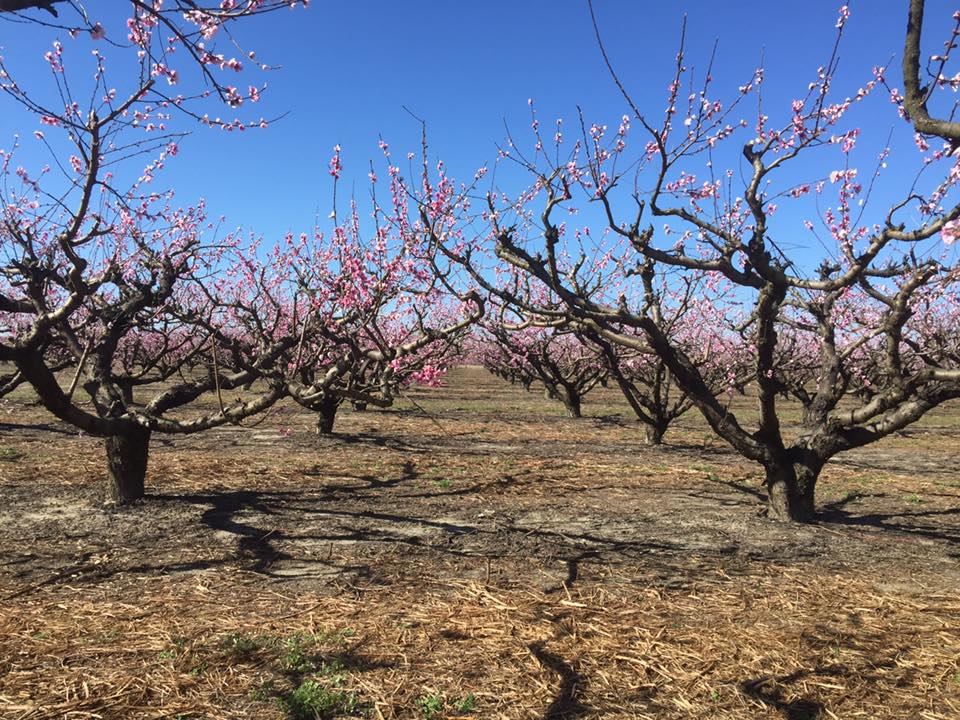
Peach blossoms up on the Ridge Photos by Gary Dexter.

Before you know it, May will be here, and the roadside stands and farmers markets will be flocked with customers eager to taste the first fruits of the season.

Peaches at a roadside stand up on the Ridge. Photo by Gary Dexter.

_____________________

Contributor Burt Glover became an accidental naturalist during his earliest childhood days exploring the dirt roads, backyards, polo field and barns of the Magnolia-Knox-Mead neighborhood of 1950s Aiken. Birds are his first love, and he can identify an impressive range by song alone. He asserts that he is an observer, not an expert, on the topics of his writings, which range from birds, box turtles, frogs and foraging, to wasps, weeds, weather and beyond.

Read More

Nature: Peaches Preceded Humans: Fossil Evidence from SW China
Smithsonian Magazine: The Fuzzy History of the Georgia Peach
National Park Service: How a Navajo Scientist is Helping to Restore Traditional Peach Horticulture

Aiken County’s Competitive Rowing Investments

Aiken County has spent millions of dollars redeveloping Langley Pond Park in the past five years. More than $2 million has been spent on competitive rowing infrastructure, where teams from mostly across the Southeast currently converge twice a year for regattas.

The investments have been made for economic reasons, to attract competitive rowing clubs, but not for local participation. Opportunities for County residents are not a priority. There is no competitive rowing program available in the Aiken County Public Schools; last year’s regattas did not feature a single team from Aiken County.

The County’s effort to attract spectators also lags. This week’s Augusta Invitational, which will close the pond to other users, was not publicized on any of the County’s social media pages until two days before the event.

by Don Moniak
March 7, 2024 (Updated March 8, 2024)

Aiken County’s Langley Pond Park is ideally suited for the challenging and rewarding Olympic-level sport of competitive rowing; the U.S. Olympic team trained there in preparation for the 1996 Summer Olympics in Atlanta.

It is also an exacting sport, one of the few that requires continuous feedback and coaching.  Teams have to operate in near perfect coordination.  Unlike in football where a missed block or tackle can be of little to no consequence, a single errant or missed stroke in a scull can easily change the results from being a medal contender to a mediocre finish.

The 285-acre pond’s 2,000-meter eight-lane race course was the venue for two annual regional rowing regattas prior to 2014. These events were placed on hold for nine years when the old Langley Pond Dam was found to be leaking, and unstable enough to warrant spending $13.5 million to replace the it, a process that closed the pond to public use for eight years (1).

The two regattas returned in 2023. This Saturday, March 9th, the Park will host the one-day Augusta Invitational Regatta. Another regatta, the two-day Master’s Southeast Regional, is scheduled for June 22-23rd.

Organized by the Augusta Rowing Club, the Invitational has 91 entries across 19 different events. At least 88 of these entries belong to five out-of-state clubs based in Peachtree City, Charlotte, Asheville, and two in Knoxville, TN. The Augusta Rowing Club represents the local rowing community; three other entries are listed as unaffiliated and from “anywhere U.S.A.”

This is a relatively small event. By comparison, the 2023 U.S. Rowing Youth National Championships held in Sarasota, Florida, drew 835 entries from 225 clubs; the 2022 Head of the Hooch in Chattanooga, TN, drew 2,037 entries from 171 clubs.

Aiken County has failed to publicize Saturday’s regatta in any meaningful fashion. The first notice on the County’s Langley Pond Facebook page was not posted until two days before the event. No notice is on the County’s home page or Facebook page. An answering machine greeted two efforts on Thursday to call the Parks, Recreation, and Tourism office for more information. There was no return call.

The $1.15 million Langley Pond Finishing Line Tower. The photo, taken from the Aiken County property database, was taken in June 2020, while the pond was still drawn down during the replacement dam construction.


The County’s Investments

Even before the new dam was completed, Aiken County officials were investing heavily (Table 1) in competitive rowing infrastructure in the hopes of drawing larger, more prominent tournaments. Since 2018–even before the new Langley Dam project was completed—the County has constructed a Finishing Line Tower (Figure 1), added anchor piles for the race course, installed a launch dock, and plans a 30-foot x 120-foot spectator dock.

Table 1: Recent Aiken County Langley Pond Rowing Venue Investments

DevelopmentBid Award Contractor Award Year
Finishing Line Driveway $33,420J.D. 2018
Finishing Line Tower*$1,151,580J.E. Stewart (Aiken) 2019
Course Anchors$77,650J.D. Gaskins (Aiken) 2020
Spectator Dock**$398,250Rowing America (Connecticut2023
Starting Docks**$225,720Rowing America (CT) 2023
Catamaran DocksCancelled
Total Costs***$1,886,620
Links are to procurement documents.
*The first procurement process in 2017 was cancelled “due to budget constraints.”
**Lowest Bid, only listed as recommended pending Council approval. The final award price is not listed on the county’s procurement webpage, and officials have yet to respond to questions about the final bid awards.
*** Total costs are for construction only, and do not include design and procurement costs

The ribbon cutting for the starting docks (Figure 2), whose installation this year closed the pond to public use for two weeks, is scheduled for this Friday at 3 p.m. The only visible notification of it was on County Council’s March 5th Work Session Agenda, titled “Ribbon Cutting for Fishing Docks.” (2)

Figure 2: Visual of Starting Line Docks at augustarowing.org website. The Finishing Line Tower is on the left-hand side at the top of the photo, 2,000 meters away.


Economic Impact, Not Local Participation

The impetus for these investments has always been the potential economic impact. In 2013, one county official claimed there was an “incredible economic impact” from two regattas that collectively drew a few hundred participants. “Exposure for the county” was another often cited rationale for investments in rowing infrastructure, which officials hoped would bring “2,000 or more” rowers to future events. These and other unsubstantiated claims were repeated without question by local media.

According to a 2016 Aiken Standard story, County officials claimed an estimated annual loss of revenues to County businesses of $2.4 million; and a speculated potential economic impact loss of $1.8 million from the loss of a single regatta. Those estimates were based on “direct visitor spending, which factors in the number of athletes and spectators attending Langley Pond events and the hotel rooms in which they would have stayed.”

However, multiplying the number of athletes and spectators by spending estimates does not equal revenues for only Aiken County businesses. For example, the Augusta Rowing Club’s website lists only two Augusta hotels offering group discount rates for this Saturday’s Regatta: the Marriot Crown Hotel on Stevens Creek Road and the Holiday Inn Express on Broad Street. The Rowing Club’s website has no link to Aiken attractions, restaurants, or hotels. (3)

The numbers are also suspect given the size of the events. By comparison, in 2021 the Aiken Standard reported that Hitchcock Woods Foundation Treasurer Larry Byers told a legislative Equine Industries Study Committee that the cancellation of the 2020 Aiken Steeplechase, considered to be the second largest annual sporting event in the CSRA, resulted in loss of “roughly $3.8 million.”

In contrast to its large and continued investment for economic impact, the County has invested minimally, if at all, in the development of local programs. Aiken County’s Public Schools have no current rowing programs or plans for any (4), even though the County’s 2014-2024 Comprehensive Plan called for collaborative parks and recreation projects with the Schools:

PRT may also wish to explore entering into agreements with the Aiken County Public School District for joint use of the District’s sports, playground, and recreational facilities.” (Page 107).

The potential for local programs at the Langley Pond rowing venue is considerable. This past Tuesday night, Aiken County Administrator Brian Sanders told Aiken County Council that the end result of the ongoing improvements will be a “world-class” rowing venue.

Yet, the spending to date has largely subsidized out-of-town rowing clubs and college teams; while offering little to County residents and failing to fund any development of homegrown talent.

At present, Langley Pond rowing is perhaps symbolic of local government, where taxpayers are more often mere spectators in decision-making processes. In this case, in the hopes of “incredible” economic impacts, the County has gambled $2 million of taxpayer money. Meanwhile, county residents are barely notified they can watch from the shore, and no consideration is given to investing in rowing equipment that could be shared by Aiken County’s public schools.

To add to the disparities, while millions are invested in the Langley Pond rowing race course, smaller County parks are neglected, and some are even scheduled to be closed (5).

Soon to come: Aiken County’s Disposable Parks.


Footnotes

(1) Aiken County took ownership, and the associated liability, of the Langley Pond Dam in 1994. In 2010, a SC Department of Health and Environmental Control (DHEC) dam inspector returned a “satisfactory” rating.

In 2012, DHEC reported cracks in the abutment/inlet structure and advised monitoring it and a crack in the ring wing wall at the emergency spillway; clearing trees adjacent to the spillway, and removing vegetation from the slopes.

In 2014, a man walking his dog observed discolored water seeping from the dam; and a leak was found indicating unstable conditions.

In 2015, the regatta events were cancelled.

In 2016, County Council approved a $12 million general obligation bond to replace the dam; and obtained a $2 million FEMA grant.

The project was completed in January 2021. One year later the redeveloped Park was dedicated.

(2) There are no “fishing docks” listed on the County’s procurement webpage. Inquiries made this week about “fishing docks” vs rowing ducks have so far been ignored by County officials.

(3) The County’s Langley Pond website has a link to Country Inn and Suites on Whiskey Road, but the link was inoperative this week.

(4) An inquiry to the Aiken School District, and response from the School District:


(5) At its March 5, 2024 County Council meeting, Council refused to require staff to answer the question as to how many parks, and which parks, are scheduled to be closed. The question was deferred to staff for a future answer. There has been no answer to a subsequent March 6th followup email asking if there is an implementation plan for divesting of parks and a list of parks scheduled to be closed.

The current Capital Project Sales Tax proposed project list only considers funding the facility needs for four parks (Roy Warner, Harrison-Caver, Langley Pond, and Boyd Pond).