Sixty-eight trees are slated for destruction in a plan devised without opportunity for public input on the fate of this historic park.
After thirteen months of asking, the City finally answered the question via email on Friday afternoon, January 12: sixty-eight. That’s how many trees the City of Aiken plans to destroy in a project intended to improve the parklands at the five-acre Smith Hazel Recreation Centerin the historic Schofield neighborhood.
Two weeks later, on Friday, January 26, another answer arrived, this time via the local newspaper: No, the City is not going to hold a public hearing to give Smith Hazel neighborhood residents, park-goers, and the larger community opportunity to provide input on the future of the Smith Hazel park and its trees.
ABOVE: From the Aiken Standard newspaper, January 26, 2024
The largest among the Smith Hazel trees once shaded the grounds of the Aiken Graded School that formerly stood here — a school built in 1924 by contractor W.M. McGhee on 8 acres of land purchased by the hard work and effort of Aiken’s Black community of that era, including Messrs. W.M. McGhee, A.B. McGhee, George Ball, and Dr. C.C Johnson; a school where Mrs. Josie Smith Hazel once taught; a school that, despite the efforts of the northside community to save it, was closed in 1969, the year the Aiken schools integrated, and 1demolished by the City in 1973, as it was deemed too expensive to maintain. This history and these trees are part and parcel of this place.
A historic marker for the Aiken Graded School located at the northwest corner of the Smith Hazel Park.
And it’s not just the grand trees that matter. All of the trees matter; all are integral to the lovely, natural, parkland setting and the quality experience of this park.
April 2023 views of Smith Hazel. The ribbons on dozens of the trees, as was later learned, were intended to tag trees to be spared from demolition.
The decisions on each and every tree have deserved thoughtful consideration and our best efforts to preserve them where possible. This is why Smith Hazel park-goers and neighborhood residents spent the past thirteen months asking questions about the fate of the trees and pushing the City to allow them input. These citizens deserved, above all, the opportunity for at least one public hearing over the past thirteen months, so that they could help steer the course of Smith Hazel’s future. In the end, however, the fate of the park and its trees was seemingly decided by fiat.
How did we get here?
Below is an attempt to answer that question through a compilation of information gathered piecemeal over the past 13 months. The following is broken down into three sections — an overview, a timeline, and a list of points for further thought. Each section is expandable to allow for an optional, abridged account. This article will likely be updated as more information becomes known.
FAQs
What is the project? Smith Hazel is slated for improvements to the indoor and outdoor facilities at the center. This article will address only the outdoor improvements, which include:
The demolition and replacement of the two existing tennis courts.
The demolition and replacement of the playground equipment and the addition of artificial turf.
The closure of the existing basketball court to be replaced with two new basketball courts.
The addition of a second picnic shelter.
The resurfacing and rerouting of the existing 1/4 mile walking trail.
So far, so good. It would appear that, with the exception of the second basketball court and the second picnic shelter, the footprint of the improved park would be similar to the footprint of the existing park.
So why are 68 trees slated to be removed? A few explanations have been heard piecemeal over the months and been repeated anecdotally, including (1) that areas of the park will essentially be bulldozed to provide “clear lines of sight” for security reasons, and, (2) that the sloping elevations of the existing walking track is not ADA compliant, so the terrain will have to be leveled, requiring regrading of the earth and the removal of many trees.
Who is funding this project? The funding came from a Land and Water Conservation Fund (LWCF) grant awarded to the City in October 2022. The City matched this with Capital Project Sales Tax IV funds, bringing the total money for the project to $900k.
What is being funded? This particular grant is for outdoor recreation area only. No indoor work. The terms of the grant provide for, specifically, the replacement of existing amenities. For example, it will replace the two old tennis courts with two new tennis courts. It will replace the old playground with a new playground. Artificial turf is being added to the playground which will compound drainage and stormwater issues at the park. This is only one of a number of topics suited for a public hearing.
Why, then, are two basketball courts being installed to replace the one existing basketball court? The City was reportedly able to secure additional funding to install a second basketball court as part of this project.
Why is the baskeball court being relocated from its existing spot? As is the case with some other parks in Aiken, parts of the Smith Hazel property are located on SCDOT right of way land. The existing basketball court is in the SCDOT right of way. The LWCF grant can only be done on City property, which means the basketball court must be relocated to another part of the park.
What will happen to the existing basketball court? This area will be incorporated into the creation of approximately 40 parking spaces that are planned for a future project.
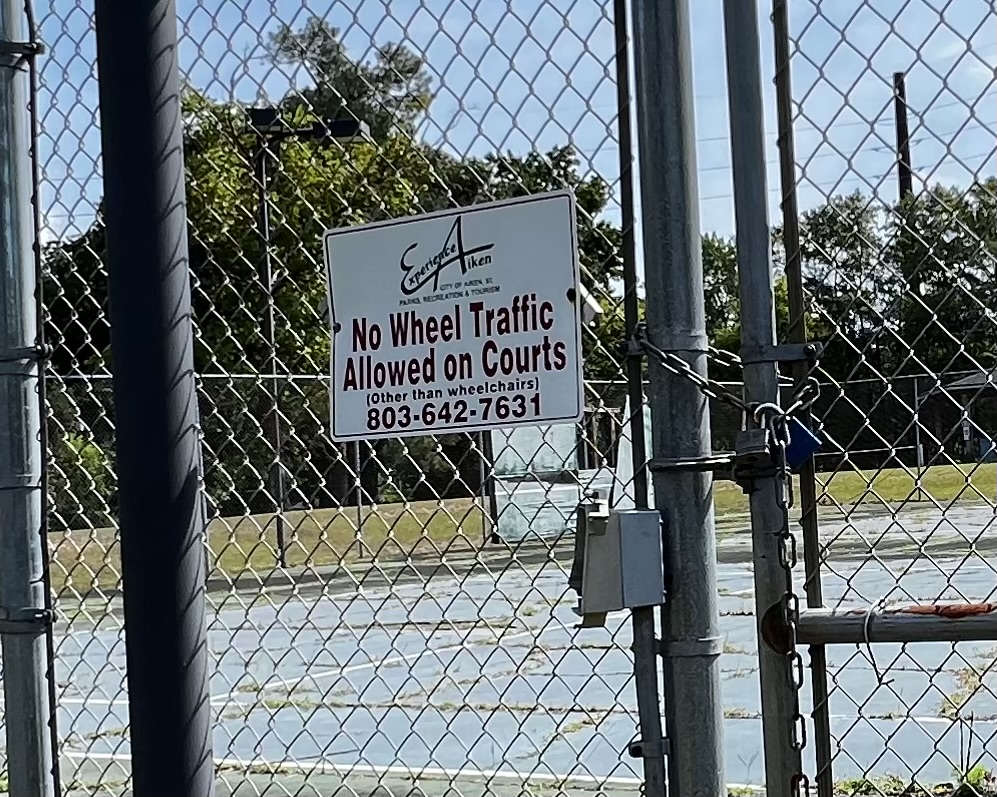
Why are the tennis courts being replaced when no one ever uses them? For those unfamiliar with this park, the tennis courts were formerly used, but have been padlocked for years and off-limits to the public due to their hazardous condition from years of disinvestment by the City of Aiken in the Smith Hazel Recreation Center.
The tennis courts at Smith Hazel have been padlocked for years.
What will happen with the existing 1/4 mile walking track? The plan is to reconfigure the track to be ADA compliant. As was learned by those who attended the September 21, 2023 monthly meeting of the Schofield Community Association, the sloping terrain prevents the track from being ADA compliant. Leveling the elevation — which will require earth-moving equipment and the removal of a large number of trees — is seen as necessary to making an ADA compliant track on the 5-acre Smith Hazel park. Were other alternatives considered? Could a future, second walking track be created across the street at the 25-acre Perry Memorial Park? The potential is there for an even longer track. Might this be preferable to destroying the historic, Smith Hazel parkland to make it ADA compliant? A public hearing with public input could have integrated such questions, ideas and potential solutions into the process.
TIMELINE: December 2022 through January 2024
December 8, 2022 A meeting had been called by the City of Aiken at the Smith Hazel Recreation Center. This was described as a “public input meeting for local community residents to review Smith-Hazel Park design options.” Attendees arrived believing they would be providing input on the newly-announced, outdoor improvement project which was set to begin within just a few months. The presentation was given by Aiken Parks, Recreation and Tourism Director, Jessica Campbell.
As the meeting progressed, it became clear that input was not actually being sought for this project, or “phase one,” as it was being termed, but for other, future projects. At approximately minute 18:00 of the meeting, (per a citizen-recorded audio of the meeting) a citizen spoke up and asked Ms .Campbell if the citizen input being solicited by the City was for the current project or for future projects. Ms. Campbell confirmed that the input was for projects “down the road.” She said, “The idea is to have a concept plan for future development.”
In other words, the concept plan for the current project (below) had already been drawn up by Cranston Engineering, and there was no public input sought either before or after this plan was drawn.
ABOVE: A photo of the concept plan for the present-day project, which was posted at the December 8, 2022 meeting. In a peculiar twist of plot, attendees were not asked for input on the current project, as seen in the above drawing but, rather, were being asked for feedback on potential projects down the road.
Citizens had been called together to comment on ideas for potential future projects, illustrated by Option A and Option B.
ABOVE: Photos of the other two drawings present in the December 8, 2022 meeting. The public had been brought together to vote on Option A or B, not to give input on plans for the current project.
When asked if any trees would be disturbed by the project, Jessica Campbell stated that they did not yet know, as the final course of the walking track hadn’t yet been determined.
April 2023 After citizens observed ribbons on dozens of the trees in the Smith Hazel park, Aaron Campbell, the City horticulturist, was contacted. He stated his shared concern to spare as many trees as possible during the project. He stated his belief that the tagged trees were those NOT be cut. He assured the caller that there would be opportunity for public input on the trees before any action was taken.
April 10, 2023 Two citizens spoke at the regular City Council meeting about the trees at Smith Hazel and wondered if the ribbons were intended to mark the trees slated for removal. According to the minutes of the non-agenda comment period, Laura Lance, “noted that she understood that the matter would be before Council at some future date where the public would have an opportunity to talk about removal of the trees. She pointed out the importance of the tree canopy in Aiken. She asked when there would be opportunity for the public to know what is going to happen and have some input.”
PRT Director Jessica Campbell, also present at the meeting, responded that the flags were for the trees not to be removed. According to the minutes, Ms. Campbell, “pointed out that those trees marked have been identified as substantial, high importance, high-priority to remain as is. she said the trees that are marked so the engineers can look and make sure the footprint of the amenities that are to be placed on the property fit within the landscape and does not create the removal of any of those marked trees.”
September 11, 2023 City Council held a work session on September 11, 2023, during which the topic of tree removals went undiscussed. There were, however, two items in the agenda package pertinent to the trees.
ABOVE: The two agenda items pertinent to the Smith Hazel outdoor improvement project. At this time, the precise number of inches of trees slated for removal was known, yet the number of trees slated for removal could not be given.
During the regular City Council meeting following the work session, Luis Rinaldini spoke to City Council about the above agenda items and on need for clarification on the matter of the trees:
“I would just like to comment on the agenda item that was included in the work session regarding the Smith Hazel renovation. It has a map and it has a page… referring to trees being cut down. But it really doesn’t give a lot of information. The information it gives us is confusing. There are something like 500 inches worth of trees, I’m not sure how that’s measured and what it means And 230 inches to be removed, which sounds like, to the uninformed person, that half of the trees in that area are going to be to be cut down. So I think that, rather than just let it sit at that, we ought to get clarification and get a map that shows what trees are being affected, and why. Because, as you know, we’ve had some not great situations with trees, And I think it’s important that we change the way we look at those things, and we change the way, we approach things, reducing the number of trees that get cut down in our activities.”
Bill McGee also spoke at this meeting. Referring to earlier mention in the meeting that some trees would have to be removed at Smith Hazel, Mr. McGhee stated that they (the SCA, or Schofield Community Association) have requested the City to come to the next SCA meeting on September 21, 2023 to discuss with the community the plans and exterior of Smith Hazel. He said he hoped the tree issue would be included in the presentation.
September 21, 2023 Attendees at the SCA’s regular monthly meeting received, from Mary Catherine Lawton,* Capital Projects Manager, what may have been the most comprehensive explanation by the City through the entire 13 months on the Smith Hazel park project. Even at this, the specifics on the numbers and locations of trees slated for destruction were not given. A video of this meeting can be viewed here, with the discussion on the outdoor improvements beginning at minute 22:35, starting with a citizen question on the any public input that went into the project. The answer provided Ms. Lawton was not quite clear.
*Correction: an earlier version of this story incorrectly identified the Assistant City Manager as the speaker at this event.
November 27, 2023 Bill McGhee, president of the Schofield Community Association, wrote to the City horticulturist, Aaron Campbell, requesting “a walkthrough of the plans for the trees involved in the project.”
December 5, 2023 Aaron Campbell responded to Mr. McGhee via email at 8:49 a.m. saying, “We are available to meet today at 1pm or Friday, December 22nd at 1pm.”
December 9, 2023 Bill McGhee sent notice that a meeting had been arranged with Aaron Campbell for Dec 22 “to have a SCA group review the exterior SH renovation plans and the status of the surrounding trees.”
December 12, 2023 Notices of the upcoming meeting were posted at the Aiken Chronicles and on social media including the Do It Right and Schofield Community Association Facebook pages.
Notice posted at the SCA webste on December 12 for the Dec. 22 walk-through at Smith Hazel.
December 14, 2023 Beatrice McGhee emailed notice of the meeting to the SCA membership
December 22, 2023 The meeting convened with over a dozen in attendance. Landscape architect Lance Cheeley, with Cranston Engineering, was in attendance and indicated, without further specifics, the plan to remove “many trees” including two significant pine trees and one significant oak. There was no actual walk-through, however, nor tagging of the trees, nor identification or total numbers of the trees slated for removal. There was reportedly discussion among some attendees that a factor in the tree removal was the need for a “clear line of site” for security purposes.
December 26, 2023 Bill McGhee emailed a recap of “The Smith Hazel Tree Walk-through” to the SCA membership, with this update on the trees:
“The draft RFP includes the removal of two ‘significant” pine trees, one ‘significant’ oak, and many other non-significant trees. No trees were tagged. The many trees to be removed were not specifically identified. It was stated that the tree removal and replacement plan complied with the city’s landscape/tree maintenance policies.
January 8, 2024 Bill McGhee emailed Aaron Campbell requesting a copy of the City’s tree inventory of the Smith Hazel trees to review for discussion.
January 10, 2024 Aaron Campbell responded that he could not give this information.
January 12, 2024 (Friday at 3:20 p.m.) Aaron Campbell emailed Bill McGhee a pdf (see image below) of the Cranston’s “Tree Removal Exhibit” for the park, with the following note: “Attached is the plan from Cranston engineering showing what trees are slated for removal. Please let me know if you have any further questions.”
TOP: The Cranston Engineering “Tree Removal Exhibit” dated November 10, 2023. BELOW: The total number of trees to be removed.
A total of 68 trees are slated to be removed according to the Cranston drawing. This drawing is dated November 10, 2023. The drawing was only emailed to Mr. Bill McGhee on January 12, 2023. This was the first time that the City divulged the total number of trees to be destroyed.
January 15, 2024: (Monday holiday, Martin Luther King Day)
January 16, 2024: — Bill McGee left a message with Aaron Campbell to give him a call. Mr. McGhee’s call was never retuned. — Bill McGhee put out a notice urging attendance at the 5:30 p.m. meeting that evening of the City Recreation Commission on Banks Mill Road. A total of six SCA member/tree preservation advocates attended: Bill McGhee, Linda Johnston, John Howard, Lee Doran Thornton, Lisa Smith, and Laura Lance. All gave their perspectives on this project regarding the shocking number of trees slated for removal and the frustration over the lack of public participation in the process. A public hearing was requested. The Recreation Commission respectfully listened and responded by making and approving two motions: (1) to recommend to City Council that a public hearing be held to allow for public input on the Smith Hazel trees, and (2) that ribbons be attached to the trees slated for removal so that the City, SCA and all interested parties could see what is planned for the park. — At 10:43 p.m. that night, local park advocates began a social media campaign to “pause the project.” Public interest and comment was robust.
January 25,2024 Bill McGhee submitted a FOIA request for a listing, from the City’s tree inventory, of the type of grand and significant trees slated for removal at Smith Hazel and the dollar value assigned to each tree.
January 26, 2024 The local newspaper announced online that the Smith Hazel project is going to go forward without “more” public input, stating:
“The City of Aiken doesn’t intend to pause plans to make long-awaited upgrades to the Smith-Hazel Recreation Center, despite a community group and city board asking for a brief stoppage to have more public input on the project.”
POINTS FOR FURTHER DISCUSSION
— Why is the City using the term, “more public input”? Given that the City has provided no opportunity for public hearing for public input on this project, the word “more” isn’t applicable.
— Cranston Engineering had already drawn the concept plans for the this project before the December 8, 2022 meeting. Why was there no public hearing for public input on this plan either before or after the plan was drawn up?
— Why was the public given opportunity during this same December 8, 20220 meeting for input on hypothetical future plans for future projects of the park, but none for the current project, as shown in Cranston’s concept plan?
— Why were dozens of trees at Smith Hazel tagged with different color ribbons in April 2023? Who decided which trees would be tagged to be spared and which would be destroyed? And by what criteria? Does this mean that the City knew as far back as April 2023 how many trees would be destroyed? Why wasn’t the public included in at this stage of planning?
— Why did the city refuse the recent requests by citizens and the recommendation by the Recreation Commission in the wake of January 16th 2024 meeting to have to have the trees marked with ribbons to show the public and the city the trees slated for destruction?
— Why did the City Council not discuss the number of trees slated for destruction in its September 11, 2023 work session? And why didn’t the City take the opportunity of Mr. Rinaldini’s call for clarification in the City Council meeting that night to state how many trees will be removed?
— Why did the City hold a work session, (which only allows the public to attend as spectators), rather than a public hearing on September 11 to accommodate public input in the discussions?
— Were alternate plans considered to reduce the destruction of trees, and, if so, what were these plans and where is a record of them?
— Why did the City — knowing how important this topic was to advocates for our City’s parks and the trees — repeatedly fail to provide the requested information on the trees for all these months?
In Closing
One marked similarity in the Williamsburg Street and Smith Hazel stories is the lack of a public hearing for pubic input on a project that would radically change a public parkland. Another is the stealth manner in which the demolition of trees was planned and kept from the pubic. A less obvious similarity is what almost appears to be the staging of a felled, hollowed tree, as if this might justify the destruction of all.
An important difference in the two stories is that is that the destruction of the 11 trees on Williamsburg cannot be undone today. The planned destruction of 68 trees at Smith Hazel can and should be undone.
The issue at hand is not about being pro or anti-progress. Nor is it about an inability or refusal to acknowledge that reality that trees sometimes need to be removed in the course of development. No, this issue is about the need to follow good faith governance and established processes. Those among us advocating for our trees and our parks are merely asking that processes be followed, and that these processes be open, transparent, fair, lawful, and available to all.
Visible in the distance is a walker on the Smith Hazel walking track.
1Correction: The date of the Aiken Graded School demolition was incorrectly given as 1969 in an earlier version. This has been correct to reflect the school was closed in 1969, the year the Aiken schools integrated. The school as then demolished in 1973.