The first time I saw a painted bunting was in the mid-1980s while tagging along with my brother, who was birdwatching in some fields and woods adjacent to his home near Wagner, SC. The sighting was actually more of a glimpse than a look, as the bird — first detected by my brother through its song — disappeared as quickly as it appeared in a flash of color flown from one leafy canopy to another.
The second time I saw a painted bunting was thirty years later, in 2016. Looking out the window one April morning, I saw something curious and said. “Why does that bird have a green leaf stuck to its back?”
Looking through the binoculars I saw that it wasn’t a leaf, but a brilliant patch of lime-colored feathers on the most fantastically colored bird I’d ever seen. “A painted bunting!” I exclaimed. I quickly took photos to document the sighting. These, below, were the least blurry of the batch.
I shared the photos with my brother and fellow birdwatching friends who urged me to keep my eyes peeled for the female, who should arrive any day. Sure enough, she arrived a week later — a small parrot-green bird with breast feathers in shades of yellow and peach that, at times, seemed to emanate a light, like a sunrise.
Since then, the painted buntings have returned every year. They have also increased in numbers. In 2018, two pairs came to the feeders. More arrived in subsequent years. I could never completely confirm the numbers. They are quick little birds and quick to flit away at the slightest disturbance. There were enough of the birds, tho, that I began referring to them as a colony of painted buntings.
This year, I finally confirmed a total of five males. How did I do this? I spent the first week or so after their arrival studying the birds, trying to memorize the color variations and subtle shape differences of each bird. Some are roundish, others more sleek and elongated; some have vivid red breasts, and others tend toward orange; the color patches on different birds vary in size and shape. No two painted buntings are alike! Through observing, I’d already determined that we had at least four different males, but I suspected more. Then one day, the implausible happened. All five males arrived to the feeding area at once, confirming my suspicions. The photo below, taken by iPad, doesn’t prove the existence of one, much less five painted buntings, but I post it here to preserve the moment.
Each spring, the first male painted buntings arrive like clockwork around April 14-16. One to three weeks later the first female arrives. The birds are always famished on arrival and spend long, long spells at the feeders. This is the only time I’ve seen them refuse to budge when other birds approach the feeder or try to bully them away.
So where is the mystery? It happens sometime in July. The buntings disappear entirely from the feeders. Each time this has happened, including this year, I’ve been alarmed and saddened, thinking something must have happened to the birds. And each time, including this year, the buntings reappeared to the feeders in late August or early September. The only difference this year is that I’ve slowed down enough to give the matter some thought, record their return on the calendar, and do a bit of research.
I don’t have a definitive answer to the mystery, just a pretty good idea, courtesy of several sources, including the Cornell University Lab of Ornithology site. As it turns out, painted buntings spend most of the year eating seeds from the fields, marshes and, as available, bird-feeders. During breeding season, however, they switch to spiders and insects such as caterpillars, wasps, flies, grasshoppers, weevils and beetles, which they feed to their young. During breeding season, they also tend to forage higher in the trees, sometimes 30 feet off the ground.
When the buntings returned to the feeders this year in early September, they were in full molt, looking disheveled and moth-eaten. Their feathers have since mostly come in, and the males are back to vividly colored perfection. Soon, they’ll be ready to make their return to Cuba and other points south where they’ll spend the winter.
The females and young have been all but absent this year. I do remain a little concerned, especially since a wave of avian pox swept through in mid-summer, forcing me to take the feeders down for two weeks. I’ve decided that, rather than worry over their plight, I’ll assume this to be another mystery that might be solved one year.
For now, I know that the original five males appear to have survived the summer, including the one with the dangling, deformed leg, who has been here for two summers now, answering the question, “Do the same birds return every year?” It appears they may.
The downtown “Mixed Use” building feasibility report: Weak cost estimates, data free analysis, and continued use of public relations criteria in site selection. Is this a VIP Entertainment Center or a Workplace Development Center? And where is the lab?
by Don Moniak September 14, 2023
The long overdue downtown Savannah River National Laboratory (SRNL) office building project (1) draft feasibility study was released this week, just two days prior to the project’s first “public input session” in seven months. Nine months in the making, the underwhelming report has the hallmarks of a few people casually sitting around an office one afternoon generating a list of evaluation criteria and project pros and cons.
The report was released just two months after great uncertainty over SRNL’s role in, and commitment to, the project emerged. The draft feasibility study does little to quell that uncertainty, at different points referring to a “proposed office tenant,” “prospective tenant,” or “future tenant.”
The acronym SRNL is actually absent from the report, replaced by the vague category of “Mixed-Use” that was first adopted four months ago.
“At the time (late 2022), the Aiken Corporation was attempting to attract a $20 million investment in the form of a grant from the PU Settlement Fund from the South Carolina General Assembly.” (2)
The now defunct Aiken Municipal Development Commission (AMDC) courted SRNL officials for the first half of 2022, in anticipation of a $20 million allocation for which the AMDC itself had originally lobbied.
The $20 million for “SRS/National Laboratory Offsite Infrastructure” was allocated in mid-2022 by the General Assembly.
The AMDC and SRNL had agreed to a proposed, never-disclosed location by June 2022.
Aiken Corporation’s late 2022 involvement consisted of being contacted by the City of Aiken “with the goal of having the Developer (Aiken Corporation) engage various experts to perform certain services.”
The City of Aiken did not approve its $250,000, no-bid “pre-development” contract with the Aiken Corporation until March 13, 2023. At this time, the Aiken Corporation remains a “pre-development” contractor.
With that kind of pat-oneself-on-the-back opening, profound insights should be unexpected, and the report does not disappoint.
A Convenient Cost Estimate
Among the underwhelming findings is a “rough order of magnitude cost estimate” of precisely $20 million and zero cents ($20,000,000.00). The breakdown of costs also remains nearly identical to the City’s January 2023 estimate, with two notable exceptions:
The construction cost estimate for a 36,000 square foot building are $1.2 million higher than for a 45,000 square foot building.
Contingency cost estimates are reduced from nearly 15% ($2.7 million) to only five percent ($1.0 million).
Deficiencies and Inconsistencies
The study purports to have evaluated five locations for locating the facility. The cost options are identical for each option.
At least one notable deficiency exists for each alternative, and, looked at across the board, inconsistency reigns:
The former Public Safety building on North Laurens Street, which is a two-minute walk from the business district, and directly across from the very busy downtown Post Office, is considered to have “limited pedestrian activity.”
The Chesterfield Street option adjacent to the new Municipal Building is said to have “no opportunity for green space,” despite being across the street from one of Aiken’s revered tree-lined Parkways.
The Newberry Street option, located on vacant lots purchased by Aiken Corporation in July, 2022, has as a negative “adjacent to existing residential uses,” although the same can be said of every site but the Pascalis properties.
At the Pascalis properties site on Richland Avenue, a “Courtyard/Plaza (that) adds green space,” is identified as a benefit, although the area in question is the small dead-end alley between the McGhee Building and Warneke Cleaners.
The Old Hospital site at 828 Richland Avenue, which has the most existing green space, received no credit for that green space. Ironically, the project’s main authors, McMillan Pazden and Smith (MPS), was the design firm hired by WTC Investments in 2019 to help with a failed effort to redevelop that property. MPS, which had no qualms about demolishing and clearcutting the entirety of the 828 Richland Avenue property four years ago, has since taken a liking to the mature trees there and does not identify the absence of demolition requirements as a site advantage. (3)
Corporate Entertainment Criteria or Workforce Development Criteria?
Key criteria identical to those leading to the original Pascalis properties siting decision, none of which are cost-related, appear to continue to disproportionately drive the current evaluation. These criteria are best summarized as “visibility” and “accessibility to downtown.”
During the January 23, 2023, State of the City Address where the project announcement was made, SRNL Director Dr. Victor Majidi emphasized that visibility was “most important:”
“Most importantly this building is the community face of the laboratory…This building…brings the Savannah River National Laboratory into the heart of the Aiken community.”
During a subsequent February 6th public forum (the only one to date), MPS moderator K.J. Jacobs described the site selection process:
“The national lab folks were very interested in a site with a high degree of visibility…they wanted to be at sort of the Main and Main Street location in Aiken so that they could have maximum visibility. They want to be a part of the community. They want their folks to be able to leverage walking downtown easily and being able to go eat in a restaurant.
Walkability was important and and their interest in having access to amenities in downtown…the other part of that is the Amentum theater and ideally having close proximity to that. Just like Newberry Hall, there’s no point going and creating a bunch of catering facilities if you have the opportunity to leverage existing relationships next door.
So those (criteria) were the framework around the decision to focus on this site. As you all know the City of Aiken controls this site so putting that criteria together with this site has led us to this conversation.”
These non-cost factors of walkability, visibility, and accessibility remain driving factors for site selection, and the two obvious throw-in alternatives, the Old Hospital and former Public Safety Building sites, both received negative reviews for these non-cost criteria.
Visibility is obviously a public relations factor. DOE contracts contain a standard provision titled “Community Commitment,” which can be summed up as “maintain a positive image” and “win hearts and minds.” The looming presence of a seemingly benign science laboratory office headquarters in downtown Aiken will certainly help provide a positive filter to offset the glare of expanded nuclear weapons materials production at the Savannah River Site, as well as the fact that the heavily contaminated 310 square-mile area will remain off-limits to public use for the foreseeable future.
The inherent cynicism of the other two non-cost criteria—walkability and accessiblity—is symbolized by one feature in the “Conceptual Building Floor Plans: the third floor’s “Covered Terrace.”
This rooftop terrace concept was first identified in the scope of work in the Aiken Corporation’s March 13, 2023 contract:
“There is a desire for a rooftop gathering and event space.”
A common refrain justifying the “nearby amenities and dining” argument is that the lab is just wanting to treat its workers well.
This workplace environment chorus is a ruse. The Department of Energy no longer even provides a cafeteria for well over one-thousand lab employees at its worn down, seventy-year old lab complex. Many employees remain in mobile offices, as if they are working on a temporary construction site.
The idea that DOE/SRNL and its operating contractor Battelle Savannah River Alliance (BSRA) might be locating fewer than ten percent of the lab’s workforce amidst the amenities of downtown Aiken as a means of workplace betterment is comical on its face.
The desire for nearby amenities and a rooftop gathering place clearly have a more utilitarian purpose: wowing visiting University system dignitaries, colleagues from other National Laboratories, technology transfer partners, and any other number of professional and political luminaries. Meetings following a long day of nuclear nonproliferation training or nuclear weapon-parts simulations can end with a trip to unwind on the rooftop terrace or a walk to the nearest fine dining establishment. The opportunities for photo-ops that will further enhance the image of the lab and thus SRS will be plentiful.
By all indications to date, the SRNL offsite office complex building is being designed more for a combination of public relations, image enhancement, and an entertainment center for DOE’s corporate contractors, and much less for the more tedious task of workforce development. Thus, $20 million of plutonium settlement funds resulting from the Department of Energy’s bureaucratic incompetence and misleading promises is likely being put to the cabinet agency’s use to enhance its own image and those of its nuclear weapons production and cleanup contractors.
That is, if DOE/SNRL is even interested.
Conceptual Plan for Third Floor of the “Mixed Use” Building. “Covered Terrace” is to the right. “Mixed Use Facility” Site Alternatives. Walking Distance is from Laurens Street and Richland Avenue. This approach discounts the presence of shops and restaurants on North Laurens and West Richland, as well as proximity of Old County Hospital Site to Rose Hill Estate. This map contains the only site selection data set in the report, an indication that “walkability” is more important than cost.
Footnotes
(1). During the January 23, 2023 State of the City address, Aiken City Councilman and Mayor Pro Tem Ed Woltz announced a proposal to construct a $20 million “Workforce Development Center” on behalf of the Department of Energy’s (DOE) Savannah River National Laboratory (SRNL) in downtown Aiken.
Project funding is from the $20 million allocation from the State of South Carolina’s 2020 settlement with our federal government, commonly referred to as plutonium settlement.
The proposed location was on properties obtained by the now defunct Aiken Municipal Development Commission (AMDC) for the purpose of the $100 million plus downtown demolition and redevelopment endeavor known as Project Pascalis. There was no discussion of alternative sites.
December 9, 2022. AMDC Chairman Keith Wood and Chris Verenes resigned in protest due to the failure of City Council to meet with them regarding the causes of the Project Pascalis failure.
“Potential purchase of real property located in downtown Aiken.”
“A proposed contractual arrangement to lease property in downtown Aiken.
In regard to the latter topic, City Council was discussing, and probably negotiating for, rental of property owned by the AMDC and not the city.
Mayor Rick Osbon recused himself because the “discussion might involve one of his direct competitors.” (Warneke Cleaners is the competitor, and the property it leases is part of the SNRL project).
Attendees included Chamber of Commerce President and AMDC commissioner David Jameson, attorneys Daniel Plyler and Gary Smith, Tim O’Briant, Buzz Rich, SRNL Director Dr. Vahid Majidi, and SRNL Assistant Director Sharon Marra.
December 14, 2022. David Jameson resigned from the AMDC, citing South Carolina’s simple Community Development Law as the root cause of the Pascalis project failure.
January 9, 2023: City Council held another closed-door Executive Session involving the same property purchase and lease arrangements at the December 12, 2022, Executive Session. Absent from list of attendees is SRNL’s leadership and Buzz Rich.
The same day, at the regular City Council meeting, Council “continued” a motion to establish itself as the governing body of the AMDC.
January 17, 2023. Despite the expressed wishes of all but two citizens to dissolve the AMDC, City Council unanimously voted to appoint itself as governing body of the AMDC; in order to transfer AMDC properties and assets to the City of Aiken.
January 25, 2023: The SRNL lab project is announced at the “State of the City” jamboree. With Mayor Osbon continuing to recuse himself, Mayor Pro-Tem Ed Woltz described the project in identical terms as the December 9th Aiken Corporation/MPS agreement, and stated: “This is not a done deal.” (Cou
SRNL Director Majidi also addressed the crowd and assured them that no chemical or radiological operations would take place; but also described the facility as a “nonproliferation training center.” According to the SRNL website, this aspect of its mission involves U.S. intelligence agencies. (His transcribed comments are in footnote 2 here.)
January 28, 2023: The City of Aiken announced it would hold a public forum. No mention of the Aiken Corporation was in the announcement.
February 6, 2023: The “City of Aiken Public Input Session” was held at the African American center. Aiken Corporation CEO Buzz Rich opened the session and described it as “focus meeting.” MPS “Principal” K.J. Jacobs moderated the meeting, which he later described as a “listening session.” No mention was made of the existing agreement between Aiken Corporation and MPS.
Present in the audience, but not taking part in the discussion or answering questions, was the SRNL leadership. SRNL has yet to engage with concerned citizens in a public forum, and has been absent from discussions involving the parking garage proposed as a key part of the lab project.
The initial cost estimate of the parking garage, euphemistically referred to by city officials as a “structured parking solution,” is estimated to be $7 million. Two identified sources of funding are hospitality tax funds and plutonium settlement funds from the city’s $25 million share of the plutonium settlement allocated for “Downtown and Northside Redevelopment.”
The garage was not a part of the February 6th discussion.
In addition to the statements mentioned in the body of this article, Mr. Jacobs also provided an email address for comments and promised to establish a website to chronicle “appropriate” comments. The latter is also a requirement in the March 13th contract. The email addressed failed to work for five days, and the website has yet to appear.
February 8, 2023: The Aiken Corporation approved two items:
a. As reported in The Agenda Setting Aiken Corporation, signed an agreement with the City of Aiken to share in the cost of hiring McMillan, Pazdan & Smith Architecture.”
b. The hiring of attorney Tracy Green at a fee of $400 per hour to “look at the current by-laws, Freedom of Information Act issues, and other legal matters.” Other legal matters includes negotiating leases with “third parties” such as SNRL. (The by-laws were updated and approved in May 2023).
City Council members Lessie Price and Gail Diggs were listed as present in the attendee list, acting as “ex-officio” voting members of the Aiken Corporation.
March 7, 2023: The Design Review Board (DRB) held a public “work session” to discuss the design of a ~$7 million parking garage, termed a “structured parking solution,” proposed to accommodate the influx of lab employees. During the pre-decisional meeting citizen comments were prohibited—reducing them to spectators while developers and city officials were participants.
March 8, 2023: The Aiken Corporation approved a motion to “to accept the proposed Professional Services Agreement with the City of Aiken.” City Councilwoman Lessie Price was listed as an attendee.
March 13, 2023. Aiken City Council convened as the governing body of the AMDC. After the issue arose of potential conflicts of interest due to the status of the two Council members on the Aiken Corporation Executive Committee, Council as AMDC tabled the motion to transfer AMDC properties and assets to the City of Aiken. A decision was made instead for a Council public hearing to dissolve the AMDC as a means to transfer the properties and assets—-since dissolution would automatically trigger the transfer.
Later, during its regular meeting, Aiken City Council approved the $250,000, no-bid professional services agreement with the Aiken Corporation; which was deemed “The Developer” in the contract. As already stated, the December 9, 2022 Aiken Corporation agreement with MPS was incorporated into the contract.
Aiken City Council approved a contract for pre-development work on property the City of Aiken did not own, and which only controlled via its dual-role existence on the AMDC.
March 27, 2023. Aiken City Council approved, on First Reading, the dissolution of the AMDC. Both Councilman Ed Woltz and Mayor Rick Osbon recused themselves from the discussion—due to Woltz’s ownership of land adjacent to AMDC properties, and Osbon’s “friendly competitor” Warneke Cleaners occupying part of the lab project property.
After the issue of a potential conflict of interest involving that status of the two Council members on the Board of the Aiken Corporation, the two committed to resigning from the Board. Subsequently the motion passed unanimously on the First Reading.
March 28, 2023: Councilmembers Lessie Price and Gail Diggs resigned from the Board of the Aiken Corporation.
April 10, 2023. Aiken City Council deferred the Second Reading of the vote to dissolve the AMDC, with City Attorney Gary Smith stating he would request an informal opinion on the ethics issues regarding the
April 13, 2023. Smith submitted his request, and added a request pertaining to Ed Woltz and Rick Osbon.
April 27, 2023. The staff of the Ethics Commission issued its informal opinion, stating that no member of Council had to recuse themselves from the vote to dissolve the AMDC.
In regard to the Council members of Aiken Corporation’s board, the informal opinion cited formal opinions of the Commission from 2000 and 2001 that exempted elected officials from conflict of interest laws if they serve as members of Boards of organizations which were created by, and exist at the discretion of, the elected officials’ governing body. In the absence of this exemption, the March 28th resignations would apply to any future votes.
In regard to Mayor Osbon and Councilman Woltz, the staff’s informal opinion cited the lack of financial gain from dissolving the AMDC because vote to dissolve was not a direct vote to transfer AMDC properties and assets.
Meanwhile, little discussion of the lab project has occurred. It might be held up by the failure of Council to transfer the properties to city control, and/or the identified closed-door meetings with “key stakeholders” is ongoing.
Meanwhile, the date for the draft “feasibility study” schedule is now two weeks overdue. No website is up and running to share citizen comments.
(2) The correct binomial for plutonium is Pu, not PU.
(3) McMillan, Pazden, and Smith’s 2019 conceptual plan for 828 Richland Avenue, W, the Old County Hospital. An apartment complex requiring removal of forest canopy was planned where the “Mixed-Use” lab facility is now proposed by Turner Development. (top building, from page 84 of the October 28, 2019 Aiken City Council meeting agenda information packet.)
MPS cited “Partially wooded site will require removal of mature trees” as a disadvantage for this Mixed-Use facility.
Some stories regarding this week’s Aiken City Council agenda, and an update on a development.
by Don Moniak
September 11 City Council MeetingAiken City Council will convene 7 p.m. on Monday, September 11th for its regularly scheduled meeting at the new City Hall at 111 Chesterfield Street, South.
The agenda includes public hearings on the city’s updated Comprehensive Plan, budget amendments to allocate a budget surplus, and a critical Memorandum of Understanding involving the Powderhouse Road Connector project.
The Aborboretum
First, some good news. The Second Public Hearing for the City of Aiken Comprehensive Plan update is near the top of the agenda. After first being omitted from the plan for years, the uniquely managed and Arboretum, which is situated within and around the City of Aiken, has been recognized as a unique resource in the plan’s cultural resources chapter.
Deep in the agenda is a Resolution Authorizing the City of Aiken to Enter Into a Memorandum of Understanding (MOU) with James S. Watson and Powderhouse Parters, LLC. This MOU is critical to the success of the long-planned and highly-debated, $38 million Powderhouse Road Connector project.
Although marketed as a Whiskey Road traffic congestion relief project, the Connector Project will facilitate, and encourage, major residential developments across the project area. At least 2,000 new residences are anticipated across an undeveloped three-hundred acre area outside of city limits. Read more in “Development Road.”
Lab Project Meetings
Two meetings regarding the proposed downtown Savannah River National Laboratory (SRNL) office complex are planned this week. One meeting is closed to the public, the second meeting is open to the public. Read more in “Secret Meeting, Open Meeting.”
How will ~2,000 new residences provide “traffic relief” benefits on the new, planned Powderhouse Connector Road project?
by Don Moniak
September 11, 2023.
Construction on the long planned, debated, and delayed Powderhouse Road Connector is expected to begin as early as next month. The Connector consists of a new, 1.0 mile road connecting Whiskey Road to Corporate Parkway and Centennial Avenue ; and another new 1.7 mile road connecting Whiskey Road to Powderhouse Road south of East Pine Log Road.
According to a recent memorandum from the Augusta Regional Transportation Study’s (ARTS) South Carolina Policy Subcommittee, the current project costs are $38 million. The memo states the intent of the project is to “provide relief to the congested Whiskey Road corridor by opening additional routes to East Pine Log Road and Centennial Parkway.”
A City of Aiken memorandum released this past Thursday states that funding for purchasing road right of ways is derived from Capital Project Sales Tax revenues which are allocated for “Whiskey Road Corridor improvements and congestions relief.” (Aiken City Council Agenda Packet for September 11, 2023, page 412).
The Connector Roads have been, and continue to be, presented as a congestion relief project. But according to two Memorandums of Understanding (MOU) pertaining to right-of-way (ROW) acquisition, the rural, open character of the landscape between Whiskey and Powderhouse Roads is also destined to be converted to a suburban environment of moderate to high-density residential development.
Tens of millions of dollars will be spent to provide limited-access roads through nearly 400 acres of undeveloped farm and forest land in unincorporated Aiken County; and to those eventual, multiple residential developments. Any developments in unincorporated areas which utilize city water and sewer services will eventually be annexed into the City of Aiken.
In addition, the City of Aiken intends to subsidize development by constructing and maintaining two major stormwater retention or detention reservoirs, and constructing essential sewer and water infrastructure to insure adequate capacity for planned residential neighborhoods.
Top Photo: Powderhouse Connector Project new roads locations. From ARTS Memorandum.
Bottom Photo: Anticipated development facilitated by project infrastructure. The 80-acre parcel is the “McLean” property, the 142-acre parcel is the Watson/Powderhouse Partners, LLC property, and the 37-acre property is owned by Clifford Place Partners. Powderhouse Partners, LLC is also the owner and developer for the new subdivision on the east side of Powderhouse Road called “The Sanctuary.” West of “The Sanctuary” is the Clifford Place Partners’ 37-acre property, which was purchased from James Watson in February 2023 for $820,000. Both Powderhouse Partners and Clifford Place Partners share the same address in County records: 3519 Wheeler Road, Augusta, GA 30909. Finally, Sycamore of Aiken, LLC, is planning to construct a 160-room hotel on four acres at the entrance/end point of the new Connector Road.
The Watson and Powderhouse Partners MOU.
A Memorandum of Understanding (MOU) between the City of Aiken, James Watson, Jr. and Powderhouse Partners, LLC is on Aiken City Council’s September 11, 2023, meeting agenda. The MOU pertains to 142 acres presently owned by Mr. Watson. Powderhouse Partners has an option to purchase all or parts of the property for future residential and commercial development. Clifton Place Partners, LLC, which shares the same Augusta business address as Powderhouse Partners, is also shown as a signatory to the MOU.
The MOU lists the following “intended land uses” as future development plans:
125 lots in “Sanctuary Residential Subdivision.”
500 townhomes
440 apartments
350 single family residential units
12 Acres of Commercial development
Under the agreement, Mr. Watson will provide 100 feet of right-of-way property for the roads, and, if necessary, the City will purchase an additional 20 feet of right-of-way. At $17,500 per acre, the one-hundred foot right-of-way amounts to an estimated $180,000 contribution.
In exchange, the City will pay $170,000 for seventeen acres of land earmarked for two new “regional detention ponds.” (1) In total, the ponds will be nearly three times larger in area than the retention pond along the Pawnee-Nielsen connector road.
The ponds will be constructed, owned, and maintained by the City of Aiken. The City will also construct a walking track around the fenced stormwater reservoir, and all landscaping to “obscure any chain link fencing.”
Although the reservoirs are designed to manage stormwater from both the new roadway and the residential developments, the developer will bear no costs. The MOU states:
“The City agrees to construct at its sole cost and expense the detention and/or retention ponds thereon,” and to “design and provide future retention capacity in these retention ponds for the Watson Property that will provide for future development of the Watson Property for all intended uses and density of residential and commercial development.”
The MOU also contains a provision for the Sanitary Sewer Trunk Main Extension Powderhouse Road project (Highfill Project No. AIK2014) to be located “along an easement granted by Clifton Place Partners.” One intent of the project is to “insure adequate capacity” for future development.
The project bid package map shows the sewer line running into the Clifton Place Partners property. The project award was for $624,975, and is being borne entirely by the city.
Finally, the MOU agreement also confers the property owner(s) and developer(s) a degree of veto power over the City’s plans for road access points, green space, bicycle paths, storm drainage lines, and landscaping. For example, the agreement states “the location of the storm drainage lines must be in locations acceptable to Watson, based on future development plans.”
On November 14, 2022, Aiken City Council approved an overlapping “Agreement” with four parties, referred to as the “McLean family tract.”
Under this agreement, the McClean Family will provide one-hundred feet of -right-of-way, and the city will purchase another twenty-feet if necessary. At $17,500 per acre, the 100 foot right-of-way amounts to an estimated $87,500 contribution to the project.
In return, the City committed to providing:
Stormwater capacity at the city’s new detention/retention ponds (on the Watson property) for any developments within that affected stormwater drainage area.
“All sewer and water service infrastructure, excepting tap fees,” which refers to the same Sanitary Sewer Trunk Main Extension Powderhouse Road project (Highfill Project No. AIK2014) referenced in the Watson/Powderhouse Parters MOU. The $624,975 extension will reach the McClain property.
Sufficient sewer capacity to facilitate development of “at least 600 residential units,” as well as undefined levels of commercial development.
Location of Sanitary Sewer Line Extension within the Powderhouse Connector Road project area, as reported in the Project Bid Package. A $624,975 bid has been accepted but the project award is pending.(2)
Footnote:
(1) The MOU indicates confusion over both the intent and size of the reservoirs. The City uses the terms “detention pond,” “retention pond,” and “detention or retention pond” in both the singular and plural sense. The MOU also uses “detention” and “retention” interchangeably.
The basic difference between a detention pond and a retention pond is as follows:
Detention Ponds, also known as dry ponds, involve no storage of water. Water is detained a minimum period of time and then released, leaving the reservoir bed dry again.
Retention Ponds, also known as wet ponds, have a permanent pool of water throughout the year, barring severe drought.
(2) Letter from City of Aiken Engineering and Utilities Department to City Manager Stuart Bedenbaugh detailing the status of the Powderhouse sewer system extension project.
UPDATE:
In June of 2024 the email below was obtained within the response to a FOIA request to the City of Aiken. The email illustrates that traffic will also flow to Whiskey Road as new residents along the Powderhouse Road connector are encouraged to shop and dine along Whiskey Road; and that the redevelopment of the Aiken Mall property is a key dynamic for this traffic flow towards Whiskey Road.
It is September — sand pear season! For those unfamiliar with sand pears, these hard, gritty fruits are an old-fashioned favorite among southerners who appreciate their unusual qualities, not the least of which is the tree’s habit of thriving in southern climates. Over the years, I’ve taken many photographs and journaled about the two sand pear trees in my mother’s yard. Below is a collection of entries from recent years.
First Day of Spring 2014
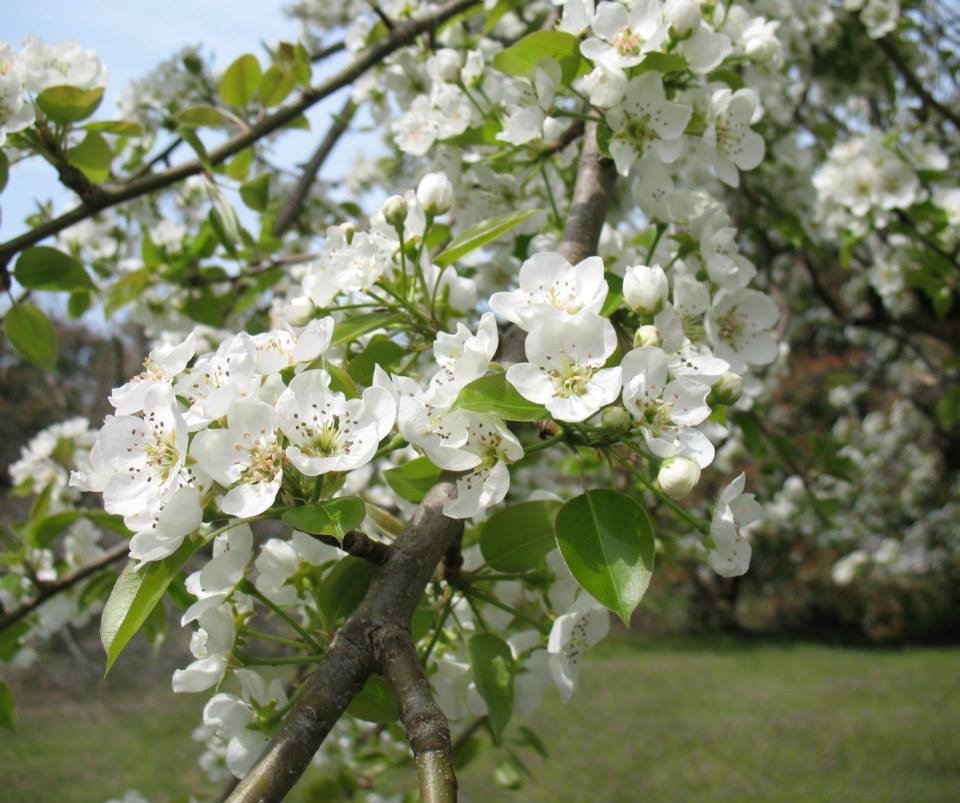
Our old pear tree is in full flower this week. This is one of two trees that my mother and father planted in the late 1970s.
Pear blossoms and blue skies
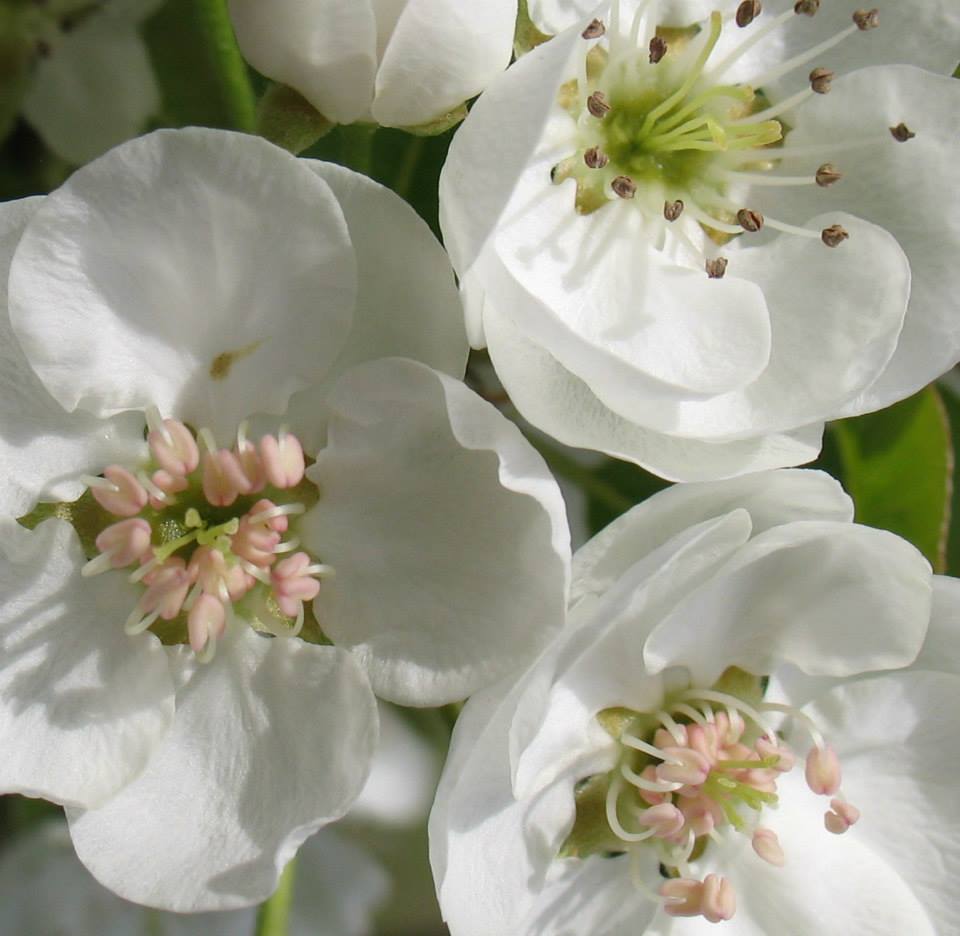
Lovely, ethereal and sensual, pear flowers open in the morning, their stamens unfurling to reveal pink, fleshy anthers.
Within hours, the pollen bursts from anthers, ready to be carried by visiting bees to the flower’s center, to the pistils, which elongate in anticipation.
Mason bees and other native pollinators hard at work.
Once the pollen is released, or dehisced, the anthers shrivel and turn brown. By the next morning, the petals will have fallen.
Already, the ovary of the fertilized flower is swelling, becoming a pear. If a late frost doesn’t kill the budding fruit, they will grow and, come May, the tree will be filled with hundreds of perfect young pears.
The sand pear in late May.
Late Summer 2015
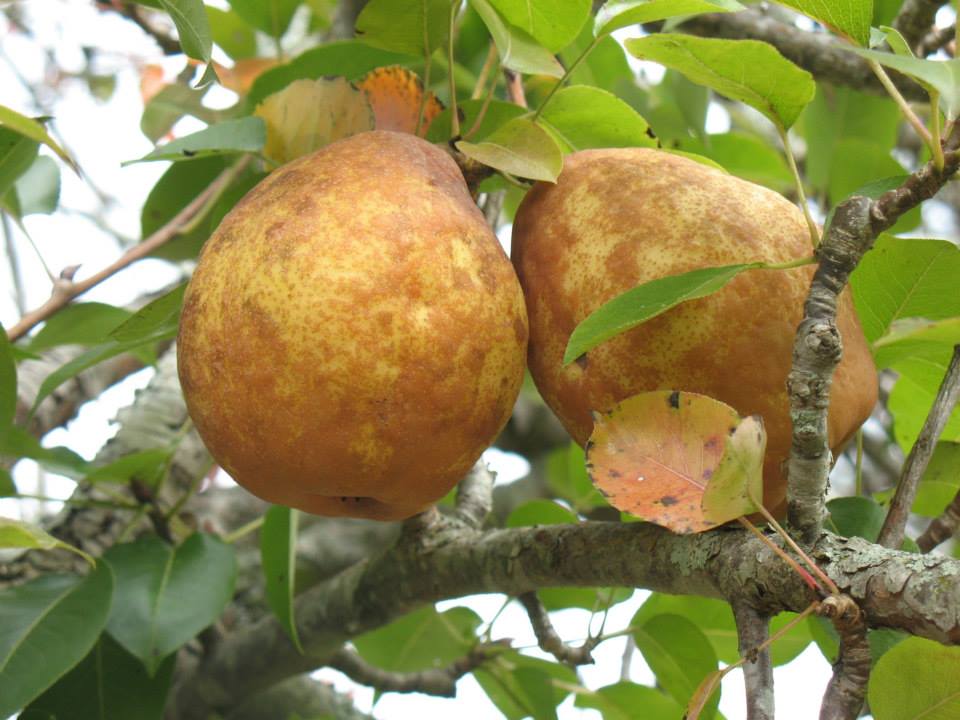
This type of pear (Pyrus pyrifolia) goes by a number of names — sand pear, Asian pear and apple pear, to name a few. By nature, these trees sometimes age into ungraceful poses– their bare branches resembling, in winter, the collapsed staves of a broken umbrella. In late summer these limbs bear the weight of hundreds of hard, delicately flavored pears.
The fruits have a long harvest season, remaining persistently hard throughout. They never grow soft, like a Bartlett pear, nor do they attain that level of sweetness. They become edible in late July, but are better once the begin to fall to the ground in August and September.
The sand pear in late July.
As the possums, deer, raccoons, fire ants and yellow jackets can attest, this is when the pears are ripe for eating.
Most years, we’ve had have a bumper crop of sand pears. Hard, crisp and mild-flavored with a satisfying grit for pear lovers, these pears are similar to, but a little different from the Asian pears you buy at the grocery.
They are good eaten out of hand or made into relish and chutneys. If you had a grandmother or great-grandmother who lived in the south from the 1970s back, she likely had a recipe for pear relish in her recipe box.
Sand pears are also wonderful sliced into green salads with a lemon-poppy dressing. They also taste wonderful sliced and dipped in sea-salted caramel on a cool fall evening.
My mother and father never cared much for the fruit, so every year, they invited old timers over to harvest them. The old timers would leave with baskets and boxes filled with sand pears and, in return a few weeks later, gift us with a few jars of pear relish – a savory southern delicacy served atop meats, greens and other vegetables. As the old timers passed away, so did the gifts.
Fire Blight, Wind and Frost 2016-2019
For a few years, it seemed the late frosts, wind storms, and fire blight had finally taken their toll. The leaves were black from fire blight. Late frosts kept killing the fruit. Major limbs had been broken and were hanging lifeless from the trees. There was talk of cutting the trees down, but I refused, preferring to allow them a natural death. I spent these years saying my goodbyes.
October 2017: Ah, our beautiful pear trees! The last two springs have brought late spring frosts that killed the young pears. The trees are near the end of their life span, so I don’t know if we’ll ever see another big crop, but I do dream about them.
October 2018: Has it been only 3 years? My, the things time changes as it flies.
March 2019: Storms and age have taken their toll over the years, and there is little left to them but broken, bare branches falling one by one back to the earth…. The memories are pretty sweet. I’m glad I have the old photos.
September 2019: Gosh, has it been only 4 years? The pear trees finally succumbed to the fire blight and the late spring freezes. But what lovely memories they left in their wake. Gather ye rosebuds while ye may….
Late Summer 2020
So imagine my surprise when I happened to be in that part of the yard one morning and, glancing over, saw the trees all green with leaves and with hundreds of pears on the trees. I felt like celebrating!
I made an apple pear pie to celebrate the 2020 crop. I was sick with Covid that year and forgot to take a picture of the finished pie. We’ve enjoyed a crop every year since.
The pears are, of course, fewer these years. The ground would usually be covered with half-eaten pears by now, but there were only three pears on the ground when I took this picture last week.
I picked my first pear that same day.
If the pears seem a little sweeter this year, that’s the memories talking.
Throughout autumn, the pears will continue to fall until, perhaps, late November…
…when the very last pear will fall.
Come spring, the flowers and bees will return, ready for an encore.