Category Archives: Trees and Deforestation

The Smith Hazel Story: What We Know

There is much misunderstanding surrounding the Smith Hazel Park project. Linked at the bottom of this page are some of the numerous articles published in the Aiken Chronicles over the past 16 months on Smith Hazel and other northside parks

To be clear …

The Smith Hazel story is not about choosing trees over people. It’s not even a story about trees, although that’s what is being discussed, since the loss of trees will be a huge part of the collateral damage from the project the City has planned for this park. Nor is the Smith Hazel story about amenities, although citizens advocating for a pause and a public hearing on this project have been accused of trying to keep northside children from receiving long-awaited amenities.

No, the Smith Hazel Park story, much like the Pascalis and Williamsburg Street stories that preceded it, is, at its root, about a city government that eschews established processes; a city government that makes decisions in a vacuum behind closed doors; a city government that withholds information from the public and denies citizens opportunity for input. It is no wonder that the output from this municipal apparatus has been a series of wasteful and destructive projects driving increasing number of local residents to rise up and say, “No more!”

The Obstructionists and Naysayers

Individuals who have spent the past two years pushing and advocating for the northside parks, and pushing to see some of the windfall plutonium money spent on the long-neglected northside, are hardly the obstructionists and naysayers in this equation, nor are they devoid of ideas and inspiration for solutions.

Destroying 68 trees, bulldozing the landscape of the Smith Hazel park, and creating expensive stormwater issues in order to cram all of the northside amenities into the 5-acre Smith Hazel Park is not the solution to the city’s long-term failure to provide amenities on Aiken’s northside.

Consider this: Across the street from Smith Hazel is the 25-acre Perry Memorial Park, (from which the City recently considered disinvesting, see articles below) — a park that could be utilized for the ADA-compliant City intends to bulldoze into 5-acre Smith Hazel Park. Out on Hwy 1/Columbia Highway are 118 acres of land the city purchased in 2015 to finally, finally provide the northside with those long-promised amenities. So where are those amenities? 

ABOVE: The City’s concept plan for the 118 acres of land purchased for a northside park in 2015 which envisioned a generosity of amenities including 4 baseball fields, 8 soccer fields, 6 tennis courts, a track and stadium complex, a multi-purpose gymnasium, a swimming pool, 2 playgrounds, and five parking lots. All of these amenities were left on the cutting room floor in the final product except for the detention ponds, a partial amphitheater, a piece of playground equipment, and some parking lots.

Forty Acres

For whom was the Beverly D. Clyburn Generations Park (nee Northside Park) built? The park is located on the outskirts of town on a 118-acre plot of land the City bought on which to build that long-studied, long-deferred Northside recreation facility and park. From this 118 acres, 40 were denuded of trees, laid with sod, left largely bereft of amenities (no money, said the City) and pronounced as a park.

The amenities include an unfinished amiphiteater whose components must be trucked in for events. Portable sinks and porta-potties must also be trucked in, as there are only two toilets (presumably due to the fact that the City could only afford a septic tank for the park). Shade must also be trucked in. Portable playgrounds are also trucked in. The park has a one-mile walking track and a water fountain. This is all good, but it is not what the City spent 25 years promising the northside and hiring a Clemson University consultant to conduct high-dollar surveys in order to state the obvious about the unfulfilled need for recreation facilities on Aiken’s northside.

ABOVE: So much open space at the Northside Park. The potential is enormous. Why is there not even a single basketball court in this park?

In the wake of creating this park, City Council stated, as generations before them have stated, that the City will one day find the money to provide the northside with some park amenities. One councilmember offered that perhaps a public-private development project could make it happen.

Cue in the greenway project, which will connect the Beverly D. Clyburn Generations Park (nee Northside Park) northward, away from the City and toward the thousands of acres of forested land between northside Aiken and I-20 that the city is opening for development to be peopled with future residents for whom the City is installing new water infrastructure.

It’s just as well the Northside Park go to someone else. After all, the distance is too far for northside kids to walk, and even if it weren’t, there’s no sidewalk to get there. What parent wants their child walking or riding a bike down the busy four-lane Columbia Highway to go and … do what?

We’re All Northsiders Now

An analogy for the Smith Hazel story appears: The City will provide sparkling clear water for future residents in Aiken’s new north — the I-20 lands. The in-town residents, whose concerns and input about their drinking water and boil-water alerts have fallen on the deaf ears of a City Council body that refuses to listen to the people they’ve been empowered to serve, will have brown water.

About the Purported Dozen or More Public Hearings on the Smith Hazel Park Project

They never happened. While the City has kept the public abreast of plans for the evolving interior improvements planned for Smith Hazel, this cannot be said about the plans for the extensive demolition, tree removal and grading work on the property about which a public hearing has been requested, but never held.

A recent video circulating on Facebook with statements to the contrary was posted this week by the Umoja Village CEO and shared by Councilwoman Diggs. It contains a timeline of purported public hearings running from November 2022 through December 2023. This individual is unfortunately confused over the difference between a public meeting and a public hearing — a common and understandable misunderstanding. We could all benefit from lessons in government jargon so that we could better understand the processes of government.

The most cogent response to the claims in this video may be found in the two emails from City Manager Stuart Bedenbaugh, which he sent on January 31, 2024 in answer to a request to, “Please provide evidence that the City has ever held a public hearing on the Smith Hazel Park project.”

A reading of the information provided in these two emails confirms that there has never been a public hearing on the plan for the Smith Hazel Park project.

About this Saturday’s Purported Public Hearing

In the above-mentioned video was an announcement that there would be “a public hearing, another public hearing, presented by the city of Aiken this Saturday.”

This is not true. Much of the confusion over the Smith Hazel Park project stems from the public’s lack of understanding on the difference between a public meeting and a public hearing, a difference that could be likened to the difference between an informal straw poll and an official election.

There will be no public hearing at Smith Hazel on Saturday if for no other reason that the legal requirement for announcing a public hearing has not been met.

Public Input

Over the past 7 days, the Mayor and City Council have received over 1240 letters and statements from local citizens calling for a pause on this project so that a public hearing — the first ever pubic hearing on the Smith Hazel Park — could be held.

An Impromptu Get Together

In response to the letter writing campaign, Mayor Milner sent emails to some of the letter writers inviting them to a meeting outdoors at Smith Hazel on Saturday, February 10 at 9:30 a.m. If it’s not raining, we can tell the Mayor or the City Manager our thoughts, opinions and wishes. It’s not clear just yet who will be there, but one thing is clear. No matter how closely or sincerely City officials do or don’t listen to our concerns, our words have zero impact on the course of this Smith Hazel Park project in the absence of a public hearing.

As Councilwoman Gail Diggs made clear in an interview with WFXG News yesterday afternoon, City Council is not prepared to bend in its determination to go forward with this destructive plan. “This project is going on,” she stated. “It will not come back to counsel for a vote.”

The City Manager has repeatedly stated as much. Our only hope, then, is that a vocal majority of the citizens arriving to the Saturday meeting will bring umbrellas and spend their energies urging the Mayor and any other Council members in attendance to use their authority to request a pause and a pubic hearing on this project. 

Whether or not trees are spared in the process is secondary. The important thing is the process itself, which is an established, democratic process and a process of which most people should be able to agree is necessary in a democratic society.

______________________

FOR FURTHER READING


Below is a history of but some of the articles published in the Aiken Chronicles over the past 16 months chronicling the advocacy of local citizens for our city’s parks, our parkways, our trees, our water, our quality of life.

September 21, 2022: Has it been only 18 months since the city was charging kids money to play basketball at Smith Hazel? (p.s. Citizens pushed back and won).
September 22, 2022 Has it been only 10 years since the City was planning to build that long-promised, long-deferred northside Park on top of the city landfill? 
From September 27, 2022 by Don Moniak 
October 11, 2022: A campaign to push back against the City’s move to disinvest of several Northside parks.
October 11, 2022: A follow-up story to the above “Divesting of Parks and Privatizing Open Space.”
From October 11, 2022.
October 26, 2022: In the wake of pubic pushback, the City waives the recreation fees it was charging children.
October 27, 2023: Photos from April 2023 taken while following the unfolding Smith Hazel Park story and trying, unsuccessfully, to get information form the City, which spent 13 months making plans for Smith Hazel behind closed doors, without public input. 
January 29, 2024: The title speaks for itself. I would add Pascalis to the list of unlearned lessons by our tone-deaf City government. 
February 1, 2024: We have been asking for a pause on the destructive Smith Hazel project to allow for a public hearing. In response, City Manager Stuart Bedenbaugh was quoted in the January 26 front page of the Aiken Standard as saying, “The city has held several public meetings to discuss the upgrades and tree removal, including a Sept 11 public hearing”.  Curiously, there is zero evidence that any such meetings took place “to discuss the upgrades and tree removal” much less a public hearing. What’s up with that? Read Kelly Cornelius‘ article on this. https://aikenchronicles.com/…/what-public-hearing-the…/
February 2, 2024: The way out of this time loop, which has City leadership creating plans in a vacuum, (the citizens for whom they work too far removed from their purview to be seen or heard), is through public hearings. A public hearing should be the standard for any project that proposes to improve a place by destroying it. 
February 2, 2024 through today:Those of us who are trying to find solutions get accused of being against everything and never offer solutions. Yet the record (see the above thread of articles) shows that just opposite is true. Let’s all learn what we can about the issues before us so that we can give informed input and use our voices wisely. https://actionnetwork.org/…/pause-the-smith-hazel-park…&
February 7, 2024: At the latest count, 1144 letters have been sent by Aiken citizens to City officials requesting a pause on the project to allow for a public hearing and informed public input. Read some of what they have to say. https://aikenchronicles.com/citizens-speak-on-smith-hazel/

Smith-Hazel Executive Summary

By Lisa Smith
February 8, 2024

What we all want:  Smith-Hazel outdoor facilities need improvement.  This can be done without destroying any trees or bulldozing and levelling the park. 

Funding:  Improvements at Smith-Hazel Park are being funded by a grant from the Land and Water Conservation Fund matched by city funds.  The grant provides a one-for-one replacement of existing facilities. No new facilities are currently funded.

Problems: 

  • According to the city, the current basketball court is in a DOT right of way and cannot be improved with grant funding.  For this reason, the Basketball court must be relocated. 
  • When the basketball court is relocated trees must be removed and the tree removal and additional hard impermeable surface will cause stormwater runoff. 
  • The Smith-Hazel Park is 30’ higher than surrounding properties.
  • The additional stormwater runoff will require a retention pond to be constructed.
  • The additional stormwater runoff and retention pond will require significant grading work all over the park, destroying not only the trees, but groundcover and surface soil and will substantially change the topography and character of the park. 
  • A retention pond is a dangerous and attractive nuisance for children.  Even with a fence. This is a lost recreation area in a park that is already small.
  • Relocating the playground will result in substantial cost and destroying two grand trees (more than 6’4’ around the trunk) longleaf pines may be between 300-400 years old.
  • The new locations of basketball and playground will require ADA approved access which requires more pavement and results in more storm water runoff.
  • As far as we know, the city has not conducted any study into the storm water runoff problem that they are creating. The adjacent Perry Park and residences sit 30’ below Smith-Hazel.
  • The city does not have funding for any additional amenities but has decided to remove all 68 trees and do all site grading in advance.
  • Parking will be added where the basketball court is now.  This will require substantial grading and the addition of a more impermeable surface will cause more stormwater runoff. Water and sediment will run into the street and neighboring properties.
  • No study has been done to determine the need for more parking, although approx. 62 spaces are being added. No study has been done to understand the traffic that will be generated. We do not know the capacity of the current building. There are currently 73 parking spaces.
  • The city has not released information on the destruction of 68 trees and substantial earthwork to be done to the public at any time.  No public hearings have been held. Only Bill McGhee has been given this information, after months of requests, and only on January 12, 2024.
  • The Neighborhood Association, Schofield Community Association, has expressed important concerns about the city plan.
  • The Parks Commission voted to pause the project.
  • 1200 citizens have sent emails requesting a pause and a public hearing.
  • The city will not release the mandatory tree inventory list for Smith Hazel Park.
  • The city conducted a survey of citizens at two public meetings held at Smith-Hazel in December 2022.  Thirty-nine people responded.  Although it was asked, no information was given about the sitework and tree destruction.  This is the only survey of residents and does not justify any of the city’s plan.  In fact, the most requested amenity, outdoor bathrooms (18 times), are not being built, and the respondents specifically asked for “less pickleball” (11 times), “less basketball courts” (8 times), more parking (8 times), also “no pickleball”, no “hammock garden” (12 times) (yes, that’s a thing) and “more green space”, “keep the trees.”
  • Removing 68 mature trees and replacing them with impermeable surface will not only cause significant storm water runoff but will also raise the temperature at the park.  There will be no shade. The long term, unfunded plan for the park will cover 80% of the park with impermeable, heat retaining, reflective surfaces.
  • The LWC fund Grant money expires on October 1, 2024
  • The removal of 68 trees, substantial grading, retention pond, demolition and moving existing amenities are all costly
  • Pickleball is loud and basketball is louder. The plan for four pickleball courts, three basketball courts and three tennis courts will be loud in this residential neighborhood.  This is the source of complaints and lawsuits in other neighborhoods. As far as we know, the city has done no study, or survey and has not notified any neighbors of the potential noise issue.
  • There are city ordinances regarding the removal of trees.  As far as we know, the city has not done surveys needed to establish the exact distance of trees being destroyed from the road.  City ordinances specifically state that no grand trees may be removed unless there is absolutely no alternative, and other protections are also included. We do not know if any other options have been explored as seem to be required by ordinance.

Solutions:

  • Pause the project until citizens can be heard at a public hearing.
  • Look into extending the Land & Water Conservation Fund grant funding deadline.
  • Fund the badly needed basketball court improvements with a different source of funding.  Fix the court where it is.
  • Learn about the “right of way” issue and see if something can be negotiated with DOT
  • Fix the tennis courts where they are.  Line them for tennis and pickleball.  Two courts surrounded by trees will not create a noise nuisance for neighbors.
  • Leave the trees alone.
  • Do not bulldoze and grade the park.
  • Do not put in a retention pond.  The park is only 4.75 acres and does not currently need a retention pond.  The limited space must be used wisely, not wasted on a retention pond.  Stagnate water, the attractive and dangerous nuisance a retaining pond is for neighborhood children, storm water runoff, sediment runoff into the streets and neighborhood are not existing problems.  They are problems this plan will create.  Do not create problems.
  • The existing trees do a wonderful job of providing shade, habitat for birds and animals, and catching storm water in their canopies, letting it run down their trunks and be absorbed by their roots.  Let them continue to do the job.
  • Utilize the 25 acres adjacent to Smith-Hazel at Perry Memorial Park, for additional park facilities IF they are needed. If necessary, work with the school system on this project.  Perhaps they’d also be able to use tennis courts or other amenities. The two parks could be managed as one and combined would be about 30 acres.  Odell Weeks is 44 acres.
  • Utilize the underdeveloped 118-acre Generations Park for other amenities.
  • Be transparent and work with citizens instead of against them.  Be willing to answer questions fully.  Always be honest. Admit mistakes.  Provide great service. Represent citizens accurately and fairly.
  • Encourage communication between citizens and City Council by responding to correspondence. Hold regular meetings in each district with councilmen to facilitate communication and diminish animosity.

__________________

.

ABOVE: Marked for destruction is a shade tree in the Smith Hazel Park, its bare bones beautiful in the winter landscape; in summertime, the tree is leafy green and provides a generosity of cooling shade and habitat and respite for birds and other wildlife. Part of the tree’s leafy bough is visible on the right side of the photo of the children’s playground at the top of this article.

The Unlearned Lessons from Williamsburg Street Now Being Visited onto Smith Hazel

Sixty-eight trees are slated for destruction in a plan devised without opportunity for public input on the fate of this historic park.

After thirteen months of asking, the City finally answered the question via email on Friday afternoon, January 12: sixty-eight. That’s how many trees the City of Aiken plans to destroy in a project intended to improve the parklands at the five-acre Smith Hazel Recreation Centerin the historic Schofield neighborhood.

Two weeks later, on Friday, January 26, another answer arrived, this time via the local newspaper: No, the City is not going to hold a public hearing to give Smith Hazel neighborhood residents, park-goers, and the larger community opportunity to provide input on the future of the Smith Hazel park and its trees.

ABOVE: From the Aiken Standard newspaper, January 26, 2024

The largest among the Smith Hazel trees once shaded the grounds of the Aiken Graded School that formerly stood here — a school built in 1924 by contractor W.M. McGhee on 8 acres of land purchased by the hard work and effort of Aiken’s Black community of that era, including Messrs. W.M. McGhee, A.B. McGhee, George Ball, and Dr. C.C Johnson; a school where Mrs. Josie Smith Hazel once taught; a school that, despite the efforts of the northside community to save it, was closed in 1969, the year the Aiken schools integrated, and 1demolished by the City in 1973, as it was deemed too expensive to maintain. This history and these trees are part and parcel of this place.

A historic marker for the Aiken Graded School located at the northwest corner of the Smith Hazel Park.

And it’s not just the grand trees that matter. All of the trees matter; all are integral to the lovely, natural, parkland setting and the quality experience of this park.

April 2023 views of Smith Hazel. The ribbons on dozens of the trees, as was later learned, were intended to tag trees to be spared from demolition.

The decisions on each and every tree have deserved thoughtful consideration and our best efforts to preserve them where possible. This is why Smith Hazel park-goers and neighborhood residents spent the past thirteen months asking questions about the fate of the trees and pushing the City to allow them input. These citizens deserved, above all, the opportunity for at least one public hearing over the past thirteen months, so that they could help steer the course of Smith Hazel’s future. In the end, however, the fate of the park and its trees was seemingly decided by fiat.

How did we get here?

Below is an attempt to answer that question through a compilation of information gathered piecemeal over the past 13 months. The following is broken down into three sections — an overview, a timeline, and a list of points for further thought. Each section is expandable to allow for an optional, abridged account. This article will likely be updated as more information becomes known.

FAQs

What is the project?
Smith Hazel is slated for improvements to the indoor and outdoor facilities at the center. This article will address only the outdoor improvements, which include:

  • The demolition and replacement of the two existing tennis courts.
  • The demolition and replacement of the playground equipment and the addition of artificial turf.
  • The closure of the existing basketball court to be replaced with two new basketball courts.
  • The addition of a second picnic shelter.
  • The resurfacing and rerouting of the existing 1/4 mile walking trail.

So far, so good. It would appear that, with the exception of the second basketball court and the second picnic shelter, the footprint of the improved park would be similar to the footprint of the existing park.

So why are 68 trees slated to be removed?
A few explanations have been heard piecemeal over the months and been repeated anecdotally, including (1) that areas of the park will essentially be bulldozed to provide “clear lines of sight” for security reasons, and, (2) that the sloping elevations of the existing walking track is not ADA compliant, so the terrain will have to be leveled, requiring regrading of the earth and the removal of many trees. 

Who is funding this project?
The funding came from a Land and Water Conservation Fund (LWCF) grant awarded to the City in October 2022. The City matched this with Capital Project Sales Tax IV funds, bringing the total money for the project to $900k.

What is being funded?
This particular grant is for outdoor recreation area only. No indoor work. The terms of the grant provide for, specifically, the replacement of existing amenities. For example, it will replace the two old tennis courts with two new tennis courts. It will replace the old playground with a new playground. Artificial turf is being added to the playground which will compound drainage and stormwater issues at the park. This is only one of a number of topics suited for a public hearing.

Why, then, are two basketball courts being installed to replace the one existing basketball court?
The City was reportedly able to secure additional funding to install a second basketball court as part of this project.

Why is the baskeball court being relocated from its existing spot?
As is the case with some other parks in Aiken, parts of the Smith Hazel property are located on SCDOT right of way land. The existing basketball court is in the SCDOT right of way. The LWCF grant can only be done on City property, which means the basketball court must be relocated to another part of the park. 

What will happen to the existing basketball court?
This area will be incorporated into the creation of approximately 40 parking spaces that are planned for a future project.

Why are the tennis courts being replaced when no one ever uses them?
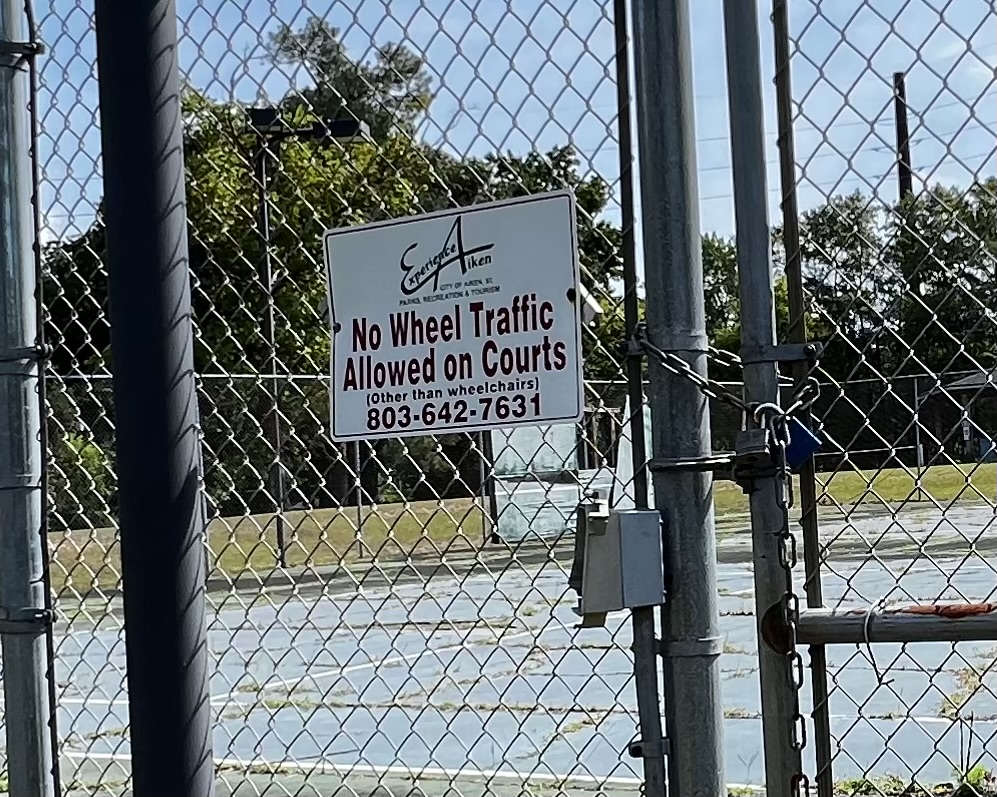
For those unfamiliar with this park, the tennis courts were formerly used, but have been padlocked for years and off-limits to the public due to their hazardous condition from years of disinvestment by the City of Aiken in the Smith Hazel Recreation Center.  

The tennis courts at Smith Hazel have been padlocked for years.


What will happen with the existing 1/4 mile walking track?
The plan is to reconfigure the track to be ADA compliant. As was learned by those who attended the September 21, 2023 monthly meeting of the Schofield Community Association, the sloping terrain prevents the track from being ADA compliant. Leveling the elevation — which will require earth-moving equipment and the removal of a large number of trees — is seen as necessary to making an ADA compliant track on the 5-acre Smith Hazel park. Were other alternatives considered? Could a future, second walking track be created across the street at the 25-acre Perry Memorial Park? The potential is there for an even longer track. Might this be preferable to destroying the historic, Smith Hazel parkland to make it ADA compliant? A public hearing with public input could have integrated such questions, ideas and potential solutions into the process.

TIMELINE: December 2022 through January 2024

December 8, 2022
A meeting had been called by the City of Aiken at the Smith Hazel Recreation Center. This was described as a “public input meeting for local community residents to review Smith-Hazel Park design options.” Attendees arrived believing they would be providing input on the newly-announced, outdoor improvement project which was set to begin within just a few months. The presentation was given by Aiken Parks, Recreation and Tourism Director, Jessica Campbell.

As the meeting progressed, it became clear that input was not actually being sought for this project, or “phase one,” as it was being termed, but for other, future projects. At approximately minute 18:00 of the meeting, (per a citizen-recorded audio of the meeting) a citizen spoke up and asked Ms .Campbell if the citizen input being solicited by the City was for the current project or for future projects. Ms. Campbell confirmed that the input was for projects “down the road.” She said, “The idea is to have a concept plan for future development.”

In other words, the concept plan for the current project (below) had already been drawn up by Cranston Engineering, and there was no public input sought either before or after this plan was drawn.

ABOVE: A photo of the concept plan for the present-day project, which was posted at the December 8, 2022 meeting. In a peculiar twist of plot, attendees were not asked for input on the current project, as seen in the above drawing but, rather, were being asked for feedback on potential projects down the road.

Citizens had been called together to comment on ideas for potential future projects, illustrated by Option A and Option B.

ABOVE: Photos of the other two drawings present in the December 8, 2022 meeting. The public had been brought together to vote on Option A or B, not to give input on plans for the current project.

When asked if any trees would be disturbed by the project, Jessica Campbell stated that they did not yet know, as the final course of the walking track hadn’t yet been determined.

April 2023
After citizens observed ribbons on dozens of the trees in the Smith Hazel park, Aaron Campbell, the City horticulturist, was contacted. He stated his shared concern to spare as many trees as possible during the project. He stated his belief that the tagged trees were those NOT be cut. He assured the caller that there would be opportunity for public input on the trees before any action was taken.


April 10, 2023
Two citizens spoke at the regular City Council meeting about the trees at Smith Hazel and wondered if the ribbons were intended to mark the trees slated for removal. According to the minutes of the non-agenda comment period, Laura Lance, “noted that she understood that the matter would be before Council at some future date where the public would have an opportunity to talk about removal of the trees. She pointed out the importance of the tree canopy in Aiken. She asked when there would be opportunity for the public to know what is going to happen and have some input.” 

PRT Director Jessica Campbell, also present at the meeting, responded that the flags were for the trees not to be removed. According to the minutes, Ms. Campbell, “pointed out that those trees marked have been identified as substantial, high importance, high-priority to remain as is. she said the trees that are marked so the engineers can look and make sure the footprint of the amenities that are to be placed on the property fit within the landscape and does not create the removal of any of those marked trees.”

September 11, 2023
City Council held a work session on September 11, 2023, during which the topic of tree removals went undiscussed. There were, however, two items in the agenda package pertinent to the trees.

ABOVE: The two agenda items pertinent to the Smith Hazel outdoor improvement project. At this time, the precise number of inches of trees slated for removal was known, yet the number of trees slated for removal could not be given.

During the regular City Council meeting following the work session, Luis Rinaldini spoke to City Council about the above agenda items and on need for clarification on the matter of the trees:

“I would just like to comment on the agenda item that was included in the work session regarding the Smith Hazel renovation. It has a map and it has a page… referring to trees being cut down. But it really doesn’t give a lot of information. The information it gives us is confusing. There are something like 500 inches worth of trees, I’m not sure how that’s measured and what it means  And 230 inches to be removed, which sounds like, to the uninformed person, that half of the trees in that area are going to be to be cut down. So I think that, rather than just let it sit at that, we ought to get clarification and get a map that shows what trees are being affected, and why. Because, as you know, we’ve had some not great situations with trees, And I think it’s important that we change the way we look at those things, and we change the way, we approach things, reducing the number of trees that get cut down in our activities.”

Bill McGee also spoke at this meeting. Referring to earlier mention in the meeting that some trees would have to be removed at Smith Hazel, Mr. McGhee stated that they (the SCA, or Schofield Community Association) have requested the City to come to the next SCA meeting on September 21, 2023 to discuss with the community the plans and exterior of Smith Hazel. He said he hoped the tree issue would be included in the presentation. 

September 21, 2023
Attendees at the SCA’s regular monthly meeting received, from Mary Catherine Lawton,* Capital Projects Manager, what may have been the most comprehensive explanation by the City through the entire 13 months on the Smith Hazel park project. Even at this, the specifics on the numbers and locations of trees slated for destruction were not given. A video of this meeting can be viewed here, with the discussion on the outdoor improvements beginning at minute 22:35, starting with a citizen question on the any public input that went into the project. The answer provided Ms. Lawton was not quite clear.

*Correction: an earlier version of this story incorrectly identified the Assistant City Manager as the speaker at this event.

November 27, 2023
Bill McGhee, president of the Schofield Community Association, wrote to the City horticulturist, Aaron Campbell, requesting “a walkthrough of the plans for the trees involved in the project.”

December 5, 2023
Aaron Campbell responded to Mr. McGhee via email at 8:49 a.m. saying, “We are available to meet today at 1pm or Friday, December 22nd at 1pm.” 

December 9, 2023
Bill McGhee sent notice that a meeting had been arranged with Aaron Campbell for Dec 22 “to have a SCA group review the exterior SH renovation plans and the status of the surrounding trees.” 

December 12, 2023
Notices of the upcoming meeting were posted at the Aiken Chronicles and on social media including the Do It Right and Schofield Community Association Facebook pages. 

Notice posted at the SCA webste on December 12 for the Dec. 22 walk-through at Smith Hazel.

December 14, 2023
Beatrice McGhee emailed notice of the meeting to the SCA membership 

December 22, 2023
The meeting convened with over a dozen in attendance. Landscape architect Lance Cheeley, with Cranston Engineering, was in attendance and indicated, without further specifics, the plan to remove “many trees” including two significant pine trees and one significant oak. There was no actual walk-through, however, nor tagging of the trees, nor identification or total numbers of the trees slated for removal.  There was reportedly discussion among some attendees that a factor in the tree removal was the need for a “clear line of site” for security purposes.

December 26, 2023
Bill McGhee emailed a recap of “The Smith Hazel Tree Walk-through” to the SCA membership, with this update on the trees:

“The draft RFP includes the removal of two ‘significant” pine trees, one ‘significant’ oak, and many other non-significant trees.  No trees were tagged.  The many trees to be removed were not specifically identified. It was stated that the tree removal and replacement plan complied with the city’s landscape/tree maintenance policies.

January 8, 2024
Bill McGhee emailed Aaron Campbell requesting a copy of the City’s tree inventory of the Smith Hazel trees to review for discussion. 

January 10, 2024
Aaron Campbell responded that he could not give this information.  

January 12, 2024 (Friday at 3:20 p.m.)
Aaron Campbell emailed Bill McGhee a pdf (see image below) of the Cranston’s “Tree Removal Exhibit” for the park, with the following note: “Attached is the plan from Cranston engineering showing what trees are slated for removal.  Please let me know if you have any further questions.”

TOP: The Cranston Engineering “Tree Removal Exhibit” dated November 10, 2023. BELOW: The total number of trees to be removed.

A total of 68 trees are slated to be removed according to the Cranston drawing. This drawing is dated November 10, 2023. The drawing was only emailed to Mr. Bill McGhee on January 12, 2023. This was the first time that the City divulged the total number of trees to be destroyed.

January 15, 2024: (Monday holiday, Martin Luther King Day)

January 16, 2024
— Bill McGee left a message with Aaron Campbell to give him a call. Mr. McGhee’s call was never retuned.  
— Bill McGhee put out a notice urging attendance at the 5:30 p.m. meeting that evening of the City Recreation Commission on Banks Mill Road.  A total of six SCA member/tree preservation advocates attended: Bill McGhee, Linda Johnston, John Howard, Lee Doran Thornton, Lisa Smith, and Laura Lance. All gave their perspectives on this project regarding the shocking number of trees slated for removal and the frustration over the lack of public participation in the process. A public hearing was requested. The Recreation Commission respectfully listened and responded by making and approving two motions: (1) to recommend to City Council that a public hearing be held to allow for public input on the Smith Hazel trees, and (2) that ribbons be attached to the trees slated for removal so that the City, SCA and all interested parties could see what is planned for the park. 
— At 10:43 p.m. that night, local park advocates began a social media campaign to “pause the project.” Public interest and comment was robust. 

January  25,2024
Bill McGhee submitted a FOIA request for a listing, from the City’s tree inventory, of the type of grand and significant trees slated for removal at Smith Hazel and the dollar value assigned to each tree.

January 26, 2024
The local newspaper announced online that the Smith Hazel project is going to go forward without “more” public input, stating:

“The City of Aiken doesn’t intend to pause plans to make long-awaited upgrades to the Smith-Hazel Recreation Center, despite a community group and city board asking for a brief stoppage to have more public input on the project.”

POINTS FOR FURTHER DISCUSSION

— Why is the City using the term, “more public input”? Given that the City has provided no opportunity for public hearing for public input on this project, the word “more” isn’t applicable.

— Cranston Engineering had already drawn the concept plans for the this project before the December 8, 2022 meeting. Why was there no public hearing for public input on this plan either before or after the plan was drawn up? 

— Why was the public given opportunity during this same December 8, 20220 meeting for input on hypothetical future plans for future projects of the park, but none for the current project, as shown in Cranston’s concept plan?

— Why were dozens of trees at Smith Hazel tagged with different color ribbons in April 2023? Who decided which trees would be tagged to be spared and which would be destroyed? And by what criteria? Does this mean that the City knew as far back as April 2023 how many trees would be destroyed? Why wasn’t the public included in at this stage of planning?

— Why did the city refuse the recent requests by citizens and the recommendation by the Recreation Commission in the wake of January 16th 2024 meeting to have to have the trees marked with ribbons to show the public and the city the trees slated for destruction?

— Why did the City Council not discuss the number of trees slated for destruction in its September 11, 2023 work session? And why didn’t the City take the opportunity of Mr. Rinaldini’s call for clarification in the City Council meeting that night to state how many trees will be removed?

— Why did the City hold a work session, (which only allows the public to attend as spectators), rather than a public hearing on September 11 to accommodate public input in the discussions?

— Were alternate plans considered to reduce the destruction of trees, and, if so, what were these plans and where is a record of them?

— Why did the City — knowing how important this topic was to advocates for our City’s parks and the trees — repeatedly fail to provide the requested information on the trees for all these months?

In Closing

One marked similarity in the Williamsburg Street and Smith Hazel stories is the lack of a public hearing for pubic input on a project that would radically change a public parkland. Another is the stealth manner in which the demolition of trees was planned and kept from the pubic. A less obvious similarity is what almost appears to be the staging of a felled, hollowed tree, as if this might justify the destruction of all.

An important difference in the two stories is that is that the destruction of the 11 trees on Williamsburg cannot be undone today. The planned destruction of 68 trees at Smith Hazel can and should be undone.

The issue at hand is not about being pro or anti-progress. Nor is it about an inability or refusal to acknowledge that reality that trees sometimes need to be removed in the course of development. No, this issue is about the need to follow good faith governance and established processes. Those among us advocating for our trees and our parks are merely asking that processes be followed, and that these processes be open, transparent, fair, lawful, and available to all.

Visible in the distance is a walker on the Smith Hazel walking track.

For more reading, see other Aiken Chronicles articles on the Williamsburg trees and the Smith Hazel trees.

1Correction: The date of the Aiken Graded School demolition was incorrectly given as 1969 in an earlier version. This has been correct to reflect the school was closed in 1969, the year the Aiken schools integrated. The school as then demolished in 1973.

New Shopping Opportunity and Tiny Lots.

Plans for another dollar store and suburban-style, high-density housing development along the Highway One gateway corridor.

by Don Moniak
November 14, 2023
Updated November 15, 2023.

Tonight’s City of Aiken Planning Commission meeting agenda includes two proposed new developments along U.S. Hwy 1 North: a request for city water and sewer service for a new dollar store across from Aiken Regional Airport, and a ninety-acre, 333-home subdivision with a typical lot size of 0.14 acres.

The two projects are likely to further stir ongoing debate and discussion over both the proliferation of dollar chain stores, suburban-style development, and how Whiskey Road-style sprawl occurs incrementally.

New Shopping Opportunity

Visitors flying into Aiken Regional Airport for the Master’s Tournament and other local pleasure and business activities will likely soon have a new shopping opportunity only one-third of a mile from the airport exit; and local residents will likely have an alternative to the nearby Dollar General.

Agenda item D on the Planning Commission’s agenda is a “City Services Request for Family Dollar Tree, 2530 Columbia Highway North, by Runway FDT.” Since Dollar Trees and Family Dollars have the same corporate owner, whether a Family Dollar or a Dollar Tree store is en route remains unknown.

(Update: The dollar store proposal passed without comment, and the future store was identified as a combined Family Dollar and Dollar Tree).

The proliferation of chain dollar stores across Aiken County is a source of both local amusement and disgruntlement. Contrary to popular perception, many of these newer stores are in the unincorporated lands in Aiken County, not within Aiken City limits.

For example, the new Dollar General stores on Hampton Avenue, at the corner of Chukker Creek Road and Whiskey Road, and on East Pine Log Road all enjoy city services but are situated just outside of city limits. One benefit to DG of these locations is the avoidance of paying city business license taxes—at least until the properties are annexed.

This latest dollar store, located on the northern edge of an established commercial stretch zoned as Urban Development by Aiken County, will be just under four miles north of the City of Aiken’s Generations Park. The property is directly across from Aiken Regional Airport, and within the airport’s restrictive noise and height zones. (Figure 1) While the most recent Aiken County market value appraisal of the 1.8 acre property was for only $35,110, it was sold this past March for $250,000.

The City of Aiken envisions the Highway One corridor as an attractive gateway into Aiken. While the airport provides a broad, pleasant vista, the presence of another dollar store 0.4 miles south of a Dollar General could add to the perception that the Highway One corridor, where locally owned businesses once prevailed, is becoming increasingly generic in nature.

Scene of proposed new Dollar General or Dollar Tree store.

A 2021 Consumer Reports article on the massive growth and presence of the two dollar store chains across the country also describes how some local governments have put a pause on these developments, or otherwise placed restrictions on dollar store densities and locations. At the same time, the authors reiterate the case that, in many areas there are few other choices as the prospects for locally owned general stores continues to grow dimmer.

Aiken County has minimal restrictions; and the one-two punch of lax restrictions and easy access to the Aiken water district’s water and sewer infrastructure further enables the corporate giants to expand their presence.

A Northside Annexation with Tiny Lots

Just under five miles along Highway One, a much more significant proposed development will be heard by the Planning Commission. Midland Valley Developers, LLC, a Fayetteville, Georgia based firm which incorporated in March 2023, is proposing to annex 90.45 acres of unincorporated lands classed as forestry and agricultural into the City of Aiken; and redevelop it into a 333-home subdivision. Two tracts totaling almost three acres and fronting Hwy 1 are proposed for commercial use.

The annexation involves five property owners whose parcels will be purchased and consolidated by Midland Valley Developers if the rezoning and concept plan is forwarded to, and approved by, Aiken City Council.

The subdivision will border Crosland Park, Osbon Drive, and Mayfield Drive. The latter two roads are flanked by 0.7 to 1.5 acre lots described by the Planning Department’s (PD) memo as “rural residential,” and are situated outside of city limits. Crosland Park is dominated by lots ranging from a quarter to one-third of an acre, and is entirely within city limits.

The design and engineering firm is Hussey Gay Bell, a regional engineering and architectural firm that boasts of “impactful projects” across the Southeast “that are the antithesis of mundane.” The company conducted a community meeting on November 9th in Crosland Park. Also attending was Midland Valley Developers representative Chad Gibson.

Tiny Lots

The Aiken Planning Department’s project description (Page 47) asserts a subdivision density of 3.68 homes per acre. However subtracting the minimum open space requirements of twenty percent (18.1 acres), and 2.7 acres of proposed commercial tracts, results in a density of 4.78 homes per acre for the remaining 69.6 acres. Subtract the land necessary for new roads and the lot sizes decrease further.

Concept Plan map for the new “May Royal Subdivision.” (Pages 47-78) The areas in light green represent proposed “open space,” which includes five stormwater management ponds (areas with black boundaries).


The density is closer to 7.1 homes per acre, since the concept plan map notes a “typical lot size” of 0.14 acres—about half the size of the typical Crosland Park parcel, and one-fifth to one-tenth the size of the parcels on Osbon and May Royal Drives. According to the community meeting notes, average home prices of $270,000 are anticipated, and neighbors were told that, “due to land costs and the current market and average demand, the smaller lots are needed.” (Page 78) .

In spite of the tiny lot size, the Planning Department (PD) contends in its memo that, due to the “more compatible” density found in Crosland Park, the proposed density provides an “appropriate transition” to the Osbon and Mayfield Drive neighborhoods it describes as “rural residential.”

In terms of housing density, the PD memo also describes Aiken County zoning rules as being more restrictive:

The existing County’ s Rural Development ( RUD) zoning would allow for a single- family subdivision, but with a 30′ greater lot width than the proposed typical lot size denoted on the concept plan.”

Access Questions

The Planning Department’s memo and the developer’s application both identify three access points for the subdivision: one off Highway 1 North, and two off Osbon Drive. No traffic light is planned at the subdivision’s junction with the five-lanes wide Hwy 1.

Osbon Drive residents are, quite predictably, not excited about a major increase in traffic. One resident wrote to Hussey Gay Bell representative Keith Utheim that access should be off May Royal Drive, and not Osbon Drive:

Osbon is a quiet, more narrow, less traveled street, and we would like to keep it that way. May Royal, however, is well-traveled seven days a week and is already equipped to handle this type of traffic. The residents are used to 24/ 7 365 traffic. We request that at least one of the entrances/ exits be placed on May Royal leaving only one on Osbon should this project come to fruition.”

Access off May Royal Drive might be hindered by the holdout by a single property owner of a 0.69 acre parcel with a 20-foot wide, 500-foot long access easement. (Figure 3). The property in the northwest quadrant of the proposed development is crossed off from the October 10, 2023, Hussey Gay Bell rezoning request (Figure 4).

Figure 3: Map showing subdivision boundary and inholding. (From Aiken County land database).
Figure 4: Listing of properties in rezoning request, with inholding deleted.

Forestland Buffers

Another key issue raised at the community meeting was that of existing and future forested buffers. Residents along both May Royal and Osbon generally back up to the forested lands proposed for clearcutting (Figures 5 and 6). The developer has offered a forested buffer of twenty-five feet, which is actually fifteen feet more than the “undisturbed buffer” required by the city’s zoning ordinance.

Figure 5: View into future development area from part of Osbon Drive. (Photo: Laura Lance)
Figure 6: View into development area from property along May Royal Drive. (Photo by Laura Lance).


Topography and Storm Water

Missing from the developer’s application is topographical information; a factor identified as a shortcoming during the Planning Commission’s review in October of the latest Old Aiken Hospital redevelopment proposal. (That proposal was unanimously approved by City Council last night.)

The prospect of the threat from increased stormwater runoff has been raised by at least one neighbor whose property is in the “downstream” portion of the drainage area that currently has a protective forest cover.
(Figure 7).

According to the PD’s memo to the Planning Commission, “ downstream stormwater analysis will be required,” but not until the permitting phase; and the same holds true for a probable sewer capacity review.

(Update: The proposal was tabled on Tuesday night by the Planning Commission and a summary of the issues are provided here.)

Figure 7: Topography of proposed subdivision. The property highlighted in red is downstream is one of several in the stormwater runoff path. The developer proposes to mitigate the expected increase in runoff with five stormwater management ponds; which will also double as “open space.”

The Family Dollar/Dollar Tree utility request is likely to be recommended to City Council, as the Planning Commission generally chooses to honor such requests. Residents of Aiken County can then joke about the latest profitable dollar store.

But the commission has recently shown a propensity for increased scrutiny of larger proposals, especially high-density residential plans with limited access.

In September the commission voted unanimously to deny recommending a high-density housing proposal with only one access point on East Richland Avenue. That proposal was strongly opposed by neighbors that included the Aiken Steeplechase Foundation.

In October the commission conducted a lengthy debate over parking, housing density, and affordable housing, among other factors, for the latest Old Aiken County Hospital property concept plan. As described in “What is Reasonable,” the plan was eventually recommended by a vote of 3-2; but the debate sparked a discussion over whether there is a new standard of review, or a double-standard of review. Residents along Mayfield and Osbon Drives, and other area residents who are discontent with the rapid rate of development without adequate infrastructure and conservation of natural areas, are hoping for the former.

Next: Dissent and Confusion in Aiken’s Land Planning Process.

Another example of the backyard views of Osbon Drive residents. (Photo by Laura Lance)

Snowbirds

My grandparents were snowbirds. Every year in late October, they departed from their home in New York, ahead of snow season, and drove south. During the earlier years, they stayed with us in our newly-purchased home, Whitehall, whose overgrown grounds kept my grandfather busy doing what he loved most — gardening. After we moved from Whitehall, my grandparents rented furnished cottages along South Boundary and Colleton Avenue and the streets in-between, which contained a number of seasonal rentals.

They stayed until April, which coincided with the end of polo season. My grandfather was an avid polo fan, and the Whitney polo field was about a block’s distance from home so, most Sundays, I walked over and visited with them during the game or, as was sometimes the case, amused myself while they visited with friends. My grandfather was a gregarious man with a wide circle of friends and acquaintances. Sometimes I got lucky and caught an out-of-bounds polo ball. These dented-up specimens were eagerly bought up by spectators, selling for fifty cents. Autographed balls commanded a higher price. Either way, there was usually enough to buy a hotdog, an orange Fanta, and a Reese’s cup from the concession stand. Two of my brothers also spent Sunday afternoons at the polo game. One walked the ponies to cool them down after chukkers; the other worked with setting up the ropes before the game and helping the scorekeeper. 

During the week, my grandmother busied herself with her bridge club and garden tea room events. In between, she knitted sweaters for me and my brothers. My grandfather spent his days gardening, visiting with friends, going on long walks in Hitchcock Woods, and feeding the ducks at Aiken State Park. Some Saturdays, we all went to the woods. My grandfather was retired, but he worked as a gardener on a number of the winter estates. I never knew when I might happen upon him working in one of the yards while I was out walking with friends. He was ever amenable to setting aside his work and visiting with me for a while. In parting, he always gave me a lifesaver — either licorice or butter rum. 

Autumn

Autumn in 1960s Aiken was a vividly-felt, sensory feast between the arrivals of the snowbirds, the horses, and “the horse people,” as we called the Winter Colony residents, and the sight of winter residences coming to life with their indescribably green rye-grass lawns; of neatly-raked sidewalks lined in purple and yellow pansies; of white doves, pink sasanquas and golden afternoons scented with tea olive. Stirred into the cooler nights and changing leaves was the the excitement over the annual Halloween Carnival at Eustis Park and entering the poster contest that preceded it. Among my favorite autumn memories was the precise moment my grandparents’ arrived from the north. My brothers and I, after hours of anticipation, would race to the driveway to greet them. My grandfather always brought bags upon bags of apples — Northern Spies, his favorite — and my grandmother always brought us a batch of her sugar and nutmeg tea cakes. When the car door was flung open, we were greeted by this wondrous bouquet of scents, backdropped by just a hint of mothballs — woolen clothes being, to us, a northern peculiarity.

Recently, I found myself recalling all of this, and more, while I was sitting on the back porch. I kept hearing this persistent chirping coming from the Rose of Sharon. It took me a minute, but I finally located the source — a single sparrow, visible only as a silhouette in the branches. “The first sparrow of the season!” I declared to my eldest brother, who was on the step visiting.

I explained how the white-throated sparrows arrive like clockwork every year on Halloween or November 1st. But this was November 2, a little later than usual. I watched the bird as it continued to chirp, its tone almost urgent. After a minute or so, it flew over to a bush near the stump of a maple tree that we’d been compelled to cut down this summer.  More plaintive chirping. Then the bird flitted to another bush, its urgent chirping directed toward the empty space where the maple tree once stood. 

The Maple Tree

The decision to cut down that tree was a difficult one. We struggled over it for years after the tree developed an enormous hollow in the center of its trunk. The rest of the tree was full and leafy — a veritable mother tree for resident birds and migrating passers-through, along with skinks, black racers, wrens and warblers that summered in the branches.

The last photos of the maple tree, taken the morning the tree was cut down. Top: The tallest tree is the maple. To its left is the Rose of Sharon in full bloom. The stump of the tulip poplar, taken a few years earlier, is visible in the lower right corner. Below: Two views of the tree hollow with pokeweed growing out of it.

While my brother and I mused over the lost maple and the chirping sparrow, a large flock of sparrows arrived to the Rose of Sharon, chattering and fluttering about. There must have been about three dozen of them. It was difficult to identify them among the leaves, but it looked to be a mix of several different species of sparrow. You could feel it in their chattering, this palpable sense of relief — something with which most long-distance travelers can probably relate. I expected the birds, hungry from their long journey, to mob the feeders but, oddly, they didn’t. Nor did they settle into the inner thickets of the pittosporum bush under the kitchen window, as is their custom every year. They just disappeared. I didn’t see them again for three days.

Among our many deliberations before taking down the maple tree, we had considered an elaborate cabling of the tree so that, if it failed, it wouldn’t crash onto the house. Ultimately, the idea was so impractical as to be impossible. The loss of that tree was made more painful arriving on the heels of another loss — a nearby giant tulip poplar a few years earlier — the first tree my father planted on this property nearly 50 years earlier. With these two trees fell entire constellations of habitat for birds, with the sudden disappearance of beetles, caterpillars, spiders and seeds for eating; leaves, sticks and webs for nest building; nooks and crevices filled with secret pools of water; leafy boughs for exploring, shelter, rest and safe haven. 

The species and habits of birds in the backyard have noticeably changed since we lost the maple. For one, the Coopers Hawk spends a lot more time on the premises, his coming and goings marked by scatterings of feathers, usually from a dove. For another, the feeders, usually bustling with activity, are utterly still for much of the day. The former variety of birds at the feeders has been replaced primarily by cardinals, which live as a colony of 16 or more on our property. It hadn’t occurred to me, until the arrival of that chirping sparrow, the maple’s importance for the arrival of these migrating birds. For three days, I listened for the first strains of that plaintive song that white-throated sparrows bring to the autumn landscape — but there was just the silence. 

Most of us keep busy enough that the arrivals and departures of migrating birds are not on our radar. Once we do notice, however, the arrivals of the hummingbirds, painted buntings, wood thrushes, and redstarts in the springtime and — in autumn — the arrivals of the sparrows, juncos, and other snowbirds become special occasions to look forward to every year.

White throated sparrow.

Grow or Die

Our “normal” white-throated sparrow population is about two dozen birds, most of them roosting in the pittosporum thicket. This, in addition to at least one song sparrow, a scattering of chipping sparrows, and the occasional fox sparrow that visit the feeders. I spent the three days from November 2nd through the 5th watching the backyard for the sparrows. Their absence made me wonder: Where do birds go when they arrive in spring or autumn and discover their home places have disappeared? How do they find food when they arrive to find only asphalt and rooftops where once stood canopies of trees, leafy thickets, and wild fields edged in autumn flowers, grasses, berries, and seeds? 

Even I, a wingless being in this changing landscape, understand how it feels to watch your homeplace disappear plot by plot, leaf by leaf, ant by ant, year by year. The impact from the loss of a single tree is profound and impossible to fully calculate in terms of the affected moths, beetles, spiders, butterflies, bats, flying squirrels, owls, lizards, snakes, mice and birds, not to mention the larger animals, including us humans. Expand this equation to a small parcel of woods, or a forest, or an entire landscape reduced to a patchwork of subdivisions, urban sprawl, clear-cuts, and pine plantations. 

Considering the impact from the destruction of single maple, it is not difficult to grasp the role of habitat loss and fragmentation in the decline of so many species. Here in South Carolina, where the rate of deforestation rivals that of the Amazon rainforest, we have front-row seats to the consequences of the runaway development and industry. Newcomers may not be cognizant of the losses, but those of us who spent our lives traveling the back roads by heart to the mountains and the coast increasingly find ourselves in terra incognita. Real estate developers have a sales pitch they use to justify transitioning a landscape from woods and fields to strip malls, high-density housing, and traffic gridlock: “We must keep growing or we’ll die.”

These words came to mind as I watched the sparrow hopping from bush to bush chirping at the empty space where the maple tree once stood. Were it possible to translate the persistent chirping of a single sparrow, we might better hear the folly of the developers’ mantra.

The white-throated sparrows reappeared after three days. The first one arrived to the jasmine thicket, then another to the grassy weeds near the feeders. Another joined, and then another. There are maybe five in all. They’ve since settled in. Even when out of sight, I can see their presence in the tips of the pittosporum branches, which stir and tremble as the birds hop about below. It’s now mid-November. The nights have grown cooler and the days shorter. The skies are bluer now, and leaves on the trees are turning color and falling. To borrow from Robert Browning, “All’s right with the world.” 

Almost, anyway. I’m still left to wonder at the ongoing silence. 


__________________

Below: A small sampling of songs from our local migratory birds.